
ICBC(01398)

Search documents
百里核保送温情,上门服务暖人心
Jiang Nan Shi Bao· 2026-02-27 04:18
Group 1 - The core event involves a customer urgently needing to withdraw funds from a bank due to a family medical emergency, highlighting the importance of timely financial services [1] - The bank's staff discovered that the customer's father's identification was expired, necessitating an update before the withdrawal could proceed [1] - The bank initiated an emergency service mechanism, sending two employees nearly 100 kilometers to the hospital to assist with identity verification and authorization [1] Group 2 - This door-to-door service exemplifies the bank's commitment to a customer-centric service philosophy, demonstrating flexibility and warmth in addressing client needs [2] - The bank's approach aims to alleviate customer concerns while ensuring compliance with regulations and risk management [2] - The positive feedback from the customer underscores the effectiveness of the bank's responsive and considerate service [2]

工行南通港闸支行深耕适老网点创建
Jiang Nan Shi Bao· 2026-02-27 04:18
Group 1 - The core focus of the news is the proactive efforts of the Industrial and Commercial Bank of China (ICBC) Nantong Port Branch in establishing "age-friendly" banking outlets in response to the banking industry's association call [1] - The branch organized nine outlets, with three aiming for "comprehensive age-friendly outlet" status and six focusing on "basic age-friendly outlet" development [1] - A special meeting was convened to emphasize the strategic importance of this initiative, with detailed guidance provided on the "Jiangsu Banking Industry Age-Friendly Outlet Construction Guidelines" [1] Group 2 - During the acceptance phase, the branch and its outlets actively cooperated and showcased their achievements, with the inspection team evaluating through on-site checks, facility experiences, document reviews, and interviews [2] - The branch mandated immediate rectification based on feedback from the inspection team, designating outlet leaders as the primary responsible persons for ensuring compliance [2] - The branch aims to transform the results of this initiative into a long-term mechanism for continuously optimizing services for elderly customers, contributing to the establishment of an age-friendly society [2]
雪夜送服务 温情暖人心
Jiang Nan Shi Bao· 2026-02-27 04:18
Core Viewpoint - The article highlights the exceptional customer service provided by the Industrial and Commercial Bank of China (ICBC) during a snowstorm, showcasing the bank's commitment to customer care and its ability to overcome physical challenges to meet client needs [1][2]. Group 1: Customer Service - A middle-aged woman approached the ICBC branch in Nantong, expressing her difficulties due to her mother's recent injury and the need to handle banking matters on her behalf [1]. - The branch manager promptly addressed the customer's concerns, explaining the procedures for handling her request and offering reassurance despite the busy season [1]. - The bank staff demonstrated dedication by providing home service to the customer after hours, ensuring that the elderly client received the necessary assistance [1]. Group 2: Employee Dedication - The bank employees braved harsh weather conditions to deliver services, reflecting their professionalism and commitment to customer satisfaction [2]. - The daughter of the elderly client expressed heartfelt gratitude for the bank's efforts, highlighting the positive impact of the staff's actions during adverse weather [2]. - The incident exemplifies ICBC's philosophy of "customer first, service as desired," reinforcing the bank's reputation as a reliable financial institution [2].
艺术品抵押贷款,唤醒沉睡资产
Sou Hu Cai Jing· 2026-02-27 03:45
Core Viewpoint - The Chinese cultural industry has surpassed a trillion yuan in scale, but financing challenges persist for collectors, artists, and cultural enterprises. The recent approval of the "Bank Support for Cultural Industry Development Report" marks a significant step towards integrating art and finance, enabling collectors to leverage their assets, artists to focus on creation, and cultural enterprises to accelerate expansion, thus making art collateral loans mainstream and enhancing the value of collections [1][2]. Group 1: Market Demand and Growth - The total estimated value of private collections in China exceeds 12 trillion yuan, yet the legal circulation rate remains below 1%, highlighting a significant market demand for art collateral loans [2]. - By 2025, the scale of art collateral loans in China is projected to exceed 1.2 trillion yuan, indicating rapid growth and a vast potential market in art finance [1]. Group 2: Banking Sector Involvement - Major state-owned banks dominate the art collateral loan market, with specific strategies: China Construction Bank focuses on traditional cultural items with a maximum collateral ratio of 70% and a loan cap of 5 million yuan; Industrial and Commercial Bank of China covers various art forms with a 60% collateral ratio; Bank of China targets antiques and ceramics with a similar collateral ratio but a lower loan cap of 3 million yuan [2]. - Joint-stock banks adopt a more cautious approach, with banks like Bank of Communications and China Merchants Bank only accepting renowned artworks, maintaining a uniform collateral ratio of 50% and a loan cap of 2 million yuan [2]. Group 3: Innovative Financing Models - Weifang Bank has pioneered a pre-purchase model for art, successfully lending 1.1 billion yuan with zero bad debts, demonstrating the feasibility of innovative financing methods [2][4]. - A new "four-step" service model for copyright pledge loans has been established in Feicheng, focusing on copyright assessment, pledge registration, financing credit, and loan issuance, creating a closed-loop system for financing [6]. Group 4: Technology Integration - Technologies such as blockchain and AI are being utilized to address trust issues in art financing, providing a permanent, traceable digital record for artworks, which helps solve problems related to authenticity, valuation, and ownership [8]. - The global art collateral loan market is maturing, with Deloitte reporting that global loan balances are expected to exceed $36 billion by 2024, indicating strong growth potential [8]. Group 5: Changing Perceptions of Art - 73% of clients use art financing to release liquidity for other business activities rather than solely purchasing more art, indicating a shift in perception of art from mere aesthetic objects to active capital [9]. - Art is increasingly recognized as a liquid asset that can address funding gaps for startups, provide operational cash flow for businesses, and serve as a tool for family wealth transfer [9].


宜春袁州首笔“标准贷”发放
Xin Lang Cai Jing· 2026-02-27 02:55
(来源:中国市场监管报) 转自:中国市场监管报 本报讯 近日,一则银行融资到账的通知出现在江西汉尧富锂科技有限公司的滚动屏幕上,中国工商银 行袁州支行995万元授信资金注入该企业账户。这笔贷款无须房产抵押,不依赖固定资产担保,其核心 依据是企业多年积累的标准化建设成果。这是江西省宜春市袁州区发放的首笔"标准贷",标志着袁州区 在探索以"标准要素"为核心的新型融资模式上迈出关键一步。 据了解,"标准贷"是一种新型融资模式,旨在破解科技创新型轻资产企业的融资难题。它将企业制定的 各类技术标准、管理标准转化为信用资产,企业可凭借标准"软实力"申请"无抵押、低利率、快审批"的 信贷支持。 在袁州区市场监管局的帮扶引导下,江西汉尧富锂科技有限公司长期专注于标准化建设,累计参与制定 6项行业标准、9项团体标准,主导制定2项企业标准,其中《富锂锰基 正极材料》企业标准获得省级标 准项目奖。以上成果成为此次银行授信的关键评估依据。 贷款落地背后,源于该局市场监管干部提供的多轮扎实服务。他们主动摸排区内标准化优势企业,建立 重点培育名录库,将该公司列为首批对接对象。市场监管干部走进企业车间,了解生产经营中的资金需 求。针对银行 ...
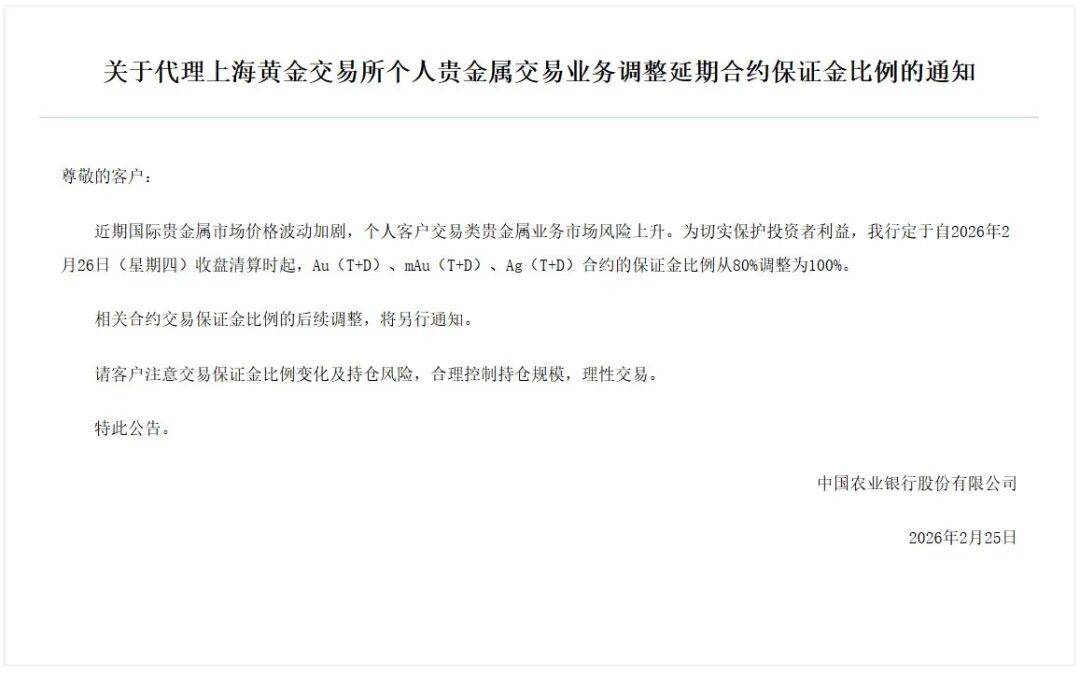
上调至100%!金价迅猛上涨,国有大行紧急出手
Sou Hu Cai Jing· 2026-02-27 00:39
Core Viewpoint - The recent adjustments in margin requirements for personal precious metals trading by several banks reflect increased market volatility and risk in the international precious metals market, particularly gold and silver. Group 1: Price Movements - London spot gold rebounded to over $5200 per ounce on February 26, following a period of price fluctuations [1] - Major jewelry brands in China, such as Chow Tai Fook, reported an increase in gold prices, with the latest price for 24K gold jewelry at 1576 RMB per gram, up from 1570 RMB per gram [1] Group 2: Margin Requirement Adjustments - Agricultural Bank of China announced an increase in the margin requirement for personal precious metals trading from 80% to 100% effective February 26, 2026, due to heightened market risks [2] - Industrial and Commercial Bank of China also confirmed a similar adjustment, effective February 27, 2026, for various gold and silver contracts [4][5] - Other banks, including China Construction Bank and Bank of China, have also made similar margin adjustments in response to market conditions [8] Group 3: Price Increase Announcements - Multiple jewelry brands are expected to raise prices, with Chow Tai Fook planning a price adjustment for gold products around March 10, with anticipated increases of 15% to 30% [11] - Lao Pu Gold announced a price increase starting February 28, 2026, following previous adjustments in 2025 [11] Group 4: Market Outlook - Deutsche Bank maintains a bullish outlook on gold prices, predicting a target of $6000 per ounce, supported by strong demand for gold and other precious metals [12] - JPMorgan has raised its long-term gold price forecast to $4500 per ounce, while maintaining a year-end target of $6300 per ounce for 2026 [12] - Bank of America anticipates gold prices could reach $6000 per ounce within the next 12 months, despite potential short-term declines in silver prices [12]


各大银行盯上了压岁钱:孩子存1000元,比你存20万利息高
Mei Ri Jing Ji Xin Wen· 2026-02-27 00:26
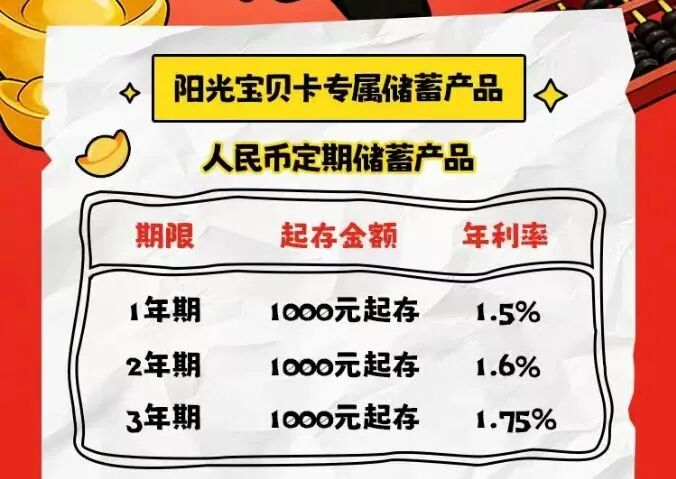
Core Insights - The article discusses the emerging trend of banks offering higher interest rates on children's savings accounts compared to traditional adult deposit products, indicating a strategic shift in the banking sector towards targeting the youth market [1][2][3]. Group 1: Interest Rate Dynamics - Beijing Rural Commercial Bank's "Sunshine Baby Card" offers a three-year interest rate of 1.75%, surpassing both the bank's standard fixed deposit rates and high-value time deposit rates [1][2]. - This "interest rate inversion" phenomenon, where children's small deposits yield higher rates than adult large deposits, is becoming a common strategy among banks to attract young customers [2][3]. Group 2: Strategic Implications - Industry experts suggest that this trend represents a long-term investment in customer lifetime value, as banks aim to establish emotional connections with young clients who will have a financial lifecycle of 50 to 60 years [3][7]. - The strategy allows banks to optimize their liability structure and manage liquidity more effectively, as children's savings typically have long retention periods and lower transaction frequencies [3][7]. Group 3: Product Offerings and Market Segmentation - Different types of banks are creating tailored product matrices to capture the significant market of "lucky money" from the Chinese New Year, focusing on specialized accounts, unique deposits, and parent-child co-management [4][5][6]. - State-owned banks leverage their comprehensive financial services to create one-stop solutions for financial management and education, while joint-stock banks emphasize differentiated account features and service experiences [4][5]. Group 4: Long-term Relationship Building - The shift towards children's financial products is seen as a transition from merely attracting deposits to building long-term relationships with families, allowing banks to access a broader range of financial needs within households [7][8]. - Successful examples include banks like China Merchants Bank and Beijing Bank, which have reported significant growth in their child account customer bases, indicating the effectiveness of this strategy in establishing family financial connections [8]. Group 5: Future Directions - Analysts recommend that banks expand their children's financial services within compliance frameworks, enhancing product offerings and integrating financial literacy education to create a comprehensive service ecosystem [9]. - The focus should be on transforming "lucky money" into a child's first financial asset, emphasizing the importance of financial education and responsible management of funds [9].



多家银行推出亲子产品 让压岁钱变身财商课
Xin Lang Cai Jing· 2026-02-26 23:52
Core Insights - The article discusses how banks are competing for children's New Year's money by offering attractive savings products and higher interest rates, emphasizing financial education for children [2][4]. Interest Rate Competition - Major banks, including state-owned and city commercial banks, have increased their medium to long-term deposit rates, particularly for three-year fixed deposits, which are now more appealing [2]. - The five major state-owned banks maintain a three-year deposit interest rate around 1.55%, while some joint-stock banks offer rates around 1.75% [2]. - City commercial banks have emerged as leaders in this interest rate competition, with three-year rates generally between 1.8% and 2.0%, with some banks like Jilin Bank and Fuxin Bank reaching 2.0% [2]. Product Innovation - Banks are focusing on the emotional and educational aspects of their products, with new offerings like the "Youth Version" savings account designed for children under 16, which can be opened by guardians [4]. - These children's accounts often come with additional features such as point systems that can be exchanged for educational materials, aiming to extend the savings process into a financial education journey [4]. Financial Guidance - Financial advisors suggest that parents open children's savings accounts to diversify asset allocation, which can help children understand basic financial concepts and create a substantial education fund over time [5]. - The approach not only serves as a financial gift but also instills a sense of family responsibility and emotional connection, making the New Year's money a valuable part of the child's growth [5].

智通ADR统计 | 2月27日





Xin Lang Cai Jing· 2026-02-26 22:27
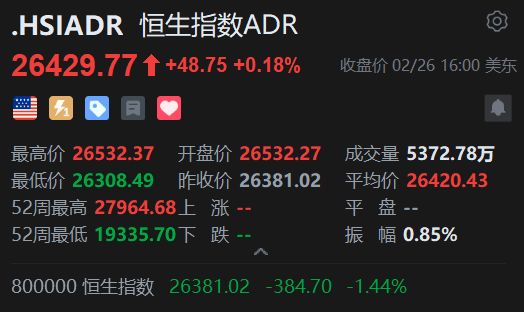
Market Overview - On Thursday, the three major U.S. stock indices showed mixed performance, while the Hang Seng Index ADR rose, closing at 26,429.77 points, an increase of 48.75 points or 0.18% compared to the Hong Kong market close [1]. Company Performance - Major blue-chip stocks exhibited varied performance: HSBC Holdings closed at HKD 147.859, up 1.97% from the Hong Kong market close; Tencent Holdings closed at HKD 513.204, up 0.24% [3]. - Tencent Holdings reported a price of HKD 512.000, with a decline of 2.01%, while its ADR price was 513.204, reflecting a 0.24% increase [4]. - Alibaba Group's stock price was HKD 143.000, down 3.57%, with its ADR at 144.779, showing an increase of 1.779% [4]. - HSBC's stock price was HKD 145.000, up 1.61%, with its ADR at 147.859, reflecting a 1.97% increase [4]. - China Ping An's stock price decreased by 4.64% to HKD 67.850, while its ADR showed a slight increase of 0.49% [4]. - Meituan's stock price fell by 2.72% to HKD 80.450, with its ADR showing a minimal change of -0.03% [4].
银行存贷差走阔意味着什么?
GF SECURITIES· 2026-02-26 15:12
Investment Rating - The report provides a "Buy" rating for the banking sector, indicating an expectation that stock prices will outperform the market by more than 10% over the next 12 months [54]. Core Insights - Recent high growth in bank deposits has led to market interpretations of banks being "asset deficient." However, this interpretation is challenged by the contractual nature of banking operations, where deposits and loans are derived simultaneously [4][12]. - The widening of the loan-to-deposit spread (LDR) is influenced by six key factors: cash withdrawal demand, reserve requirements, interbank lending, bond investment scale, bond issuance, and bank capital [4][14]. - The increase in net bond financing is a significant factor contributing to the widening of the loan-to-deposit spread. Two scenarios are identified: when bond financing costs are lower than loan rates, and when non-bank entities reduce their borrowing, leading to a return of funds to banks [4][35]. - From January 2025 to January 2026, the loan-to-deposit spread widened by 11.4 trillion CNY, with new bond investments contributing 16.6 trillion CNY and market bond net financing at 20.6 trillion CNY [4][45]. - In January 2026, net bond investment increased by 1.9 trillion CNY, while total market bond net financing was only 1.4 trillion CNY, indicating a negative contribution of -9.68% from bond financing to the loan-to-deposit spread [4][45]. Summary by Sections Section 1: Implications of Widening Loan-to-Deposit Spread - The loan-to-deposit spread for large banks increased from 15.8 trillion CNY in January 2025 to 21.8 trillion CNY in January 2026, while for medium-sized banks, it rose from 16.5 trillion CNY to 23.5 trillion CNY [12]. - The decline in loan-to-deposit ratios for large banks from 89.1% to 86.5% and for medium-sized banks from 88.3% to 84.7% reflects a shift in asset allocation demands [12]. Section 2: Factors Influencing Loan-to-Deposit Spread - The six factors affecting the loan-to-deposit spread include: 1. Cash withdrawal demand 2. Reserve situation 3. Interbank lending to non-banking entities 4. Scale of bond investments 5. Bond issuance 6. Bank capital [4][14]. - The report emphasizes that the relationship between bond financing and loans must differentiate between government and non-government bonds, as the issuance of government bonds does not affect the loan-to-deposit spread [4][35]. Section 3: Analysis of Recent Changes in Bank Assets and Liabilities - The report details the contributions of various factors to the loan-to-deposit spread, including a -47% contribution from bank funds exiting the balance sheet and a 173% contribution from the substitution effect of bonds for loans [4][45]. - The analysis of January 2026 data shows that non-bank funds returning to banks contributed 25.9% to the loan-to-deposit spread, while interbank net assets contributed 43.3% [4][45].