PSBC(01658)

Search documents
邮储银行(601658) - H股公告
2025-09-17 10:01
香港交易及結算所有限公司及香港聯合交易所有限公司對本公告的內容概不負責,對其準確性 或完整性亦不發表任何聲明,並明確表示,概不對因本公告全部或任何部份內容而產生或因倚 賴該等內容而引致的任何損失承擔任何責任。 POSTAL SAVINGS BANK OF CHINA CO., LTD. 中國郵政儲蓄銀行股份有限公司 杜春野 聯席公司秘書 中國,北京 2025年9月17日 於本公告日期,本行董事會包括董事長及非執行董事鄭國雨先生;執行董事劉建軍先生及 姚紅女士;非執行董事韓文博先生、劉新安先生、張宣波先生、劉瑞鋼先生、胡宇霆先 生、丁向明先生及余明雄先生;獨立非執行董事溫鐵軍先生、鍾瑞明先生、潘英麗女士、 唐志宏先生、洪小源先生及楊勇先生。 1658 暫停辦理股份過戶登記 中國郵政儲蓄銀行股份有限公司(「本行」)董事會(「董事會」)宣佈,本行擬於 2025年10月9日(星期四)舉行2025年第二次臨時股東大會(「臨時股東大會」)。 為確定有權出席臨時股東大會的H股股東名單,本行將於2025年10月3日(星期 五)至2025年10月9日(星期四)(首尾兩天包括在內)期間暫停辦理H股股份過 戶登記手續。H股股東如欲 ...
邮储银行(01658) - 暂停办理股份过户登记
2025-09-17 09:27
暫停辦理股份過戶登記 中國郵政儲蓄銀行股份有限公司(「本行」)董事會(「董事會」)宣佈,本行擬於 2025年10月9日(星期四)舉行2025年第二次臨時股東大會(「臨時股東大會」)。 為確定有權出席臨時股東大會的H股股東名單,本行將於2025年10月3日(星期 五)至2025年10月9日(星期四)(首尾兩天包括在內)期間暫停辦理H股股份過 戶登記手續。H股股東如欲出席臨時股東大會,須於2025年10月2日(星期四) 下午4時30分前,將股票連同股份過戶文件一併送交本行H股股份過戶登記處 香港中央證券登記有限公司,地址為香港灣仔皇后大道東183號合和中心17樓 1712-1716號舖。 香港交易及結算所有限公司及香港聯合交易所有限公司對本公告的內容概不負責,對其準確性 或完整性亦不發表任何聲明,並明確表示,概不對因本公告全部或任何部份內容而產生或因倚 賴該等內容而引致的任何損失承擔任何責任。 POSTAL SAVINGS BANK OF CHINA CO., LTD. 1658 中國郵政儲蓄銀行股份有限公司 杜春野 聯席公司秘書 中國,北京 2025年9月17日 於本公告日期,本行董事會包括董事長及非執行董事鄭 ...
邮储银行青岛分行:多维宣教护好“钱袋子”
Zhong Guo Jin Rong Xin Xi Wang· 2025-09-17 08:35
Core Viewpoint - Postal Savings Bank of China Qingdao Branch is actively promoting financial education to enhance public risk prevention capabilities and create a stable financial environment through various initiatives [1][2]. Group 1: Organizational Initiatives - A special working group was established to implement targeted educational plans based on specific community needs, focusing on knowledge dissemination, risk awareness, service optimization, and integrity promotion [2]. - The bank adheres to the "three appropriateness" principle regarding financial products, channels, and customers, conducting internal training to enhance the compliance skills of frontline staff [2]. Group 2: Targeted Education for Key Groups - The bank conducted scenario-based education for different demographics, including anti-fraud initiatives for over 200 elderly individuals in community settings, and financial literacy programs in schools addressing issues like "campus loans" [3]. - In business environments, the bank provided risk alerts and educational sessions to employees of companies, enhancing their awareness of fraud and consumer rights [3]. Group 3: Rural Outreach - The bank launched a "village-to-village" financial education initiative to address the lack of financial knowledge in rural areas, utilizing village-level service stations for education and dispute resolution [4]. - A dedicated "rural lecture team" was formed to explain common rural financial risks in local dialects, making complex information more accessible [4]. Group 4: Innovative Communication Strategies - The bank is exploring immersive and interactive communication methods, such as financial short dramas on social media and risk alerts through mobile banking applications [5]. - Future plans include ongoing financial education initiatives across various community sectors to ensure the safety of public assets and contribute to the healthy development of the financial ecosystem in Qingdao [5].
“买买买”!平安“扫货”3只金融股
券商中国· 2025-09-17 05:58
Core Viewpoint - China Ping An is actively increasing its holdings in both insurance and banking stocks, indicating a strategic investment approach in the current low-interest-rate environment [1][7]. Group 1: Investment in Insurance Stocks - On September 11, China Ping An purchased 77.8092 million shares of China Pacific Insurance (H shares), raising its stake to 11.28% from 8.47% [2][3]. - The total investment in China Pacific Insurance since August has exceeded 5 billion HKD, with a significant increase in holdings over the month [4][6]. - China Ping An's strategy includes a series of incremental purchases, starting from an initial stake of 5.04% on August 8, which has now grown substantially [3][4]. Group 2: Investment in Banking Stocks - China Ping An has also been active in acquiring banking stocks, including 40.213 million shares of Agricultural Bank of China (H shares), increasing its stake to 18.07% [2][7]. - The company has invested over 100 billion HKD in banking stocks this year, reflecting a strong commitment to this sector [7]. - The investment strategy appears to be a "bulk buying" approach, focusing on stable and high-dividend yielding assets [7][8]. Group 3: Market Context and Strategy - The low-interest-rate environment and the implementation of new accounting standards have increased the demand for insurance companies to enhance investment returns through equity investments [7][8]. - Analysts suggest that the investment in insurance stocks by insurance funds is a continuation of a strategy to allocate more to high-dividend stocks under current market conditions [8][10]. - The overall trend shows a significant increase in equity investments by insurance companies, with a reported 25% growth in stock and fund investments year-on-year [10][11].



这家国有大行,让金融服务扎根田野,长出“金色”未来
Jing Ji Guan Cha Bao· 2025-09-17 05:13
Core Insights - Postal Savings Bank of China (PSBC) has demonstrated resilience and steady growth in its financial performance, particularly in agricultural loans, which reached 2.44 trillion yuan by mid-2025, accounting for over 25% of total customer loans [1][3][2] - The bank's total assets surpassed 18 trillion yuan, with a year-on-year growth of 6.47%, indicating a stable business scale [2] - PSBC's focus on rural revitalization and agricultural finance has positioned it as a leader in providing financial services to rural areas, enhancing its competitive edge in the banking sector [4][5] Financial Performance - As of June 2025, PSBC's total assets reached 18.19 trillion yuan, with customer loans totaling 9.54 trillion yuan, reflecting a growth of 6.99% from the previous year [2][3] - The bank's net profit for the first half of 2025 was 494.15 billion yuan, a year-on-year increase of 1.08%, showcasing its stable profitability [2] - Non-interest income has seen significant growth, with middle business income increasing by 11.59% and other non-interest income rising by 25.16% [2] Agricultural Loan Growth - PSBC's agricultural loan balance grew by 21.28% year-on-year, reaching 2.24 trillion yuan, highlighting the bank's commitment to supporting the agricultural sector [9] - The bank's strategy includes optimizing small loan products for staple grain planting and enhancing financial support for rural infrastructure projects [9][6] Rural Revitalization Initiatives - PSBC has established a comprehensive financial service model that integrates payment, credit, and wealth management tailored to rural needs [7] - The bank's "Industry Smart Payment" solution has been implemented across over 160 cities, providing efficient financial services to various agricultural sectors [7] - The bank's collaboration with local agricultural enterprises, such as the "Jiyou Shen Loan" series for ginseng, exemplifies its targeted approach to supporting local industries [8] Digital Transformation - PSBC is leveraging digital technology to enhance its financial services, including the development of a "Rural Financial Service Portrait" data product to better understand and meet customer needs [10] - The bank is actively pursuing partnerships to integrate digital solutions into agricultural financing, aiming to improve transaction efficiency and reduce costs [11] - The ongoing digital transformation efforts are expected to bolster the bank's service capabilities and support its strategic goals in rural finance [12]
六大行校招“管理+专业”并进,科技岗向“人工智能+”升级
2 1 Shi Ji Jing Ji Bao Dao· 2025-09-17 05:05
Group 1 - The core viewpoint of the article highlights the stable recruitment scale and optimized structure of the six major state-owned banks in their 2026 campus recruitment, with a focus on the demand for composite talents in technology-related fields [1][2][3] - The Industrial and Commercial Bank of China (ICBC) plans to recruit approximately 20,351 individuals, with a significant emphasis on technology elite positions, including system development, application research, information security, and data mining [2][3] - Agricultural Bank of China (ABC) aims to recruit around 20,780 individuals, with specialized positions aligned with national strategies, including financial technology, data analysis, rural revitalization, and green finance [4][5] Group 2 - The recruitment initiatives reflect a transformation direction in the banking industry, with a notable increase in the demand for technology and data analysis roles, aligning with the government's "Artificial Intelligence +" action plan [1][3] - The recruitment plans of the banks include specialized training programs, such as ICBC's "Artificial Intelligence +" and trading sector recruitment plans, which focus on nurturing composite talents through structured rotations [3][4] - The banks are implementing dual-track talent supply systems, combining management training programs with specialized positions to build a robust talent pipeline for future leadership and strategic business needs [6][7] Group 3 - The China Merchants Bank continues its global talent reserve strategy, enhancing international business talent supply through specialized language recruitment plans [5][6] - Postal Savings Bank emphasizes its "U + Talent Cultivation Plan," which includes comprehensive training and mentorship for new employees, focusing on IT and financial economics roles [8][9] - The recruitment efforts are also aimed at supporting the growth of private banking services, with Construction Bank leading in asset under management (AUM) growth and expanding its private banking team [8]



四大行校招释放超7万岗位
21世纪经济报道· 2025-09-17 04:18
Group 1 - The core viewpoint of the article highlights the stable recruitment scale and optimized structure of the six major state-owned banks in their 2026 campus recruitment, with a focus on the demand for composite talents in technology-related fields [1][2] - The total recruitment numbers for major banks are as follows: ICBC plans to recruit approximately 20,351, ABC about 20,780, CCB 17,336, and BOC 13,291, maintaining stability compared to last year [1][3][9] - The recruitment emphasizes the integration of artificial intelligence and data analysis roles, aligning with the State Council's "Artificial Intelligence +" action plan, indicating a strategic shift towards technology-driven positions [1][4] Group 2 - ICBC has introduced two special recruitment plans: the "Artificial Intelligence +" plan targeting candidates with AI and big data backgrounds, and a trading sector recruitment plan, both aimed at nurturing composite talents for key business departments [3][4] - ABC's recruitment strategy includes specialized positions in financial technology, data analysis, rural revitalization, green finance, and pension finance, directly reflecting the national strategy [4][5] - CCB's recruitment plan includes a focus on private banking, which has shown significant growth, with a 14.39% increase in AUM and a 14.69% rise in customer numbers in the first half of 2025 [9][10] Group 3 - The banks are implementing differentiated training models and high-end position layouts to build a dual-track talent supply system, combining management and specialized roles [7][8] - The management trainee programs at ICBC and BOC emphasize cross-border training and global exposure, with a focus on nurturing core business talents [8][9] - Postal Savings Bank has launched the "U + Talent Cultivation Plan," which includes a structured training and mentorship program for new employees, emphasizing a dual career path in management and specialization [10][11]

绿意新生:邮储银行深耕绿色金融显实效
Zhong Guo Huan Jing Bao· 2025-09-17 03:06
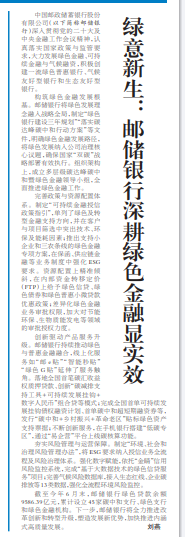
中国邮政储蓄银行股份有限公司(以下简称邮储银行)深入贯彻党的二十大及中央金融工作会议精神, 认真落实国家政策与监管要求,大力发展绿色金融、可持续金融与气候融资,积极创建一流绿色普惠银 行、气候友好型银行和生态友好型银行。 构筑绿色金融发展根基。邮储银行将绿色发展理念融入战略全局,制定"绿色银行建设三年规划""落实 碳达峰碳中和行动方案"等文件,明确绿色金融发展路径,将绿色发展纳入公司治理核心议题,确保国 家"双碳"战略部署有效执行。组织架构上,成立多层级碳达峰碳中和暨绿色金融领导小组,全面推进绿 色金融工作。 夯实风险管理与运营保障。制定"环境、社会和治理风险管理办法",将ESG要求纳入授信业务全流程及 风险治理体系。强化数字赋能,依托"金睛"信用风险监控系统,完成"基于大数据技术的绿色信贷服 务"项目;完善气候风险数据库,接入生态红线、企业碳排放等13类数据,强化全流程环境风险监控。 截至今年6月末,邮储银行绿色贷款余额9586.39亿元,累计设立45家碳中和支行、绿色支行和绿色金融 机构。下一步,邮储银行将全力推进改革创新和转型升级,塑造发展新优势,加快推进内涵式高质量发 展。 完善政策与资源配置体系。制 ...
新华中证同业存单AAA指数7天持有成立 规模41.6亿元
Zhong Guo Jing Ji Wang· 2025-09-17 03:05
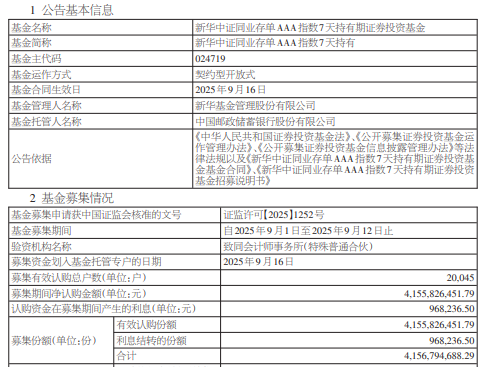
募集期间净认购金额4,155,826,451.79元,认购资金在募集期间产生的利息968,236.50元,募集份额合计 4,156,794,688.29份。 中国经济网北京9月17日讯今日,新华基金发布新华中证同业存单AAA指数7天持有期证券投资基金基 金合同生效公告。 | 1 公告基本信息 | | | | --- | --- | --- | | 基金名称 | 新华中证同业存单 AAA指数7天持有期证券投资基金 | | | 基金面标 | 新华中证同业存单 AAA指数7天持有 | | | 基金主代码 | 024719 | | | 基金运作方式 | 製约型开放式 | | | 基金合同生效日 | 2025年9月16日 | | | 基金管理人名称 | 新华基金管理股份有限公司 | | | 基金托管人名称 | 中国邮政储备银行股份有限公司 | | | 公告依据 | 《中华人民共和国证券投资基金法》、《公开募集证券投资基金运 作管理办法》、《公开募集证券投资基金信息披露管理办法》等法 律法规以及《新华中证同业存单AAA指数7天持有期证券投资基 | | | | 金基金合同》、《新华中证同业存单AAA指数7天持有期证券投资 ...
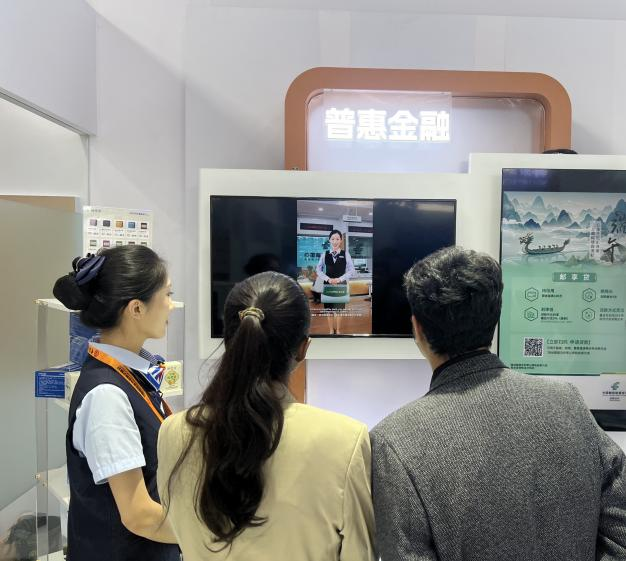
邮储银行北京分行服贸会完美收官,多维诠释“支付为民”服务温度
Zhong Guo Jin Rong Xin Xi Wang· 2025-09-17 02:13
Core Viewpoint - Postal Savings Bank of China Beijing Branch showcased its payment service optimization at the Beijing Service Trade Fair, receiving widespread acclaim from attendees [1] Group 1: Service Offerings - The bank utilized a three-pronged promotional approach of video presentations, on-site explanations, and printed materials to enhance attendee understanding of its services [1] - Services highlighted included simplified account opening, payment facilitation, and foreign currency exchange tailored for foreign nationals in China [1][4] - Key service points were established in areas with high concentrations of foreign nationals, providing resources such as English account opening materials and translation tools [4] Group 2: Cash and Mobile Payment Services - The bank actively promoted cash services, including "change wallet" exchanges and anti-counterfeit currency campaigns, ensuring cash availability for elderly and foreign clients [4] - In mobile payment, the bank supports high-frequency scenarios like online shopping and bill payments, offering discounts for card binding with WeChat and Alipay [4] Group 3: Foreign Exchange and Customer Experience - The bank implemented a dual-channel approach for foreign exchange services, enhancing customer experience through online and offline promotional efforts [4] - Foreign card acceptance was piloted in major commercial areas, improving the spending experience for international tourists [5] - Dedicated service windows for elderly clients were established across all branches, ensuring personalized and caring financial services [5] Group 4: Future Directions - The bank plans to continue optimizing its payment service system based on customer needs, aiming to provide high-quality and convenient financial services [5]