
PSBC(01658)

Search documents
国内首只“科创+绿色”双主题债券指数基金在京发布
Xin Hua Cai Jing· 2026-02-06 17:07
本次活动邀请了北京市委金融办、中央国债登记结算有限责任公司等单位代表,以及金融机构、企业代 表参与,围绕金融如何支持科技创新、绿色转型与产业升级等议题展开探讨。 据了解,该基金为国内首只同时聚焦科技创新与绿色发展的债券指数基金,旨在通过指数化投资方式, 为投资者提供相关债券资产的配置工具。产品由富达基金、邮储银行及中央结算公司共同推动落地。中 央结算公司负责编制主题债券指数,邮储银行发挥渠道与生态协同优势,富达基金则提供资产配置方案 设计与产品管理。 新华财经北京2月6日电日前,中国邮政储蓄银行与富达基金管理(中国)有限公司在京联合举办"科创 +绿色"双主题基金产品发布暨金融服务新质生产力研讨会。国内首只"科创+绿色"双主题债券指数基金 ——富达中债高等级科技创新及绿色债券指数证券投资基金于会上正式宣布成立。 与会代表认为,在"十五五"规划步入开局之年的背景下,科技创新与绿色低碳领域已成为金融服务实体 经济的关键方向。银行、理财子公司、资产管理机构及科创企业应加强协同,引导中长期资金流向相关 领域,推动形成"科技—产业—金融"良性循环。 后续,随着该基金的落地,更多市场参与者有望通过产品创新与机制优化,引导更 ...

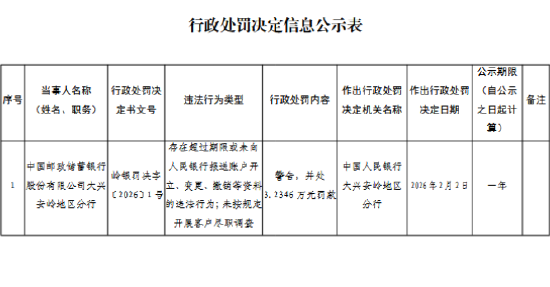
邮储银行大兴安岭地区分行被罚3.23万元:未向人民银行报送账户开立、变更、撤销等资料
Xin Lang Cai Jing· 2026-02-06 12:53
2月6日金融一线消息,中国人民银行大兴安岭地区分行行政处罚决定信息公示表显示,中国邮政储蓄银 行股份有限公司大兴安岭地区分行因存在超过期限或未向人民银行报送账户开立、变更、撤销等资料的 违法行为;未按规定开展客户尽职调查,受到警告,并被罚款3.2346 万元。 | | 当事人名称 | 行政处罚决 | | | | 作出行政处罚 作出行政处罚 | 公示期限 (自公示 | | | --- | --- | --- | --- | --- | --- | --- | --- | --- | | 序号 | | | 违法行为类型 | 行政处罚内容 | | | | 备注 | | | (姓名: 职务) | 定书文号 | | | 决定机关各称 | 决定日期 | 之日起计 | | | | | | 五米留度疑左翼出传 | | | | 算) | | | | 中国邮政管管银行 | | 人民银行报送账户开 | | 中国人民银行 | | | | | | 股份有限公司大兴 | 什么区都省 | 立、变更、搬到等资料 | 零合,并处 | 大兴安地地区 | 2026年2月2日 | 一年 | | | | | 〔2026〕1 号 | | 3.2346 ...

邮储银行沈阳市分行:践行金融使命 服务实体经济
Sou Hu Cai Jing· 2026-02-06 08:30
Core Insights - Postal Savings Bank of China Shenyang Branch actively supports local enterprises by utilizing bill discounting services to lower financing costs and enhance financial services for the real economy [1][2] - The bank's bill discounting service allows enterprises to obtain liquidity by applying for early payment on unexpired commercial bills, which is crucial for sectors like pharmaceuticals and manufacturing [1] Group 1: Financial Support for Key Industries - The bank has tailored its bill discounting services to meet the specific needs of large pharmaceutical companies, providing a dedicated service team and a specialized financing plan that has facilitated over 4 billion yuan in discounts since last year [1] - For small and medium-sized manufacturing enterprises, the bank has simplified the bill discounting process to alleviate cash flow pressures, enabling more flexible fund allocation for technology upgrades and production expansion [1] Group 2: Commitment to Service Excellence - The Shenyang Branch is committed to continuously optimizing financing service processes to enhance efficiency and customer experience, contributing to the high-quality development of the local economy [2]
邮储银行申请数据库对象的识别方法专利,提高数据库对象的识别效率
Jin Rong Jie· 2026-02-06 03:55
Group 1 - The core viewpoint of the news is that China Postal Savings Bank has applied for a patent related to a method for identifying database objects, which aims to improve the efficiency of database object recognition [1] Group 2 - China Postal Savings Bank was established in 2007 and is located in Beijing, primarily engaged in monetary financial services [2] - The registered capital of China Postal Savings Bank is approximately 9.92 billion RMB [2] - The bank has made investments in 7 companies and participated in 5,000 bidding projects, with a total of 1,213 trademark records and 1,021 patent records [2]
多重因素倒逼架构调整 银行财富管理业务地位进阶
Shang Hai Zheng Quan Bao· 2026-02-05 17:52
Core Viewpoint - The banking sector is undergoing a transformation in wealth management, with banks establishing or integrating dedicated wealth management departments to enhance the independence and importance of this business line within their overall operations [2][3][4]. Group 1: Structural Changes in Wealth Management - Major banks, including state-owned ones, have begun to establish or reorganize wealth management departments at the headquarters level, indicating a strategic shift towards centralized management of personal wealth services [3][4]. - This trend is not limited to large banks; smaller banks are also elevating the status of wealth management, with institutions like Qingnong Commercial Bank planning to build a comprehensive wealth management system by 2026 [4]. - The establishment of dedicated wealth management departments aims to unify business planning and customer service, thereby enhancing professional capabilities [4][5]. Group 2: Market Dynamics and Drivers - The decision to elevate wealth management services is driven by multiple factors, including the rapid expansion of household wealth and a shift in asset allocation preferences among consumers [6]. - The low-interest-rate environment has pressured traditional profit models based on interest margins, prompting banks to seek new sources of intermediary income [6]. - China has become the world's second-largest asset and wealth management market, with a significant annual growth rate of 15.4% in personal financial assets over the past 20 years, creating diverse wealth management demands [6]. Group 3: Revenue Generation and Business Strategy - Wealth management is seen as a light-capital business that can generate substantial intermediary income, positioning it as a new growth engine for banks [7]. - For instance, Ningbo Bank reported a 30.72% year-on-year increase in net commission income, highlighting the role of intermediary business in revenue growth [7]. - The focus on wealth management not only aims to increase income sources but also to optimize overall profitability and reduce capital consumption [7]. Group 4: Challenges and Competitive Landscape - Despite the potential benefits, banks face challenges in differentiating their wealth management offerings, with issues such as product homogeneity and insufficient advisory capabilities [8]. - Current wealth management services are primarily focused on selling products rather than providing comprehensive customer service, leading to a lack of tailored solutions [8]. - Different-sized banks can adopt varied strategies; large banks can leverage their brand and comprehensive financial services, while smaller banks can focus on niche markets and customized services to build customer trust [9].



沪市两个多月现金分红近3500亿
Di Yi Cai Jing Zi Xun· 2026-02-05 15:04
Core Viewpoint - The article highlights the significant cash dividends being distributed by companies in the Shanghai stock market ahead of the Spring Festival, with a total of 258 billion yuan expected to be distributed by nearly 20 companies, and a cumulative dividend amount exceeding 3,476 billion yuan by the end of the distribution period [2][3]. Group 1: Bank Sector - The banking sector is the main contributor to cash dividends before the Spring Festival, with nine banks, including Industrial Bank and China Merchants Bank, announcing a total distribution of nearly 700 billion yuan for the 2025 interim period [2]. - China Merchants Bank initiated the distribution of cash dividends to A-share investors, amounting to approximately 255.48 billion yuan, with a distribution ratio of 35% [2]. - The six major state-owned banks have collectively distributed 2,046.57 billion yuan in cash dividends, with the Industrial and Commercial Bank of China leading with a distribution of 503.96 billion yuan [3]. Group 2: Other Industries - Traditional industries are also participating in cash dividend distributions, with companies like Yangtze Power and Da Ren Tang planning to issue cash dividends before the Spring Festival [3]. - Yangtze Power will distribute over 5.1 billion yuan in cash dividends on February 12, having committed to a high cash dividend ratio since 2016 [3]. - Da Ren Tang announced a cash dividend of 2.45 yuan per share, totaling 18.87 billion yuan, with a cumulative cash dividend of 5.117 billion yuan since its listing in 2001 [4]. Group 3: Regulatory Environment - The continuous strengthening of cash dividend regulations and disclosure requirements by regulatory authorities has led to an increased awareness among listed companies regarding shareholder returns [4]. - Investors are encouraged to select companies that can withstand economic cycles and are committed to returning value to shareholders, which is becoming an important path for value investment [4].



沪市两个多月现金分红近3500亿
第一财经· 2026-02-05 14:54
Core Viewpoint - The article highlights the significant cash dividends being distributed by companies in the Shanghai stock market, particularly focusing on the banking sector, which is leading the trend of pre-Spring Festival cash distributions to investors [3][4]. Group 1: Cash Dividends Distribution - Nearly 20 companies in the Shanghai market are set to distribute a total of 25.8 billion yuan in cash dividends before the Spring Festival [3]. - From December 2025 to the pre-Spring Festival period, the total cash dividends distributed by the Shanghai market will exceed 347.6 billion yuan, with 321.8 billion yuan already distributed by February 5 [3]. - Industrial Bank is set to distribute over 11.9 billion yuan in cash dividends to A-share investors, with a per-share cash dividend of 0.565 yuan (tax included) [3]. Group 2: Banking Sector Performance - The banking sector is the main contributor to cash distributions, with nine banks, including Industrial Bank, Jiangsu Bank, and China Merchants Bank, announcing a total of nearly 70 billion yuan in cash dividends for the first half of 2025 [3][4]. - China Merchants Bank announced a cash dividend of approximately 25.5 billion yuan (tax included) for A+H shares, with a distribution ratio of 35% [3]. Group 3: Other Industries - Other traditional industries are also participating in cash distributions, with companies like Yangtze Power and Da Ren Tang planning to issue cash dividends before the Spring Festival [4]. - Yangtze Power will distribute over 5.1 billion yuan in cash dividends on February 12, having committed to a high cash dividend ratio since 2016 [4]. - Da Ren Tang announced a cash dividend of 2.45 yuan per share (tax included), totaling 1.887 billion yuan, with a cumulative cash dividend of 5.117 billion yuan since its listing [5]. Group 4: Regulatory Environment and Investor Sentiment - Industry insiders note that the continuous strengthening of cash dividend regulations and disclosure requirements by regulatory authorities is enhancing shareholder return awareness among listed companies [6]. - Investors are increasingly inclined to choose companies that can withstand economic cycles and are willing to consistently return value to shareholders, marking a significant trend in value investing [6].

港股内银股多数上扬 重庆银行涨超3%
Mei Ri Jing Ji Xin Wen· 2026-02-05 06:27
Group 1 - The majority of Hong Kong's banking stocks have risen, indicating positive market sentiment [1] - Chongqing Bank (01963.HK) increased by 3.6%, reaching HKD 8.05 [1] - Tianjin Bank (01578.HK) rose by 2.53%, trading at HKD 2.43 [1] - China Merchants Bank (03968.HK) saw a rise of 2.44%, with a price of HKD 48.66 [1] - Postal Savings Bank of China (01658.HK) gained 2.15%, priced at HKD 5.23 [1]

内银股多数上扬 重庆银行涨超3% 招商银行涨超2%
Zhi Tong Cai Jing· 2026-02-05 06:22
Core Viewpoint - The banking sector in China is experiencing a positive trend, with several banks showing significant stock price increases following a recent meeting by the People's Bank of China regarding the credit market for 2026, which is expected to provide multiple benefits to the banking sector [1] Group 1: Stock Performance - Chongqing Bank's stock rose by 3.6%, reaching HKD 8.05 [1] - Tianjin Bank's stock increased by 2.53%, reaching HKD 2.43 [1] - China Merchants Bank's stock climbed by 2.44%, reaching HKD 48.66 [1] - Postal Savings Bank's stock grew by 2.15%, reaching HKD 5.23 [1] Group 2: Credit Market Outlook - The People's Bank of China emphasized the need to understand the economic and financial situation during the 14th Five-Year Plan period and to enhance financial services for key areas and weak links [1] - Analysts from Zhongtai Securities noted that the credit issuance for the year is expected to maintain a year-on-year increase, with a stable retail new issuance rate at 3.06% for three consecutive quarters [1] - The expectation of a narrowing decline in interest margins, supported by stable interest income, suggests that the banking sector's revenue and profit will remain robust throughout the year [1] Group 3: Investment Appeal - The banking sector is characterized by strong performance certainty and stability, with high dividend yields, making it an attractive investment option [1]
港股异动 | 内银股多数上扬 重庆银行(01963)涨超3% 招商银行(03968)涨超2%
智通财经网· 2026-02-05 06:20
Core Viewpoint - The majority of Chinese bank stocks have risen, with specific banks showing notable increases in their stock prices, indicating positive market sentiment towards the banking sector following a recent meeting by the People's Bank of China [1] Group 1: Stock Performance - Chongqing Bank (01963) increased by 3.6%, trading at 8.05 HKD [1] - Tianjin Bank (01578) rose by 2.53%, trading at 2.43 HKD [1] - China Merchants Bank (03968) saw a rise of 2.44%, trading at 48.66 HKD [1] - Postal Savings Bank (01658) increased by 2.15%, trading at 5.23 HKD [1] Group 2: Central Bank Meeting Insights - The People's Bank of China held a meeting to discuss the credit market for 2026, emphasizing the need to adapt to economic and financial changes during the 14th Five-Year Plan [1] - The meeting highlighted the importance of providing quality financial services to major strategies, key areas, and weak links [1] Group 3: Market Analysis - Analysts from Zhongtai Securities noted that the early-year credit issuance has been strong, with expectations for continued growth in credit supply throughout the year [1] - The new corporate lending rates have slightly decreased, while retail lending rates have stabilized, with new mortgage rates remaining at 3.06% for three consecutive quarters [1] - Despite expectations of interest rate cuts, the decline in interest margins is anticipated to be smaller than last year, supporting stable revenue and profit for banks [1] - The banking sector is characterized by strong performance certainty and stability, with high dividend yields, making it an attractive investment option [1]