PSBC(01658)

Search documents
消失的信用卡App
Bei Jing Shang Bao· 2025-12-22 12:59
Core Insights - A trend of "streamlining and integration" of credit card apps across state-owned banks, joint-stock banks, and regional banks is accelerating, with Postal Savings Bank being the latest to announce the integration of its credit card app into its main banking app [1][3] - This shift reflects a significant transformation in the banking industry's digital strategy, moving from "expansion" to "refinement," indicating a new phase of "reducing quantity while improving quality" in online credit card services [1][8] Group 1: Integration of Credit Card Apps - Postal Savings Bank will gradually stop updating its "Postal Credit Card App," migrating all functions to the "Postal Bank App," following China Bank's earlier move to close its independent credit card app [3][4] - The integration aims to enhance operational efficiency and user experience by consolidating resources and focusing on the main app ecosystem [5][6] - The trend of integrating independent credit card apps is not limited to large banks; smaller banks like Beijing Rural Commercial Bank and Jiangxi Bank have also closed their credit card apps, merging services into their mobile banking platforms [7][8] Group 2: Industry Context and Drivers - The rise of independent credit card apps began around 2015, aiming to create a "financial + lifestyle" ecosystem, but as competition intensified, these apps became burdensome due to overlapping functionalities and low user engagement [6][10] - Regulatory pressures and the need for cost reduction are driving banks to optimize or terminate underperforming mobile applications, as highlighted by the recent guidelines from the National Financial Regulatory Administration [7][9] - The future of credit card services is expected to evolve into a "main app + diversified lightweight touchpoints" model, where the main app serves as a comprehensive platform while maintaining personalized services through various channels [9][10]



邮储银行(01658.HK)发布2025年度中期利润分配方案,12月22日股价下跌0.94%
Sou Hu Cai Jing· 2025-12-22 10:05
Core Viewpoint - Postal Savings Bank of China (01658) has announced a cash dividend distribution plan for the year 2025, reflecting its commitment to returning value to shareholders through significant cash payouts [1]. Group 1: Stock Performance - As of December 22, 2025, Postal Savings Bank's stock closed at 5.25 yuan, down 0.94% from the previous trading day, with a trading volume of 116 million yuan [1]. - The stock's 52-week high was 5.95 yuan, while the low was 4.23 yuan [1]. Group 2: Dividend Distribution - The bank will distribute a cash dividend of 1.230 yuan per 10 shares (before tax) to all ordinary shareholders, totaling 14.772 billion yuan [1]. - The A-share dividend is expected to be distributed on January 12, 2026, while the H-share dividend will be distributed on February 13, 2026 [1]. - H-share shareholders have the option to receive dividends in either RMB or HKD, with the selection deadline set for January 28, 2026 [1]. - For H-share shareholders, the bank will withhold taxes at a rate determined by relevant tax agreements, with a 20% withholding tax rate applicable to mainland individual investors and securities investment funds through the Hong Kong Stock Connect [1].
AI当“搭子”,手机银行的未来是什么样?
Zhong Guo Jing Ying Bao· 2025-12-22 07:38
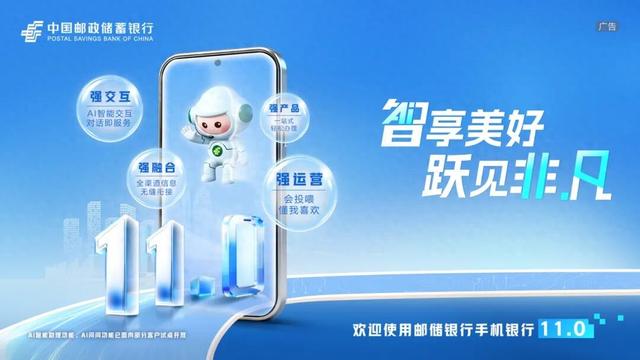
Core Insights - The article emphasizes the transformation of the Chinese banking industry driven by digital technology and artificial intelligence, marking a critical turning point for banks to shift from quantitative accumulation to qualitative breakthroughs [1] - The launch of Postal Savings Bank's mobile banking 11.0 signifies a transition from a functional tool to an intelligent partner, showcasing the bank's commitment to a comprehensive digital ecosystem with its "AI2ALL" strategy [3][4] Digital Transformation - Postal Savings Bank's mobile banking 11.0 integrates AI deeply into the customer journey, transforming traditional interactions into a conversational service model [4] - The app features a "one-stop" search experience and a "dialogue as service" approach, enhancing user convenience and making complex financial operations more intuitive [4][5] - The bank aims to create a financial service ecosystem that merges finance with daily life, enhancing user engagement through personalized services [5] User Experience and Security - The mobile banking 11.0 introduces a dual protection mechanism called "Friends + Bank," integrating social trust into security measures to enhance transaction safety [5] - New features include voice verification for identity confirmation and expanded family financial services, allowing shared product purchases among close contacts [5] Recognition and Performance - Postal Savings Bank's continuous investment in user experience has been recognized, with its mobile banking app ranking first in user experience for three consecutive years according to CFCA's report [6] AI and Ecosystem Development - The "AI2ALL" digital ecosystem aims to integrate AI capabilities across all banking operations, focusing on enhancing customer experience and operational efficiency [7][8] - The strategy includes nearly 260 AI application scenarios, promoting a comprehensive integration of AI in management and customer service [8] Internal Efficiency and External Service - The "AI2ALL" initiative enhances internal processes from front to back office, improving marketing precision and risk management efficiency [8][9] - The bank has developed a new human-machine collaboration system for customer service, significantly improving service efficiency and response times [9] Technological Foundation - Postal Savings Bank has made substantial investments in data, computing power, and algorithms, establishing a robust foundation for its AI capabilities [10] - The bank's strategy includes building a comprehensive data architecture and enhancing its AI computing resources, demonstrating a commitment to sustainable transformation [10]

邮储银行助力谱写海南自贸港新篇
Jin Rong Shi Bao· 2025-12-22 03:51
Group 1 - The core viewpoint of the articles emphasizes the role of Postal Savings Bank in supporting the development of Hainan Free Trade Port through innovative financial services and products, particularly in cross-border trade and tourism [1][2][3] Group 2 - Cross-border trade is identified as a key engine for the development of Hainan Free Trade Port, with Postal Savings Bank leveraging its differentiated credit policies and innovative preferential policies to provide personalized services for cross-border business clients [1] - The bank has been approved as a pilot bank for high-level open cross-border trade in Hainan Province and Yangpu, enhancing the efficiency of fund utilization and reducing transaction costs for enterprises [1] - The tourism industry is highlighted as a significant asset for Hainan, with expectations of over 100 million visitors by 2025, and the bank is collaborating with various institutions to create a "finance + consumption" ecosystem to boost consumer spending [2] - Postal Savings Bank has initiated exclusive discount activities with five major duty-free brands and has deployed smart POS machines supporting digital RMB to facilitate consumer transactions [2] - The bank's financial support has enabled local enterprises, such as Hainan Zhongjian Cable, to enhance their technological capabilities and production capacity, addressing the financing challenges faced by technology-driven companies [2] - The bank is innovating financing solutions for small enterprises, focusing on personalized plans to overcome traditional barriers in securing loans for technology firms [2]
财通资管鸿福短债债券型证券投资基金暂停大额申购、转换转入、定期定额投资业务公告
Zhong Guo Zheng Quan Bao - Zhong Zheng Wang· 2025-12-21 23:21
Core Viewpoint - The company will adjust the large subscription limits for its fund starting December 22, 2025, across various sales channels, impacting both individual and institutional investors [1][2][3][4][5]. Group 1: Subscription Adjustments - From December 22, 2025, the company will limit large subscriptions for the A-class shares of the fund at specific sales institutions, with a cap of RMB 50 million for certain channels [1]. - For China Postal Savings Bank, the cap for large subscriptions will be set at RMB 100 million starting December 22, 2025 [2]. - At Shanghai Wind Fund Sales Co., the limit for large subscriptions will be RMB 10,000 starting December 22, 2025 [3]. - For subscriptions through Caixin Securities, the limit will be RMB 200 million starting December 24, 2025 [4]. - Large subscription services at various sales institutions will resume on December 23, 2025, with adjusted limits of RMB 10 million for non-individual investors and RMB 100 million for individual investors [5]. Group 2: Resumption of Services - The large subscription services at Caixin Securities will resume on December 26, 2025, with the same adjusted limits as mentioned previously [5]. - During the suspension of these services, redemption and other operations of the fund will continue as normal [5].


2026年贺岁纪念币、纪念钞今起陆续发行 预约方式→
Xin Lang Cai Jing· 2025-12-21 21:43
Core Points - The People's Bank of China is issuing the 2026 New Year commemorative banknotes and coins starting from December 22, 2023, which includes one banknote and three types of coins, all recognized as legal tender in the People's Republic of China [1][7]. Commemorative Banknote - The commemorative banknote features a horse design on the front, along with the national emblem, the name of the bank, and various security features such as a holographic pattern and a transparent window. The denomination is 20 yuan [1][3]. - The back of the banknote showcases a festive scene with children celebrating, accompanied by Mongolian decorative patterns, and includes the denomination in multiple languages [3]. - The banknote has a face value of 20 yuan, dimensions of 145mm by 70mm, is made of plastic, and has a total issuance of 100 million pieces, including 20,000 for historical archives [5]. Commemorative Coins - The commemorative coins include a 10 yuan dual-color copper alloy coin, which features traditional Chinese paper-cut art and a horse image on the back, with a total issuance of 100 million pieces, including 10,000 for historical archives [6]. - The dual-color copper alloy coin has a diameter of 27mm and will be available for reservation from January 13 to 14, 2026, through designated banks [6]. - Additionally, a set of gold and silver commemorative coins is being issued, which includes a 1-gram round gold coin and an 8-gram diamond-shaped silver coin, both featuring traditional auspicious designs [7][9]. - The 1-gram gold coin has a face value of 10 yuan, a diameter of 10mm, and a maximum issuance of 150,000 pieces, while the 8-gram silver coin has a face value of 3 yuan, a side length of 23mm, and a maximum issuance of 1 million pieces [8][9]. Sales Channels - The sales channels for these commemorative coins and banknotes will be detailed on the China Gold Coin website and the "China Gold Coin" WeChat official account [10].





银行理财年末蓄势待发
Bei Jing Ri Bao Ke Hu Duan· 2025-12-21 16:34
Core Viewpoint - The year-end bonus has become a focal point for banks' marketing strategies, with various banks launching specialized financial products to attract customers looking to invest their bonuses [1][6]. Group 1: Bank Marketing Strategies - Multiple banks have initiated year-end bonus exclusive financial activities through online channels, offering a range of products including wealth management, funds, and precious metals [1][3]. - Postal Savings Bank has launched a campaign featuring low-risk financial products with attractive yields, such as "天天盈" with a maximum annualized yield of 1.52% and "优盛·鸿锦" with a yield of 4.76% [3]. - Traffic Bank's promotional activities cover a wide array of products, emphasizing low-risk financial products with annualized yields above 4.9% for certain offerings [4]. Group 2: Product Characteristics - The core focus of the promoted financial products is on low to medium risk, aligning with the general market trend towards stable investment options [6][7]. - The financial products are primarily invested in fixed-income assets such as government bonds, financial bonds, and corporate bonds, with some higher-risk products including stocks and funds for enhanced returns [6][7]. - Banks are encouraging a tiered asset allocation strategy, suggesting a mix of conservative, stable, and aggressive investments based on individual risk tolerance [5][6]. Group 3: Investor Guidance - Investors are advised to assess their risk tolerance and investment goals before selecting financial products, with recommendations for low-risk options if the bonus is needed for short-term expenses [7]. - The importance of understanding the performance benchmarks of financial products is emphasized, as actual returns may vary due to market conditions [7].


银行发力年终奖专属理财
Bei Jing Shang Bao· 2025-12-21 15:55
Core Insights - Year-end bonuses are a key focus for banks, leading to the launch of specialized financial products aimed at maximizing returns for employees expecting these bonuses [1][4] - Banks are promoting low to medium-risk financial products, aligning with the conservative investment preferences of the general public [1][4] Product Offerings - Several banks, including Postal Savings Bank, have introduced specific financial products for year-end bonuses, such as "天天盈" with a maximum annualized yield of 1.52% and "优盛·鸿锦最短持有" with a yield of 4.76% [2] - The products are designed to cater to different investment timelines and risk appetites, with options ranging from low-risk daily redeemable products to those with longer holding periods [3] Marketing Strategies - Banks are intensifying their marketing efforts around year-end bonuses to boost their wealth management, fund, and insurance services, enhancing customer loyalty and overall contribution [4] - The marketing strategies include a variety of products such as deposits, wealth management, funds, and insurance, with a focus on low-risk options [3][4] Investment Recommendations - Analysts suggest that investors should assess their risk tolerance and investment needs before selecting financial products, recommending low-risk options for short-term needs and higher-yield products for long-term investments [5] - The importance of understanding the performance benchmarks of financial products is emphasized, as actual returns may vary due to market conditions [5]
信用分析周报(2025/12/15-2025/12/19):利差低位走扩,品种表现分化-20251221
Hua Yuan Zheng Quan· 2025-12-21 14:01
1. Report Industry Investment Rating No relevant content provided. 2. Core Viewpoints of the Report - This week, the credit spreads of the AAA electrical equipment industry compressed significantly compared to last week, while the credit spreads of other industries and ratings widened to varying degrees. For urban investment bonds, the credit spreads of those with a maturity over 10 years compressed slightly by 1BP, while the spreads of other maturities widened by 3BP. For industrial bonds, most of the industrial credit spreads continued to widen, with the short - end widening more significantly than the long - end. For bank capital bonds, the short - end spreads of bank Tier 2 and perpetual bonds within 1 year widened slightly, while the long - end spreads over 10 years compressed slightly [3][4][30]. - In 2026, for urban investment bonds, short - duration (within 2Y) sinking urban investment bonds can be used as a base position, and high - quality urban investment entities with a moderately extended duration (3 - 5Y) can be selected. For industrial bonds, high - quality central and state - owned enterprise industrial bonds can be used as a base position with an extended duration, and attention should be paid to industries with marginal improvements. For Tier 2 and perpetual bonds, trading opportunities of those with good liquidity (preferably 3 - 5Y AAA -) should be grasped, and attention should be paid to high - quality city commercial banks and rural commercial banks in economically developed areas and areas with advanced debt resolution progress [5][7][44]. 3. Summary by Related Catalogs 3.1 This Week's Credit Hot Events - On December 19th, the Shanghai Stock Exchange issued a notice allowing eligible overseas institutional investors to conduct bond repurchase business on the Shanghai Stock Exchange, providing them with standardized liquidity management tools [11]. - On December 15th, the National Association of Financial Market Institutional Investors launched a self - regulatory investigation into Postal Savings Bank of China for suspected violations in the underwriting and issuance of debt financing instruments [12]. - On December 15th, Guizhou Rural Commercial United Bank Co., Ltd. was approved to open. It acquired the shares of 16 rural commercial banks and 5 rural credit cooperatives, with an increased registered capital of 10.458 billion yuan and new shareholders including the Guizhou Provincial Department of Finance and China Kweichow Moutai Group Co., Ltd. [13]. 3.2 Primary Market 3.2.1 Net Financing Scale - This week, the net financing of credit bonds (excluding asset - backed securities) was 116.1 billion yuan, a decrease of 128.1 billion yuan compared to last week. The total issuance was 365.5 billion yuan, a decrease of 99.1 billion yuan, and the total repayment was 249.3 billion yuan, an increase of 29 billion yuan. The net financing of asset - backed securities was 20.9 billion yuan, a decrease of 27 billion yuan compared to last week [14]. - By product type, the net financing of urban investment bonds was 21.3 billion yuan, an increase of 500 million yuan; the net financing of industrial bonds was 70.9 billion yuan, a decrease of 44.7 billion yuan; and the net financing of financial bonds was 24 billion yuan, a decrease of 83.9 billion yuan [15]. 3.2.2 Issuance Cost - This week, the issuance rates of AA industrial bonds and urban investment bonds were adjusted to over 2.8%, while the average issuance rates of other bonds with different ratings and types were below 2.8%. Specifically, the issuance rates of AA industrial bonds and urban investment bonds increased by 45BP and 27BP respectively compared to last week, and the issuance rate of AA + financial bonds increased by 58BP [17]. 3.3 Secondary Market 3.3.1 Transaction Situation - In terms of trading volume, the trading volume of credit bonds (excluding asset - backed securities) decreased by 44.3 billion yuan compared to last week. By product type, the trading volume of urban investment bonds was 259.4 billion yuan, a decrease of 13.7 billion yuan; the trading volume of industrial bonds was 367.4 billion yuan, an increase of 13.2 billion yuan; the trading volume of financial bonds was 627.5 billion yuan, a decrease of 43.8 billion yuan. The trading volume of asset - backed securities was 25.5 billion yuan, an increase of 1 billion yuan [24]. - In terms of turnover rate, the turnover rate of credit bonds showed a mixed trend compared to last week. Specifically, the turnover rate of urban investment bonds was 1.66%, a decrease of 0.1 pct; the turnover rate of industrial bonds was 1.89%, an increase of 0.06 pct; the turnover rate of financial bonds was 4.05%, a decrease of 0.29 pct; the turnover rate of asset - backed securities was 0.67%, an increase of 0.03 pct [24]. 3.3.2 Yield - This week, the yields of credit bonds with different ratings and maturities fluctuated within 3BP compared to last week. For example, the yields of AA, AAA -, and AAA + credit bonds within 1 year decreased by 2BP, 2BP, and 1BP respectively; the yields of AA and AAA + credit bonds with a 5 - year maturity increased by 2BP and 1BP respectively, while the yield of AAA - credit bonds decreased by 1BP; the yields of AA, AAA -, and AAA + credit bonds with a maturity over 10 years decreased by 1BP, 1BP, and less than 1BP respectively [25]. 3.3.3 Credit Spreads - Overall, the credit spreads of the AAA electrical equipment industry compressed significantly by 14BP compared to last week, while the spreads of other industries and ratings widened to varying degrees. For example, the credit spreads of the AA + leisure service industry widened by 20BP, and the spreads of the AA + media and light manufacturing industries widened by 9BP [30]. - **Urban Investment Bonds**: By maturity, the credit spreads of urban investment bonds with a maturity over 10 years compressed slightly by 1BP, while the spreads of other maturities widened by 3BP. By region, the top five regions with the highest credit spreads of AA - rated urban investment bonds were Guizhou, Yunnan, Jilin, Shandong, and Sichuan; for AA + urban investment bonds, they were Guizhou, Inner Mongolia, Gansu, Shaanxi, and Yunnan; for AAA urban investment bonds, they were Liaoning, Yunnan, Shaanxi, Jilin, and Tianjin [32][34]. - **Industrial Bonds**: Most of the industrial credit spreads continued to widen, with the short - end widening more significantly than the long - end. For example, the credit spreads of 1 - year AAA -, AA +, and AA private industrial bonds widened by 4BP, 4BP, and 7BP respectively compared to last week; the spreads of 10 - year AAA -, AA +, and AA private industrial bonds widened by 2BP, 2BP, and 2BP respectively [36]. - **Bank Capital Bonds**: The short - end spreads of bank Tier 2 and perpetual bonds within 1 year widened slightly, while the long - end spreads over 10 years compressed slightly. For example, the credit spreads of 1 - year AAA -, AA +, and AA Tier 2 capital bonds widened by 4BP, 3BP, and 3BP respectively compared to last week, and the spreads of 10 - year AAA -, AA +, and AA Tier 2 capital bonds compressed by 3BP, 2BP, and 2BP respectively [39]. 3.4 This Week's Bond Market Negative News - This week, the implied ratings of bonds issued by five issuers, including Nanjing Zijin Financial Leasing Co., Ltd. and Beijing Tianheng Yuanxin Capital Investment Management Co., Ltd., were downgraded. The "H20 Tianying 3" issued by Wuhan Tianying Investment Group Co., Ltd. and the "Hongda Debenture" issued by Hongda Xingye Co., Ltd. defaulted in essence [4][40]. 3.5 Investment Recommendations - In 2026, for urban investment bonds, short - duration (within 2Y) sinking urban investment bonds can be used as a base position to obtain stable coupon income, and high - quality urban investment entities with a moderately extended duration (3 - 5Y) can be selected to increase portfolio returns. For industrial bonds, high - quality central and state - owned enterprise industrial bonds can be used as a base position with an extended duration to obtain stable coupon income, and attention should be paid to industries with marginal improvements. For Tier 2 and perpetual bonds, trading opportunities of those with good liquidity (preferably 3 - 5Y AAA -) should be grasped, and attention should be paid to high - quality city commercial banks and rural commercial banks in economically developed areas and areas with advanced debt resolution progress [44].


盯上年终奖,银行理财蓄势待发,这类产品成“香饽饽”
Bei Jing Shang Bao· 2025-12-21 12:51
Core Insights - The year-end bonus has become a focal point for banks' marketing strategies, with various institutions launching dedicated financial products to attract customers [1][5] - Banks are primarily promoting low to medium-risk financial products, aligning with the conservative investment preferences of the general public [1][5] Group 1: Bank Marketing Strategies - Multiple banks have initiated year-end bonus exclusive financial activities through online channels, offering a one-stop investment solution that includes wealth management, funds, and precious metals [1][3] - Postal Savings Bank has introduced products like "天天盈" with a maximum annualized yield of 1.52% and "优盛·鸿锦最短持有7天15号薪享C" with a yield of 4.76%, targeting different investor needs [3] - The marketing campaigns by banks not only aim to increase sales of financial products but also enhance customer loyalty and overall contribution [5] Group 2: Product Offerings and Risk Assessment - The financial products being marketed are primarily low to medium-risk, focusing on fixed-income assets such as government bonds and corporate bonds, which are consistent with the broader market trends [5] - Traffic Bank's offerings include products with annualized yields above 4.9%, catering to various investment horizons from short-term to annual investments [4] - Investors are advised to assess their risk tolerance and investment goals, with recommendations for low-risk products for those with lower risk capacity and higher-risk options for more aggressive investors [6]