CMBC(01988)

Search documents
民生银行跌2.02%,成交额14.26亿元,主力资金净流出3.13亿元
Xin Lang Zheng Quan· 2025-09-12 06:30
Group 1 - The core point of the news is that Minsheng Bank's stock price has experienced a decline, with a drop of 2.02% on September 12, 2023, and a total market capitalization of 191.33 billion yuan [1] - As of June 30, 2023, Minsheng Bank reported a net profit of 21.38 billion yuan, a year-on-year decrease of 4.87% [2] - The bank's main business revenue composition includes corporate business at 50.15%, retail business at 40.28%, and other businesses at 9.57% [1] Group 2 - Minsheng Bank has cumulatively distributed dividends of 148.37 billion yuan since its A-share listing, with 33.19 billion yuan distributed in the last three years [3] - The number of shareholders as of June 30, 2023, is 299,400, a decrease of 11.41% from the previous period [2] - The top ten circulating shareholders include Hong Kong Central Clearing Limited, holding 1.241 billion shares, an increase of 181 million shares from the previous period [3]

银行上半年“人均月薪”有多少?招商、兴业超4.5万元
Xin Lang Cai Jing· 2025-09-12 00:55
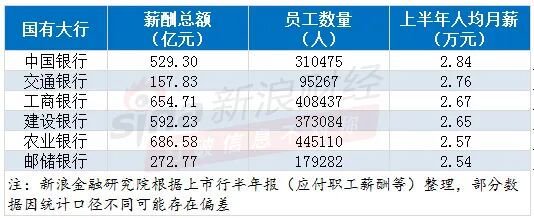
Summary of Key Points Core Viewpoint - The recent strong performance of the banking sector has drawn attention to the salary situation of listed banks, with significant differences in average salaries between state-owned banks and joint-stock banks [1][2]. Salary Data of State-Owned Banks - In the first half of 2025, the average monthly salary for employees in state-owned banks ranged from 25,400 to 28,400 yuan, with Agricultural Bank having the lowest average salary at 25,100 yuan [4][11]. - The total salary expenditure for Agricultural Bank reached 68.658 billion yuan, ranking first among state-owned banks, followed by Industrial and Commercial Bank with 65.471 billion yuan [3][4]. Salary Data of Joint-Stock Banks - Joint-stock banks generally offered higher average monthly salaries, with China Merchants Bank and Industrial Bank exceeding 45,000 yuan, specifically 50,100 yuan and 45,700 yuan respectively [6][7]. - The total salary expenditure for China Merchants Bank was 35.484 billion yuan, leading among joint-stock banks, while several others exceeded 10 billion yuan [5][6]. Employee Count Changes - Many banks reported a reduction in employee numbers, with Agricultural Bank reducing its workforce by 9,606 employees, and Industrial and Commercial Bank by over 6,700 employees [8][12]. - In contrast, China Merchants Bank was the only bank to increase its employee count, adding 867 employees [10][12]. Performance-Based Salary Mechanisms - Several banks have implemented performance-based salary mechanisms, including deferred payment and clawback provisions for high-risk positions, as seen in the practices of Minsheng Bank and Shanghai Pudong Development Bank [13][14]. - The trend of extending salary resources to county-level operations is noted, with Agricultural Bank allocating over 50% of its recruitment plan to county areas to support rural revitalization efforts [16].





民生银行陆续终止与中国移动和包、华能集团旗下平台合作代销金融产品业务
Mei Ri Jing Ji Xin Wen· 2025-09-11 12:49
Group 1 - Minsheng Bank has terminated its financial product distribution cooperation with "China Mobile and Package" (中移和包), effective September 19, limiting the platform to only query Minsheng Bank's services without further operations [1][2] - The bank is also in the process of ending its distribution cooperation with Huaneng Group's Yun Cheng Jin Fu, alongside previously announced terminations with "Huawei Wallet" and "Yutong Life" [2][3][4] - A new regulatory framework issued by the National Financial Supervision Administration will take effect on October 1, restricting commercial banks from outsourcing sales processes or embedding sales activities within third-party platforms [3][4][6] Group 2 - Following the termination of cooperation with "Yipay," users will no longer be able to access Minsheng Bank's fund distribution services through the app starting September 24, 2025 [5] - The closure of the fund distribution channel on "Yipay" will prevent users from querying or transacting with specific fund products, requiring them to use Minsheng Bank's app for such operations [5][6] - The changes reflect a broader industry shift towards compliance with new regulations, which will eliminate the previous model where users could access Minsheng Bank's products through third-party apps without holding a Minsheng Bank account [6]
港股高股息ETF(159302)涨0.38%,成交额886.21万元
Xin Lang Cai Jing· 2025-09-11 07:11
Core Viewpoint - The Hong Kong High Dividend ETF (159302) has shown a slight increase in its closing price and has experienced a decrease in both share count and total assets since the beginning of the year [1][2]. Fund Overview - The Hong Kong High Dividend ETF (159302) was established on August 23, 2024, with an annual management fee of 0.50% and a custody fee of 0.10% [1]. - As of September 10, 2024, the fund's latest share count is 87.8 million, and the total asset size is 117 million yuan [1]. - The fund's performance benchmark is the China Securities Hong Kong Stock Connect High Dividend Investment Index return (adjusted for valuation exchange rate) [1]. Performance Metrics - Year-to-date, the fund has seen a 19.30% decrease in share count and a 3.14% decrease in total assets compared to December 31, 2024 [1]. - Over the last 20 trading days, the cumulative trading amount is 217 million yuan, with an average daily trading amount of 10.84 million yuan [1]. - Since the beginning of the year, the cumulative trading amount over 170 trading days is 2.135 billion yuan, with an average daily trading amount of 12.56 million yuan [1]. Fund Management - The current fund managers are Li Yixuan and Zhang Yichi, both managing the fund since its inception, with a return of 33.32% during their tenure [2]. Top Holdings - The top holdings of the fund include: - COSCO Shipping Holdings: 8.68% of the portfolio - Yancoal Australia: 6.17% - Seaspan Corporation: 4.28% - Orient Overseas International: 4.23% - Minsheng Bank: 4.22% - CITIC Bank: 4.07% - China Petroleum: 3.41% - Guotai Junan: 3.41% - Agricultural Bank of China: 3.30% - CNOOC: 3.19% [2][3].



民生银行获摩根大通增持2365.62万股
Ge Long Hui· 2025-09-11 00:18
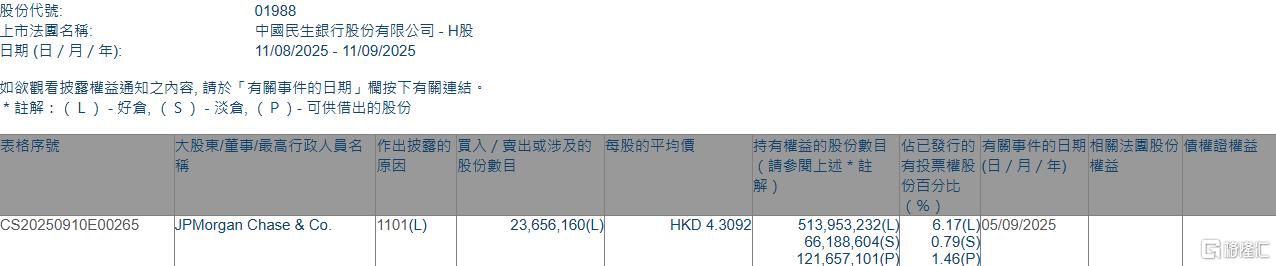
Group 1 - JPMorgan Chase & Co. increased its stake in China Minsheng Bank (01988.HK) by acquiring 23,656,160 shares at an average price of HKD 4.3092 per share, totaling approximately HKD 102 million [1][2] - Following this acquisition, JPMorgan's total holdings in China Minsheng Bank rose to 513,953,232 shares, increasing its ownership percentage from 5.89% to 6.17% [1][2]
民生银行(01988.HK)获摩根大通增持2365.62万股
Ge Long Hui A P P· 2025-09-10 23:25
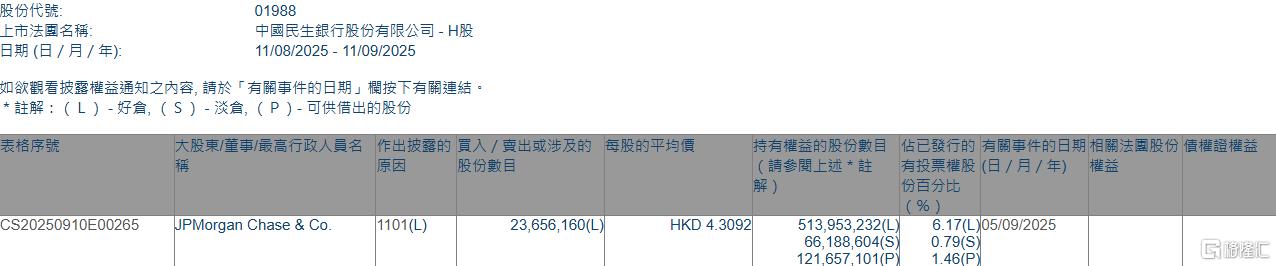
Group 1 - JPMorgan Chase & Co. increased its stake in China Minsheng Bank (01988.HK) by acquiring 23,656,160 shares at an average price of HKD 4.3092 per share, totaling approximately HKD 102 million [1][2] - Following this acquisition, JPMorgan's total holdings in China Minsheng Bank rose to 513,953,232 shares, increasing its ownership percentage from 5.89% to 6.17% [1][2]
今日重磅看点
Bei Jing Shang Bao· 2025-09-10 17:35
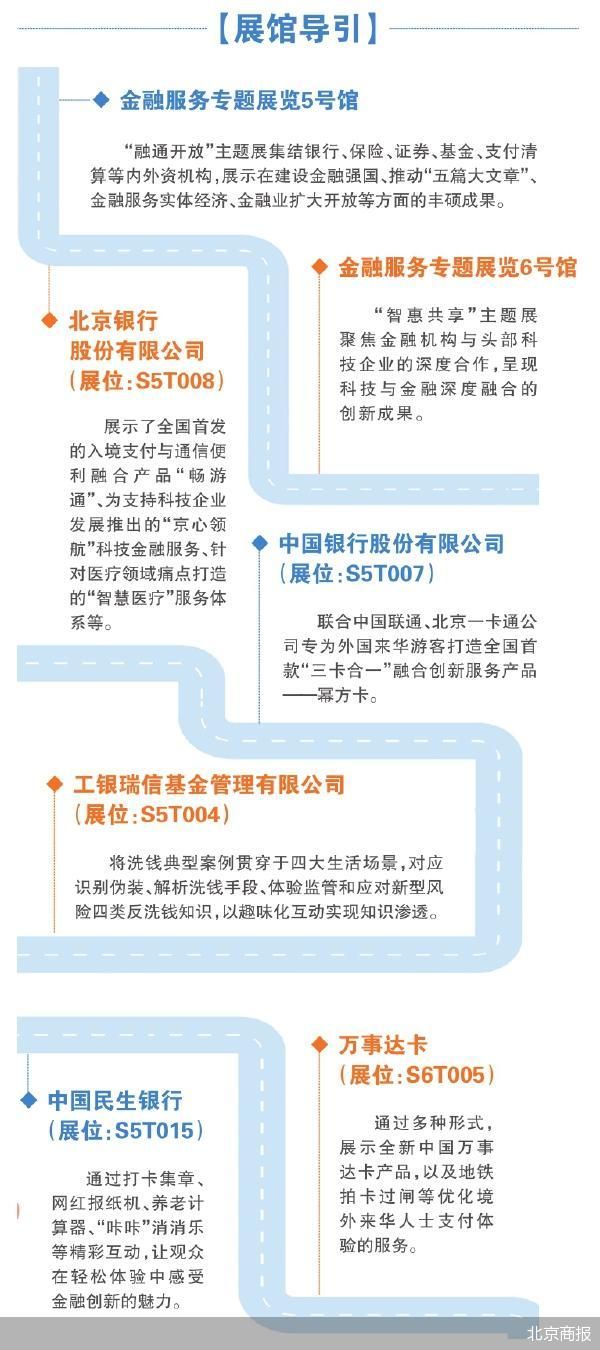
Group 1: Financial Services Exhibition Highlights - The exhibition features a theme of "融通开放" (Open Integration), showcasing achievements in building a strong financial nation and expanding financial services to the real economy [1] - Beijing Bank introduced innovative products such as "畅游通" for inbound payment and communication, "京心领航" for supporting tech enterprises, and a "智慧医疗" service system targeting healthcare pain points [2] - The "智惠共享" (Intelligent Sharing) theme focuses on deep cooperation between financial institutions and leading tech companies, highlighting the integration of technology and finance [3] Group 2: Collaborative Innovations - Bank of China, in collaboration with China Unicom and Beijing Yikatong, launched the first "三卡合一" (Three-in-One) service product for foreign tourists [4] - ICBC Credit Suisse Asset Management incorporated anti-money laundering education into four life scenarios, using interactive methods to enhance knowledge dissemination [5] - Various interactive experiences were provided to engage audiences in understanding financial innovations, including activities like stamp collection and games [7] Group 3: Upcoming Events - The 2025 Global Service Trade Entrepreneurs Summit will take place on September 11, 2025, focusing on intelligent driving and color integration [10] - The 2025 World Tourism Cooperation and Development Conference will also occur on September 11, 2025, emphasizing smart tourism and mutual benefits [10] - The International Education Cooperation Forum and the Fourth International Exhibition Economy Development Forum are scheduled for the same day, addressing future innovations and digital reconstruction of value chains [10]


摩根大通增持民生银行约2365.62万股 每股均价约4.31港元
Zhi Tong Cai Jing· 2025-09-10 11:20
Group 1 - Morgan Stanley increased its stake in Minsheng Bank by acquiring 23.656 million shares at an average price of 4.3092 HKD per share, totaling approximately 102 million HKD [1] - After the acquisition, Morgan Stanley's total shareholding in Minsheng Bank reached approximately 514 million shares, representing a stake of 6.17% [1]

摩根大通增持民生银行(01988)约2365.62万股 每股均价约4.31港元
智通财经网· 2025-09-10 11:15
Group 1 - Morgan Stanley increased its stake in Minsheng Bank by purchasing 23.656 million shares at an average price of 4.3092 HKD per share, totaling approximately 102 million HKD [1] - After the purchase, Morgan Stanley's total holdings in Minsheng Bank reached approximately 514 million shares, representing a stake of 6.17% [1]
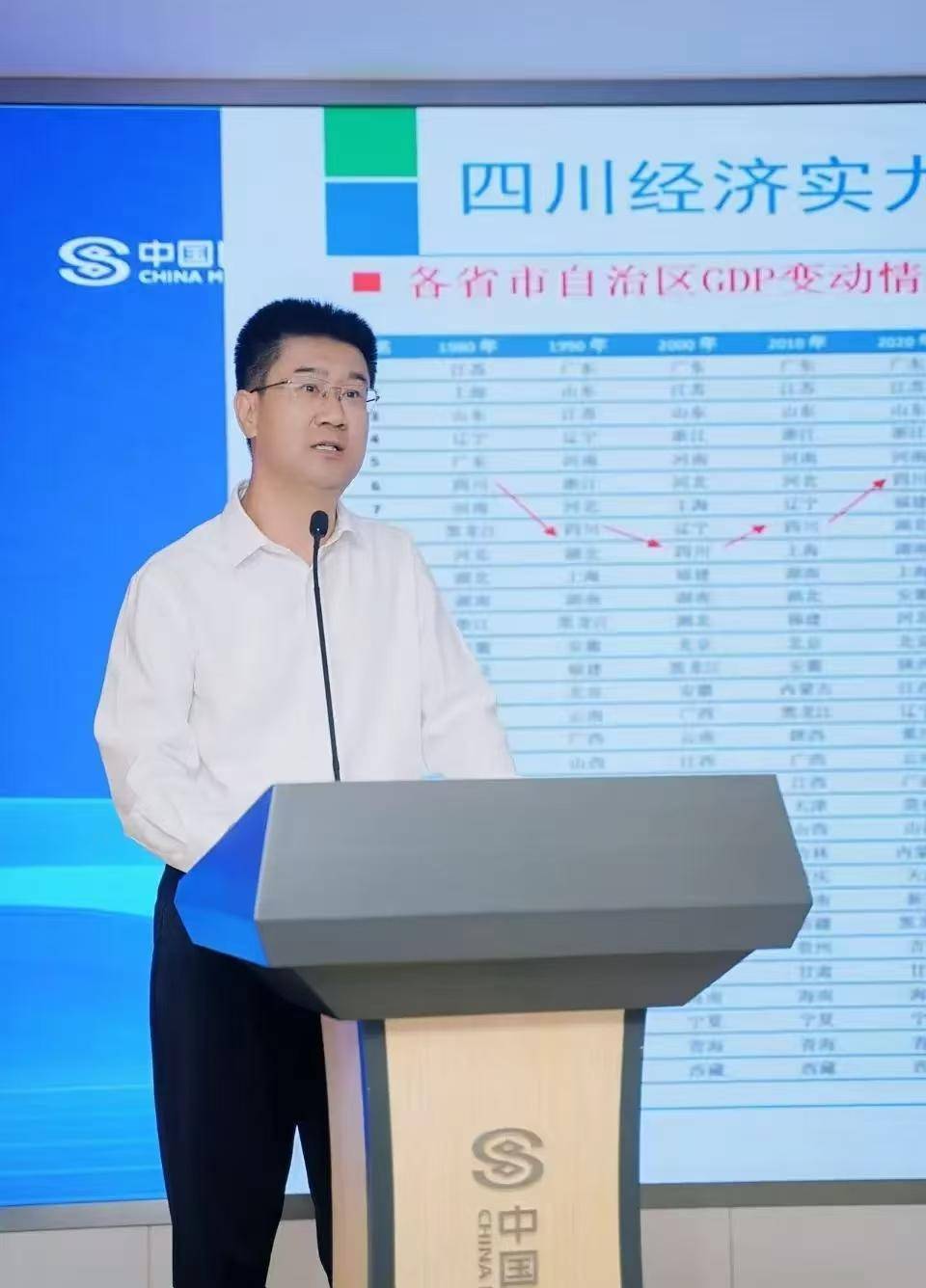
中国民生银行首席经济学家温彬:全年5%增长目标有望达成,扩内需是下半年稳增长的关键
Sou Hu Cai Jing· 2025-09-10 10:47
Core Viewpoint - The seminar highlighted the analysis and outlook of China's economic and financial situation for mid-2025, emphasizing the need for macroeconomic regulation and deepening reforms to enhance internal economic momentum in response to complex international challenges [1]. Economic Performance - In the first half of 2025, China's economy showed significant characteristics: consumption outperformed investment, and external demand was stronger than internal demand. The annual growth target of around 5% is expected to be achieved [5][6]. - The GDP growth rates were 5.4% in Q1 and 5.2% in Q2, leading to an overall growth of 5.3% in the first half. A growth rate of 4.7% in the second half would suffice to meet the annual target [5][6]. Regional Economic Development - Sichuan has emerged as the fifth-largest economy in China, with a continuously optimized industrial structure and enhanced competitiveness. Future efforts should focus on leveraging internal demand and upgrading industries to promote high-quality development [4][6]. Consumer and External Demand - Retail sales in May increased by 6.4% year-on-year, driven by holiday effects, promotional activities, and government subsidies for major consumer goods [6]. - Exports contributed 1.7 percentage points to economic growth in the first half, acting as a stabilizer amid slower domestic demand recovery [6][7]. Financial Indicators - The narrowing gap between M1 and M2 indicates a gradual recovery in corporate confidence, while the expansion of the gap between social financing and credit growth suggests that government bond issuance is a key driver of social financing growth [7][8]. Policy Focus for the Second Half - The policy direction for the second half of 2025 will prioritize domestic demand, with a focus on stimulating consumption and increasing infrastructure investment [8][9]. - Major projects in infrastructure, such as the Yarlung Tsangpo River hydropower station, are expected to play a crucial role in stabilizing investment growth [8]. Long-term Economic Strategy - To address the challenges posed by high savings rates and trade protectionism, reforms should focus on increasing consumption rates through income distribution reforms and enhancing social security systems [9][10]. - The establishment of a unified national market is essential for optimizing resource allocation and promoting new quality productivity [11]. Global Competitiveness - Chinese companies are encouraged to enhance their global perspective and operational capabilities while deepening their engagement in the domestic market to improve international competitiveness [11][12].