
INNOGEN-B(02591)

Search documents
银诺医药-B(02591.HK)拟8月29日举行董事会会议批准中期业绩
Ge Long Hui· 2025-08-19 09:01
Group 1 - The company, Silver诺医药-B (02591.HK), announced that its board meeting will be held on August 29, 2025, to consider and approve the interim results for the six months ending June 30, 2025 [1]
银诺医药-B(02591) - 董事会会议通告
2025-08-19 08:38
香港交易及結算所有限公司及香港聯合交易所有限公司對本公告的內容概不負責,對其準確性 或完整性亦不發表任何聲明,並明確表示概不就因本公告全部或任何部分內容而產生或因倚賴 該等內容而引致的任何損失承擔任何責任。 Guangzhou Innogen Pharmaceutical Group Co., Ltd. 廣州銀諾醫藥集團股份有限公司 (於中華人民共和國成立的股份有限公司) (股份代號:2591) 董事會會議通告 廣州銀諾醫藥集團股份有限公司(「本公司」)董事會(「董事會」)謹此宣佈,董事 會會議將於2025年8月29日(星期五)舉行,藉以(其中包括)考慮及批准本公司及 其附屬公司截至2025年6月30日止六個月之中期業績及其發佈。 承董事會命 廣州銀諾醫藥集團股份有限公司 董事長、執行董事及總經理 WANG QINGHUA博士 中華人民共和國,上海 2025年8月19日 於本公告日期,董事會包括執行董事WANG QINGHUA博士、姜帆女士、徐文潔 女士及黃冰先生;非執行董事HO KYUNG SHIK先生及衡磊先生;及獨立非執行 董事陶武平先生、宋瑞霖博士及陳向榮先生。 ...
银诺医药上市首日大涨206.5%
Bei Jing Shang Bao· 2025-08-15 13:52
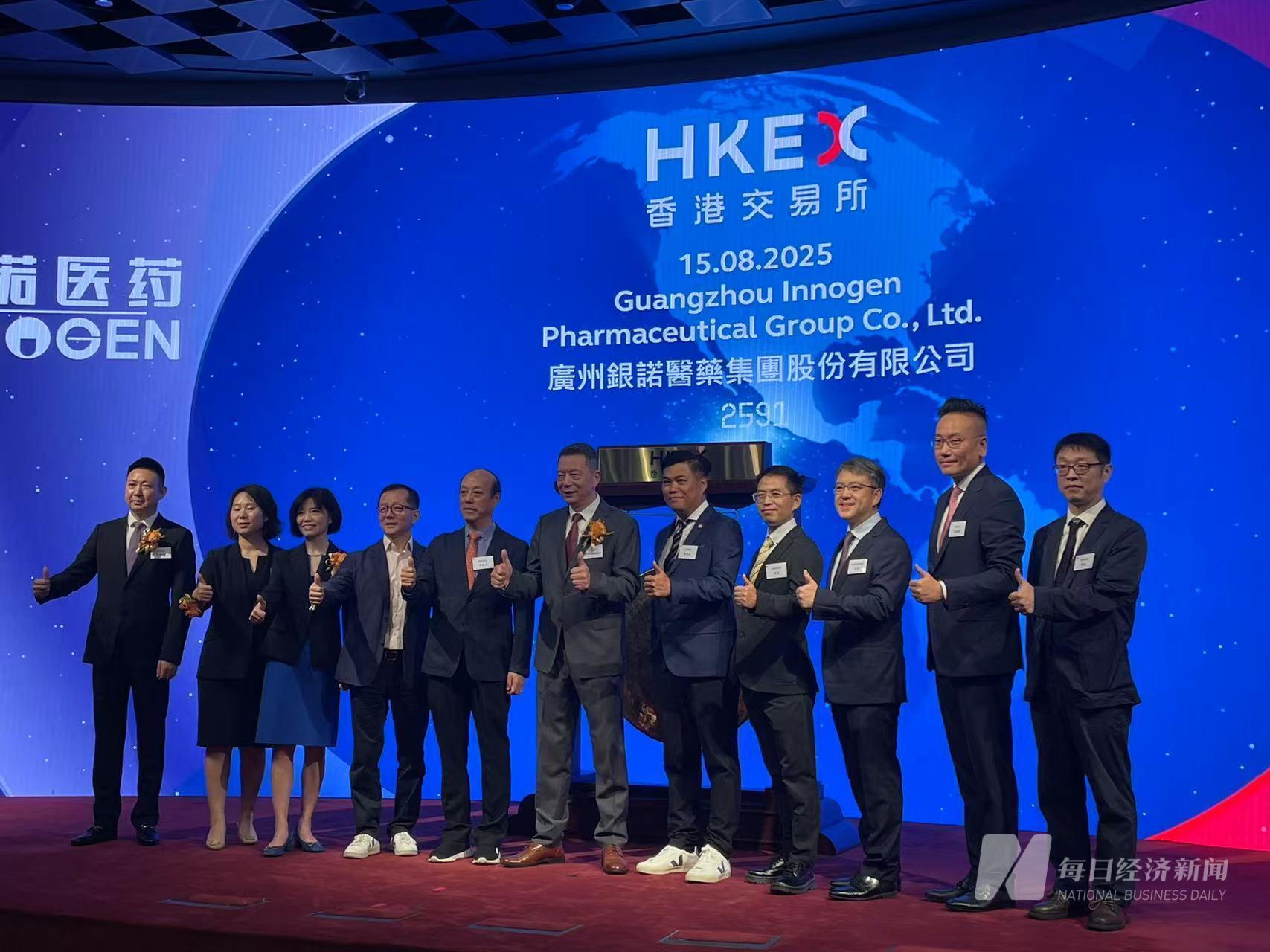
Core Viewpoint - Silver诺医药 (02591.HK) made a strong debut on the Hong Kong Stock Exchange, with a significant increase of 206.5% on its first trading day, closing at HKD 57.25 per share, resulting in a total market capitalization of HKD 26.15 billion [1] Company Overview - Silver诺医药 was established in 2014 and focuses on the discovery, development, and commercialization of innovative therapies for diabetes and other metabolic diseases [1] - The company has developed a pipeline of candidate drugs targeting diabetes and other metabolic disorders [1] Market Response - The public offering portion of Silver诺医药 was oversubscribed by 5,341.66 times, indicating strong investor interest [1]
港交所重磅新规生效,散户打新时代或终结
2 1 Shi Ji Jing Ji Bao Dao· 2025-08-15 13:17
Group 1 - Guangzhou Yinnuo Pharmaceutical Group Co., Ltd. officially listed on the Hong Kong Stock Exchange on August 15, becoming the first company to utilize the new allocation mechanism under the recent IPO regulations [1] - On its first trading day, Yinnuo's stock price surged over 280%, with approximately 260,000 subscriptions leading to an oversubscription of 5,364 times, making it the second highest oversubscription this year [1] - The new IPO mechanism allows for a pre-locked public subscription ratio of 10% and an international placement ratio of 90%, with no mechanism for reallocation, ensuring institutional investors receive a stable allocation [1][3] Group 2 - The Hong Kong Stock Exchange's new IPO pricing mechanism, effective from August 4, is considered the most comprehensive adjustment in 27 years, aimed at balancing the interests of institutional and retail investors [3][4] - The minimum allocation for institutional investors has been reduced from 50% to 40%, and a dual-track allocation mechanism has been introduced, allowing issuers to choose between traditional reallocation or a pre-locked allocation [3][4] - Mechanism B, which is being increasingly favored by issuers, allows for a public subscription ratio between 10% and 60%, with no reallocation, enhancing flexibility for issuers [4] Group 3 - The reform aims to improve pricing efficiency by enhancing the role of professional institutional investors in the pricing process, which was previously dominated by retail investors [6][7] - The new rules are expected to reduce pricing bubbles caused by excessive retail subscriptions and mitigate the risk of post-listing price drops [6][7] - The market is witnessing a shift where high-quality projects are increasingly leaning towards institutional investors, as seen in recent IPOs like Ningde Times and Heng Rui Pharmaceutical [4][10] Group 4 - The Hong Kong IPO market has shown strong performance, with 53 new listings and a total fundraising amount of approximately HKD 127 billion in the first seven months of the year, a year-on-year increase of over six times [10] - Approximately two-thirds of the recent IPO investors are from foreign capital, indicating a growing interest from international long-term investors [10][12] - The previous allocation mechanism often left institutional investors struggling to secure adequate shares, leading to increased competition and the need to purchase shares in the secondary market [10][12] Group 5 - Retail investors are expressing concerns about their reduced chances of obtaining shares in IPOs due to the new allocation mechanisms, particularly with the public subscription ratio being locked at a low level [14][15] - The new rules may lead to a decrease in retail participation, as many retail investors feel that their chances of winning allocations are diminishing [15][17] - Despite the challenges for retail investors, the reforms aim to enhance overall market stability and reduce the risk of price drops post-listing, potentially benefiting all investors in the long run [16][17]

港交所重磅新规生效,散户打新时代或终结
21世纪经济报道· 2025-08-15 12:17
Core Viewpoint - The article discusses the recent IPO of Guangzhou Yinnuo Pharmaceutical Group, which became the first company to utilize the new allocation mechanism under the Hong Kong Stock Exchange's (HKEX) revised IPO rules, highlighting a shift towards favoring institutional investors over retail investors in the IPO process [1][6][16]. Summary by Sections IPO Mechanism Reform - The HKEX's new IPO pricing mechanism, effective from August 4, is considered the most comprehensive reform in 27 years, aimed at balancing the interests of institutional and retail investors [6][7]. - The new rules lower the minimum allocation for institutional investors from 50% to 40% and introduce a dual-track allocation mechanism, allowing issuers to choose between a traditional mechanism with a flexible allocation or a fixed allocation with no reallocation [6][9]. Impact on Institutional Investors - The reform is expected to enhance the participation of institutional investors, who have historically faced challenges in securing adequate allocations due to the previous reallocation mechanisms favoring retail investors [12][13]. - Notable IPOs like CATL and Heng Rui Pharmaceutical have already shown a trend of favoring institutional investors, with CATL locking in a low public offering ratio of 7.5% to ensure a larger share for institutions [7][12]. Retail Investor Concerns - Retail investors are increasingly concerned about their reduced chances of obtaining shares in IPOs, as seen in the case of Yinnuo Pharmaceutical, which had a public offering oversubscription of 5,364 times, leading to a lottery system for allocations [1][16]. - The new rules may lead to a perception of unfairness among retail investors, as they may find it more difficult to participate in IPOs, potentially diminishing their enthusiasm for the market [16][17]. Market Dynamics and Pricing Efficiency - The reform aims to improve pricing efficiency by allowing more informed institutional investors to participate in the pricing process, which could reduce the risk of inflated IPO prices and subsequent poor performance [9][10]. - However, the initial performance of Yinnuo Pharmaceutical, which saw its stock price surge over 200% on the first day, raises questions about the effectiveness of the new pricing mechanism in stabilizing stock prices [10][11]. Future Outlook - The HKEX has acknowledged the concerns of retail investors and made some adjustments to the proposed reforms, but the overall trend appears to favor institutional investors, which may lead to a more rational market environment in the long term [18][19]. - The ongoing transition period may result in volatility in the IPO market as both institutional and retail investors adjust to the new rules [10][19].
港交所“回拨新规”第一股:银诺医药上市首日股价涨超200%,董事长称糖尿病代谢病领域临床需求巨大
Mei Ri Jing Ji Xin Wen· 2025-08-15 10:20
Group 1 - The new listing rules of the Hong Kong Stock Exchange took effect on August 4, focusing on IPO issuance and pricing mechanisms, as well as public market regulations [1] - Silver诺医药-B (HK02591) experienced significant market interest during its subscription phase, with over 250,000 investors participating and nearly HKD 300 billion frozen in subscriptions [1] - On August 15, Silver诺医药 officially listed on the Hong Kong Stock Exchange at a price of HKD 18.68 per share, with an opening price that surged over 200%, closing with a gain of 206.48% [3] Group 2 - The new rules allow new listing applicants to choose between Mechanism A or Mechanism B for public subscription distribution, with Mechanism B allowing a fixed allocation of 10% to 60% for public offerings [4] - Silver诺医药 opted for Mechanism B, allocating only 10% of its shares for public sale, resulting in a significantly lower chance of winning shares for retail investors [4][5] - The company received 5,341.66 times the subscription demand, but only 0.5% of investors successfully obtained shares, with only 18,300 out of over 250,000 participants winning shares [5] Group 3 - Silver诺医药 focuses on innovative therapies for diabetes and other metabolic diseases, with its core product, Irsuglutide α (brand name: Yinuo Qing), being referred to as "domestic Semaglutide" [6] - Despite the commercialization of Irsuglutide α, the company faces intense market competition, with three long-acting GLP-1 receptor agonists expected to capture 83% of the global GLP-1 therapy market by 2024 [6] - The company is also advancing clinical trials for its core product targeting obesity, amidst a competitive landscape with 51 GLP-1 receptor agonist candidates in clinical development in China [6]
港股收盘 | 恒指收跌0.98% 互联网医疗股逆势走强 银诺医药-B首挂暴涨200%
Zhi Tong Cai Jing· 2025-08-15 09:31
Market Overview - The Hong Kong stock market continued its downward trend, with all three major indices in the red but maintaining above the 25,000 mark. The Hang Seng Index closed down 0.98% at 25,270.07 points, with a total turnover of HKD 31.27 billion [1] - Short-term market focus is on mid-year performance and cost-effectiveness, with potential volatility from US-China trade negotiations and fluctuations in US stocks [1] Blue-Chip Stocks Performance - JD Health (06618) led blue-chip stocks, rising 11.67% to HKD 61.25, contributing 11.31 points to the Hang Seng Index. The company's H1 2025 performance exceeded market expectations due to strong growth in the pharmaceutical category [2][4] - Other notable blue-chip movements included Xinyi Solar (00968) up 5.96%, Alibaba Health (00241) up 4.92%, while New World Development (00016) and Henderson Land (00012) saw declines of 5.35% and 4.63% respectively [2] Sector Highlights - Internet healthcare stocks showed strong performance, with Dingdang Health (09886) up 36.07% and JD Health (06618) up 11.67% following strong mid-year results [3][4] - The brokerage sector saw significant gains, with CITIC Securities (06066) up 10.98% and Zhongtai Securities (01375) up 9.03%, reflecting a structural shift in fund flows towards financial markets [5][6] - The photovoltaic sector also experienced gains, driven by a shortage and price increases in solar components, with Xinyi Solar (00968) rising 8.15% [6][7] Regulatory Developments - The Hong Kong Monetary Authority and the Securities and Futures Commission issued a joint statement regarding recent market fluctuations related to stablecoins, emphasizing a cautious approach to licensing [8] Notable Stock Movements - Silver诺医药-B (02591) surged 206.48% on its debut, reflecting strong market interest in GLP-1 drug treatments [9] - Liken Technology (00558) rose 46.02% following a strategic partnership for magnesium alloy humanoid robot development [10] - Far East China (02789) saw an 84.34% increase after announcing a profit forecast for H1 2025, driven by international market orders [11][12] - Jin Hai Medical Technology (02225) fell 50.56% after announcing a share subscription at a discount to market price [13]

港股收盘(08.15) | 恒指收跌0.98% 互联网医疗股逆势走强 银诺医药-B(02591)首挂暴涨200%
智通财经网· 2025-08-15 09:27
Market Overview - The Hong Kong stock market continued its downward trend, with all three major indices in the red but maintaining above the 25,000 mark. The Hang Seng Index closed down 0.98% at 25,270.07 points, with a total turnover of HKD 312.69 billion [1] - Short-term market focus is on mid-year performance and value for money, with potential volatility from US-China trade negotiations and fluctuations in US stocks [1] - The outlook for the second half of the year remains positive, with expectations of upward movement and new highs for the Hong Kong stock market, supported by potential interest rate cuts from the Federal Reserve [1] Blue Chip Performance - JD Health (06618) led blue-chip stocks, rising 11.67% to HKD 61.25, contributing 11.31 points to the Hang Seng Index. The company's H1 2025 performance exceeded market expectations due to strong growth in the pharmaceutical category [2][4] - Other notable blue-chip movements included Xinyi Solar (00968) up 5.96%, Alibaba Health (00241) up 4.92%, while Sun Hung Kai Properties (00016) fell 5.35% [2] Sector Highlights - Internet healthcare stocks showed strong performance, with Dingdang Health (09886) up 36.07% and JD Health (06618) up 11.67% [3] - The recent surge in the two financing balances indicates a high level of market trading sentiment, with Chinese brokerage stocks performing well [5][6] - The photovoltaic sector saw a general rise, attributed to a shortage and price increase of solar components, with Xinyi Solar (00968) up 8.15% [6][7] Company-Specific Developments - JD Health reported a 24.5% year-on-year revenue increase to HKD 35.3 billion for H1 2025, driven by strong user growth and performance in the pharmaceutical sector [4] - Silver诺医药-B (02591) debuted with a significant increase of 206.48%, reflecting strong market interest in GLP-1 drug treatments [9] - Lijin Technology (00558) rose 46.02% after announcing a strategic partnership for the development of magnesium alloy humanoid robots [10] - Yuanda China (02789) saw an 84.34% increase following a profit warning, projecting a net profit of HKD 150-210 million for H1 2025 [11]
港交所IPO新规生效,散户打新时代终结?|中环观察
2 1 Shi Ji Jing Ji Bao Dao· 2025-08-15 09:25
Core Viewpoint - The recent IPO reform by the Hong Kong Stock Exchange aims to rebalance the interests of institutional and retail investors, with a focus on enhancing pricing efficiency and reducing speculative behavior in the market [2][4][10]. Group 1: IPO Reform Details - The new IPO distribution mechanism allows issuers to choose between a traditional allocation method or a pre-locked allocation ratio, with a minimum public offering ratio set at 10% [1][2]. - Mechanism A retains a similar structure to previous rules but lowers the minimum allocation for public offerings from 10% to 5%, while adjusting the reallocation percentages based on oversubscription levels [2][4]. - Mechanism B introduces a fixed allocation for public offerings, ensuring that institutional investors receive a larger share, with no reallocation mechanism in place [2][3]. Group 2: Market Reactions and Implications - The first company to utilize the new rules, Guangzhou Yino Pharmaceutical Group, saw its stock price surge over 280% on its debut, raising questions about the effectiveness of the new pricing mechanism [1][5]. - The reform is expected to enhance the participation of institutional investors, as it addresses previous concerns about the unpredictability of allocations under the old system [7][10]. - Despite the potential benefits for institutional investors, retail investors express concerns about reduced chances of allocation, leading to dissatisfaction and fears of market liquidity being compromised [9][11]. Group 3: Market Performance and Trends - The Hong Kong IPO market has shown robust growth, with 53 new listings in the first seven months of the year, raising approximately HKD 127 billion, a year-on-year increase of over 600% [6]. - International interest in Hong Kong IPOs has surged, with about two-thirds of recent investors being foreign, indicating a shift in market dynamics [6][7]. - The new rules are designed to mitigate the risks of pricing bubbles and post-listing volatility, potentially leading to more stable stock performances [4][10].

银诺医药上市 大钲资本等机构医疗健康领域投资再获丰收
Sou Hu Cai Jing· 2025-08-15 09:15
Group 1 - Guangzhou Yinnuo Pharmaceutical Group Co., Ltd. officially listed on the Hong Kong Stock Exchange on August 15, with an IPO price of HKD 18.68 per share, opening at HKD 72 on the first day, a 285.44% increase from the issue price [1] - The IPO was significantly oversubscribed, with a subscription rate of approximately 5,364 times, indicating strong market recognition of the company [1] - The company completed four rounds of financing before the IPO, raising a total of CNY 1.514 billion, with major institutional investors including KIP, Tongchuang Weiye, and Dachang Capital [1] Group 2 - Yinnuo Pharmaceutical focuses on innovative therapies for diabetes and other metabolic diseases, rapidly rising in the field since its establishment in 2014, supported by strong R&D capabilities and a rich product pipeline [1] - The core product, Isu-Paglutide α (brand name: Yinuo Qing), is a human long-acting GLP-1 receptor agonist approved for the treatment of adult type 2 diabetes (T2D) in China, with commercialization expected in February 2025 [1] - The GLP-1 diabetes drug market in China is still in its emerging stage, with a market size projected to grow from CNY 700 million in 2018 to CNY 10.1 billion by 2024, at a compound annual growth rate (CAGR) of 55.5%, and expected to reach CNY 43.7 billion by 2028 and CNY 84.8 billion by 2034 [2] Group 3 - The clinical indications for Isu-Paglutide α are expanding, with a Phase IIb/III clinical trial for the treatment of obesity and overweight starting in March 2025, and a global multi-center Phase IIa clinical trial for metabolic dysfunction-associated steatotic liver disease (MASH) planned for 2026 [2] - Dachang Capital, a key investor in Yinnuo Pharmaceutical, focuses on the healthcare sector, investing in various sub-sectors including innovative drugs, medical devices, and medical services, with a portfolio that includes leading companies in blood products, nuclear medicine, and cardiovascular medical devices [2]