TRANSTHERA-B(02617)

Search documents
港股医药股走强 永泰生物涨近15%
Mei Ri Jing Ji Xin Wen· 2025-10-20 01:37
Group 1 - Yongtai Biologics-B (06978.HK) increased by 14.94% [1] - Hepp Pharmaceuticals-B (02142.HK) rose by 5.32% [1] - Rongchang Biologics (09995.HK) gained 5.14% [1] - Yaojie Ankang (02617.HK) saw an increase of 5.02% [1] - Cornerstone Pharmaceuticals-B (02616.HK) experienced a rise of 3.92% [1]
港股通10月17日成交活跃股名单
Zheng Quan Shi Bao Wang· 2025-10-17 15:04
Market Overview - On October 17, the Hang Seng Index fell by 2.48%, with southbound trading totaling HKD 153.005 billion, comprising HKD 79.654 billion in buying and HKD 73.351 billion in selling, resulting in a net buying amount of HKD 6.303 billion [1] Southbound Trading Details - Southbound trading through the Stock Connect (Shenzhen) recorded a total transaction amount of HKD 58.715 billion, with buying at HKD 29.681 billion and selling at HKD 29.034 billion, leading to a net buying of HKD 0.647 billion [1] - Southbound trading through the Stock Connect (Shanghai) had a total transaction amount of HKD 94.290 billion, with buying at HKD 49.973 billion and selling at HKD 44.317 billion, resulting in a net buying of HKD 5.656 billion [1] Active Stocks - Alibaba-W had the highest transaction amount among southbound stocks at HKD 137.12 billion, with a net selling of HKD 21.53 billion and a closing price drop of 4.22% [1] - Other notable stocks included SMIC with a transaction amount of HKD 98.39 billion and a net selling of HKD 15.78 billion, and Xiaomi Group-W with a transaction amount of HKD 58.48 billion and a net buying of HKD 4.14 billion [2] Continuous Net Buying - Two stocks, Xiaomi Group-W and Pop Mart, have seen continuous net buying for over three days, with Xiaomi Group-W leading at a total net buying of HKD 74.03 billion over 10 days, followed by Pop Mart with HKD 14.68 billion over 4 days [2]



港股通(深)净买入6.47亿港元
Zheng Quan Shi Bao Wang· 2025-10-17 15:04
Market Overview - On October 17, the Hang Seng Index fell by 2.48%, closing at 25,247.10 points, while southbound funds through the Stock Connect recorded a net purchase of 6.303 billion HKD [1][3] - The total trading volume for the Stock Connect on the same day was 153.005 billion HKD, with a net buying amount of 6.303 billion HKD [1][3] Trading Activity - In the Shanghai Stock Connect, the trading volume was 94.290 billion HKD with a net purchase of 5.656 billion HKD; in the Shenzhen Stock Connect, the trading volume was 58.715 billion HKD with a net purchase of 0.647 billion HKD [1][3] - The most actively traded stock in the Shanghai Stock Connect was Alibaba-W, with a trading amount of 8.411 billion HKD, followed by SMIC and Xiaomi Group-W, with trading amounts of 5.454 billion HKD and 3.257 billion HKD, respectively [1][2] Stock Performance - In terms of net buying, Meituan-W led with a net purchase of 648 million HKD, despite its closing price dropping by 4.30% [1][2] - Alibaba-W experienced the highest net selling amount of 1.112 billion HKD, with a closing price decline of 4.22% [1][2] - In the Shenzhen Stock Connect, Alibaba-W also topped the trading volume with 5.302 billion HKD, while SMIC and Xiaomi Group-W followed with 4.385 billion HKD and 2.591 billion HKD, respectively [2]
从679暴跌至112,再暴涨翻倍:药捷安康是谁在 “造神”?
Zhi Tong Cai Jing· 2025-10-17 14:30
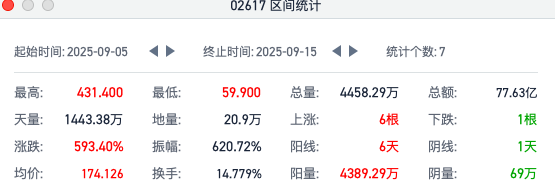
Core Insights - The stock of Yaojie Ankang - B (02617) experienced extreme volatility, with a significant rise followed by a sharp decline, indicating a classic "pump and dump" scenario [1][7][14] Group 1: Price Movement and Trading Volume - From September 5 to September 15, 2025, the stock surged by 593.40% with a trading volume of 44.58 million shares, totaling 7.763 billion [2][3] - The stock reached a peak price of 431.40 and a low of 59.90 during this period, with a trading turnover rate of 14.78% [3] - The subsequent period from September 16 to October 15 saw a drastic decline, with the stock price dropping over 72% from a high of 679.50 [7][8] Group 2: Market Dynamics and Investor Behavior - The initial surge was driven by mainland investors through the Hong Kong Stock Connect, which increased holdings by over 306,000 shares, indicating strong buying interest [4][5] - In contrast, during the decline, the Southbound Stock Connect saw a significant reduction in holdings by 0.6650%, while the Northbound Stock Connect increased by 0.598%, highlighting a divergence in investor sentiment [9][12] - The rebound from October 16 to 17, 2025, saw a 78.85% increase, characterized by a trading volume of 22.76 million shares, indicating a classic "dead cat bounce" [10][11] Group 3: Institutional Actions - Major institutional players like BNP Paribas and Merrill Lynch emerged as new buyers during the rebound, suggesting a shift in market dynamics [10][12] - The actions of domestic funds indicated a lack of confidence in the sustainability of the rebound, as they were net sellers during this period [12][14] - The overall trading behavior suggests that the rebound was primarily driven by short-term speculative trading rather than long-term investment confidence [14]

智通港股解盘 | 美国小银行爆雷引发蝴蝶效应 创新药BD引发炒作
Zhi Tong Cai Jing· 2025-10-17 12:46
Market Overview - Recent reactions to China's rare earth measures have led to significant declines in global stock markets, with major Asian markets dropping sharply, particularly in Japan and Taiwan, which fell over 1% [1] - In the U.S., regional banks Zions Bancorp and Western Alliance Bancorp reported losses due to fraudulent commercial mortgage investments, causing their stock prices to plummet by 13% and 11% respectively, triggering widespread panic in the banking sector [1] - The fear index VIX has risen above 25 for the first time in five months, indicating increased market anxiety [1] Commodity Insights - Gold prices have surged past $4,300, with a total market capitalization exceeding $30 trillion, leading to strong performances in gold jewelry stocks such as Chow Tai Fook and Lao Poo Gold, which rose over 5% and 3% respectively [2] - In contrast, oil prices have declined significantly, with WTI crude oil falling to $56.99 per barrel, a drop of 2.3%, attributed to decreased consumption and increased production from OPEC and the U.S. [3] Sector Focus - The logistics sector is being prioritized for cost reduction and efficiency improvements, with a focus on building a modern logistics system that integrates digital infrastructure and supports small and micro enterprises [6] - Companies like Jitu Express and SF Express are highlighted as key players in the logistics market [7] Company Developments - Xiansheng Pharmaceutical Group has completed the first patient dosing in a Phase I clinical trial for its innovative cancer drug SIM0505 in the U.S., which targets advanced solid tumors [8] - The company reported a 15.1% year-on-year revenue growth to 3.585 billion yuan, driven by its innovative drug business, which accounted for 77.4% of total revenue [9] - The company has multiple innovative drugs in the pipeline, with significant potential for future growth, including two new drug applications expected to be submitted within the next 1-2 years [9]

从679元到112元,再回到224元:药捷安康-B(02617)是谁在“造神”?
智通财经网· 2025-10-17 11:44
Core Viewpoint - The recent trading activity of Yaojie Ankang-B (02617) has exhibited extreme volatility, characterized by a rapid price surge followed by a significant decline, indicating a potential manipulation of stock prices by major players in the market [1]. Group 1: Price Surge Phase - From September 5 to September 15, 2025, the stock experienced a staggering increase of 593.40% with a volatility of 620.72%, marked by a high turnover rate of 14.78% and a dominant bullish trend with 6 up days against 1 down day [2][3]. - The total trading volume during this period reached 44.58 million shares, with a total transaction value of 7.763 billion [3]. - Major funds aggressively bought shares, creating a "star stock" effect to attract attention and speculative trading, while also facilitating a redistribution of shares from weaker hands to stronger ones [4]. Group 2: Distribution Phase - From September 16 to October 15, 2025, the stock price plummeted from a high of 679.50 to a low of 111.00, reflecting a maximum decline of over 72% [7][8]. - The trading volume during this period was 59.19 million shares, with a total value of 13.0581 billion, and a predominance of bearish trading days (13 down days vs. 6 up days) [8]. - The selling pressure was primarily driven by the deep stock connect funds, which significantly reduced their holdings, while the Shanghai stock connect funds attempted to stabilize the price through selective buying [9]. Group 3: Short-term Rebound - A brief rebound occurred on October 16 and 17, 2025, with a two-day increase of 78.85% and a volatility of 98.50%, indicating a classic "dead cat bounce" pattern [10][11]. - The total trading volume for this rebound was 22.76 million shares, all of which were bullish, suggesting that new buying interest emerged from international short-term traders [10][12]. - The rebound was not supported by the original major holders, who instead viewed it as an opportunity to reduce their positions, indicating a lack of confidence in a sustained recovery [14].
港股午评|恒生指数早盘跌1.61% 燃气股逆市走高
智通财经网· 2025-10-17 04:10
Market Overview - The Hang Seng Index fell by 1.61%, down 415 points, closing at 25,472 points, while the Hang Seng Tech Index dropped by 2.81%. The early trading volume in the Hong Kong market was HKD 153.2 billion [1] Energy Sector - Gas stocks rose, with Zhongyu Energy (03633) increasing by over 10%. This surge is attributed to the early initiation of winter heating in Gansu and other regions due to continuous temperature drops, leading to increased natural gas demand [1] Biotechnology Sector - Newly listed stock Xuan Zhu Bio-B (02575) surged over 13%, reaching a new high, and is up more than 190% from its IPO price. Yimai Sunshine (02522) rose over 4% following the global launch of its medical imaging model product AIR. The performance of medical stocks varied, with Yaojie Ankang-B (02617.HK) up over 21%, Baize Medical (02609) up over 5%, while Kangfang Biotech (09926) fell by 2%. Kangning Jereh Pharma-B (09966) increased by over 13% after announcing a share buyback plan, with market attention on significant data from the ESMO conference [2] Precious Metals Sector - Laopu Gold (06181) rose over 4%, benefiting from increased channel expansion and upgrades, with institutions indicating that rising gold prices favor its high-end brand positioning [3] Hospitality Sector - Wanda Hotel Development (00169) increased by over 10% after completing a sale and announcing a special dividend of HKD 0.462 per share to be paid next month [4] Digital Assets Sector - Delin Holdings (01709) rose over 3% after entering a strategic cooperation agreement with Antalpha to promote business in the digital asset sector [5] Telecommunications Sector - Changfei Optical Fiber and Cable (06869) fell over 6%, having dropped 40% from its September peak due to declining fiber optic prices and shareholder sell-offs. Cryptocurrency-related stocks collectively declined, with Bitcoin experiencing significant volatility and a recent incident in the US stablecoin market. Mi Strategy (02440) fell by 4.36%, and OSL Group (00863) dropped by 3.99% [6] Semiconductor Sector - Chip stocks continued to decline, with SMIC (00981) down over 5% and Huahong (01347) down over 3%, as US export controls accelerate domestic semiconductor replacements [6]
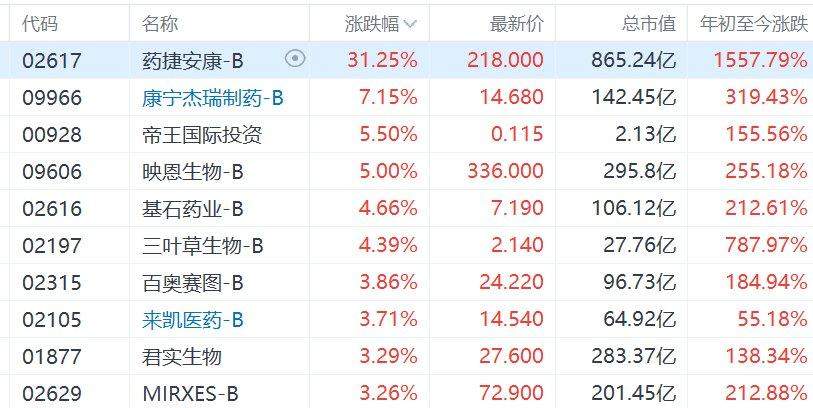
港股生物科技股再度集体逆势走强,药捷安康-B飙升30%,康宁杰瑞制药-B涨7%,帝王国际投资、映恩生物-B涨5%
Ge Long Hui· 2025-10-17 03:45
Core Insights - The biotechnology sector in the Hong Kong stock market has shown strong performance, with several stocks experiencing significant gains today, particularly药捷安康-B which surged over 30% [1] Stock Performance Summary - 药捷安康-B: Increased by 31.25%, latest price at 218.000, total market value of 86.524 billion, year-to-date increase of 1557.79% [2] - 康宁杰瑞制药-B: Increased by 7.15%, latest price at 14.680, total market value of 14.245 billion, year-to-date increase of 319.43% [2] - 帝王国际投资: Increased by 5.50%, latest price at 0.115, total market value of 0.0213 billion, year-to-date increase of 155.56% [2] - 映恩生物-B: Increased by 5.00%, latest price at 336.000, total market value of 29.58 billion, year-to-date increase of 255.18% [2] - 基石药业-B: Increased by 4.66%, latest price at 7.190, total market value of 10.612 billion, year-to-date increase of 212.61% [2] - 三叶草生物-B: Increased by 4.39%, latest price at 2.140, total market value of 2.776 billion, year-to-date increase of 787.97% [2] - 百奥塞图-B: Increased by 3.86%, latest price at 24.220, total market value of 9.673 billion, year-to-date increase of 184.94% [2] - 来凯医药-B: Increased by 3.71%, latest price at 14.540, total market value of 6.49217 billion, year-to-date increase of 55.18% [2] - 君实生物: Increased by 3.29%, latest price at 27.600, total market value of 28.337 billion, year-to-date increase of 138.34% [2] - MIRXES-B: Increased by 3.26%, latest price at 72.900, total market value of 20.145 billion, year-to-date increase of 212.88% [2]
智通港股通活跃成交|10月16日





智通财经网· 2025-10-16 11:12
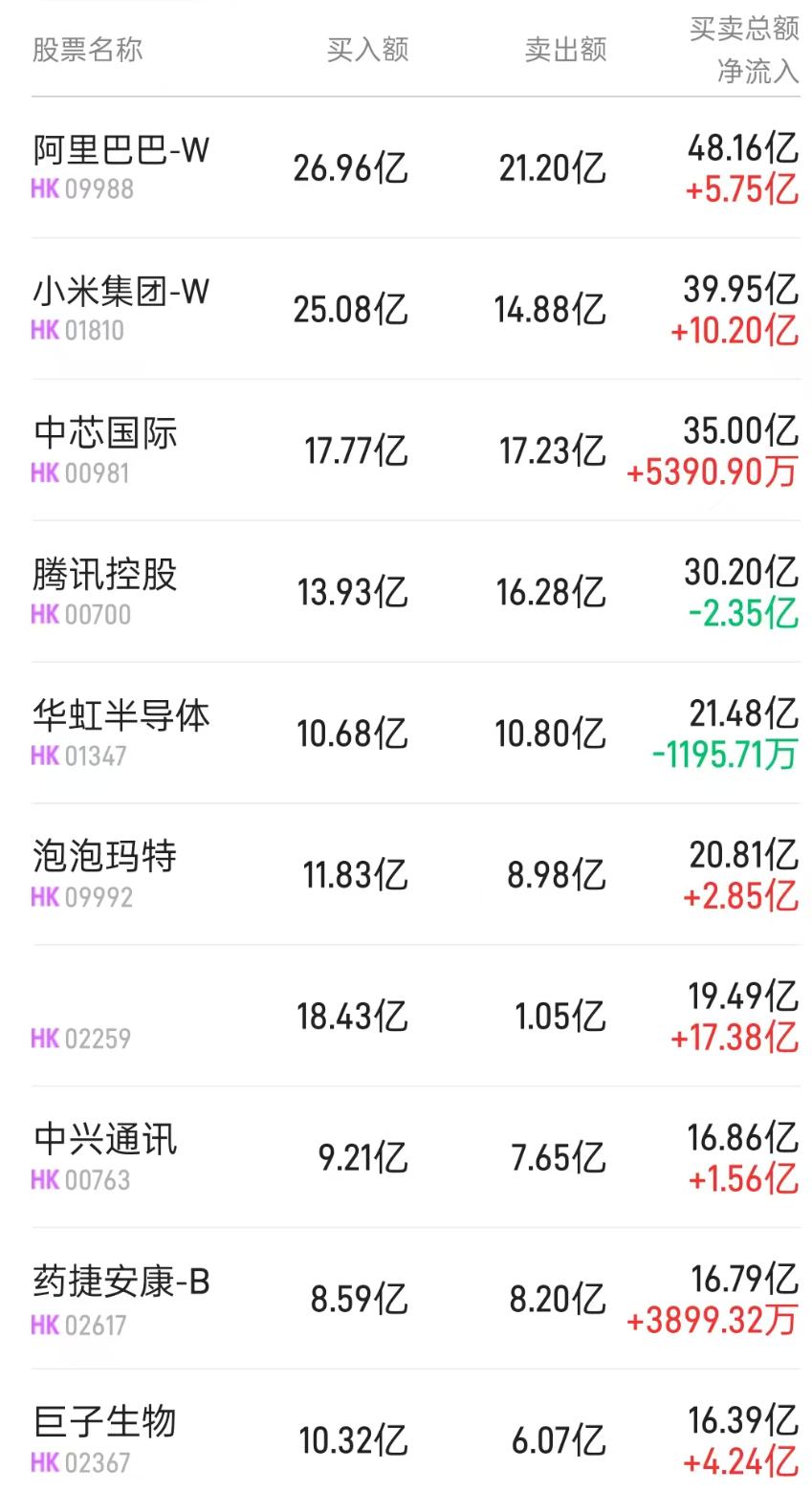
| 公司名称 | 成交金额 | 净买入额 | | --- | --- | --- | | 阿里巴巴-W(09988) | 48.16 亿元 | +5.75 亿元 | | 小米集团-W(01810) | 39.95 亿元 | +10.20 亿元 | | 中芯国际(00981) | 35.00 亿元 | +5390.90 万元 | | 腾讯控股(00700) | 30.20 亿元 | -2.35 亿元 | | 华虹半导体(01347) | 21.48 亿元 | -1195.71 万元 | | 泡泡玛特(09992) | 20.81 亿元 | +2.85 亿元 | | 紫金黄金国际(02259) | 19.49 亿元 | +17.38 亿元 | | 中兴通讯(00763) | 16.86 亿元 | +1.56 亿元 | | 药捷安康-B(02617) | 16.79 亿元 | +3899.32 万元 | | 巨子生物(02367) | 16.39 亿元 | +4.24 亿元 | 深港通(南向)十大活跃成交公司 | 公司名称 | 成交金额 | 净买入额 | | --- | --- | --- | | 小米集团-W(0 ...
北水动向|北水成交净买入158.22亿 紫金黄金国际(02259)正式入通 北水全天抢筹超17亿港元
智通财经网· 2025-10-16 10:00
Core Insights - The Hong Kong stock market saw a net inflow of 15.822 billion HKD from northbound trading on October 16, with the Shanghai-Hong Kong Stock Connect contributing 8.672 billion HKD and the Shenzhen-Hong Kong Stock Connect contributing 7.15 billion HKD [1] Group 1: Stock Performance - The most net bought stocks included Zijin Mining International (02259), Xiaomi Group-W (01810), and Alibaba-W (09988) [1] - The most net sold stocks included SMIC (00981), GigaDevice Semiconductor (02367), and Tencent (00700) [1] Group 2: Detailed Stock Transactions - Alibaba-W had a net inflow of 2.696 billion HKD, with total transactions amounting to 4.816 billion HKD [2] - Xiaomi Group-W recorded a net inflow of 2.508 billion HKD, with total transactions of 3.995 billion HKD [2] - SMIC had a net outflow of 539.09 million HKD, with total transactions of 3.5 billion HKD [2] - Tencent experienced a net outflow of 235 million HKD, with total transactions of 3.02 billion HKD [2] - Zijin Mining International received a net inflow of 1.738 billion HKD, following its inclusion in the Stock Connect list [4] Group 3: Company-Specific News - Zijin Mining International is expected to achieve a compound annual growth rate of approximately 20% in production from 2025 to 2027, increasing total output from 45 tons to 65 tons, leading to a 30% compound annual growth rate in profits [4] - Xiaomi Group's stock price has been volatile due to various news events, with expectations of a decline in gross profit margin in the second half of the year [5] - Alibaba's stock received a boost from the launch of the Tmall Double 11 shopping festival and an upgrade in capital expenditure forecasts by Goldman Sachs [5] - Kangfang Biopharma (09926) received a net inflow of 6.02 billion HKD following the acceptance of its clinical research results for a new drug in a top medical journal [6] - Pop Mart (09992) saw a net inflow of 4.7 billion HKD, with expectations of strong sales growth from new IPs [7]