JD LOGISTICS(02618)

Search documents
蓝图始于快递,看好Robovan承接万亿城配市场
Soochow Securities· 2026-01-21 11:01
Investment Rating - The report maintains a positive outlook on the Robovan sector, particularly emphasizing the potential of L4 RoboX technology in 2026 [3]. Core Insights - The 2026 smart technology landscape differs from previous years, focusing more on AI logic and software opportunities rather than hardware and consumer sales [3]. - Key catalysts for Robovan's growth include model iterations, increased RoboX deployments, and supportive policy developments [3]. - The report highlights the successful penetration of Robovan in the express delivery sector, with expectations for expansion into fast-moving consumer goods, durable goods, and chain restaurant applications [3]. - Investment recommendations suggest a strong focus on L4 RoboX as a primary investment theme for 2026 [3]. Summary by Sections Industry Overview - The report draws parallels between the current AI-driven transformation in transportation and the previous 4G mobile internet wave, noting that AI will enhance hardware capabilities and replace existing transportation methods [4][12]. - The report identifies Robovan as a key player in urban logistics, with significant potential for replacing traditional delivery vehicles [4][12]. Robovan Market Dynamics - Robovan's successful deployment in express delivery has led to approximately 27,000 units delivered in the first 11 months of 2025, primarily in the express sector [3]. - The report outlines the expected growth of Robovan in various logistics scenarios, including fast-moving consumer goods and durable goods delivery [3][46]. Technological Advancements - The report discusses the technological advancements in Robovan, including hardware and algorithm improvements that reduce costs and enhance operational efficiency [23][24]. - It emphasizes the importance of a robust supply chain and the integration of AI technologies to facilitate Robovan's commercial viability [23][24]. Policy Support - The report highlights ongoing government support for Robovan technology, with numerous policies aimed at facilitating the deployment and commercialization of autonomous delivery vehicles [12][19]. - It notes that over 250 cities have opened public road rights for Robovan, indicating a favorable regulatory environment for growth [20]. Market Potential - The urban delivery market is projected to reach 1.4292 trillion yuan in 2022, with Robovan expected to capture a significant share due to its efficiency in the supply chain [56]. - The report identifies that 64% of the urban delivery market consists of scenarios suitable for Robovan, indicating substantial growth opportunities [56].



快运行业整合浪潮延续 德邦股份拟主动退市
Mei Ri Jing Ji Xin Wen· 2026-01-15 13:40
Core Viewpoint - The proposed delisting of two major express delivery giants, Debon Logistics and JD Logistics, introduces uncertainty into the express delivery industry's landscape and competition dynamics [1][2]. Group 1: Company Developments - Debon Logistics announced its intention to voluntarily withdraw its A-share listing on the Shanghai Stock Exchange, with a market value of approximately 17.23 billion yuan [1]. - JD Logistics plans to offer cash options to Debon shareholders at a price of 19 yuan per share, with an estimated total value of around 3.797 billion yuan [1]. - The delisting marks a new phase of business and network integration between JD Logistics and Debon Logistics, following JD's acquisition of a controlling stake in Debon in 2022 [1][3]. Group 2: Industry Trends - The express delivery and logistics industry is undergoing deep consolidation, with multiple mergers and privatizations occurring, indicating a shift from a focus on scale to a focus on strength and service quality [2][8]. - The delisting of Debon and the planned privatization of Aneng Logistics signify a transformative phase in the logistics sector, emphasizing the need for improved service quality and comprehensive capabilities [2][8]. - The competitive landscape is expected to evolve, with new players entering the market and existing companies like Zhongtong and SF Express intensifying their competition [8]. Group 3: Financial Performance - In the first three quarters of 2025, Debon Logistics reported revenue of 30.27 billion yuan, a year-on-year increase of nearly 7%, but recorded a net loss of 277 million yuan compared to a profit of 517 million yuan in the same period of 2024 [6]. Group 4: Management Changes - Several key executives at Debon Logistics are set to leave, with a transition towards greater integration with JD Logistics, as evidenced by the resignation of the general manager and chairman in 2025 [5][6]. Group 5: Market Speculation - Following the announcement of Debon's delisting, speculation arose regarding potential asset injections or JD Logistics returning to A-share listings, although regulatory challenges may hinder such moves [7].

快运巨头拟退市,此前已有多位“老将”离任,京东物流溢价35%接盘
Mei Ri Jing Ji Xin Wen· 2026-01-15 05:08
Core Viewpoint - The recent delisting of major express delivery companies, Debon Logistics and Aneng Logistics, introduces uncertainty into the logistics industry's competitive landscape, marking a transition from scale-focused growth to a new phase emphasizing both scale and strength [1][3]. Group 1: Company Developments - Debon Logistics announced its intention to voluntarily withdraw its A-share listing on the Shanghai Stock Exchange, with JD Logistics offering a cash option to Debon shareholders at a price of 19 RMB per share, representing a premium of over 35% compared to the last trading day [1][6]. - Following the acquisition of Debon by JD Logistics in 2022, the companies are now moving towards deeper integration of their business and networks [1]. - Debon Logistics reported a market capitalization of 15.44 RMB per share, totaling 156.64 billion RMB as of January 14 [4]. Group 2: Industry Trends - The logistics industry is experiencing a wave of privatization and delisting, with Aneng Logistics also announcing plans to privatize and delist by February 9, 2025, indicating a trend towards deep industry consolidation [3][8]. - Experts suggest that the delisting of Debon and Aneng signifies a shift in the logistics sector towards a focus on service quality and comprehensive strength, moving away from merely expanding scale [3]. - The logistics market is becoming increasingly competitive, with new players entering the zero-load logistics space and existing companies like Zhongtong and SF Express intensifying their market efforts [9]. Group 3: Financial Performance - In the first three quarters of 2025, Debon Logistics achieved a revenue of 30.27 billion RMB, reflecting a year-on-year growth of nearly 7%, but reported a net loss of 277 million RMB compared to a profit of 517 million RMB in the same period of 2024 [7]. - The decision to delist is seen as a strategic move to alleviate financial pressures associated with being a public company, allowing for more efficient resource allocation within JD Logistics' management framework [7]. Group 4: Future Outlook - The market is closely watching whether the integration of Debon into JD Logistics will yield significant synergies, with the potential to create a more competitive logistics entity [7]. - The trend of privatization in the logistics sector may also influence the express delivery industry, suggesting that similar consolidation efforts could occur in that space as well [9].

快运巨头拟退市!此前已有多位“老将”离任,京东物流溢价35%接盘
Mei Ri Jing Ji Xin Wen· 2026-01-15 04:52
Core Viewpoint - The recent delisting of major express delivery companies, Debon Logistics and Aneng Logistics, introduces uncertainty into the logistics industry's competitive landscape, marking a transition towards deeper integration and transformation within the sector [1][3][8]. Group 1: Company Actions - Debon Logistics announced its intention to voluntarily withdraw its A-share listing on the Shanghai Stock Exchange, with JD Logistics offering a cash option to Debon shareholders at a price of 19 RMB per share, representing a premium of over 35% compared to the last trading price [1][5]. - Aneng Logistics has also announced plans for privatization and delisting, indicating a trend of privatization within the logistics industry since 2025 [3][8]. - Debon Logistics' delisting is part of JD Logistics' commitment to resolve competition issues following its acquisition of Debon, allowing for better resource integration and operational efficiency [4][6]. Group 2: Industry Trends - The logistics industry is entering a phase of deep integration and transformation, shifting from a focus on scale to a focus on both scale and strength, emphasizing service quality and comprehensive capabilities [3][4]. - The delisting of Debon and Aneng signifies a broader trend of consolidation in the logistics sector, with increased mergers and acquisitions expected as companies seek to enhance competitiveness [7][8]. - New players are entering the market, and existing companies like Zhongtong and SF Express are intensifying their competition in the express delivery sector [8]. Group 3: Financial Performance - Debon Logistics reported a revenue of 30.27 billion RMB for the first three quarters of 2025, reflecting a year-on-year growth of nearly 7%, but also recorded a net loss of 277 million RMB, contrasting with a profit of 517 million RMB in the same period of 2024 [5].
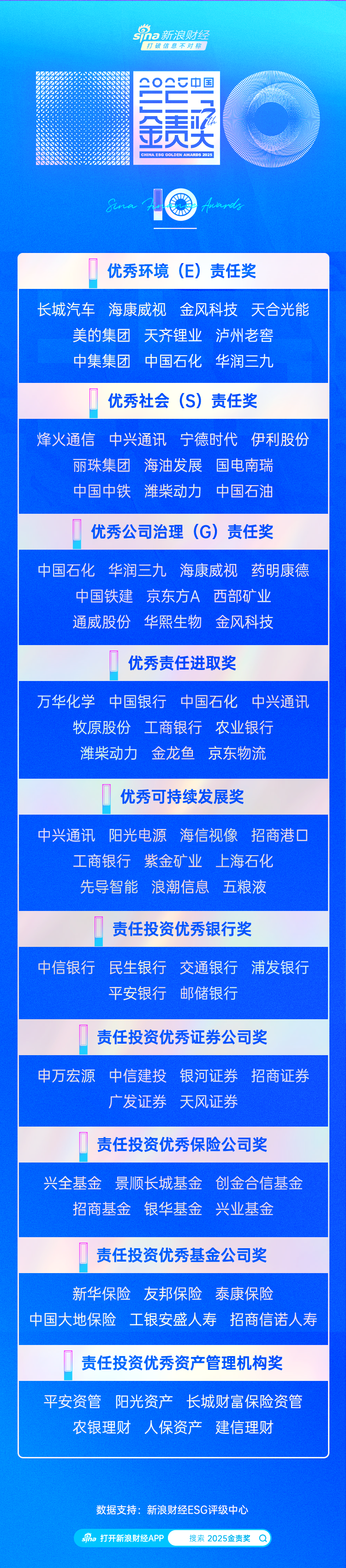
2025中国企业ESG“金责奖”优秀奖评选结果揭晓

Xin Lang Cai Jing· 2026-01-15 03:45
Core Viewpoint - The 2025 China Enterprise ESG "Golden Responsibility Award" aims to recognize companies and institutions that have made significant contributions to ESG initiatives in China, reflecting a shift from voluntary practices to compliance requirements in ESG performance [1][12]. Group 1: ESG Development and Awards Overview - By 2025, China's ESG development has transitioned from "setting standards" to "strengthening regulations," with a comprehensive disclosure standard system being established [1][12]. - The award selection attracted over 5,000 companies, with results based on ESG performance, online voting, and professional evaluations [2][12]. Group 2: Award Categories and Winners - The award categories include Excellent Environmental Responsibility Award, Excellent Social Responsibility Award, Excellent Corporate Governance Responsibility Award, Excellent Responsibility Initiative Award, Excellent Sustainable Development Award, and various responsibility investment awards [1][12]. - Notable winners of the Excellent Environmental Responsibility Award include Great Wall Motors, Hikvision, and China Petroleum [7][24]. - The Excellent Social Responsibility Award was awarded to companies such as YF Communication, ZTE, and Ningde Times [7][24]. - Winners of the Excellent Corporate Governance Responsibility Award include China Petroleum, Hikvision, and WuXi AppTec [7][24]. - The Excellent Responsibility Initiative Award was given to companies like ZTE, Sunlight Power, and Industrial and Commercial Bank of China [7][24]. - The Excellent Sustainable Development Award included companies such as WanHua Chemical, China Bank, and China Petroleum [7][24]. Group 3: Responsibility Investment Awards - The Responsibility Investment Excellent Bank Award was given to institutions like CITIC Bank and Minsheng Bank [5][21]. - The Responsibility Investment Excellent Securities Company Award included firms such as Shenwan Hongyuan and CITIC Securities [5][22]. - The Responsibility Investment Excellent Insurance Company Award recognized companies like New China Life and AIA [5][26]. - The Responsibility Investment Excellent Fund Company Award included firms such as Xinhua Fund and Harvest Fund [5][27]. - The Responsibility Investment Excellent Asset Management Institution Award recognized institutions like Ping An Asset Management and Sunshine Asset Management [5][28]. Group 4: Call to Action and Future Directions - The award committee encourages more Chinese enterprises to integrate ESG principles into their operations and strategic planning, emphasizing the importance of balancing commercial and social values [10][29].
德邦拟主动退市,京东物流提供35%高溢价现金选择权
2 1 Shi Ji Jing Ji Bao Dao· 2026-01-15 01:23
Core Viewpoint - JD Logistics is integrating its logistics system, with DeBang Logistics announcing its intention to voluntarily withdraw from the A-share market to enhance resource coordination and fulfill commitments to avoid competition with JD Logistics [1] Group 1: DeBang Logistics' Withdrawal - DeBang Logistics plans to withdraw its A-share listing to better coordinate resources within JD Logistics, ensuring no adverse effects on its assets, personnel, or operations [1] - The proposal has been approved by the board and awaits shareholder voting and approval from the Shanghai Stock Exchange [1] - Following the announcement, DeBang's stock price surged to 15.44 yuan, a 9.97% increase, with significant trading volume, indicating positive market sentiment towards the withdrawal plan [1] Group 2: High Premium Cash Option - A cash option is being offered to shareholders at a price of 19.00 yuan per share, representing a 35.3% premium over the last closing price before suspension [2] - This cash option is not mandatory, allowing dissenting shareholders the choice to accept or reject it, with a total potential payout of approximately 37.97 billion yuan if all eligible shareholders participate [2] - The high premium reflects JD's commitment to facilitating the integration process amid increasing competition in the logistics sector [2] Group 3: Industry Context and Feasibility - Speculations about JD Logistics injecting other logistics assets into DeBang were deemed unfeasible due to regulatory and competitive concerns, making voluntary delisting the optimal solution [3] - The logistics industry lacks clear boundaries between different business segments, complicating potential integrations and increasing regulatory risks [3] - JD Logistics faces strict conditions for returning to the A-share market, making voluntary delisting a more practical approach to resolving competition issues and promoting resource integration [3] Group 4: Industry Trends - DeBang's withdrawal is part of a broader trend in the logistics industry, shifting from expansion to deep integration and efficiency improvement [5] - Successful delisting could allow DeBang to leverage JD's resources while maintaining its brand, enhancing operational efficiency and upgrading its core business [5] - The integration of DeBang and JD Logistics aligns with the logistics industry's high-quality development trend and balances corporate strategy with shareholder interests [5]
德邦退市,京东物流溢价35%接盘:一场价值156亿元的“一体化”豪赌
Mei Ri Jing Ji Xin Wen· 2026-01-15 00:57
Core Viewpoint - The recent delisting of major express delivery companies, Debon Logistics and Aneng Logistics, marks a significant shift in the logistics industry, indicating a transition from a focus on scale to a focus on quality and strength in operations [1][7]. Group 1: Company Developments - Debon Logistics announced its intention to voluntarily withdraw its A-share listing on the Shanghai Stock Exchange, with JD Logistics offering a cash option to Debon shareholders at a price of 19 RMB per share, representing a premium of over 35% compared to the last trading price [1][4]. - The delisting of Debon and the planned privatization of Aneng Logistics signal a trend of privatization in the logistics sector, which has been ongoing since 2025, leading to deeper industry consolidation [1][7]. - Debon Logistics has experienced leadership changes, with several long-term executives resigning as the integration with JD Logistics deepens [5]. Group 2: Industry Trends - The logistics industry is entering a phase of deep integration and value reassessment, with multiple mergers and privatizations occurring, including JD's privatization of Dada Group and Aneng Logistics' planned delisting [7][8]. - The competition in the zero担 logistics market is intensifying, with new players entering the field and existing companies like Zhongtong and SF Express vying for market share [8]. - The exit of major players like Debon and Aneng may lead to new opportunities for emerging companies in the logistics sector, suggesting that while some companies are exiting, others may rise to take their place [8].
2026年A股首家,德邦股份拟主动退市
Cai Jing Wang· 2026-01-14 09:06
Core Viewpoint - Debon Holdings has announced its decision to voluntarily withdraw its A-share listing on the Shanghai Stock Exchange and will apply for trading on the National Equities Exchange and Quotations after obtaining the delisting decision, marking it as the first A-share company to voluntarily delist in 2026 [1][2] Group 1: Company Actions - The company plans to withdraw its A-share listing through a shareholder resolution, with a cash option exercise price set at 19.00 yuan per share [1] - The decision to delist is influenced by the need to better align with the logistics industry's development trends and to effectively coordinate resources within JD Logistics [2] Group 2: Shareholder and Market Impact - The indirect controlling shareholder, Suqian JD Zhuofeng Enterprise Management Co., Ltd., proposed the major matter, which was approved by the company's board [1] - The company aims to address the issue of competition with JD Logistics, as the profitability differences are affected by various factors including macro environment and business strategies [1][2] Group 3: Investor Relations - The company emphasizes the importance of enhancing information disclosure during major matter planning to protect investors' rights and ensure they are informed about the impacts and synergies of the proposed actions [2]
年内首家主动退市股来了
Di Yi Cai Jing· 2026-01-14 07:25
Core Viewpoint - Debon Logistics has chosen to voluntarily delist from the A-share market to resolve issues related to competition and integration with JD Logistics after two years of business integration [2][4]. Group 1: Delisting Decision - On January 13, Debon Logistics announced its decision to withdraw its A-share listing on the Shanghai Stock Exchange through a shareholder resolution, marking it as the first company in the A-share market to propose voluntary delisting in 2026 [2]. - Following the resumption of trading on January 14, Debon Logistics opened with a limit-up price of 15.44 yuan per share [3]. Group 2: Background of the Acquisition - The decision to delist stems from the competitive landscape in the logistics industry, particularly after JD Logistics acquired a controlling stake in Debon Logistics, which was completed in 2022 [4][5]. - JD Logistics' subsidiary, Suqian JD Zhuofeng, acquired a significant portion of Debon Holdings, leading to JD Logistics indirectly controlling 66.4965% of Debon Logistics [4]. Group 3: Industry Competition and Integration - The acquisition aimed to enhance the efficiency of logistics operations and to create a comprehensive logistics supply chain group, with the intention of terminating Debon Logistics' public listing status [5]. - Despite the acquisition, Debon Logistics maintained its listing status initially, as only a fraction of shares accepted the buyout offer, resulting in JD Logistics holding 71.93% of Debon Logistics [5]. Group 4: Future Plans and Shareholder Protection - Debon Logistics announced plans to resolve competition issues with JD Logistics over a five-year period, focusing on operational integration and resource coordination [6]. - The delisting plan includes a cash option for dissenting shareholders at a price of 19 yuan per share, representing a 35.3% premium over the last trading price before suspension, with an estimated total value of approximately 3.797 billion yuan [6].

年内首家主动退市股来了
第一财经· 2026-01-14 07:03
Core Viewpoint - Debon Holdings (603056.SH) has chosen to voluntarily delist from the Shanghai Stock Exchange to resolve issues related to competition and integration with JD Logistics (02618.HK) after two years of business integration [3][4]. Group 1: Delisting Decision - On January 13, Debon Holdings announced its decision to withdraw its A-share listing, becoming the first company in the A-share market to propose voluntary delisting in 2026 [3]. - Following the announcement, Debon Holdings' stock opened with a limit-up at 15.44 CNY per share upon resuming trading [4]. Group 2: Background of the Acquisition - The decision to delist is rooted in the competitive landscape of the logistics industry, which has seen increasing market concentration from 2020 to 2022 [4]. - JD Logistics acquired a controlling stake in Debon Holdings through its subsidiary, JD Zhuofeng, which gained indirect control of 66.4965% of Debon Holdings' shares [5]. - The acquisition aimed to enhance operational efficiency and integrate logistics services, with the ultimate goal of terminating Debon Holdings' public listing status [5]. Group 3: Shareholder Response and Competition Issues - Following the acquisition, JD Zhuofeng controlled 71.93% of Debon Holdings, but the company maintained its listing status due to the remaining share distribution [6]. - Debon Holdings announced a five-year commitment to address competition issues with JD Logistics, focusing on operational integration and protecting shareholder interests [6][8]. Group 4: Cash Option for Shareholders - The delisting plan includes a cash option for dissenting shareholders, with JD Logistics offering a price of 19 CNY per share, representing a 35.3% premium over the last trading price [9]. - The estimated value of the cash option is approximately 3.797 billion CNY, assuming all eligible shareholders exercise their rights [9].