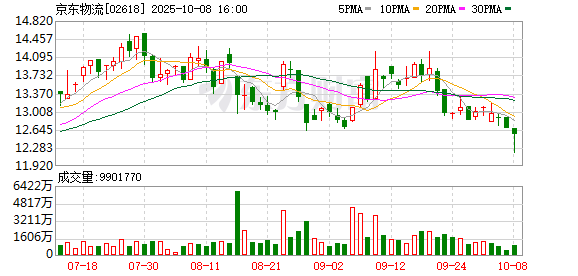
JD LOGISTICS(02618)
Search documents
刘强东的底牌藏不住了
Hu Xiu· 2025-05-28 22:57
Core Viewpoint - JD Logistics has shown significant revenue growth and profitability improvements, driven by external customer expansion and enhanced service offerings, particularly through its integrated supply chain solutions [1][2][3]. Revenue and Profitability - In 2024, JD Logistics reported revenue of 182.84 billion, a year-on-year increase of 9.7%, and a net profit of 7.09 billion, reflecting a remarkable year-on-year growth of 507% [1]. - For Q1 2025, the revenue was 46.97 billion, up 11.5% year-on-year, with a net profit of 610 million, marking an 89.5% increase [2]. Customer Base and Service Offerings - The company has focused on expanding its external customer base, with a notable shift in revenue sources. By 2023, revenue from external customers reached 116.56 billion, accounting for 70% of total revenue [12][14]. - The integrated supply chain service, while a key product, has seen its revenue share decrease as more external customers opt for other service options [11][9]. Cost Management and Profit Margins - JD Logistics has improved its gross profit margins significantly, with the gross profit margin reaching 10.2% in 2024, up from 2.9% in 2018 [22][24]. - The reduction in outsourcing costs has also contributed to the improved profit margins, with outsourcing costs as a percentage of revenue decreasing from 38.5% in 2021 to 34.6% in 2024 [25]. Financial Health and Cash Flow - The company has transitioned from a cost center to a profit center since its independence in 2017, contributing one-sixth of JD Group's profits in 2024 [49][50]. - Operating cash flow exceeded 20 billion in 2024, indicating a strong financial position and reduced debt burden [48]. Logistics Infrastructure and Strategy - JD Logistics has invested heavily in building a robust logistics infrastructure, including over 1,600 warehouses and 20,000 delivery stations, enhancing its last-mile delivery capabilities [43][41]. - The company has also focused on improving its transportation capabilities through acquisitions and partnerships, significantly increasing its fleet size and operational efficiency [40][38].
修订后的《快递暂行条例》即将施行 填补快递包装治理制度空白——快递包装“瘦身增绿”(大数据观察)
Ren Min Ri Bao· 2025-05-28 22:10
Core Viewpoint - The revised "Express Delivery Temporary Regulations" will take effect on June 1, introducing a dedicated chapter on "express packaging," which addresses the regulatory gap in packaging management and supports the green development of the express delivery industry [1]. Group 1: Industry Growth and Challenges - China's express delivery industry has entered the era of over 100 billion packages, with an expected volume exceeding 1.75 trillion packages in 2024, representing a year-on-year growth of 21.5% [1]. - The rapid growth of express delivery services has led to significant usage and disposal of packaging materials, making packaging management a crucial task for the industry's high-quality development [1]. Group 2: Green Transformation Efforts - The regulations encourage the adoption of new technologies and materials to develop environmentally friendly packaging [2]. - The packaging waste primarily consists of product packaging, e-commerce packaging, and delivery service packaging, with a focus on reducing, recycling, and upgrading packaging materials [2]. - Companies like Jingxing Packaging are utilizing recycled materials to produce corrugated paper, achieving a consumption rate of approximately 1.1 tons of waste cardboard for every ton of new paper produced [2]. Group 3: Innovations in Packaging - Companies are developing biodegradable tape and reusable packaging solutions, such as Zhongtong's "multi-life" boxes designed for frequent returns [3]. - The introduction of intelligent packaging systems has improved packaging efficiency, with original direct shipping increasing from about 5% to 25% in recent years, and projected to reach 40% [5][6]. - The use of smart recommendations for packaging materials has led to a 20% reduction in material usage across nearly 300 warehouses [6]. Group 4: Recycling and Circular Economy - The establishment of recycling facilities at delivery points is crucial for closing the packaging management loop [7]. - Initiatives like the "return box plan" at Zhejiang University have resulted in 90% of used boxes being recycled for further use, significantly reducing waste [8]. - The shift from a linear model of "manufacture-use-dispose" to a circular model of "production-consumption-recycling-reuse" is being accelerated through enhanced end-of-life management practices [8][9]. Group 5: Regulatory Framework and Future Directions - The regulations clarify the responsibilities of various stakeholders in the green governance of packaging, marking a significant step in the legal and standard implementation system [9]. - The National Postal Administration plans to promote a series of standards and policies to guide innovation in packaging products, technologies, and models, further advancing the green transformation of the express delivery sector [9].
京东物流-非交易路演要点:2025 年营收与利润稳步增长,聚焦供应链与国际化业务, 买入
2025-05-22 15:48
Summary of JD Logistics (2618.HK) Conference Call Company Overview - **Company**: JD Logistics (2618.HK) - **Industry**: E-commerce & Logistics in China Key Points Discussed Strategic Focus - **Revenue and Profit Growth**: JD Logistics aims for double-digit revenue growth and mid-single-digit profit growth for 2025, prioritizing service competitiveness over absolute profit [1][6] - **Supply Chain Focus**: The company emphasizes improving service quality to reduce supply-chain costs for clients, particularly targeting high-end manufacturing and premium client verticals [2][9] Market Competition - **Price Competition**: The express delivery industry has seen heightened price competition since March-April, but JD Logistics maintains rational pricing due to its supply chain focus [2][9] - **High-End Market Positioning**: JD Logistics is transitioning to a closed-loop B2B2C model, integrating end-to-end supply chain solutions to help clients reduce costs by 10-30% [9] Business Trends - **Reverse Logistics**: The company is focusing more on emerging e-commerce platforms for reverse logistics, with a low contribution from reverse logistics to overall parcel volume [3] - **International Growth**: Revenue growth in international business accelerated year-over-year in April, with Asia contributing the most, followed by Europe, while U.S. expansion remains contingent on trade relations [3] Operational Efficiency - **Network Optimization**: Improvements in capacity utilization and distribution efficiency through regional hubs and smart routing have been noted, significantly reducing delivery times and costs [9] Financial Outlook - **Price Target**: Goldman Sachs maintains a price target of HK$17.60 for JD Logistics, reflecting a potential upside of 51.2% from the current price of HK$11.64 [11][13] - **Market Capitalization**: JD Logistics has a market cap of HK$69.9 billion [13] Risks - **Revenue Dependency**: A significant portion of revenue comes from JD Group, which has declined to approximately 30% in 2023 from over 50% in 2020 [12] - **Sector Concentration**: The company is reliant on a few industries, which could negatively impact operations and profitability during economic downturns [12] - **High-End Positioning Risks**: The company may face growth pressures under macroeconomic softness, particularly from SMEs focusing on short-term cost savings [12] Additional Insights - **Technological Know-How**: JD Logistics benefits from a proven model and technological expertise, enhancing its competitive edge in the logistics sector [3] - **Future Projections**: Revenue estimates for JD Logistics are projected to reach RMB 201.89 billion in 2025, with EBITDA of RMB 12.39 billion [13]
一季度指标全线飘红、净利润同比增长89% 京东物流“卡位战”靠什么?| 寻光一季报
Mei Ri Jing Ji Xin Wen· 2025-05-22 09:49
Core Insights - The logistics industry is transitioning from a focus on speed differentiation to a more complex competitive landscape, with companies like JD Logistics and SF Express adopting different strategies to maintain market share [1][2][3] Group 1: Company Performance - JD Logistics reported a revenue of 46.967 billion yuan in Q1, representing a year-on-year growth of 11.5%, with a net profit of 0.451 billion yuan, up 89.1% [1] - The revenue from JD Logistics' integrated supply chain clients reached 23.2 billion yuan in Q1, growing by 13.2% year-on-year, accounting for nearly 50% of total revenue [3] - SF Express achieved a revenue of 69.85 billion yuan in Q1, with a year-on-year increase of 6.9%, and a net profit of 2.234 billion yuan, up 16.87% [7] Group 2: Strategic Initiatives - JD Logistics is focusing on deep integration with manufacturing and various industry segments, moving away from traditional express delivery competition [3] - The company has over 3,600 self-operated warehouses and cloud warehouses, with a total management area exceeding 32 million square meters [2] - JD Logistics is implementing advanced technologies, such as the "Super Brain" model, to enhance operational efficiency and ensure smooth delivery of products under national subsidy programs [5][6] Group 3: Market Trends - The logistics market is experiencing intensified competition, with companies seeking to avoid reliance on price wars while maintaining market share [2][3] - The rise of e-commerce has significantly influenced the logistics sector, leading to a saturated market where differentiation is increasingly challenging [2] - JD Logistics is expanding its overseas operations, with plans to exceed 1 million square feet of overseas warehouse space by 2025, and has already established over 20 overseas warehouses in Europe [6][7]
京东物流(02618.HK):2025Q1营收同比+11.5% 盈利能力保持稳健
Ge Long Hui· 2025-05-22 01:51
Core Insights - The company reported a revenue of 46.967 billion yuan for Q1 2025, representing a year-on-year increase of 11.5% [1] - The net profit attributable to shareholders reached 0.451 billion yuan, up 89.1% year-on-year [1] - Adjusted net profit (non-IFRS) was 0.75 billion yuan, reflecting a 13.4% increase year-on-year [1] Integrated Supply Chain Performance - Integrated supply chain revenue was 23.201 billion yuan, showing a year-on-year growth of 13.2% [1] - Revenue from JD Group contributed 14.699 billion yuan, an increase of 14.1% year-on-year [1] - External integrated supply chain business revenue was 8.510 billion yuan, up 11.6% year-on-year, with a customer base of 63,100, growing by 13.1% [1] Express and Freight Business - Revenue from other clients (express and freight) was 23.766 billion yuan, a year-on-year increase of 9.8%, slightly below the overall revenue growth [2] - Excluding Debon Holdings, express and freight revenue (including Kuaixue Express) was 13.360 billion yuan, up 8.3% year-on-year [2] - Anticipation for Q2 2025 is positive due to the support from JD's 618 shopping festival and brand advantages [1] Profitability and Cost Structure - Gross profit for Q1 2025 was 3.387 billion yuan, a year-on-year increase of 7.6% [2] - Operating costs reached 43.580 billion yuan, up 11.8% year-on-year, driven by increased employee compensation and outsourcing costs [2] - The main business gross margin was 7.2%, a decrease of 0.3 percentage points year-on-year [2] Future Projections - Revenue forecasts for 2025-2027 are 202.418 billion, 217.649 billion, and 233.101 billion yuan, with year-on-year growth rates of 10.7%, 7.5%, and 7.1% respectively [2] - Net profit projections for the same period are 6.614 billion, 7.117 billion, and 7.819 billion yuan, with growth rates of 6.7%, 7.6%, and 9.9% respectively [2] - The company maintains a "buy" rating based on the expected growth in integrated supply chain and steady performance in express and freight business [2]
京东物流(02618)2025Q1营收同比+11.5%,盈利能力保持稳健
Guolian Securities· 2025-05-20 02:20
Investment Rating - The investment rating for the company is "Buy" [6][4] Core Insights - In Q1 2025, the company achieved a revenue of 46.967 billion yuan, representing a year-on-year increase of 11.5%. The net profit attributable to shareholders was 0.451 billion yuan, up 89.1% year-on-year. The adjusted net profit was 0.75 billion yuan, reflecting a 13.4% increase year-on-year. The company's integrated supply chain business is expected to continue its steady growth, supported by cost reduction and efficiency improvements [4][12][16] Summary by Sections Financial Performance - In Q1 2025, the company reported a revenue of 46.967 billion yuan, a year-on-year increase of 11.5%. The net profit attributable to shareholders was 0.451 billion yuan, up 89.1% year-on-year, while the adjusted net profit was 0.75 billion yuan, reflecting a 13.4% increase year-on-year [4][12] Integrated Supply Chain Business - The integrated supply chain revenue for Q1 2025 was 23.201 billion yuan, showing a year-on-year growth of 13.2%. This growth was primarily driven by increased revenue from JD Group, which amounted to 14.699 billion yuan, up 14.1% year-on-year. External integrated supply chain business revenue was 8.510 billion yuan, up 11.6% year-on-year [13] Express and Freight Business - The revenue from other customers (express and freight) in Q1 2025 was 23.766 billion yuan, a year-on-year increase of 9.8%, slightly lower than the overall revenue growth. Excluding revenue from Debon Logistics, the express and freight business revenue was 13.360 billion yuan, up 8.3% year-on-year [14] Profitability and Cost Management - The company achieved a gross profit of 3.387 billion yuan in Q1 2025, a year-on-year increase of 7.6%. The operating costs were 43.580 billion yuan, up 11.8% year-on-year. The main business gross margin was 7.2%, a decrease of 0.3 percentage points year-on-year. The company aims to enhance gross margin through technology-driven operational efficiency and refined resource management [15] Future Projections - Revenue projections for 2025-2027 are 202.418 billion yuan, 217.649 billion yuan, and 233.101 billion yuan, with year-on-year growth rates of 10.7%, 7.5%, and 7.1% respectively. The net profit attributable to shareholders is projected to be 6.614 billion yuan, 7.117 billion yuan, and 7.819 billion yuan for the same period, with year-on-year growth rates of 6.7%, 7.6%, and 9.9% respectively [16][17]
交通运输行业周报:美线抢运拉动航运景气,内需物流保持稳健-20250518
Hua Yuan Zheng Quan· 2025-05-18 07:51
Investment Rating - The investment rating for the transportation industry is "Positive" (maintained) [4] Core Views - The shipping industry is experiencing a surge in demand due to a recent temporary reduction in tariffs between China and the US, leading to a significant increase in shipping volumes on the US route. The average booking volume surged by 277% compared to the previous week [5] - The Shanghai Export Container Freight Index (SCFI) rose by 10.0% week-on-week, indicating a strong recovery in shipping rates, particularly for routes to the US [6] - The logistics sector is showing resilience, with express delivery volumes in April increasing by 19.1% year-on-year, reflecting robust demand across various sectors [9] - The airline industry is expected to benefit from macroeconomic recovery, with a long-term supply-demand imbalance favoring growth in the sector [12] Summary by Sections Shipping Vessels - The recent tariff reductions have led to a surge in demand for shipping services, particularly on the US route, with a projected increase in freight rates over the next 2-3 months due to supply constraints [5] - The average weekly capacity for the US route is expected to be 500,000 TEU, down 6% from last year [5] - The oil tanker market is facing supply tightness due to limited new orders and an aging fleet, which is expected to sustain high demand in the coming years [12] Express Logistics - In April, the express delivery industry in China saw a business volume of 16.32 billion pieces, a year-on-year increase of 19.1%, with revenue reaching 121.28 billion yuan, up 10.8% [9] - The concentration index for express delivery brands (CR8) was 86.7, indicating a stable competitive landscape [9] Aviation and Airports - The airline industry is poised for growth due to low supply growth and recovering demand, with key companies to watch including China Southern Airlines and Air China [12] - The passenger transport volume in March was approximately 59 million, reflecting a year-on-year increase of 3.5% [50] Overall Market Performance - From May 12 to May 16, the transportation index rose by 2.12%, outperforming the Shanghai Composite Index [17] - The shipping sector saw the highest increase at 7.42%, indicating strong market performance [17]
省农业农村厅赴湛江茂名全链条协同推进荔枝营销工作
Nan Fang Nong Cun Bao· 2025-05-17 12:02
Core Viewpoint - The Guangdong provincial government is actively promoting the sales of lychee during the peak season, focusing on addressing bottlenecks in the production, supply, and sales chain to enhance the quality and efficiency of the lychee industry [2][3][4]. Group 1: Industry Development - The provincial agricultural department is coordinating efforts to resolve key issues in the lychee sales process, aiming for high-quality development of the lychee industry [3][4]. - The government is implementing a three-year plan to achieve initial results in the "Hundred Counties, Thousand Towns, and Ten Thousand Villages High-Quality Development Project" [4]. Group 2: Production and Sales - The Dayrise Cooperative, a national-level farmer professional cooperative, has a lychee planting area of 15,000 acres, primarily growing the "Feizixiao" variety, with an annual sales volume of nearly 10,000 tons [14][15]. - The cooperative has pre-sold about 5,000 tons of "Feizixiao" lychee and expects to export over 2,000 tons to countries including the USA, Canada, Australia, and Russia [16][17]. - The company Mingjing Agricultural Development primarily exports lychee to markets in Hebei, Xinjiang, Zhejiang, Henan, and Hunan, with confidence in the pricing during the peak season [18]. Group 3: Logistics and Transportation - Cold chain logistics is crucial for lychee sales due to the fruit's short shelf life and transportation challenges [20][21]. - Logistics companies like SF Express and JD Logistics are setting up over 2,000 collection points and arranging dedicated flights for lychee air transport, as well as opening land transport lines to ensure timely delivery [24][25]. - The government emphasizes the need to strengthen cold storage facilities and reduce logistics costs to enhance the overall efficiency of lychee distribution [29][30]. Group 4: Marketing Strategies - The government is advocating for the development of a "Lychee Procurement Map" and a directory of buyers to strengthen the marketing system [36][37]. - Innovative marketing strategies, including collaborations with social media platforms and e-commerce sites, are being promoted to expand sales channels and enhance consumer engagement [38][39]. - The initiative includes creating diverse consumption scenarios and developing various lychee products to increase value and boost farmers' income [42][46].
京东物流(02618.HK):1Q营收利润双位数增长 看好中长期提质增效
Ge Long Hui· 2025-05-17 01:50
Core Viewpoint - The company's Q1 2025 performance met expectations, with revenue of 46.97 billion yuan, a year-on-year increase of 11%, and non-IFRS net profit of 750 million yuan, up 13% year-on-year, indicating a positive outlook for long-term profit release [1][2] Revenue Summary - Integrated supply chain business showed steady growth, with client revenue increasing by 13% year-on-year to 23.2 billion yuan, driven by a 14% increase in revenue from JD Group to 14.7 billion yuan, reflecting strong collaboration and efficiency improvements [1] - External client revenue rose by 12% year-on-year to 8.5 billion yuan, with the number of clients increasing by 14% to 63,600, although average revenue per client decreased by 2% to 134,000 yuan, indicating potential for long-term improvement [1] - Revenue from express and freight services increased by 10% year-on-year to 23.8 billion yuan, with external revenue accounting for 69%, maintaining a high level [1] Cost and Expense Summary - Operating costs increased by 12% year-on-year, with specific costs such as employee benefits, outsourcing, and other operating costs rising by 14%, 18%, and 6% respectively, while rental costs decreased by 9% [2] - Gross margin slightly declined by 0.5 percentage points to 7.2% due to increased investment in transportation and delivery resources aimed at expanding customer base and improving service quality [2] - Total expenses for Q1 2025 were 3.18 billion yuan, up 1.3% year-on-year, with the expense ratio decreasing by 0.7 percentage points to 6.8% [2] Development Trends - The company is expected to enter a phase of simultaneous scale expansion and product upgrades in 2025, focusing on four key drivers: integration of the TaoTian platform for customer and revenue growth, optimization of operational efficiency in supply chain and express services, new market opportunities from international business and overseas warehouse construction, and synergy from integration with Debon Network [2] Profit Forecast and Valuation - Based on continuous improvement in operational efficiency and realization of scale effects, the non-IFRS net profit forecast for 2025 has been raised by 35% to 8.54 billion yuan, with a projected 10% growth to 9.43 billion yuan in 2026 [2] - The current price corresponds to 8.5 times and 7.6 times non-IFRS P/E ratios for 2025 and 2026 respectively, with a target price of 18.5 HKD, indicating a potential upside of 57.3% from the current stock price [2]
JD LOGISTICS(02618.HK):DOUBLE-DIGIT REVENUE AND PROFIT GROWTH IN 1Q25; UPBEAT ON QUALITY AND EFFICIENCY IMPROVEMENT IN MEDIUM AND LONG TERM
Ge Long Hui· 2025-05-17 01:50
Core Viewpoint - JD Logistics reported 1Q25 results that met expectations, with revenue growth driven by increased investment in product competitiveness and a focus on medium to long-term profit growth [1]. Revenue Performance - Total revenue for 1Q25 increased by 11% YoY to Rmb46.97 billion, with non-IFRS net profit rising 13% YoY to Rmb751 million [1]. - Revenue from the integrated supply chain business grew 13% YoY to Rmb23.2 billion, with JD.com contributing Rmb14.7 billion, a 14% YoY increase [2]. - Revenue from external customers rose 12% YoY to Rmb8.5 billion, with the number of customers increasing by 14% YoY to 63,601 [3]. - Revenue from express delivery and freight delivery industries increased by 10% YoY to Rmb23.8 billion, maintaining a high external revenue proportion of about 70% [4]. Cost and Expense Analysis - Operating costs rose 12% YoY, with specific increases in employee compensation (+14%), outsourcing costs (+18%), and other operating costs (+6%) [5]. - Gross margin decreased by 0.5 percentage points YoY to 7.2%, attributed to increased investments in transportation and delivery resources [5]. - Total expenses rose 1.3% YoY to Rmb3.18 billion, with the expense proportion in revenue decreasing by 0.7 percentage points to 6.8% [5]. Future Trends and Growth Drivers - The company is expected to enter a development phase in 2025, focusing on scale expansion and product upgrades, driven by channel integration with the Taotian platform and improvements in operational efficiency [6]. - Expansion of overseas warehouses is anticipated to unlock new market opportunities for the international business [7]. - Integration with Deppon's network is expected to enhance economies of scale [7]. Financial Forecast and Valuation - The non-IFRS net profit forecast for 2025 has been raised by 35% to Rmb8.54 billion, with a new forecast for 2026 at Rmb9.43 billion, reflecting a 10% YoY increase [7]. - The stock is currently trading at 8.5x 2025e and 7.6x 2026e non-IFRS P/E, with a target price of HK$18.5, indicating a potential upside of 57.3% [7].