China Life(02628)

Search documents
超50亿,中国人寿联合设立汇智长三角(上海)基金
FOFWEEKLY· 2026-01-26 10:04
Core Viewpoint - China Life Insurance Company has announced the establishment of a private equity fund named Huizhi Yangtze River Delta (Shanghai) Private Equity Fund Partnership, with a total subscription amount of RMB 5.0515 billion, where China Life contributes RMB 4 billion [1] Group 1 - The fund aims to focus on "technology innovation and industrial upgrading" guided by artificial intelligence, collaborating with Shanghai and Pudong New Area [1] - The fund will primarily invest in artificial intelligence technologies and related applications, as well as other technology innovation industries such as integrated circuits and biomedicine, aligning with insurance capital allocation needs [1] - The partnership includes several entities such as Shanghai Pudong Leading Area Investment Center, Shanghai Guotou Pioneer Artificial Intelligence Private Investment Fund, and China Life Infrastructure Investment Management [1]


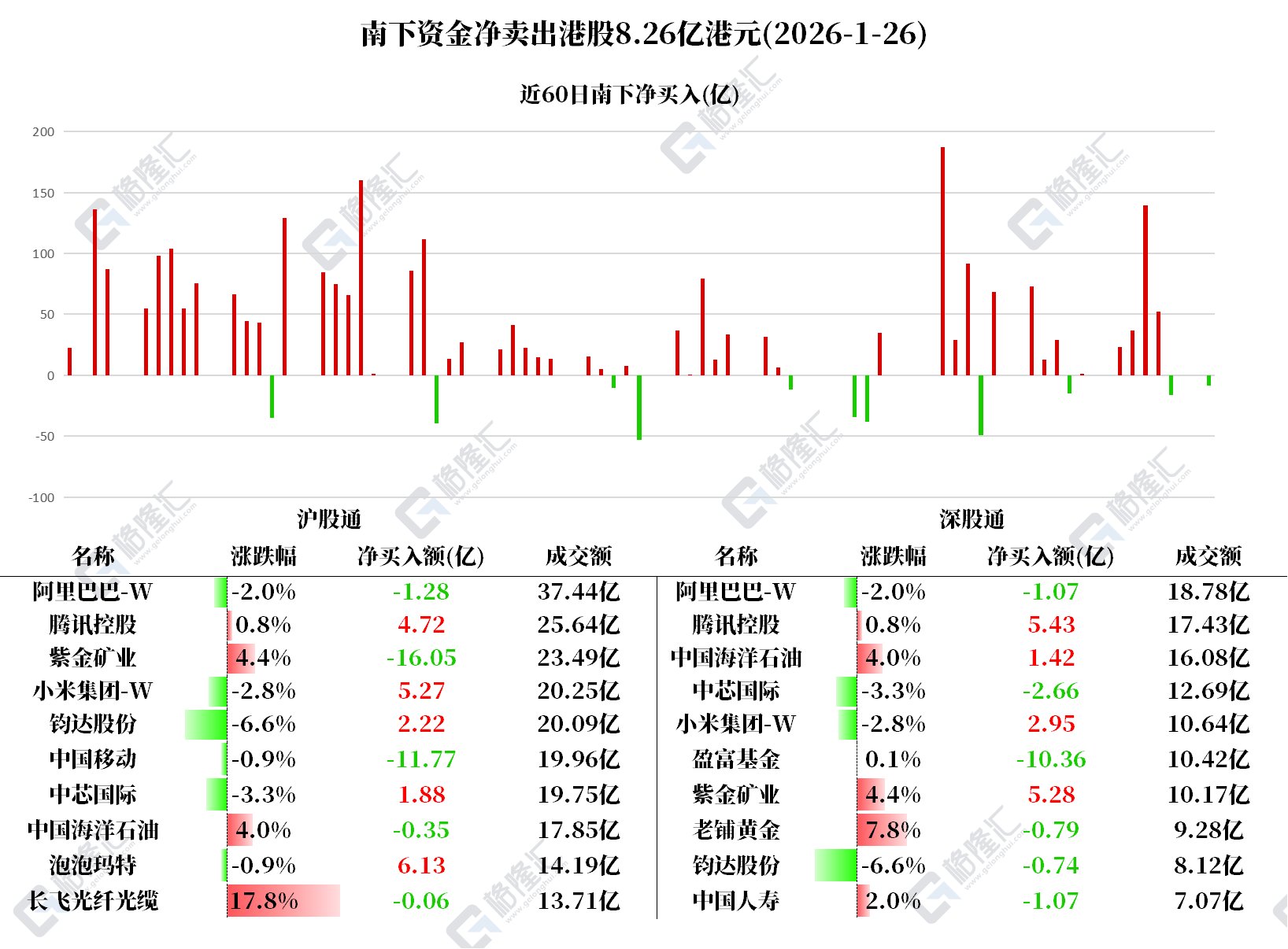
图解丨南下资金连续第二日净卖出港股,加仓腾讯、小米,持续出中国移动
Ge Long Hui A P P· 2026-01-26 09:52
Group 1 - Southbound funds recorded a net sell of HKD 826 million in Hong Kong stocks for the second consecutive day [1] - Notable net purchases included Tencent Holdings at HKD 1.015 billion, Xiaomi Group at HKD 822 million, and Pop Mart at HKD 613 million [1] - Significant net sales were observed in China Mobile at HKD 1.177 billion, Zijin Mining at HKD 1.077 billion, and Alibaba at HKD 235 million [1] Group 2 - Southbound funds have consistently net bought Xiaomi for 7 days, totaling HKD 3.89621 billion [1] - Continuous net buying for China National Offshore Oil Corporation (CNOOC) for 4 days, amounting to HKD 1.09627 billion [1] - Pop Mart has seen net buying for 3 consecutive days, totaling HKD 1.73397 billion [1] - China Mobile has faced net selling for 16 days, accumulating to HKD 12.89303 billion [1]





中国人寿迎来个险营销30周年 以“三十”之名服务人民美好生活
Zhong Guo Jing Ji Wang· 2026-01-26 09:46
Core Insights - China Life Insurance Co., Ltd. is celebrating the 30th anniversary of its individual insurance marketing, launching a series of themed activities titled "Thirty and Li, Win Together" to express gratitude to customers for their long-term support [2][3] Group 1: Company Milestones - The company was established 30 years ago as the predecessor China Insurance Life Co., marking the beginning of specialized operations in personal insurance and the introduction of the personal marketing agent system [4] - The total premium income from individual insurance sales has grown from less than 1.2 billion in 1996 to over 520 billion in 2024, reflecting significant growth in customer protection and wealth accumulation [4] Group 2: Financial Performance - In the first three quarters of 2025, the company achieved a net profit attributable to shareholders exceeding 167.8 billion, representing a 60.5% increase year-on-year [4] - Shareholder equity reached 625.83 billion, a 22.8% increase from the end of the previous year, while total assets amounted to 7,417.98 billion, with investment assets growing by 10.2% [4] - As of November 30, 2025, total premiums for the year surpassed 700 billion, marking a new high compared to the previous year's total [4] Group 3: Future Commitment - The company emphasizes its commitment to providing high-quality insurance products and services, aiming to enhance the economic foundation of people's lives and improve their sense of security and happiness [5]
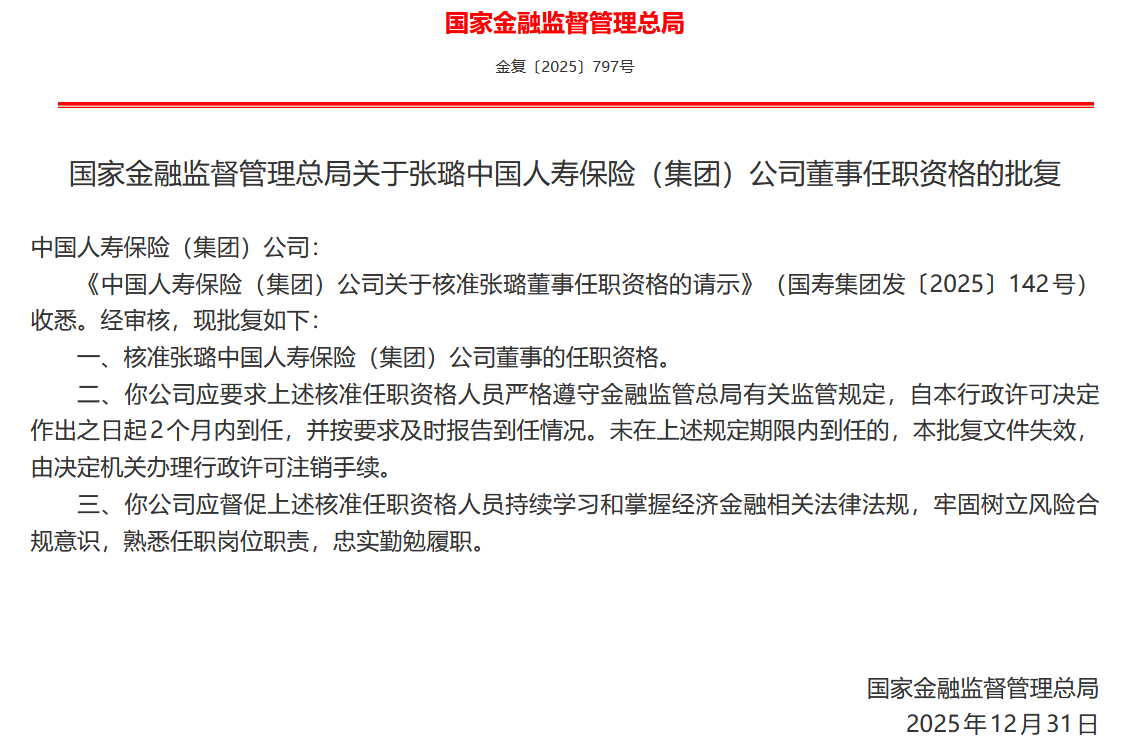
张璐获批担任中国人寿董事
Xin Lang Cai Jing· 2026-01-26 08:04
1月26日金融一线消息,国家金融监督管理总局日前发布《关于张璐中国人寿保险(集团)公司董事任职资格的批复》,核准张璐中国人寿保险(集团)公 司董事的任职资格。 官网简历显示,张璐,1971年出生,中国人寿党委副书记、执行董事。经济学硕士学位,2025年2月任现职。曾任中央和国家机关工委委员、基层组织建设 指导部部长。 责任编辑:曹睿潼 1月26日金融一线消息,国家金融监督管理总局日前发布《关于张璐中国人寿保险(集团)公司董事任职资格的批复》,核准张璐中国人寿保险(集团)公 司董事的任职资格。 官网简历显示,张璐,1971年出生,中国人寿党委副书记、执行董事。经济学硕士学位,2025年2月任现职。曾任中央和国家机关工委委员、基层组织建设 指导部部长。 责任编辑:曹睿潼 ...
合计出资125亿元,中国人寿参设两支股权基金
Huan Qiu Lao Hu Cai Jing· 2026-01-26 07:19
Group 1 - China Life announced a partnership with Guoshou Qiyuan to establish the Beijing Guoshou Pension Industry Equity Investment Fund Phase II, with a total subscription amount of 8.5 billion yuan, where China Life contributes 8.4915 billion yuan and Guoshou Qiyuan contributes 8.5 million yuan [1] - The fund will adopt a combination of light and heavy asset models, focusing on investments in the pension industry, particularly in the acquisition of existing pension real estate projects and the expansion of new pension real estate projects [1] - This initiative is part of the implementation of the Healthy China strategy and supports the development of the real economy, aiming to achieve continuous asset management and operational income through investments in pension real estate projects [1] Group 2 - China Life also announced another investment plan to establish the Huizhi Yangtze River Delta (Shanghai) Private Equity Fund Partnership, with a total subscription amount of 5.0515 billion yuan, where China Life contributes 4 billion yuan [1] - The partnership will focus on technological innovation and industrial upgrading opportunities in the Yangtze River Delta region, investing in growth-stage equity assets, particularly in artificial intelligence, integrated circuits, and biomedicine, with a minimum of 70% of investments allocated to the artificial intelligence sector [2] - As of September 2025, the cumulative investment scale of Guoshou Investment in technological self-reliance is expected to reach approximately 43 billion yuan, with over 36 billion yuan under management, and an increase of over 8 billion yuan in new funding in 2025, representing a 24% growth from the beginning of the year [2]
小摩:偏好中国人寿及中国平安增长前景胜地区同业
Zhi Tong Cai Jing· 2026-01-26 06:37
小摩表示,香港保险业监管局计划自2026年1月起下调前端销售佣金,促使经纪渠道销售贡献显著提 升,第三季度占新单保费比例达35%,同比增加8个百分点。 报告同时指出,美元保单需求保持稳健,第三季度同比增长48%,反映在内地保证利率下调后,香港寿 险市场在产品多元性及回报竞争力方面的优势。展望第四季度,小摩预期在销售佣金率调整前,代理及 经纪渠道将共同推动新单业务保持强劲。此外,内地保险公司自2025年9月起下调非分红险保证利率, 可能进一步刺激内地访客对香港保险产品的需求。 摩根大通发布研报称,香港寿险业在2025年第三季度再次创下新单销售纪录,首年保费达910亿元,同 比大幅增长69%。然而,该行认为虽然销售量创新高,但整体产品结构及业务发展的健康度不及近期季 度,并预期在监管趋紧的背景下,管理增长动能将成为2026年关键。小摩表示,2026年更偏好中国人寿 (601628)(02628)及中国平安(601318)(02318),认为其业务增长前景优于其他地区同业。 ...

小摩:偏好中国人寿(02628)及中国平安(02318)增长前景胜地区同业
智通财经网· 2026-01-26 06:33
报告同时指出,美元保单需求保持稳健,第三季度同比增长48%,反映在内地保证利率下调后,香港寿 险市场在产品多元性及回报竞争力方面的优势。展望第四季度,小摩预期在销售佣金率调整前,代理及 经纪渠道将共同推动新单业务保持强劲。此外,内地保险公司自2025年9月起下调非分红险保证利率, 可能进一步刺激内地访客对香港保险产品的需求。 智通财经APP获悉,摩根大通发布研报称,香港寿险业在2025年第三季度再次创下新单销售纪录,首年 保费达910亿元,同比大幅增长69%。然而,该行认为虽然销售量创新高,但整体产品结构及业务发展 的健康度不及近期季度,并预期在监管趋紧的背景下,管理增长动能将成为2026年关键。小摩表示, 2026年更偏好中国人寿(02628)及中国平安(02318),认为其业务增长前景优于其他地区同业。 小摩表示,香港保险业监管局计划自2026年1月起下调前端销售佣金,促使经纪渠道销售贡献显著提 升,第三季度占新单保费比例达35%,同比增加8个百分点。 ...

港股午评:恒指涨0.09%、科指跌1.31%,有色金属及石油股齐涨,科网股走势分化,商业航天股普跌
Jin Rong Jie· 2026-01-26 04:09
Market Overview - The Hong Kong stock index showed mixed performance with the Hang Seng Index rising by 0.09% to 26,773.97 points, while the Hang Seng Tech Index fell by 1.31% to 5,721.82 points [1] - Major tech stocks experienced varied movements, with Alibaba down by 1.25%, Tencent up by 0.92%, and JD.com up by 1.39% [1] - Gold stocks led the rise in the metals sector, with companies like Lingbao Gold and Shandong Gold reaching new highs, while China Nonferrous Mining surged over 11% [1] - Oil stocks strengthened, with CNOOC rising by over 4% [1] - Commercial aerospace stocks generally declined, with Asia Pacific Satellite down over 8% [1] Corporate News - Road King Infrastructure (01098.HK) plans to sell several property rights in the Road King New World commercial project in Ningbo for 100.3 million yuan [2] - Asia Cement (00743.HK) expects a net profit of approximately 85.6 million yuan for 2025 [3] - Zijin Mining (02899.HK) announced the completion of the second phase of the Julong Copper Mine, which will become the largest copper mine in China [4] - Minmetals Capital (01141.HK) anticipates a net profit of 130 million to 170 million HKD for 2025, representing a year-on-year increase of 155.9% to 234.6% [4] - Everbright Securities (06178.HK) projects a revenue of 10.863 billion yuan for 2025, a year-on-year growth of 13.18%, with a net profit of 3.729 billion yuan, up 21.92% [4] - China Merchants Bank (03968.HK) reported a revenue of 337.532 billion yuan for 2025, with a slight increase of 0.01%, and a net profit of 150.181 billion yuan, up by 1.21% [4] - Shanghai Fudan (01385.HK) expects a revenue of approximately 3.93 billion to 4.03 billion yuan for 2025, with a net profit decrease of about 66.82% to 50.58% [4] - China Life Insurance (02628.HK) plans to invest 4 billion yuan to establish a partnership focused on AI-driven technological innovation and industrial upgrades in the Yangtze River Delta [5] - Xinda International Holdings (00111.HK) issued a profit warning, expecting a net profit of approximately 74 million to 82 million HKD [6] - Huadian International Power (01071.HK) reported a cumulative power generation of 262 million MWh for 2025, a decrease of about 6.99% year-on-year [7] - CNOOC Services (02883.HK) released a strategic guideline for 2026, expecting capital expenditure of approximately 8.44 billion yuan [8] - Sinopec (00386.HK) forecasts an oil production of 39.7 million tons for 2025, a slight increase of 0.2%, and a natural gas production of 41.253 billion cubic meters, up 4.02% [8] Institutional Insights - Galaxy Securities noted that the short-term interest rate cut expectations by the Federal Reserve have decreased, leading to a forecast of narrow fluctuations in the Hong Kong stock market [9] - The technology sector remains a long-term investment focus, benefiting from price increases in the supply chain, domestic substitution, and accelerated AI applications [9] - Consumption sectors are expected to continue benefiting from policy support, with attention needed on policy implementation and improvements in consumption data [9] - Dongxing Securities highlighted that the number of satellite launches in China is expected to accelerate by 2026, creating market opportunities in satellite manufacturing and rocket launches [10] - Guangfa Securities indicated that space photovoltaics are likely to benefit from the global commercial aerospace boom, with existing low-orbit satellite plans potentially creating nearly 10 GW of demand for space photovoltaics [10]

骉力全开迎新春!中国人寿财险第六届“财宝节”温暖启航
Jin Rong Jie Zi Xun· 2026-01-26 02:57
Core Viewpoint - China Life Property & Casualty Insurance is launching its sixth "Treasure Festival" from January 19 to March 31, 2026, focusing on various insurance needs related to travel, health, accidents, and family property, while enhancing customer engagement through interactive online content [1][2]. Group 1: Event Overview - The "Treasure Festival" integrates traditional culture with modern digital interaction, creating a festive atmosphere that includes diverse activities to meet customer participation needs [2]. - Activities include online fireworks, traditional games, and lantern riddles, designed to enhance family safety awareness and provide a fun experience [2]. Group 2: Product Matrix - The festival introduces a comprehensive product matrix covering multiple life scenarios, including auto insurance, accident insurance, health insurance, and home insurance, aimed at providing systematic and one-stop protection solutions [3][4]. - Specific products include travel accident insurance, children's accident insurance, and senior citizen accident insurance, addressing the needs of different age groups and life situations [3]. Group 3: Health Management - The product system is continuously improved to offer differentiated health insurance options, including cancer medical insurance for seniors and diabetes medical insurance, enhancing health protection levels for individuals and families [4]. - Family insurance discounts are available for major medical insurance products, alleviating the financial burden of serious illnesses [4]. Group 4: Digital Transformation - The company is committed to digital transformation, integrating technology into its operations to enhance customer service and operational efficiency [6][7]. - The "Anxin Enjoy" platform serves as a key hub for online activities and customer engagement, transitioning from traditional services to a dual online and offline service model [6]. Group 5: Customer-Centric Approach - The festival combines festive joy with practical risk protection, ensuring customers feel secure during the celebrations [8]. - The company aims to continue optimizing its service system through technological innovation, focusing on customer needs and contributing to national development [8].
智通港股通持股解析|1月26日
智通财经网· 2026-01-26 00:32
Core Insights - The top three companies by Hong Kong Stock Connect holding ratios are China Telecom (00728) at 70.92%, Green Power Environmental (01330) at 69.34%, and Kaisa Group Holdings (01108) at 67.61% [1][2] - The largest increases in holding amounts over the last five trading days were seen in the following companies: Yingfu Fund (02800) with an increase of 4.041 billion, Hang Seng China Enterprises (02828) with 1.783 billion, and Alibaba - W (09988) with 1.455 billion [1][2] - The largest decreases in holding amounts over the last five trading days were recorded for China Mobile (00941) with a decrease of 2.395 billion, Innovent Biologics (01801) with 589 million, and UBTECH Robotics (09880) with 556 million [1][3] Group 1: Hong Kong Stock Connect Holding Ratios - China Telecom (00728) has a holding of 9.843 billion shares, representing 70.92% [2] - Green Power Environmental (01330) has a holding of 280 million shares, representing 69.34% [2] - Kaisa Group Holdings (01108) has a holding of 169 million shares, representing 67.61% [2] Group 2: Recent Increases in Holdings - Yingfu Fund (02800) saw an increase of 4.041 billion in holding amount, with a change of 14.9907 million shares [2] - Hang Seng China Enterprises (02828) increased by 1.783 billion, with a change of 1.8975 million shares [2] - Alibaba - W (09988) increased by 1.455 billion, with a change of 0.8637 million shares [2] Group 3: Recent Decreases in Holdings - China Mobile (00941) experienced a decrease of 2.395 billion, with a change of -3.01224 million shares [3] - Innovent Biologics (01801) saw a decrease of 589 million, with a change of -0.70319 million shares [3] - UBTECH Robotics (09880) had a decrease of 556 million, with a change of -0.38639 million shares [3]