
养老第三支柱

Search documents
单周12只FOF基金集中发行,刷新历史纪录
Guo Ji Jin Rong Bao· 2026-01-20 13:57
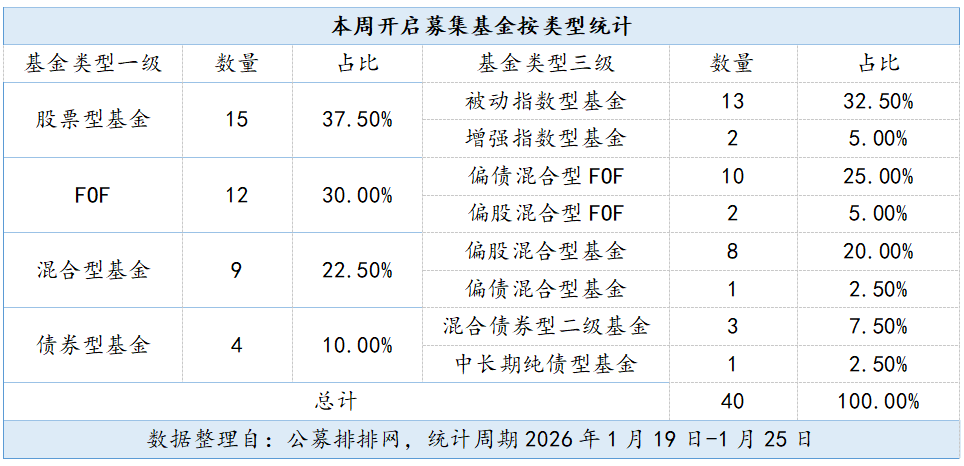
Core Insights - The public fund issuance market has maintained an active trend since the beginning of the year, with 40 new funds launched for subscription in the week of January 19 to January 25, representing an 11.11% week-on-week increase and sustaining a high issuance level above 35 funds for three consecutive weeks [1] Fund Type Analysis - Among the newly launched funds, equity funds remain the mainstay, with 23 equity funds entering the subscription period, accounting for 57.5% of the total new funds. This includes 15 stock funds and 8 equity hybrid funds, indicating sustained enthusiasm for equity asset allocation [2][3] - In terms of specific types, passive index funds lead with 13 funds, making up 32.5% of all new funds, while enhanced index funds account for 5%. In the hybrid fund category, 8 equity hybrid funds and 1 debt hybrid fund were issued. For bond funds, there were 3 mixed bond secondary funds and 1 medium to long-term pure bond fund [3] FOF Fund Trends - FOF (Fund of Funds) issuance has significantly rebounded, with 12 new FOFs launched, marking a historical single-week issuance high. Among these, debt hybrid FOFs are the majority, totaling 10 funds, which represents 83.33% of the new FOF issuance, reflecting investors' focus on risk control while pursuing returns [3][4] Market Dynamics - The current new fund issuance structure is characterized by "equity dominance, FOF rebound, and active index products," showcasing market confidence in equity assets and a trend towards diversified fund offerings. The sustained heat in the public fund issuance market is attributed to multiple factors, including market sentiment, policy guidance, channel promotion, and favorable macroeconomic conditions [3][4] - The "A-share opening red" effect has attracted investors to enter the market through new funds, while policy dividends and channel efforts have formed a dual driving force for fund issuance. The "14th Five-Year Plan" focuses on new quality productivity, providing opportunities for the issuance of thematic funds in technology and manufacturing [4]

专属商业养老保险利率超存款 八成收益超3%
2 1 Shi Ji Jing Ji Bao Dao· 2026-01-19 10:34
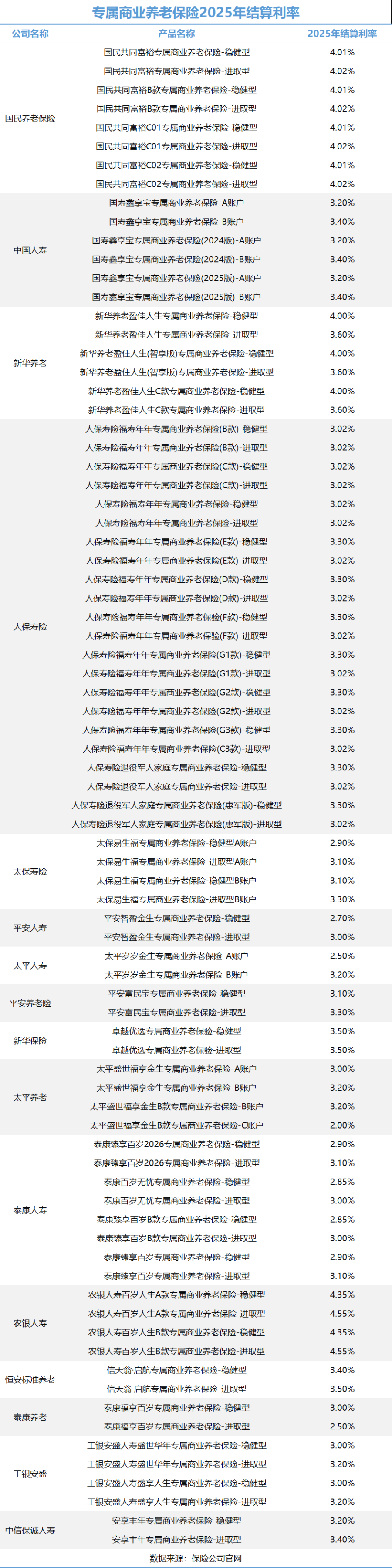
Core Viewpoint - The recent disclosure of 2025 settlement rates for exclusive commercial pension insurance products by multiple insurance institutions highlights a promising investment opportunity amidst declining bank deposit rates and fluctuating wealth management product values. The majority of these products offer competitive returns, with over 80% of them exceeding a 3.00% settlement rate for 2025 [1][2][8]. Summary by Category Insurance Product Performance - A total of 40 exclusive commercial pension insurance products have been reported, with settlement rates for stable accounts ranging from 2.00% to 4.35%, and for aggressive accounts from 2.50% to 4.55% [1][2]. - Among these products, 70 accounts (87.5%) have a settlement rate exceeding 3.00% [1][2]. - Notably, the products from Nongyin Life and Guomin Pension have all their settlement rates above 4.00%, with Nongyin Life's stable and aggressive accounts both at 4.35% and 4.55%, respectively [8]. Market Context - The backdrop of declining deposit rates has led to increased difficulty for investors seeking stable returns, prompting a shift towards pension insurance products as a viable alternative [2][8]. - The trend of "deposit special forces" among young investors reflects the growing demand for higher interest rates, which has become increasingly challenging to find in traditional banking products [2]. Product Structure and Design - Exclusive commercial pension insurance products are designed with both stable and aggressive accounts, allowing for a balance between guaranteed returns and potential higher yields [10][14]. - The unique structure of these products enables insurance companies to adopt long-term investment strategies, optimizing returns despite a low-interest environment [9][10]. - There is a notable phenomenon where some stable accounts are yielding higher returns than aggressive accounts, contrary to typical expectations [11]. Target Audience and Flexibility - These products cater to the needs of flexible employment groups, offering more adaptable payment options compared to traditional annuity insurance [12][14]. - The ability to choose between different account types and adjust contributions provides consumers with a tailored approach to retirement planning [13][14]. Regulatory Environment - The regulatory framework for exclusive commercial pension insurance includes mechanisms for monitoring settlement rates and ensuring financial stability, which enhances consumer confidence in these products [20].


近九成账户收益率超过3%! 37款专属商业养老险交出2025年“成绩单”
Mei Ri Jing Ji Xin Wen· 2026-01-13 12:49
Core Viewpoint - The exclusive commercial pension insurance products have shown impressive performance in the low interest rate environment, with various insurance institutions disclosing their 2025 settlement rates, indicating a robust investment opportunity for individuals seeking retirement security [1][3]. Group 1: Product Overview - Exclusive commercial pension insurance is designed for long-term personal retirement security, featuring simple underwriting, flexible payment options, and stable returns [1]. - There are currently 37 exclusive commercial pension insurance products with 76 accounts that have announced their 2025 settlement rates, with a range of 2% to 4.35% for stable accounts and 2.5% to 4.55% for aggressive accounts [3][4]. Group 2: Performance Metrics - Over 80% of stable accounts have settlement rates exceeding 3%, while only one aggressive account has a rate below 3% [3]. - Seven products have settlement rates reaching or exceeding 4%, with notable performances from products by Nongyin Life and Guomin Pension Insurance [4][5]. Group 3: Investment Strategy - The products are structured in two phases: accumulation and payout, utilizing a "guarantee + floating" return model, which allows for a mix of investment portfolios [4][6]. - The stable accounts generally invest in fixed-income assets, while aggressive accounts have a higher allocation to equity assets, aiming for higher returns [7][8]. Group 4: Market Outlook - Despite a general decline in guaranteed rates, the industry remains optimistic about the future of exclusive commercial pension insurance due to its unique advantages in combining protection and investment, as well as its ability to provide stable long-term returns [9].
21书评|算清“养老账”
2 1 Shi Ji Jing Ji Bao Dao· 2025-12-29 09:57
Core Insights - The Chinese asset management industry has grown significantly from a total scale of less than 3 trillion yuan in 2005 to over 165 trillion yuan by the end of 2024, becoming a crucial part of the financial system [1] - The personal pension system, established in April 2022, is set to be fully promoted nationwide by December 2024, aiming to address the aging population's pension needs [1][5] - The report highlights the need for continuous innovation in the asset management sector, including the introduction of new products like public REITs, ESG investments, and family trusts [1] Industry Overview - The asset management industry in China has undergone substantial innovation over the past 20 years, with financial technology playing a key role [1] - By the end of 2024, it is estimated that around 75 million people will participate in the personal pension system, with a total fund scale of approximately 200 billion yuan [6] Personal Pension System Analysis - As of the first quarter of 2023, 30.38 million personal pension accounts have been opened, but only about 9 million have made contributions, indicating a low participation rate of approximately 5% [7] - Projections suggest that by 2050, participation rates could reach between 6% to 10% under different scenarios, with cumulative investment scales potentially reaching up to 21.7 trillion yuan in an optimistic scenario [8] Challenges in the Personal Pension System - The current challenges include low contribution rates, insufficient contribution amounts, and a low proportion of funds being invested [9] - Tax incentives are not attractive enough for lower-income groups, and the lack of flexibility in account design limits the ability to transfer funds between different pension accounts [11][12] Recommendations for Improvement - Suggestions for enhancing the personal pension system include adjusting tax incentives based on economic development, expanding participation eligibility, and creating mechanisms for fund transfer between different pension pillars [13][14] - Increasing the range of investable products and innovating product designs to cater to different risk profiles and age groups is also recommended [16][17]
基金行业话养老 | 养老不能只靠退休金,你的“第三支柱”搭好了吗?
Xin Lang Cai Jing· 2025-12-26 08:06
Core Insights - The personal pension system in China, recognized as the "third pillar" of retirement planning, is gaining significant attention as it approaches its third anniversary, with over 70 million investors participating [1][3][4] Group 1: Importance of the Third Pillar - The basic pension system only provides a minimal safety net, necessitating a stronger third pillar for maintaining living standards in retirement [3][20] - The personal pension system was officially launched in November 2022 across 36 pilot cities, marking a significant step in enhancing individual retirement planning [3][18] Group 2: Structure of the Pension System - China's pension system consists of three pillars: 1. Basic pension insurance, which covers essential living needs but has a replacement rate of about 45% for urban employees, insufficient for quality living [20] 2. Enterprise annuities, which are under 20% coverage and not universally accessible [20] 3. Personal pensions, which allow individuals to voluntarily save for retirement beyond basic guarantees [20] Group 3: Growth and Market Potential - As of November 25, 2025, there are 1,245 personal pension products available, with over 72.79 million accounts opened and total contributions reaching several hundred billion yuan [21][22] - The U.S. Individual Retirement Account (IRA) serves as a model, with a total asset size of $13.9 trillion by the end of 2021, highlighting the potential for growth in China's personal pension market [22] Group 4: Unique Value Proposition - The personal pension system offers three unique benefits: 1. Tax incentives, allowing up to 12,000 yuan in contributions to be deducted from taxable income, potentially saving taxpayers up to 5,400 yuan annually [24] 2. Long-term investment benefits through compounding, as funds are generally not accessible before retirement [24] 3. Professional management of funds, with investments in regulated financial products, enhancing the efficiency of wealth accumulation [24][25] Group 5: Practical Steps for Investors - Investors can initiate their personal pension journey in three steps: 1. Open a personal pension account through a bank's mobile app or physical branch [26] 2. Contribute up to 12,000 yuan annually, either as a lump sum or through regular investments [27] 3. Choose suitable financial products based on individual risk tolerance and investment knowledge [28]
外资新设独资公募入局!养老FOF再迎新品,规模较小问题待解
Bei Jing Shang Bao· 2025-11-18 11:40
Core Insights - The first foreign-funded wholly-owned public offering of a pension target fund (Pension FOF) is set to launch, with Fidelity Fund becoming the first foreign entity to introduce a pension FOF in China [1][3] - As of November 18, 2023, a total of 10 pension FOFs have been established this year, with a combined issuance scale of approximately 3.67 billion [4][5] - The introduction of the pension FOF by Fidelity is seen as a significant step in enhancing the pension financial system in China, aiming to provide a comprehensive pension solution for domestic investors [3][6] Fund Launch Details - Fidelity Fund announced the launch of the Fidelity Renyuan Conservative Pension Target One-Year Holding Mixed Fund (FOF) on November 18, 2023, with public sales scheduled from December 1, 2025, to February 27, 2026, and a minimum issuance of 200 million shares [3] - The fund's performance benchmark includes global assets such as the Hang Seng Index, S&P 500, and gold, marking it as the first pension FOF in the market to incorporate overseas market indices [3] Market Challenges - The average scale of newly launched pension FOFs is relatively small, with the largest fund, Qianhai Kaiyuan Kangyue Stable Pension One-Year Holding Mixed Fund, reaching 2.26 billion, while others fall below 1 billion [5] - A total of 10 pension FOFs have been liquidated this year due to insufficient scale, with many existing products also facing similar challenges [5][6] - The small scale of pension FOFs is attributed to a high number of offerings, varying product quality, and a preference among sales channels for higher-fee products [6] Future Outlook - Experts suggest that enhancing the competitiveness and performance of pension FOFs is crucial for their growth, recommending diversification through the inclusion of assets like gold and overseas investments [6] - The transformation of pension FOFs from niche products to mainstream options is contingent upon policy support and improved institutional performance [6]

蔡昉:养老三支柱不是“三足鼎立”|直击外滩年会
Jing Ji Guan Cha Bao· 2025-10-24 06:52
Core Viewpoint - The current pension system in China requires exploration of new insurance models, emphasizing the importance of including urban and rural residents in discussions about pension reforms [1][2]. Group 1: Current Pension Landscape - Over 50% of pension recipients are receiving urban and rural resident pension insurance, indicating a need to include this demographic in pension reform discussions [2]. - There are over 300 million private laborers and individual workers, along with more than 200 million flexible employment individuals, who have low pension insurance coverage [2]. - The rise of digital economy and flexible employment is leading to a shift in traditional employment patterns, necessitating new approaches to pension coverage [2]. Group 2: Structural Insights - The status of the resident pension insurance system should be a key criterion for evaluating the first pillar of the pension system [4]. - The three pillars of pension insurance should not be viewed as equal or independent; rather, the first pillar is foundational, and without it, the second and third pillars cannot effectively function [4]. - The development of artificial intelligence is expected to bring revolutionary changes, necessitating a rethinking of pension insurance models and the establishment of effective sharing mechanisms for productivity gains [4].
险企加注养老金融赛道 “叫好不叫座”如何解决
Sou Hu Cai Jing· 2025-09-28 17:01
Core Insights - The insurance industry is increasingly focusing on the development of the third pillar of pension systems, emphasizing the integration of insurance with pension services as a new growth direction [1][2][3] Group 1: Market Overview - The commercial pension insurance market in China is still relatively small, but it is expected to grow significantly, with projections indicating that the market size will exceed 100 billion yuan in 2024, a substantial increase from 18 billion yuan in 2023 [2] - As of mid-2023, 13 insurance institutions have invested in 60 elderly care communities across 20 provinces, providing approximately 80,000 beds, with the total number of communities exceeding 150 when including light-asset models [2] Group 2: Regulatory and Policy Environment - The National Financial Regulatory Administration has proposed reforms to promote high-quality development in commercial pension finance, encouraging the creation of new insurance products that combine pension risk protection with wealth management [3] - Recent discussions have highlighted the need for greater public awareness and acceptance of pension financial products, as well as the importance of tax incentives to encourage individual pension contributions [3][4] Group 3: Challenges and Opportunities - The insurance sector faces challenges in fundraising capabilities compared to the banking sector, with the insurance channel holding a significant share of the pension finance market, while the individual insurance channel is experiencing a decline in agent numbers [3] - The development of commercial long-term care insurance is still in its infancy, with market growth hindered by the need for adequate social care capabilities and investment returns [5] - Despite being the second-largest insurance market globally, China's insurance premium income is significantly lower than that of the United States, indicating substantial potential for growth in commercial pension and life insurance [5]
专属商业养老险扩容在即 养老险机构整装待发
Xin Hua Wang· 2025-08-12 06:30
Core Viewpoint - The expansion of the exclusive commercial pension insurance pilot program to nationwide coverage allows pension insurance companies to participate, marking a significant step for the insurance industry in engaging with the third pillar of pension systems [1][2]. Group 1: Expansion of Pilot Program - The China Banking and Insurance Regulatory Commission (CBIRC) announced that starting March 1, the pilot program for exclusive commercial pension insurance will expand to all regions in the country [2]. - Previously, only six insurance companies were involved in the pilot, but now pension insurance companies are also permitted to participate, which is seen as a crucial opportunity for the industry [2][3]. Group 2: Participation of Pension Insurance Companies - Several pension insurance companies, including Ping An Pension and Taikang Pension, have expressed intentions to actively participate in the pilot program [2]. - Companies are focusing on developing products tailored for unconventional employment groups, such as gig economy workers, and are preparing to align their resources with the upcoming third pillar policy [2][3]. Group 3: Advantages of Pension Insurance Companies - Pension insurance companies have advantages in developing individual tax-deferred commercial pension insurance due to their experience since 2018 [3]. - They can integrate second and third pillar pension products, leveraging their roles as trustees and investment institutions for second pillar annuities [3]. - The existing expertise in group insurance, particularly for unconventional employment groups, positions pension insurance companies favorably in this new market [3]. Group 4: Challenges for Non-Contractual Insurance Companies - Many pension insurance companies, such as China Life Pension and New China Pension, have not previously engaged in contractual insurance and will need to establish new systems and processes to enter the exclusive pension insurance market [4][8]. - The transition from a pension management focus to a contractual insurance model requires significant restructuring of business operations and compliance with different regulatory frameworks [8][9]. Group 5: Product Development and Market Positioning - There is no significant difference in product offerings between pension insurance companies and life insurance companies in the exclusive commercial pension insurance space, although pension companies may have a long-term focus on retirement-related products [6]. - The pilot program has seen a steady operation since its inception, with nearly 50,000 policies and a total premium of 400 million yuan by January 2022 [6][7]. - Despite the potential, the overall scale of the exclusive commercial pension insurance remains small compared to the vast premium volumes of life insurance companies [7]. Group 6: Regulatory Guidance and Future Directions - The CBIRC has issued guidelines to promote the development of commercial pension insurance and related services, requiring pension insurance companies to submit their business transformation plans by June 30 [9]. - This regulatory push aims to clarify the future direction of pension insurance companies and enhance their engagement in the commercial pension insurance market [9].

养老第三支柱迎黄金时代 险企该如何发挥特长
Xin Hua Wang· 2025-08-12 06:30
Group 1 - The Chinese government is actively responding to the aging population by enhancing the pension security system, with policies aimed at promoting personal pension systems and expanding commercial pension insurance trials [1][2] - The "14th Five-Year Plan" emphasizes the development of enterprise annuities and personal pensions, encouraging financial institutions to create pension financial products tailored for the elderly [1][2] - As of the seventh national census, approximately 264 million people aged 60 and above account for 18.7% of the population, with projections indicating that by 2050, this demographic will represent 27.9% of the total population, highlighting significant social pension pressures [1] Group 2 - The current pension system in China consists of three pillars: basic pension, enterprise (occupational) annuities, and personal pension investments, with the first pillar covering over 1 billion people but facing heavy burdens [1][2] - In 2019, the total assets of the pension system were reported as follows: the first pillar at 6.29 trillion yuan (65.45%), the second pillar at 1.8 trillion yuan (18.73%), and the third pillar at 1.52 trillion yuan (15.82%), indicating a dominant first pillar structure [2] - The insurance industry has been actively participating in the development of the third pillar, with initiatives like tax-deferred pension insurance and dedicated commercial pension insurance products designed to meet retirement needs [2][3] Group 3 - Despite the smooth initiation of dedicated commercial pension insurance trials, the overall business scale remains small, and tax-deferred pension insurance has not yet achieved significant regional scale effects [3] - Challenges such as competition with bank financial products and complex operational procedures hinder the growth of the third pillar [3] - The future pension market is expected to be competitive across industries, requiring collaboration among banks, insurance, trusts, funds, and securities to convert short-term savings into long-term retirement assets [3] Group 4 - The golden age for the development of the third pillar is approaching, with insurance institutions placing significant emphasis on this business area [4] - The industry aims to leverage professional strengths in fund management and risk management to support the construction of the three-pillar pension system [4] - Policy encouragement for financial institutions to develop diverse pension financial products aligns with the industry's focus on utilizing their expertise [4]