
BANK COMM(03328)

Search documents
交通银行今日大宗交易溢价成交450.44万股,成交额3427.88万元
Xin Lang Cai Jing· 2025-08-27 09:40
8月27日,交通银行大宗交易成交450.44万股,成交额3427.88万元,占当日总成交额的2.17%,成交价7.61元,较市场收盘价7.44元溢价2.28%。 | 交易日期 | 证券简称 | 证券代码 | 成交价(元) 成交金额(万元) 成交量( * ) 买入营业部 | | | 卖出营业部 | | --- | --- | --- | --- | --- | --- | --- | | 2025-08-27 | 交通银行 | 601328 | 7.61 3427.88 | 450.44 | 国泰海通证券股份 | 中国中金财富证券 | | | | | | | 有限公司南京太平 | 有限公司扬州文昌 | | | | | | | 00 三 九 六 元 小 ) 一 中 十 十 六 十 | ないことを言いない | ...



金融活水润泽“宁电入湘” 绿色动能赋能三湘发展
Chang Sha Wan Bao· 2025-08-27 08:38
Group 1 - The core viewpoint of the articles highlights the collaboration between the Bank of Communications Hunan Branch and Hunan Energy Group to support the 3 million kW photovoltaic composite power generation project in Hongsi Fort District with a financial backing of 160 million yuan [1][2] - The "Ningdian into Hunan" project is a crucial part of the national "West-East Power Transmission" strategy, aimed at optimizing Hunan's energy structure and ensuring power supply [1] - The financing model employed involves "intra-bank joint loans," which effectively integrates the Hunan Branch's customer insights with the Ningxia Wuzhong Branch's local project management capabilities, enhancing resource allocation and risk management [1] Group 2 - The financial support for the Hunan Energy Group's project is a practical implementation of the Bank of Communications Hunan Branch's commitment to green finance and aligns with the national "dual carbon" strategy [2] - The Hunan Branch plans to continue deepening its financial practices related to green development, focusing on innovation in products and service models to support high-quality economic and social development in Hunan [2]
外汇局济宁市分局依托“两张清单”机制,解小微外贸企业融资难题
Qi Lu Wan Bao Wang· 2025-08-27 08:37
Core Viewpoint - The development of foreign trade enterprises is crucial for regional economic growth, but many small and medium-sized foreign trade companies face funding shortages. The Jining branch of the State Administration of Foreign Exchange is promoting cross-border trade facilitation through the establishment of "policy product lists" and "enterprise demand lists" to better align with the needs of the real economy [1][3]. Group 1: Financial Support Initiatives - Jining banks are actively implementing the requirements of the local foreign exchange bureau by innovating foreign exchange financing products, optimizing cross-border settlement services, and simplifying business processes for enterprises [1][2]. - The "Foreign Trade Quick Loan" service, launched on June 27, 2025, in Shandong, provides new financing solutions for small and micro foreign trade enterprises [1][2]. Group 2: Case Study of Financing - A mechanical enterprise in Jining, primarily engaged in large machinery and parts sales with a focus on exports, expressed urgent financing needs due to increasing overseas orders and a significant funding gap for raw material procurement [2]. - The Jining branch of the Bank of Communications successfully provided a credit limit of 3 million yuan to the enterprise, alleviating its financial pressure and enabling timely procurement of raw materials for fulfilling overseas orders [2][3]. Group 3: Policy Implementation and Impact - The implementation of the two-list management mechanism by the Jining foreign exchange bureau has effectively connected policy transmission with market demand, facilitating over 400 financing and settlement needs for more than 1,000 foreign trade enterprises [3]. - This initiative has significantly improved the quality and efficiency of foreign exchange financial services for the real economy, supporting the stable scale and optimized structure of regional foreign trade for high-quality development [3].
智通ADR统计 | 8月27日





智通财经网· 2025-08-26 22:37
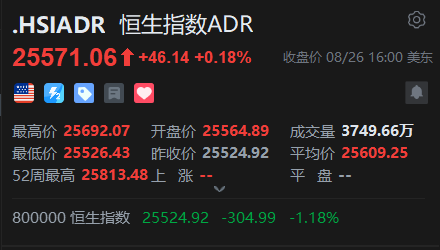
Market Overview - The Hang Seng Index (HSI) closed at 25,571.06, up by 46.14 points or 0.18% as of August 26, 16:00 Eastern Time [1] - The index reached a high of 25,692.07 and a low of 25,526.43 during the trading session, with a trading volume of 37.496 million [1] Major Blue-Chip Stocks Performance - Most large-cap stocks saw an increase, with HSBC Holdings closing at HKD 102.078, up by 1.87% compared to the Hong Kong close [2] - Tencent Holdings closed at HKD 610.224, reflecting a slight increase of 0.12% from the Hong Kong close [2] Stock Movements - Tencent Holdings experienced a decrease of HKD 5.000, or 0.81%, while its ADR price increased by HKD 0.724, or 0.12% [3] - Alibaba Group saw a decline of HKD 3.200, or 2.57%, with its ADR price down by HKD 0.317, or 0.26% [3] - HSBC Holdings dropped by HKD 1.300, or 1.28%, but its ADR price increased by HKD 1.878, or 1.87% [3] - Other notable movements include Meituan-W down by HKD 2.300, or 1.88%, and BYD Company up by HKD 1.800, or 1.55% [3]
信澳中证同业存单AAA指数7天持有期证券投资基金基金份额发售公告
Shang Hai Zheng Quan Bao· 2025-08-26 19:37
Fund Overview - The fund is named "Xinao Zhongzheng Interbank Certificate of Deposit AAA Index 7-Day Holding Period Securities Investment Fund" with a fund code of 024728 [19] - It is a mixed-type, contractual open-end fund with a minimum holding period of 7 days for each fund share [19][20] - The fund's subscription period is from September 1, 2025, to September 19, 2025, not exceeding 3 months [21] Fund Management and Custody - The fund is managed by Xinda Australia Fund Management Co., Ltd. and the custodian is Bank of Communications Co., Ltd. [50][51] - The fund's management and registration agency is also Xinda Australia Fund Management Co., Ltd. [52] Subscription and Redemption Rules - Each investor can only subscribe up to 10 million yuan per day, with a total subscription cap of 5 billion yuan [4][13] - The fund allows multiple subscriptions during the subscription period, but once a subscription application is accepted, it cannot be withdrawn [8][12] - Investors cannot redeem or transfer their shares until the 7th day after the fund contract takes effect [2][19] Fund Investment Strategy - The fund primarily invests in interbank certificates of deposit, specifically those rated AAA with a maturity of 1 year or less [14][15] - The fund aims to reflect the overall performance of AAA-rated interbank certificates of deposit [15] Fees and Charges - There is no subscription fee for investors, but a sales service fee will be charged as per the fund contract and prospectus [21] - The fund's share value is set at 1.00 yuan per share [20] Investor Eligibility - The fund is open to individual investors, institutional investors, qualified foreign investors, and other investors permitted by laws and regulations [3][4] - The fund does not sell to financial institutions' proprietary accounts, except for the fund manager's own funds [13] Important Dates and Announcements - The fund's prospectus and contract will be disclosed on the company's website and the China Securities Regulatory Commission's electronic disclosure website on August 27, 2025 [54]
陆家嘴金融沙龙第24期圆桌对话 养老金融多层次服务体系构建
Di Yi Cai Jing· 2025-08-26 13:41
Core Viewpoint - The event focused on promoting innovation in the elderly finance sector through collaboration among financial institutions, aiming to enhance the quality of elderly financial services and address the challenges posed by an aging population [3][4][10] Group 1: Financial Institutions' Role - Financial institutions are leveraging their strengths in service scenarios, channel development, and product innovation to energize the silver economy and elderly finance [4] - Traffic Bank is focusing on three main directions: "trade-in, silver consumption, and cultural tourism integration" to promote consumption among the elderly [4] - China Minsheng Bank is enhancing elderly services through a "three-full" standard, which includes full process, full channel, and full staff engagement [5] Group 2: Multi-layered Elderly Financial Service System - Financial institutions possess four key advantages: vast customer base, channel accessibility, risk management capabilities, and financial technology [6] - Shanghai Trust is working on creating a "high, medium, and low" tiered trust account system to lower the entry barrier for elderly trusts [6][7] - The proactive investment standard for personal wealth management at Shanghai Trust has reached approximately 200 billion, including nearly 30 billion in "fixed income plus" products [7] Group 3: Challenges and Solutions in Elderly Finance - The industry faces challenges such as talent shortages and risk management, with suggestions for solutions including talent cultivation and multi-party collaboration [8] - Traffic Bank is training elderly finance advisors and establishing branches as service bases to enhance public awareness and service standards [8] - Minsheng Bank emphasizes a multi-dimensional risk prevention approach, including technology-driven solutions to protect elderly clients' finances [8] Group 4: Collaborative Funding System - There is a consensus on the need for a diversified funding system for elderly finance, involving government guidance, financial innovation, and corporate pension schemes [9] - Trust products should transition from being perceived as high-end tools to accessible life service tools, enhancing public understanding and experience [9][10] - The core principles of elderly finance include the importance of early planning for retirement funding, diverse funding methods, and the necessity of starting preparations early [10]



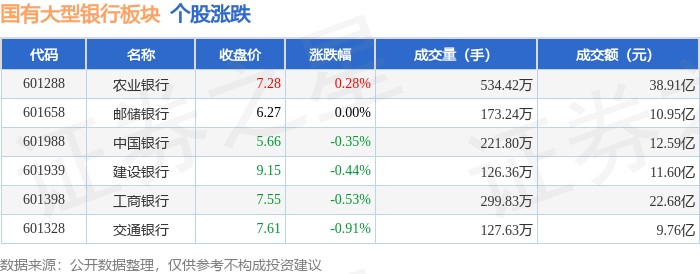
国有大型银行板块8月26日跌0.18%,交通银行领跌,主力资金净流出2.3亿元
Zheng Xing Xing Ye Ri Bao· 2025-08-26 08:36
证券之星消息,8月26日国有大型银行板块较上一交易日下跌0.18%,交通银行领跌。当日上证指数报收 于3868.38,下跌0.39%。深证成指报收于12473.17,上涨0.26%。国有大型银行板块个股涨跌见下表: | 代码 | 名称 | 主力净流入 (元) | 主力净占比 游资净流入 (元) | | 游资净占比 散户净流入 (元) | | 散户净占比 | | --- | --- | --- | --- | --- | --- | --- | --- | | 601288 农业银行 | | 2.65 Z | 6.80% | -7322.66万 | -1.88% | -1.91亿 | -4.92% | | 601328 交通银行 | | -2748.73万 | -2.82% | 1080.49万 | 1.11% | 1668.24万 | 1.71% | | 601658 邮储银行 | | -3405.92万 | -3.11% | 4881.62万 | 4.46% | -1475.70万 | -1.35% | | 601988 中国银行 | | -6823.34万 | -5.42% | -1584.64万 | - ...



建湖农商银行与交通银行盐城分行战略合作
Jiang Nan Shi Bao· 2025-08-26 06:54
Group 1 - The core viewpoint of the article is the strategic cooperation between Bank of Communications Yancheng Branch and Jianhu Rural Commercial Bank, focusing on mutual benefits in various financial services [1] - The two banks signed agreements on party building, digital currency, fund management, wealth management, agency services, and asset custody [1] - This partnership aims to combine the comprehensive and cross-regional capabilities of Bank of Communications with the localized service strengths of Jianhu Rural Commercial Bank [1]
智通ADR统计 | 8月26日
智通财经网· 2025-08-25 22:40
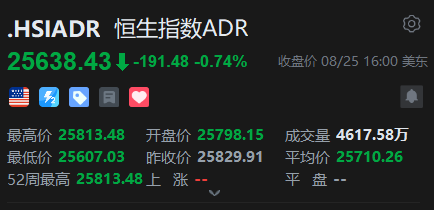
Market Overview - Most large-cap stocks experienced declines, with HSBC Holdings closing at HKD 101.904, up 0.40% from the previous close, while Tencent Holdings closed at HKD 610.534, down 0.65% [1] Stock Performance Summary - Tencent Holdings (00700) saw an increase of HKD 14.500, or 2.42%, but was down HKD 3.966, or 0.65%, compared to the Hong Kong close [2] - Alibaba Group (09988) increased by HKD 6.500, or 5.51%, but was down HKD 3.067, or 2.46%, compared to the Hong Kong close [2] - HSBC Holdings (00005) rose by HKD 0.200, or 0.20%, and was up HKD 0.404, or 0.40%, compared to the Hong Kong close [2] - Xiaomi Group (01810) increased by HKD 0.950, or 1.81%, but was down HKD 0.407, or 0.76%, compared to the Hong Kong close [2] - AIA Group (01299) rose by HKD 1.750, or 2.40%, but was down HKD 0.559, or 0.75%, compared to the Hong Kong close [2] - Meituan (03690) increased by HKD 3.900, or 3.29%, but was down HKD 1.521, or 1.24%, compared to the Hong Kong close [2] - NetEase (09999) rose by HKD 12.400, or 6.04%, but was down HKD 5.730, or 2.63%, compared to the Hong Kong close [2] - Hong Kong Exchanges and Clearing (00388) increased by HKD 14.800, or 3.30%, but was down HKD 1.716, or 0.37%, compared to the Hong Kong close [2] - Industrial and Commercial Bank of China (01398) decreased by HKD 0.020, or 0.34%, and was down HKD 0.014, or 0.24%, compared to the Hong Kong close [2] - JD.com (09618) increased by HKD 5.200, or 4.28%, but was down HKD 1.642, or 1.30%, compared to the Hong Kong close [2] - Kuaishou Technology (01024) rose by HKD 3.850, or 5.14%, and was up HKD 4.842, or 6.15%, compared to the Hong Kong close [2] - Ctrip (09961) increased by HKD 11.000, or 2.18%, but was down HKD 0.933, or 0.18%, compared to the Hong Kong close [2]
交行四川省分行助力西部金融中心建设
Si Chuan Ri Bao· 2025-08-25 22:20
Core Viewpoint - The article highlights the significant role of the Bank of Communications Sichuan Branch in supporting the construction of the Chengdu-Chongqing economic circle, emphasizing its commitment to providing financial support for major projects and contributing to regional economic development [1][2]. Financial Support and Commitment - The Bank of Communications Sichuan Branch signed a strategic cooperation agreement with the Sichuan provincial government in September 2021, pledging to provide 800 billion yuan in special credit support during the 14th Five-Year Plan period, focusing on six key areas [1]. - As of mid-2025, the Sichuan Branch has provided over 50 billion yuan in credit support for major projects within the Chengdu-Chongqing economic circle [1]. Project Financing and Economic Impact - In 2024 alone, the Sichuan Branch granted over 10 billion yuan in credit for 13 key projects in Chengdu [1]. - The branch's loan balance exceeded 240 billion yuan by mid-2025, reflecting its extensive support for local enterprises and individuals [1]. Innovation in Financial Services - The Sichuan Branch has developed a multi-layered service system tailored to six key industries, including electronic information and equipment manufacturing, enhancing its support for medium-sized clients [1]. - The introduction of innovative financial products, such as "Science and Technology Quick Loan," has facilitated funding for technology-driven enterprises, with an increase of 2.256 billion yuan in inclusive loans by mid-2025 [1]. Collaboration and Regional Development - The Sichuan and Chongqing branches of the Bank of Communications have engaged in frequent interactions, conducting 11 mutual visits in 2024 and co-hosting financial innovation summits to explore new cross-border financial services [1]. - A flexible working team was established to enhance collaboration between the two branches, resulting in over 1.8 billion yuan in credit support for joint projects [1]. Community and Social Responsibility - The Sichuan Branch has expanded its partnerships with local governments, establishing connections with 21 cities and over 20 provincial departments to enhance financial services across the region [1]. - The branch has actively engaged with over 40 enterprises to understand their needs and develop new service models, demonstrating its commitment to integrating financial services with local industry [2].