BANK COMM(03328)

Search documents
交通银行“文旅大戏”云南站正式发布
Zheng Quan Ri Bao Wang· 2026-02-10 07:52
Core Viewpoint - The launch of the "Cultural Tourism Grand Performance" in Yunnan by Bank of Communications aims to enhance financial support for the local tourism industry through strategic cooperation with the Yunnan provincial government [1] Group 1: Event Overview - On February 9, Bank of Communications officially launched the "Cultural Tourism Grand Performance" in Yunnan, in collaboration with the Yunnan Provincial Department of Culture and Tourism [1] - The event features the "Travel Yunnan, Good Luck" 2026 launch ceremony and the "Winter Warmth Blossoms Travel Yunnan" initiative [1] Group 2: Strategic Goals - The initiative focuses on deepening cooperation between finance, government, and enterprises to introduce more financial products that are close to the public and empower the industry [1] - The bank aims to support the construction of a strong tourism nation and contribute to local economic and social development through high-quality financial services [1] Group 3: Future Plans - Bank of Communications plans to further deepen its strategic cooperation with the Yunnan provincial government, leveraging the "14th Five-Year Plan" as an opportunity [1] - The bank intends to provide more precise credit allocation, a wider range of financial products, and smarter technological empowerment to create a model of integrated development between culture, tourism, and finance [1] Group 4: Partnerships - During the event, Bank of Communications Yunnan Branch signed cooperation agreements with four cultural tourism enterprises, including China Travel (Yunnan) Tourism Development Co., Ltd. and Yunnan Tourism Investment Co., Ltd. [1]

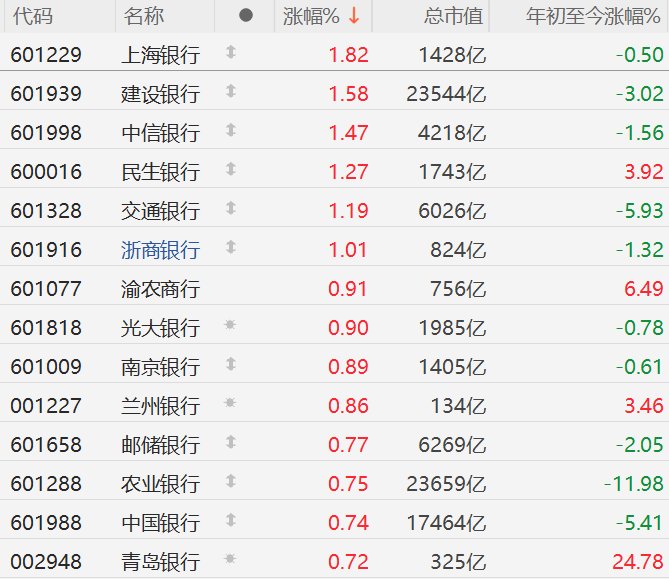
A股银行股普涨,建设银行、交通银行续涨超1%
Ge Long Hui A P P· 2026-02-10 05:25
Core Viewpoint - The A-share market saw a broad increase in bank stocks, with Shanghai Bank, Construction Bank, CITIC Bank, Minsheng Bank, Bank of Communications, and Zheshang Bank all rising over 1% [1] Group 1: Stock Performance - Shanghai Bank (601229) increased by 1.82%, with a total market capitalization of 142.8 billion and a year-to-date decline of 0.50% [2] - Construction Bank (601939) rose by 1.58%, holding a market cap of 2,354.4 billion, and has a year-to-date decline of 3.02% [2] - CITIC Bank (601998) saw a rise of 1.47%, with a market cap of 421.8 billion and a year-to-date decline of 1.56% [2] - Minsheng Bank (600016) increased by 1.27%, with a market cap of 174.3 billion and a year-to-date increase of 3.92% [2] - Bank of Communications (601328) rose by 1.19%, with a market cap of 602.6 billion and a year-to-date decline of 5.93% [2] - Zheshang Bank (601916) increased by 1.01%, with a market cap of 82.4 billion and a year-to-date decline of 1.32% [2] Group 2: Additional Bank Performance - Chongqing Rural Commercial Bank (601077) rose by 0.91%, with a market cap of 75.6 billion and a year-to-date increase of 6.49% [2] - Everbright Bank (601818) increased by 0.90%, with a market cap of 198.5 billion and a year-to-date decline of 0.78% [2] - Nanjing Bank (6000009) rose by 0.89%, with a market cap of 140.5 billion and a year-to-date decline of 0.61% [2] - Lanzhou Bank (001227) increased by 0.86%, with a market cap of 13.4 billion and a year-to-date increase of 3.46% [2] - Postal Savings Bank (601658) rose by 0.77%, with a market cap of 626.9 billion and a year-to-date decline of 2.05% [2] - Agricultural Bank (601288) increased by 0.75%, with a market cap of 2,365.9 billion and a year-to-date decline of 11.98% [2] - Bank of China (601988) rose by 0.74%, with a market cap of 1,746.4 billion and a year-to-date decline of 5.41% [2] - Qingdao Bank (002948) increased by 0.72%, with a market cap of 32.5 billion and a year-to-date increase of 24.78% [2]




“文旅大戏”进云南,交通银行金融活水浇灌彩云之南文旅新生态
Jin Rong Jie· 2026-02-10 01:49
Core Viewpoint - The event "Travel Yunnan, Good Luck with Bank of Communications" aims to deepen cooperation between the bank and the Yunnan provincial government, focusing on providing high-quality financial services to support the local tourism industry [1][4]. Group 1: Event Overview - The launch event was held on February 9, featuring over 400 attendees, including government officials and industry leaders [1]. - The event included the release of a promotional video titled "Where the Heart Is, Yunnan" showcasing the unique lifestyle and experiences in Yunnan [4]. Group 2: Strategic Initiatives - Bank of Communications plans to enhance its strategic partnership with the Yunnan provincial government by offering more precise credit allocations and a wider range of financial products [4]. - The bank aims to create a model of integration between tourism and finance, promoting mutual benefits [4]. Group 3: Financial Products and Services - The bank has introduced various financial products tailored for the tourism industry, such as "Colorful Cloud Tourism Loan" and "Intangible Cultural Heritage Inheritance Loan" [5]. - A new "Colorful Yunnan Tourism Theme Credit Card" has been launched, providing tourists with discounts and benefits while exploring Yunnan [5]. Group 4: Marketing and Promotion - The bank is actively promoting Yunnan's tourism through collaborations with major media outlets and its own platforms, highlighting unique travel routes [5]. - The bank has partnered with over 300 quality merchants to offer consumer discounts across various travel-related services [5].

数字人民币再添新场景 保障农民工工资发放
Jin Rong Shi Bao· 2026-02-10 01:28
Core Insights - The implementation of digital RMB for wage payments to migrant workers in Chengdu represents a significant innovation in financial technology aimed at enhancing livelihood security [1][2] - The use of digital RMB smart contracts is designed to ensure timely and accurate wage payments, addressing historical issues of wage delays and disputes among migrant workers [2][3] Group 1: Digital RMB Implementation - The first application of digital RMB for migrant worker wage payments was successfully executed in Chengdu, facilitated by the People's Bank of China and local financial institutions [1][2] - The initiative aims to create a secure and efficient payment system that minimizes the risk of wage misappropriation and enhances transparency in wage distribution [2][3] Group 2: Smart Contract Mechanism - Digital RMB smart contracts automate and enforce payment agreements, preventing human interference and ensuring compliance across different financial institutions [3][4] - The smart contract system allows for precise control over funds, ensuring that wages are disbursed according to predefined agreements without the risk of diversion [3][4] Group 3: Broader Applications of Smart Contracts - Beyond wage payments, digital RMB smart contracts are being tested in various sectors, including prepaid fund management, supply chain finance, and subsidy distribution [6][7] - The technology ensures that prepaid funds remain under the consumer's control until the conditions of the contract are met, thereby protecting consumer interests even in cases of merchant bankruptcy [5][6] Group 4: Future Developments - The digital RMB operation management center plans to expand the application of smart contracts and enhance the underlying service infrastructure to support broader financial inclusion and social governance [8][9] - Ongoing innovations in smart contract applications are expected to improve the efficiency and effectiveness of financial services across multiple sectors [8][9]

金价重回5000美元关口,普通人买金该如何布局?
Bei Jing Shang Bao· 2026-02-10 01:28
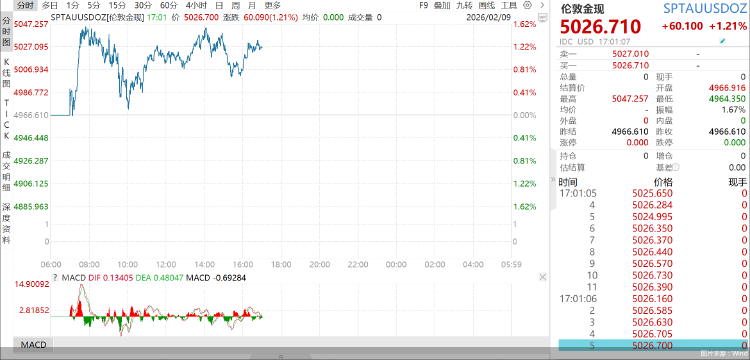
Group 1 - The core viewpoint of the article highlights the contrasting behaviors in the gold market, with retail investors showing enthusiasm for gold purchases while financial institutions adopt a cautious approach by tightening investment criteria and risk assessments [1][4][5] - As of February 9, the spot gold price reached a high of $5047.257 per ounce, marking a significant recovery above the $5000 threshold, with A-share and Hong Kong gold stocks also experiencing gains [1][2] - The current gold bull market has seen a cumulative increase of over 246% since its low in September 2022, with a notable surge of 64.56% in 2025, indicating strong market momentum [2][3] Group 2 - Financial institutions are raising the entry thresholds for gold investment, with banks like China Construction Bank and China Merchants Bank increasing minimum investment amounts for gold accumulation products [4][5] - Risk assessment standards are being tightened, with banks requiring higher risk tolerance levels for clients wishing to engage in gold investment, reflecting a proactive approach to consumer protection [5][6] - Despite the tightening of investment criteria, banks are also promoting gold-related financial products, such as structured deposits, which offer lower risk and are designed to appeal to a broader range of investors [6][7] Group 3 - The demand for physical gold products is surging ahead of the Spring Festival, with many banks reporting shortages of gold bars and coins, leading to recommendations for online purchases [7][8] - Investors are advised to be cautious during the holiday period, as international gold markets will remain active while domestic trading may pause, creating potential volatility [8][9] - Recommendations for gold investment include understanding the purpose of the purchase, with suggestions for gradual buying strategies to mitigate risks associated with high prices [10][11]


智通ADR统计 | 2月10日





智通财经网· 2026-02-09 22:30
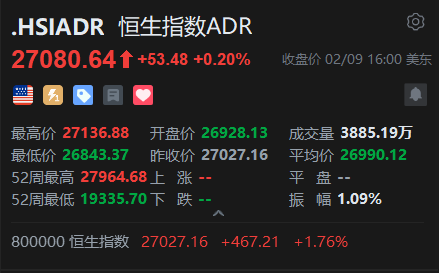
Group 1 - Major blue-chip stocks mostly rose, with HSBC Holdings closing at HKD 141.801, up 1.8% from the previous close [2] - Tencent Holdings closed at HKD 561.139, reflecting a 0.2% increase from the previous close [2] Group 2 - Tencent Holdings (00700) latest price is HKD 560.000, with an increase of HKD 12.500 or 2.28% [3] - Alibaba Group (09988) latest price is HKD 157.900, up HKD 2.900 or 1.87% [3] - HSBC Holdings (00005) latest price is HKD 139.300, up HKD 4.500 or 3.34% [3] - AIA Group (01299) latest price is HKD 86.350, up HKD 2.850 or 3.41% [3] - Meituan (03690) latest price is HKD 91.050, down HKD 0.350 or 0.38% [3] - China Ping An (02318) latest price is HKD 73.000, up HKD 3.400 or 4.89% [3] - Hong Kong Exchanges (00388) latest price is HKD 418.600, up HKD 11.000 or 2.70% [3] - Baidu Group (09888) latest price is HKD 142.200, up HKD 4.400 or 3.19% [3] - Kuaishou Technology (01024) latest price is HKD 69.300, down HKD 1.950 or 2.74% [3]
工资秒到更安心 数字人民币智能合约守护农民工“钱袋子”
Zhong Guo Zheng Quan Bao· 2026-02-09 22:04
Core Insights - The digital RMB wallet has been successfully implemented for migrant workers' salary payments in Chengdu, showcasing the convenience and security it offers to users [1][2] - The initiative represents a significant innovation in leveraging technology to enhance livelihood security, with multiple stakeholders collaborating to ensure effective implementation [2][3] Group 1: Implementation and Impact - The digital RMB smart contract for salary payments allows for precise and direct payment to workers, addressing concerns related to traditional payment methods [2][3] - The initiative has been positively received by migrant workers, who express increased confidence in the payment process due to the transparency and security provided by the digital RMB [2][3] Group 2: Technological Framework - The digital RMB smart contract operates on a digital infrastructure that ensures automated execution and prevents human intervention, facilitating cross-institutional interactions [3] - The digital RMB operation management center provides an ecosystem service platform that allows banks to integrate their systems and create tailored solutions for various applications [3] Group 3: Future Applications and Expansion - Beyond salary payments, the digital RMB smart contract is being tested in areas such as prepayment fund management, supply chain finance, and subsidy distribution [5] - As of January 2026, there have been 486,400 contracts signed under the digital RMB smart contract, with a total transaction amount of 316 million yuan, indicating a growing adoption across various sectors [6]
金价重回5000美元关口,普通人买金该如何在春节布局?
Bei Jing Shang Bao· 2026-02-09 14:56
Core Viewpoint - The gold market is experiencing a surge in demand ahead of the Spring Festival, with spot gold prices stabilizing above $5000 per ounce, while financial institutions are adopting a cautious approach by tightening investment criteria and risk assessments [1][4][5]. Group 1: Gold Price Dynamics - As of February 9, spot gold prices reached a high of $5047.257 per ounce, marking a significant recovery above the $5000 threshold [1]. - The current bull market for gold has seen prices increase by over 246% since September 2022, with a notable rise of 64.56% in 2025 alone [3]. - Despite recent volatility, including a sharp drop to $4402.06 per ounce, gold prices rebounded quickly, indicating strong market resilience [3][4]. Group 2: Institutional Responses - Major banks have raised the entry thresholds for gold investment, with institutions like China Construction Bank increasing the minimum amount for gold accumulation to 1500 yuan [5][6]. - Risk assessment standards have been tightened, requiring clients to achieve a cautious risk rating before engaging in gold accumulation products [6]. - These measures are in response to the heightened volatility in gold prices and aim to protect inexperienced investors from potential losses [6]. Group 3: Consumer Behavior and Recommendations - There is a growing demand for physical gold products, with banks reporting shortages and advising customers to purchase online [8][9]. - Consumers are encouraged to clarify their purchasing intentions, distinguishing between investment and consumption, and to consider strategies like dollar-cost averaging to mitigate risks [10][11]. - The market is expected to remain volatile during the Spring Festival, with predictions of gold prices fluctuating between $4600 and $5000 per ounce [11].
践行金融为民,交通银行信用卡率先落地账单分期贴息
Feng Huang Wang Cai Jing· 2026-02-09 13:11
Core Viewpoint - The Ministry of Finance, the People's Bank of China, and the Financial Regulatory Administration jointly issued a notice to optimize the implementation of personal consumption loan interest subsidy policies, aiming to boost consumption, expand domestic demand, and lower personal consumption credit costs for residents [1] Group 1: Policy Implementation - The new policy extends the implementation period, expands the support scope, broadens the subsidy areas, and increases the subsidy standards to enhance consumer willingness [1] - The policy includes credit card installment services for the first time, allowing eligible customers to enjoy a 1% financial subsidy, with an annual cap of 3,000 yuan per person, covering both personal consumption loans and credit card installments [1] Group 2: Bank Response - The Bank of Communications (BCOM) Credit Card Center quickly responded to the policy, becoming one of the first financial institutions to implement installment interest subsidies, aligning with national strategies and supporting high-quality economic development [1] - BCOM Credit Card has launched a comprehensive subsidy service through its "Buy Now" app and customer service hotline, ensuring customers can easily access the subsidy [2] Group 3: Customer Experience - Customers can apply for the subsidy through a simple one-click process on the "Buy Now" app during the installment application, with subsidy funds automatically deducted from the corresponding installment interest [2] - BCOM Credit Card integrates consumption scenarios with installment services, creating a seamless experience where customers can enjoy subsidies and exclusive benefits, effectively reducing financing costs [2] Group 4: Future Outlook - The implementation of installment interest subsidies reflects BCOM Credit Card's commitment to the "finance for the people" philosophy and its dedication to serving the real economy [3] - BCOM Credit Card plans to continue optimizing products and services in the consumer finance sector, ensuring high-quality financial services support consumption upgrades [3]
践行金融为民,交通银行信用卡率先落地账单分期贴息
凤凰网财经· 2026-02-09 12:40
Core Viewpoint - The recent policy issued by the Ministry of Finance, the People's Bank of China, and the Financial Regulatory Administration aims to boost consumption and expand domestic demand by optimizing personal consumption loan interest subsidy policies, including extending the policy duration, expanding support scope, and increasing subsidy standards [1] Group 1: Policy Implementation - The new fiscal subsidy policy includes credit card installment services for the first time, allowing eligible customers to enjoy a 1% subsidy with an annual cap of 3000 yuan, which includes both personal consumption loans and credit card installments [1] - The policy aims to lower personal consumption credit costs and enhance consumer willingness to spend, thereby supporting high-quality development of the real economy [1] Group 2: Service Enhancement - The Bank of Communications Credit Card Center has quickly responded to the policy by launching a comprehensive subsidy service through its "Buy Now" app and customer service hotline, ensuring customers can easily access the subsidy [2] - Customers can apply for the subsidy with a simple one-click process in the app during the installment application, with subsidy amounts automatically deducted from the corresponding installment interest and clearly displayed in monthly statements [2] Group 3: Consumer Engagement - The bank is integrating consumption scenarios with installment services, creating a closed-loop experience of "consumption equals installment, installment enjoys subsidy," which effectively stimulates market vitality and supports the continuous prosperity of the consumption sector [2] - The bank's commitment to the "financial for the people" philosophy is demonstrated through its proactive service in implementing financial policies that benefit consumers and enhance the consumption finance sector [3]