
CM BANK(03968)

Search documents
招商银行大宗交易成交5.70万股 成交额242.82万元
Zheng Quan Shi Bao Wang· 2025-08-28 13:30
证券时报·数据宝统计显示,招商银行今日收盘价为42.98元,下跌0.05%,日换手率为0.40%,成交额为 35.30亿元,全天主力资金净流出1.96亿元,近5日该股累计下跌1.13%,近5日资金合计净流出11.20亿 元。 招商银行8月28日大宗交易平台出现一笔成交,成交量5.70万股,成交金额242.82万元,大宗交易成交价 为42.60元,相对今日收盘价折价0.88%。该笔交易的买方营业部为光大证券股份有限公司宁波柳汀街证 券营业部,卖方营业部为光大证券股份有限公司宁波柳汀街证券营业部。 进一步统计,近3个月内该股累计发生9笔大宗交易,合计成交金额为47.28亿元。 两融数据显示,该股最新融资余额为87.10亿元,近5日增加6.44亿元,增幅为7.98%。(数据宝) 8月28日招商银行大宗交易一览 | 成交量 | 成交金额 | 成交价 | 相对当日收盘 | | | | --- | --- | --- | --- | --- | --- | | (万 | (万元) | 格 | 折溢价(%) | 买方营业部 | 卖方营业部 | | 股) | | (元) | | | | | 5.70 | 242.82 | 4 ...


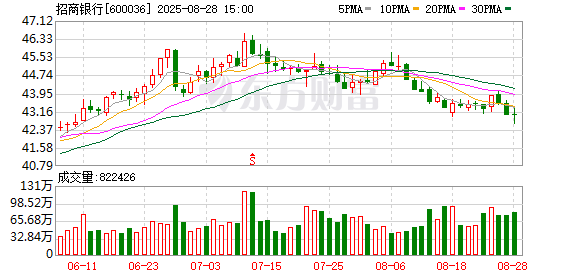
招商银行今日大宗交易折价成交5.7万股,成交额242.82万元
Xin Lang Cai Jing· 2025-08-28 09:38
| 交易日期 | 证券简称 | 证券代码 | 成交价(元) 成交金额(万元) 成交量( * ) 买入营业部 | | | | 卖出营业部 | | --- | --- | --- | --- | --- | --- | --- | --- | | 2025-08-28 | 招商银行 | 600036 | 242.82 42.6 | 5.7 | 光大证券股份有限 | 光大证券股份有限 | | | | | | | | 公司宁波柳汀街证 | 公司宁波柳汀街证 | | | | | | | | Jak stop 11 dary | Jald view 11 days | | 8月28日,招商银行大宗交易成交5.7万股,成交额242.82万元,占当日总成交额的0.07%,成交价42.6元,较市场收盘价42.98元折价0.88%。 ...

智通AH统计|8月28日
智通财经网· 2025-08-28 08:21
Group 1 - The article highlights the top three companies with the highest AH premium rates as Northeast Electric (00042) at 785.25%, Hongye Futures (03678) at 250.59%, and Andeli Juice (02218) at 244.32% [1] - The bottom three companies with the lowest AH premium rates include Ningde Times (03750) at -18.40%, Hengrui Medicine (01276) at 3.92%, and China Merchants Bank (03968) at 7.34% [1] - The article provides a detailed ranking of the top ten and bottom ten AH stocks based on their premium rates and deviation values, indicating significant disparities in market valuations between H-shares and A-shares [1][2] Group 2 - The top three companies with the highest deviation values are Jinli Permanent Magnet (06680) at 37.37%, Andeli Juice (02218) at 33.98%, and Fudan Zhangjiang (01349) at 22.87% [1] - Conversely, the bottom three companies with the lowest deviation values are BYD Company (01211) at -75.67%, Longpan Technology (02465) at -57.24%, and Changfei Optical Fiber Cable (06869) at -31.37% [1][2] - The article emphasizes the importance of monitoring these premium rates and deviation values as indicators of potential investment opportunities and market inefficiencies [1][2]
招商银行依法有序推进个人消费贷款贴息政策组织实施工作
Jin Tou Wang· 2025-08-28 02:28
招商银行将按照市场化、法治化原则,优化办理流程,简化办理手续,加强资金合规使用,推动政策尽 快实施。具体办理渠道、操作指引等实施细则后续将通过招商银行官方网站、微信公众号等渠道发布, 敬请留意。 2025年8月27日,招商银行(600036)发布公告称,为贯彻落实党中央和国务院关于大力提振消费、全 方位扩大国内需求的决策部署,降低居民消费信贷成本,助力释放居民消费潜力,根据《关于印发<个 人消费贷款财政贴息政策实施方案>的通知》(财金〔2025〕80 号)精神及相关要求,招商银行正在依 法有序推进个人消费贷款贴息政策的组织实施工作。 ...
智通ADR统计 | 8月28日
智通财经网· 2025-08-27 22:38
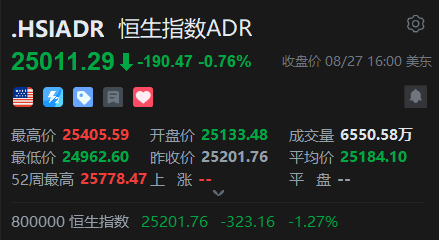
Market Overview - Major blue-chip stocks mostly declined, with HSBC Holdings closing at HKD 100.610, up 0.51% from the previous close, while Tencent Holdings closed at HKD 592.833, down 1.03% [1] Stock Performance Summary - Tencent Holdings: Decreased by HKD 10.500, or 1.72%, with an ADR price of HKD 592.833, showing a decline of HKD 6.167 or 1.03% compared to the Hong Kong stock price [2] - Alibaba Group: Increased by HKD 0.200, or 0.16%, with an ADR price of HKD 118.977, down HKD 2.523 or 2.08% compared to the Hong Kong stock price [2] - HSBC Holdings: Decreased by HKD 0.100, or 0.10%, with an ADR price of HKD 100.610, up HKD 0.510 or 0.51% compared to the Hong Kong stock price [2] - AIA Group: Decreased by HKD 1.050, or 1.43%, with an ADR price of HKD 72.011, down HKD 0.389 or 0.54% compared to the Hong Kong stock price [2] - BYD Company: Decreased by HKD 2.500, or 2.13%, with an ADR price of HKD 114.159, down HKD 0.941 or 0.82% compared to the Hong Kong stock price [2] - JD.com: Decreased by HKD 3.100, or 2.49%, with an ADR price of HKD 120.000, down HKD 1.300 or 1.07% compared to the Hong Kong stock price [2]





贴息前消费贷市场调查: 系统进行最后测试 9月起“自动减息”
Zhong Guo Zheng Quan Bao· 2025-08-27 20:21
Core Insights - The implementation of consumer loan interest subsidy policies is expected to stimulate credit activity expansion and provide dual support for retail lending business, benefiting both consumer loan demand and bank interest margins [1][8][9] Group 1: Consumer Loan Interest Subsidy Policy - The consumer loan interest subsidy policy will allow borrowers to apply online, simplifying the process and potentially reducing the effective interest rate to the 2% range after subsidies [1][3] - Banks are preparing to launch the subsidy program, with some already offering high credit limit products, including those with limits reaching millions [2][4] - The minimum interest rate for consumer loans remains at 3%, but with the subsidy, borrowers can expect a significant reduction in their actual interest burden [3][4] Group 2: Bank Strategies and Consumer Engagement - Banks are actively promoting consumer loans and preparing for the subsidy rollout, with some offering increased loan limits to valued customers [2][3] - The subsidy will be automatically applied based on consumer spending data, requiring borrowers to authorize banks to access their transaction records [5][6] - Banks emphasize that the subsidy does not apply to credit card or installment products, and they will not charge any fees for processing these loans [7][6] Group 3: Economic Implications - The fiscal subsidy is expected to lower financing costs and protect bank interest margins, while also enhancing the stability of consumer loan growth [8][9] - Analysts suggest that the subsidy could support a significant increase in consumer and service industry loan disbursements, with estimates indicating that every 100 billion yuan in subsidies could facilitate 1 trillion yuan in loans [8] - There is a need for compliance monitoring to ensure that the funds are used appropriately for consumption rather than investment, to mitigate credit risk [9]


贴息前消费贷市场调查:系统进行最后测试 9月起“自动减息”
Zhong Guo Zheng Quan Bao· 2025-08-27 20:17
Core Insights - The implementation of consumer loan interest subsidy policies is expected to stimulate credit activity expansion and provide dual support for retail lending business, benefiting both consumer loan demand and bank interest margins [1][6][5] Group 1: Consumer Loan Interest Subsidy Policy - The consumer loan interest subsidy policy is in the final testing phase, allowing borrowers to apply online and automatically receive interest deductions based on their consumption data [1][3] - The minimum interest rate for consumer loans remains at 3%, but after subsidies, the effective rate for borrowers could drop to the 2% range [2][3] - Banks are preparing to launch the subsidy program, with some already increasing loan limits for quality customers [2][3] Group 2: Loan Products and Features - Some banks offer consumer loans with credit limits reaching millions, with specific products allowing for a combination of consumption and business purposes [3][4] - The subsidy policy will not apply to credit card transactions or installment products, and banks will not charge any fees for processing these loans [5][6] - The subsidy will be automatically applied to identifiable consumer expenditures, while unrecognized expenses may require manual verification [4][5] Group 3: Market Impact and Future Outlook - The subsidy is expected to lower financing costs and protect bank interest margins, potentially stabilizing loan pricing in the retail sector [6][5] - Analysts suggest that the subsidy could support a significant increase in consumer and service industry loan issuance, with estimates indicating that every 100 billion yuan in subsidies could facilitate 1 trillion yuan in loans [6] - There is a need for banks to ensure compliance in the use of subsidized loans to prevent misuse in non-consumption areas [6]
信用卡资金炒股风险巨大
Zheng Quan Ri Bao· 2025-08-27 16:20
Core Viewpoint - The use of credit card funds for stock trading is prohibited by banks and regulatory authorities due to the inherent risks and misalignment with the intended purpose of credit cards, which is for consumer spending rather than investment [1][4]. Group 1: Risks of Using Credit Card Funds for Stock Trading - Using credit card funds for stock trading significantly amplifies the debt risk for cardholders due to high borrowing costs and short repayment periods, making it unsuitable for investment purposes [2]. - Credit card funds are often accessed through cash advances or other means that incur fees several times higher than brokerage financing rates, creating a burden that requires excessive returns to cover costs [2]. - The mismatch between the short repayment cycle of credit cards and the uncertain duration of stock investments can lead to financial distress for investors [2]. Group 2: Impact on Banking and Risk Management - The diversion of credit card funds into the stock market undermines the established risk management frameworks of banks, which are based on predictable consumer behavior and spending patterns [3]. - This shift necessitates increased operational costs for banks as they must invest more resources to meet compliance requirements and manage the heightened risk associated with stock market volatility [3]. - The potential for increased default rates and bad debts due to stock market investments poses a threat to the asset quality of banks [3]. Group 3: Broader Financial Market Implications - The speculative nature of using credit card debt for stock trading can disrupt normal market operations, leading to irrational price fluctuations and undermining the price discovery process [4]. - Such practices transfer stock market risks to the banking system, increasing the overall risk exposure of the financial system [4]. - The consequences of investment losses can lead to a cycle of debt for cardholders, potentially impacting the stability of the credit market and the broader financial ecosystem [4].

高铁LOF: 鹏华中证高铁产业指数型证券投资基金(LOF)2025年中期报告
Zheng Quan Zhi Xing· 2025-08-27 15:37
Fund Overview - The fund is named Penghua CSI High-Speed Rail Industry Index Securities Investment Fund (LOF) and aims to closely track the underlying index with minimal tracking deviation [2] - The fund operates as a listed open-end fund and was established on May 27, 2015, with a total of 52,837,383.28 shares at the end of the reporting period [2][3] - The investment strategy is based on passive index investment, aiming to minimize tracking error and maintain a daily tracking deviation of no more than 0.35% [2][3] Financial Performance - For the reporting period from January 1, 2025, to June 30, 2025, the fund's A class shares experienced a net value growth rate of -4.63%, while the benchmark growth rate was -4.30% [9][12] - The C class shares had a net value growth rate of -4.77%, and the I class shares recorded -4.59% [9][12] - The fund's total assets under management reached 12,513 billion RMB, with a total of 359 public funds managed [6] Market and Industry Insights - The high-speed rail industry showed steady growth in the first half of 2025, with fixed asset investment reaching 355.9 billion RMB, a year-on-year increase of 5.5% [11] - The number of passengers transported by rail from January to May was 1.86 billion, reflecting the ongoing impact of policies promoting rail transport [11] - The industry is expected to continue benefiting from high levels of fixed asset investment and equipment demand, with a positive outlook for the second half of 2025 [11][12]
落实金融支持新型工业化政策 银行加码“科创人才贷”
Zhong Guo Jing Ying Bao· 2025-08-27 15:35
Core Viewpoint - The introduction of "Talent Loans" by multiple banks aims to address the financing challenges faced by high-level talent in the technology and innovation sectors, facilitating a cycle of talent aggregation, innovation breakthroughs, financial support, and industrial upgrades [1][2]. Group 1: Financial Innovation and Support - The People's Bank of China and several ministries issued guidelines to provide tailored financial services for high-level talent, including credit financing and management consulting [1]. - "Talent Loans" focus on high-level talent, creating a credit channel that accelerates the transformation of technological achievements and supports the construction of new productive forces [1][3]. Group 2: Addressing Financing Challenges - Banks are enhancing "Talent Loans" to solve the financing difficulties of research teams that lack assets and collateral, with limits reaching up to 10 million yuan for certain programs [2]. - The loans are designed to evaluate credit based on talent qualifications, technical patents, and R&D capabilities rather than traditional asset-based metrics, thus addressing the "light asset, difficult financing" issue [3][4]. Group 3: Evaluation and Risk Management - A comprehensive evaluation system is being developed to assess talent value, incorporating non-financial indicators and dynamic information to reduce subjective bias in credit assessments [6]. - A three-dimensional evaluation system is proposed to prevent overestimation of talent value, including quantitative models and technology maturity assessments [6][7]. Group 4: Future Policy Recommendations - Recommendations for future policy support include establishing a unified talent credit conversion mechanism, creating risk compensation funds, and enhancing dynamic supervision of talent loan projects [7].

