CISCO(04333)

Search documents
英伟达与新思科技宣布战略合作 共同推动跨行业设计与工程创新
Zheng Quan Shi Bao Wang· 2025-12-02 11:15
Core Insights - Nvidia and Synopsys are expanding their strategic partnership to drive innovation across various industries, addressing challenges such as increased workflow complexity, rising development costs, and pressure on time-to-market [1][2] Group 1: Partnership Details - Nvidia is investing $2 billion to acquire 2.6% of Synopsys' common stock at a price of $414.79 per share [1] - The collaboration aims to leverage Nvidia's strengths in AI and accelerated computing alongside Synopsys' leadership in engineering solutions [1][2] Group 2: Key Initiatives - The partnership will accelerate Synopsys' product applications by utilizing Nvidia's CUDA-X libraries and AI-Physics technology, enhancing various computationally intensive applications such as chip design and physical verification [3] - Both companies will integrate Synopsys' AgentEngineer technology with Nvidia's Agentic AI technology stack to enable autonomous design capabilities in EDA and simulation workflows [3] - The collaboration will promote the use of digital twin technology to connect the physical and digital worlds, facilitating innovation in sectors like semiconductors, robotics, automotive, energy, industrial, and healthcare [3] - Joint market expansion efforts will be undertaken to promote local and cloud-based solutions, leveraging Synopsys' extensive sales force and existing customer base [3] Group 3: Non-Exclusive Agreement - The partnership is not exclusive, allowing both Nvidia and Synopsys to continue collaborating with a broader ecosystem in the semiconductor and electronic design automation (EDA) sectors [4]


英伟达20亿美元入股新思科技,无排他协议,也不要求购买芯片
Guo Ji Jin Rong Bao· 2025-12-02 10:02
Core Insights - NVIDIA is reinforcing its dominance in the artificial intelligence market through strategic investments and partnerships, including a $2 billion acquisition of Synopsys shares and an expanded collaboration to develop new AI-driven design tools [1][4]. Group 1: Strategic Partnership - NVIDIA and Synopsys have signed a securities purchase agreement, with NVIDIA acquiring 4,821,717 shares at $414.79 per share, totaling $2 billion [1]. - The partnership aims to address engineering challenges across various industries by combining NVIDIA's AI and accelerated computing capabilities with Synopsys' engineering solutions [1][2]. - The collaboration will focus on five key areas, including accelerating Synopsys applications and integrating agentic AI workflows [2]. Group 2: Technological Advancements - The partnership will leverage digital twin technology to connect physical and digital worlds, enhancing virtual design, testing, and validation across multiple sectors [3]. - Cloud solutions will be developed to provide GPU-accelerated engineering solutions, making them accessible to engineering teams of all sizes [3]. Group 3: Market Strategy - Both companies will jointly develop marketing plans to promote their solutions across various industries, utilizing Synopsys' extensive global network of sales and channel partners [3]. - The collaboration is not exclusive, as both companies continue to engage with the broader semiconductor and EDA ecosystem to create shared growth opportunities [5]. Group 4: Investment Landscape - NVIDIA has made significant investments recently, including a potential $100 billion investment in OpenAI and $15 billion in Anthropic, raising concerns about its influence over customers purchasing its chips [4]. - Synopsys' CEO stated that the funds from NVIDIA will provide flexibility in adapting their software to NVIDIA chips, clarifying that there are no commitments to purchase NVIDIA GPUs with the investment [4].
英伟达入股EDA霸主新思科技,科创100ETF华夏(588800)成交额领先同类,科创半导体ETF(588170)越跌越买
Mei Ri Jing Ji Xin Wen· 2025-12-02 06:25
Group 1 - The Shanghai Stock Exchange Sci-Tech Innovation Board 100 Index decreased by 1.45% as of December 2, 2025, with mixed performance among constituent stocks [1] - The Sci-Tech 100 ETF (588800) saw a trading volume of 2.03 billion yuan, with a turnover rate of 7.94% [1] - The semiconductor materials and equipment theme index on the Sci-Tech Innovation Board fell by 1.57%, with major declines in stocks like Huahai Chengke and Aisen Co., Ltd. [1] Group 2 - Nvidia invested $2 billion in Synopsys at a price of $414.79 per share, aiming to enhance GPU-accelerated engineering solutions through collaboration [1] - Zhongyuan Securities highlighted that the "14th Five-Year Plan" will focus on integrated circuits and basic software, with increased government procurement in the information technology sector [2] - The domestic operating system Harmony is expected to benefit from Huawei's AI business development, positively impacting ecosystem partners [2]
英伟达20亿美元入股新思科技,成为第七大股东深化AI合作
Jin Rong Jie· 2025-12-02 02:56
Core Insights - Nvidia announced a $2 billion investment to acquire 2.6% of Synopsys shares at $414.79 per share, marking a significant strategic partnership between the two tech giants [1] - Following the announcement, Synopsys' stock price rebounded strongly, rising over 8% in pre-market trading [1] - The collaboration will focus on accelerating Synopsys' compute-intensive application product iterations and advancing AI engineering technology [1] Group 1 - Nvidia will assist Synopsys in enhancing its engineering solutions, integrating Nvidia's AI and accelerated computing technology with Synopsys' capabilities [1] - The partnership aims to improve the design and verification processes of intelligent products with higher precision, speed, and lower costs [1] - Nvidia's CEO emphasized the significance of this collaboration, stating it will bring revolutionary changes to the design and engineering sectors [1] Group 2 - Unlike Nvidia's previous investment in OpenAI, this partnership does not obligate Synopsys to purchase Nvidia's chips, indicating a focus on technological collaboration rather than commercial bundling [2] - Nvidia's stock rose 1.65% on the day of the announcement, with a trading volume of $33 billion, leading the market [2] - This strategic investment reflects Nvidia's ongoing efforts to build an AI ecosystem and strengthen its influence in the chip design toolchain [2]
英伟达又出手,20亿美元入股新思科技,投资支出2年暴涨10倍
Sou Hu Cai Jing· 2025-12-02 01:37
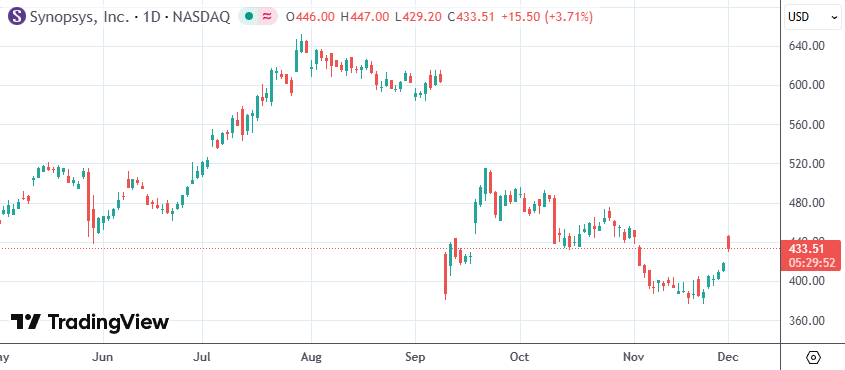
Core Insights - NVIDIA announced the acquisition of 4.8 million shares of Synopsys at $414.79 per share, totaling $2 billion, gaining a 2.6% stake and becoming one of the top ten shareholders [1] - The partnership aims to enhance GPU-accelerated engineering solutions, integrating NVIDIA's AI capabilities with Synopsys' leading engineering software to address complexities in semiconductor workflows [2][8] Investment Details - The acquisition price was slightly below Synopsys' stock price of $418.01 prior to the announcement, which saw a subsequent increase of 4.6% to $438.29 after the news [5] - NVIDIA's stock, which had previously dropped 12.6%, rose by 1.65% on the day of the announcement [5] Strategic Collaboration - The collaboration will focus on optimizing Synopsys' software for broader applications, promoting AI workflows, and leveraging Synopsys' extensive sales network for joint marketing efforts [8][10] - NVIDIA's CEO emphasized the partnership as a technological upgrade aimed at enhancing engineering and design efficiency across various industries, with potential market growth of 10-100 times [10] Market Context - The competitive landscape is shifting with Google's TPU posing a challenge to NVIDIA's GPU dominance, as Google aims to capture 10% of NVIDIA's revenue share [6][12] - Despite NVIDIA's claims of GPU superiority, market sentiment appears cautious, reflected in stock performance [7] Broader Investment Strategy - NVIDIA has significantly increased its investment activities, totaling $62.24 billion over the past two years, with a focus on expanding its ecosystem and partnerships in AI [14][16] - The company aims to maintain its leadership in AI computing, despite concerns over potential market corrections reminiscent of past tech bubbles [15][17]

半导体早参 | DeepSeek发布新模型,英伟达投资20亿美元入股EDA霸主新思科技
Mei Ri Jing Ji Xin Wen· 2025-12-02 01:29
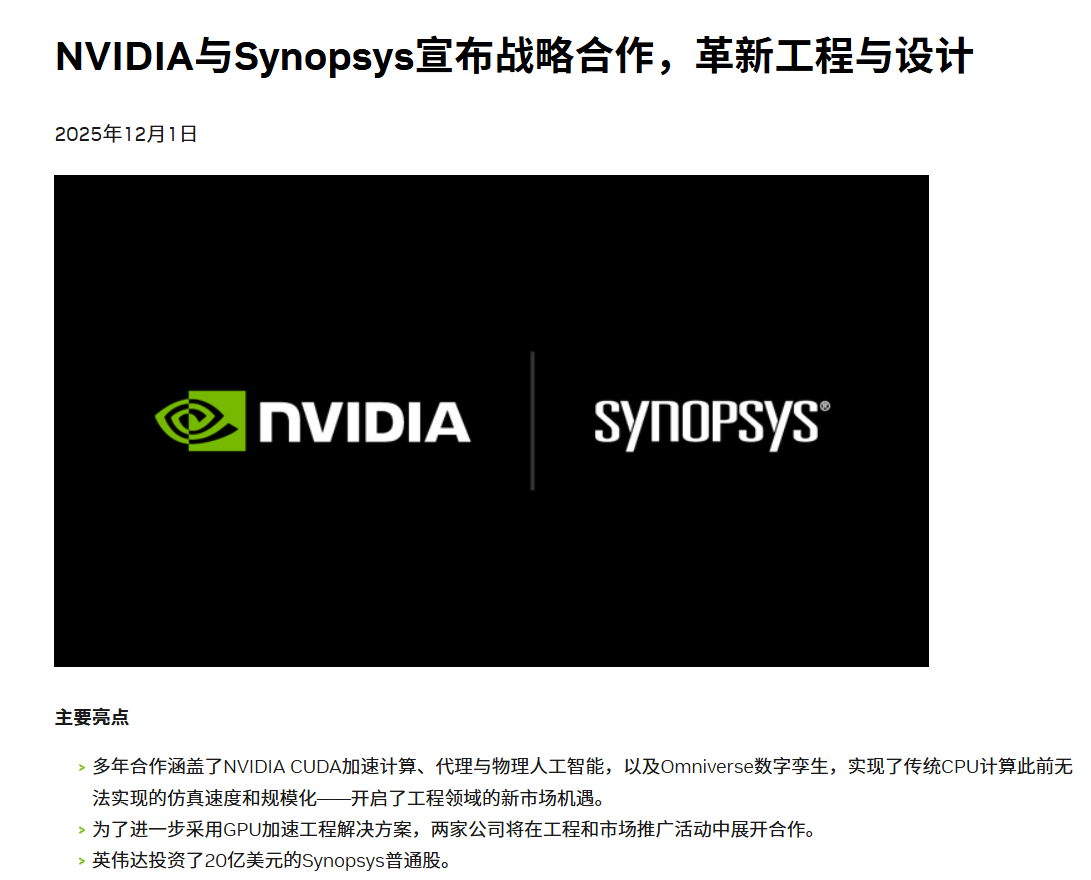
Market Overview - On December 1, the Shanghai Composite Index rose by 0.65% to close at 3914.01 points, the Shenzhen Component Index increased by 1.25% to 13146.72 points, and the ChiNext Index gained 1.31% to 3092.50 points [1] - The overnight U.S. market saw the Dow Jones Industrial Average decline by 0.90%, the Nasdaq Composite fell by 0.38%, and the S&P 500 dropped by 0.53% [1] Industry News - DeepSeek released two official model versions, DeepSeek-V3.2 and DeepSeek-V3.2-Speciale, with updates available on their official website, app, and API [2] - NVIDIA invested $2 billion in Synopsys at a share price of $414.79, aiming to enhance GPU-accelerated engineering solutions through collaboration in engineering and marketing activities [2] AI Glasses Market - The AI glasses concept stocks in the A-share market gained renewed attention, with major tech companies entering the space. Alibaba launched Quark AI glasses on November 27, which sold out in the first batch [3] - Li Auto is set to hold a launch event for its first AI glasses on December 3, while Meta's new Ray-Ban smart glasses received positive global feedback, and Google is reviving its AI glasses project, potentially launching in Q4 2026 [3] Semiconductor Supply Chain - Samsung Electronics and SK Hynix have become key players in Google's TPU supply chain, with SK Hynix likely to be the preferred supplier for Google's seventh-generation TPU internal HBM3E 8-layer chips [3] - Huajin Securities remains optimistic about the semiconductor supercycle driven by AI, recommending attention to the entire semiconductor industry chain from design to manufacturing and packaging [3] Related ETFs - The Sci-Tech Semiconductor ETF (588170) and its linked funds track the Sci-Tech Board Semiconductor Materials and Equipment Index, focusing on semiconductor equipment (61%) and materials (23%) [4] - The Semiconductor Materials ETF (562590) also emphasizes semiconductor equipment (61%) and materials (21%), highlighting the importance of domestic substitution in the semiconductor industry [4]
美股五连涨,结束!英伟达,入股新思科技!
Zhong Guo Ji Jin Bao· 2025-12-02 00:20
Market Overview - US stock market ended a five-day rally with major indices declining: Dow Jones down 427.09 points (0.90%) to 47289.33, Nasdaq down 89.77 points (0.38%) to 23275.92, and S&P 500 down 36.46 points (0.53%) to 6812.63 [3] - The ISM Manufacturing PMI for November fell to 48.2, marking the largest contraction in four months and remaining below the neutral level of 50 for nine consecutive months [3] Oil Market - Crude oil prices increased due to supply concerns following an attack on a Black Sea terminal, with WTI crude rising by $0.77 (1.32%) to $59.32 per barrel and Brent crude up $0.79 (1.27%) to $63.17 per barrel [10] - The Caspian Pipeline Consortium announced a suspension of operations at its Black Sea terminal due to drone attacks, although loading operations at Novorossiysk port continued [10] Nvidia and Synopsys Partnership - Nvidia announced a $2 billion investment in Synopsys, aiming to enhance collaboration in AI and accelerated computing, which will help design and validate smart products more efficiently [4][5] - Nvidia's CEO Jensen Huang emphasized the significance of this partnership for innovation in the design and engineering sectors [5] Semiconductor Sector - Mixed performance in the semiconductor sector with Philadelphia Semiconductor Index down 0.07%, while companies like ASML and NXP Semiconductors saw gains of over 2% [5] - Micron Technology plans to invest $9.6 billion in a new AI memory chip factory in Japan, expected to start production around 2028, supported by substantial government subsidies [7] Large Tech Stocks - Major tech stocks showed mixed results, with Apple up over 1% and Amazon rising 0.28%, while Google, Microsoft, and Facebook experienced declines of over 1% [8]

英伟达斥资20亿美元投资新思科技 获得约2.6%的股权
Sou Hu Cai Jing· 2025-12-01 23:58
Core Insights - Nvidia announced an investment of approximately $2 billion in Synopsys, acquiring about 2.6% of its shares at a price of $414.79 per share [1][3] Group 1: Company Overview - Synopsys is a key player in electronic design automation (EDA), providing essential software for chip design and manufacturing [3] - The company focuses on automating the design of transistors and circuit layouts, as well as design verification [3] Group 2: Strategic Partnership - The partnership aims to leverage Nvidia's accelerated computing and AI capabilities to enhance engineering and design processes [3] - Nvidia's CEO emphasized the goal of helping engineers invent superior products that will shape the future [3] Group 3: Technological Integration - The collaboration will integrate Synopsys' design software with Nvidia's "CUDA-X" technology and AI simulation platform for improved efficiency [3] - Plans include merging Synopsys' AI-driven design engine with Nvidia's AI technology stack to automate semiconductor design and verification processes [3] Group 4: Development and Market Strategy - Both companies will develop a virtual testing environment based on digital twin technology, applicable across various industries including semiconductors, automotive, and aerospace [3] - The jointly developed technologies will be offered through cloud platforms, ensuring accessibility for businesses of all sizes [3] - The partnership will utilize Synopsys' global distribution network alongside Nvidia's technology to expand into local deployment and cloud markets [3]
英伟达锁定EDA霸主!20亿美元入股新思科技扩大合作版图!黄仁勋发声
Sou Hu Cai Jing· 2025-12-01 23:45
Core Insights - Nvidia announced an expansion of its strategic partnership with Synopsys, investing $2 billion to purchase common stock [1][4] - Following the announcement, Synopsys' stock price surged over 11% in pre-market trading, closing with a gain of approximately 4.85% [1] - The collaboration aims to integrate Nvidia's strengths in AI and accelerated computing with Synopsys' engineering solutions, enhancing the design, simulation, and verification of smart products [1][3] Company Overview - Synopsys is a leading Electronic Design Automation (EDA) company based in California, specializing in silicon design and verification [3] - The company's software is crucial for designing complex layouts of billions of transistors and connectors in modern chips, particularly for AI systems [3] Strategic Importance - Nvidia's CEO, Jensen Huang, described the partnership as a "revolutionary" industry transformation, emphasizing the shift from traditional software tools to GPU acceleration [5] - The industrial market, which Huang highlighted, represents a significant opportunity, with engineering software expenditures potentially reaching billions, while prototyping costs can be 10 to 20 times higher [5] Market Dynamics - The transition from CPU to GPU in supercomputing has dramatically shifted, with 90% of the world's scientific supercomputers now utilizing GPUs [6] - The partnership is expected to significantly reduce workload times, enhancing value delivery to customers [6]

英伟达锁定EDA霸主,20亿美元入股新思科技扩大合作版图
Feng Huang Wang· 2025-12-01 22:37
Core Insights - Nvidia announced an expansion of its strategic partnership with Synopsys, investing $2 billion to purchase common stock [1][4] - Following the announcement, Synopsys' stock price surged over 11% in pre-market trading, reaching $464 per share [1] - The partnership aims to integrate Nvidia's strengths in AI and accelerated computing with Synopsys' engineering solutions to enhance the design, simulation, and verification of smart products [3] Company Overview - Synopsys is a leading Electronic Design Automation (EDA) company based in California, specializing in silicon design and verification [3] - It is recognized as the world's top provider of chip automation design solutions and chip interface IP [3] - Synopsys' software is crucial for designing complex layouts of billions of transistors and connectors in modern chips, particularly for AI systems [3] Partnership Details - The collaboration will leverage Nvidia's CUDA-X libraries and AI physics technology to optimize Synopsys' compute-intensive applications across various fields [3] - Both companies will work together to create next-generation virtual design, testing, and verification solutions for industries such as semiconductors, robotics, aerospace, automotive, energy, industrial, and healthcare [3][4] - The integration of Synopsys' technology with Nvidia's AI technology stack will enable autonomous design capabilities in EDA and simulation workflows [4] Market Impact - Nvidia plans to implement a joint marketing strategy with Synopsys to reach engineering teams across multiple industries [4] - Nvidia's investment in Synopsys is part of a broader strategy, as the company has also invested in other firms like OpenAI and CoreWeave, and even agreed to invest $5 billion in Intel for joint chip development [4] - Industry analysts note that Synopsys' technology is utilized by major semiconductor and systems companies, including Google and Tesla, enhancing its market relevance [4]