
INTEL(04335)

Search documents
英特尔取得SRS传输的系统和方法专利
Jin Rong Jie· 2026-01-16 06:00
国家知识产权局信息显示,英特尔公司取得一项名为"SRS传输的系统和方法"的专利,授权公告号 CN112994862B,申请日期为2020年12月。 作者:情报员 声明:市场有风险,投资需谨慎。本文为AI基于第三方数据生成,仅供参考,不构成个人投资建议。 本文源自:市场资讯 ...

台积电董事长霸气回应英特尔竞争 魏哲家:大客户订单不松动
Jing Ji Ri Bao· 2026-01-15 23:36
Group 1 - TSMC's Chairman Wei Zhejia firmly stated that there will be no loosening of orders from major clients like Nvidia and Apple, despite potential collaborations between Intel and these companies [1] - Wei emphasized that the complexity of advanced processes and system integration means that competition cannot be won merely by increasing capital expenditure [1] - The timeline for developing advanced technology and achieving mass production typically spans several years, making it difficult to alter supply chain choices in the short term [1] Group 2 - Intel's latest technology advancement is the Intel 18A process, focusing on optimizing internal product demands, which will serve as a key technological foundation for future client and server products [2] - The upcoming 14A process is being developed with external (foundry) demands in mind from the outset [2] - Nvidia has announced collaborations with Intel to develop customized data center and PC products, including tailored x86 CPUs for data centers and integrated x86 systems with Nvidia's RTX GPU chips for personal computing [2]

英特尔副总裁宋继强:智能体AI带来算力挑战,异构计算将成为构建AI基础设施的重要方向
Xin Lang Cai Jing· 2026-01-15 10:41
Core Insights - The development of AI capabilities is transitioning from foundational large models to intelligent agents, focusing more on providing specific functions to build workflows [3][7] - Embodied intelligence, as a significant form of physical AI, integrates digital intelligence into physical devices for interaction with the real world, primarily emphasizing reasoning applications [3][7] Group 1: AI Capability Development - AI capability is evolving towards intelligent agents that emphasize specific functionalities for workflow construction [3][7] - Industry analysts predict a shift in AI computing power demand from training to inference, which will consume a corresponding proportion of computational resources [3][7] Group 2: Heterogeneous Computing Infrastructure - The need for heterogeneous infrastructure arises from the requirement for multi-agent systems to build complete workflows and operate multiple streams in parallel [3][7] - AI agents require support from various models, schedulers, and preprocessing modules, necessitating different hardware to provide optimal energy efficiency and cost-effectiveness [3][7] - A flexible heterogeneous support capability is needed at three levels: an open AI software stack at the top, infrastructure adaptable to small and medium enterprises in the middle, and a diverse hardware integration at the bottom [3][7] Group 3: Embodied Intelligence Robotics - In the field of embodied intelligent robotics, various methods for achieving intelligent tasks are being explored, with no optimal solution currently established [4][8] - Traditional industrial automation focuses on reliability, real-time performance, and computational accuracy, while large language model-based approaches lean towards neural network solutions requiring differentiated computing architectures [4][8] - The era of embodied intelligent robots is anticipated to bring challenges in computing power and energy consumption, with heterogeneous computing becoming the core architecture of AI infrastructure [4][8] Group 4: Multi-Agent Systems - The future of robotics, when scaled to millions, is expected to transcend industrial limitations and support widespread commercial and personalized applications, necessitating multi-agent systems [4][9] - The technical stack for multi-agent systems operating on physical AI devices faces numerous challenges, with heterogeneous computing being a key pathway to address system reliability issues [4][9]

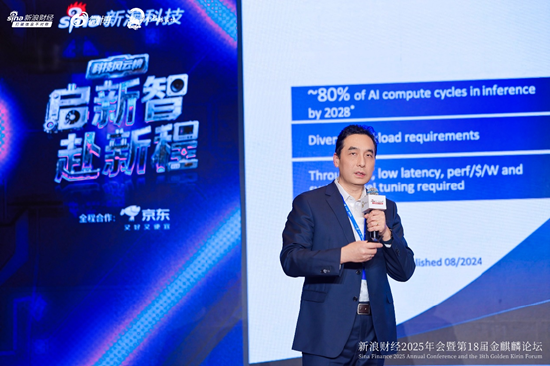
英特尔副总裁宋继强:AI计算重心正在向推理转移
Xin Lang Cai Jing· 2026-01-15 10:41
Core Insights - The development of AI capabilities is transitioning from foundational large models to intelligent agents, focusing more on providing specific functions to build workflows [3][7] - Embodied intelligence, as a significant form of physical AI, integrates digital intelligence into physical devices for interaction with the real world, primarily emphasizing reasoning applications [3][7] AI Demand and Infrastructure - Industry analysts predict that the demand for AI computing power is shifting from training to inference, which will consume a corresponding proportion of computing resources [3][7] - The construction of multi-agent systems is essential for creating complete workflows and achieving parallel operations, necessitating heterogeneous infrastructure [3][7] Heterogeneous System Requirements - Heterogeneous systems must possess flexible support capabilities at three levels: an open AI software stack at the top layer, infrastructure that meets the needs of small and medium enterprises in the middle layer, and a bottom layer that integrates diverse hardware [3][7] - The bottom layer should include various architectures such as CPUs, GPUs, NPUs, AI accelerators, and brain-like computing devices to build a flexible heterogeneous system through layered infrastructure [3][7] Embodied Intelligence Robotics - In the field of embodied intelligent robotics, various methods for achieving intelligent tasks are being explored, from traditional layered custom models to end-to-end VLA models, with no optimal solution currently established [4][8] - Traditional industrial automation solutions focus on reliability, real-time performance, and computational accuracy, while large language model-based solutions lean towards neural network approaches requiring differentiated computing architectures [4][8] Future Challenges and Opportunities - The era of embodied intelligent robots is anticipated to bring challenges in computing power and energy consumption, with heterogeneous computing becoming the core architecture of AI infrastructure [4][8] - As the scale of robots reaches millions, they are expected to break through industrial scene limitations and widely support commercial and personalized applications, necessitating multi-agent systems [4][8][9]
大行评级|瑞银:上调英特尔目标价至49美元 预计今年前景好坏参半但逐步改善
Ge Long Hui· 2026-01-15 08:03
Core Viewpoint - UBS expects Intel's Q4 performance to rise due to strong demand in personal computers and servers, with market expectations for the company's guidance for the fiscal quarter ending March being reasonable [1] Group 1: Financial Outlook - UBS forecasts a mixed but gradually improving outlook for Intel this year, as the current fiscal quarter is expected to be the most challenging period for capacity issues [1] - The firm predicts that memory price increases will suppress some positive momentum in the short-term personal computer market [1] - UBS raised Intel's target price from $40 to $49 while maintaining a "Neutral" rating [1] Group 2: Key Financial Metrics - During the earnings release, Intel is expected to discuss gross margins, which are anticipated to fall below the 40% to 60% range, with UBS predicting an annual gross margin of approximately 38% [1] - Total and net capital expenditures are forecasted to be around $19 billion and $12 billion, respectively, both showing slight increases [1] - Operating expenses are expected to align with previous guidance at $16 billion [1] Group 3: Wafer Foundry Business - A critical narrative surrounds the wafer foundry business, which UBS believes is gradually improving [1] - There are potential discussions with multiple clients regarding collaboration on 14nm process technology, including Nvidia in gaming, as well as Google, Broadcom, and Apple as potential customers [1]
苹果入股英特尔?特朗普语出惊人
Guan Cha Zhe Wang· 2026-01-15 07:41
Core Viewpoint - The news highlights President Trump's comments regarding potential investments in Intel by Apple, which has sparked significant interest in the tech industry, despite the lack of official confirmation from either company about such an investment [1][3]. Group 1: Intel's Financial Situation - Intel has faced financial difficulties due to strategic missteps and costly capacity expansions over the past two years [3]. - In August of the previous year, the Trump administration announced an agreement to invest $8.9 billion in Intel, acquiring approximately 10% of the company's shares, making the U.S. government a major shareholder [3]. - Following Trump's investment, Nvidia also invested $5 billion in Intel shares [3]. - Intel's stock has seen a significant increase of nearly 110% over the past six months, reflecting some recovery in its performance [8]. Group 2: Potential Collaboration with Apple - There are speculations that Apple may be considering a deeper collaboration with Intel, particularly in the chip manufacturing sector, although the likelihood of Apple purchasing a large amount of Intel stock is deemed low [4]. - Apple has previously been a long-term customer of Intel but has shifted to using self-developed processors, making a return to Intel processors unlikely [4]. - Recent job postings by Apple indicate a focus on advanced packaging technologies, including Intel's proprietary EMIB technology, suggesting potential collaboration in chip packaging [4][5]. Group 3: Future Developments - Reports suggest that Apple is considering using Intel's 18A process technology for its future System on Chip (SoC) designs, with plans to start mass production of low-end M-series chips by the second to third quarter of 2027 [6]. - If successful, this could lead to significant orders for Intel, with projected shipments of 15 to 20 million M-series chips for low-end MacBooks and iPads by 2027 [7]. Group 4: Market Context - In the third quarter of 2025, Intel reported revenue of $13.7 billion, marking a 3% year-over-year increase, the first positive growth in over a year and a half [9]. - Despite this, Intel's foundry business continues to face challenges, with a 2% decline in revenue for that segment [9]. - The global foundry market saw a 17% year-over-year revenue increase, reaching $84.8 billion, with TSMC holding a 39% market share compared to Intel's 5% [9].


英特尔亮出AI PC王牌:酷睿Ultra
Tai Mei Ti A P P· 2026-01-15 07:08
Core Insights - Intel has launched the Core Ultra processors based on the new Panther Lake platform, marking a significant advancement in semiconductor manufacturing with the introduction of the Intel 18A process technology [2][3] - The company anticipates 2026 to be a pivotal year for the industry, with a surge in AI, computing, and process technology [2] - The Core Ultra processors demonstrate enhanced CPU performance, leading GPU integration, and improvements in energy efficiency, gaming performance, connectivity, and AI capabilities [2] Manufacturing Technology - The Core Ultra processors utilize Intel's 18A process technology, featuring backplane power delivery and a mixed architecture of performance cores, efficiency cores, and LPE efficiency cores [3] Performance Metrics - The Panther Lake platform supports up to 27 hours of battery life, with CPU performance improved by 60%, graphics performance by 77%, and overall AI performance doubled compared to the previous generation [4] - The new platform achieves a total computing power of 180 TOPS, capable of running large models with 700 billion parameters, and features a low-power NPU with 50 TOPS, enhancing inference performance by 2 times [4] AI Strategy and Market Position - Intel supports over 350 independent software developers and more than 900 AI models for local deployment, indicating rapid growth in the AI PC ecosystem [6] - The company plans to release the first Core Ultra-equipped PCs globally on January 27, with a total computing power equivalent to 40 data centers [6] - Intel's strategy includes the simultaneous launch of edge processors and corresponding PC versions, aiming to accelerate AI deployment in various sectors [6] Market Outlook - Following the restart of its wafer foundry business, Intel aims to validate its manufacturing technology through product performance and market success, which is crucial for future advancements [8] - The capital market outlook for Intel is optimistic, with a 32% increase in stock price year-to-date as of January 14, 2026, and a notable 10.6% rise over two days [8]

英特尔(INTC.US))盘前涨逾2% 特朗普暗示苹果已入股
Zhi Tong Cai Jing· 2026-01-14 14:03
周三,英特尔(INTC.US)盘前涨逾2%,报48.48美元。消息面上,白宫官方发布的视频显示,特朗普在 采访时透露,"苹果公司已出手投资英特尔"。目前,苹果公司及英特尔尚未证实此事。 ...
美股异动 | 英特尔(INTC.US))盘前涨逾2% 特朗普暗示苹果已入股
智通财经网· 2026-01-14 13:52
智通财经APP获悉,周三,英特尔(INTC.US)盘前涨逾2%,报48.48美元。消息面上,白宫官方发布的视 频显示,特朗普在采访时透露,"苹果公司已出手投资英特尔"。目前,苹果公司及英特尔尚未证实此 事。 ...
被立案调查,携程跌超10%;特朗普称苹果已投资英特尔,后者涨逾4%;特斯拉将停售FSD买断版,全面转向订阅制模式【美股盘前】
Mei Ri Jing Ji Xin Wen· 2026-01-14 11:28
Group 1 - Major stock index futures are experiencing declines, with Dow futures down 0.16%, S&P 500 futures down 0.18%, and Nasdaq futures down 0.22% [1] - Ctrip's stock dropped over 10% following an announcement that the State Administration for Market Regulation is investigating the company for alleged monopolistic practices under the Anti-Monopoly Law of the People's Republic of China [1] - Tesla will stop selling the one-time purchase version of its Full Self-Driving (FSD) capability starting February 14, transitioning to a subscription-only model for this feature [1] - Citigroup analysts have raised their gold price target to $5,000 per ounce over the next three months, although a pullback is expected after reaching this high [1] - Silver prices have surpassed $90 per ounce, marking a historic high and pushing its total market value above $5 trillion, making it the second-largest asset globally, surpassing Nvidia [1] Group 2 - Google announced the launch of the open-source medical AI model MedGemma 1.5, aimed at enhancing medical imaging support [2] - The U.S. government has approved Nvidia to export its H200 AI chips to China, which is expected to restart shipments to Chinese customers [2] - Intel's stock rose over 4% after former President Trump revealed in an interview that Apple has invested in Intel, although this has not been confirmed by either company [2] - Rivian's stock fell over 3% after the company announced a recall of 19,641 units of its R1T pickup and R1S SUV due to potential safety risks related to incorrect maintenance procedures [2]


