
INTEL(04335)

Search documents
苹果台积电或入股英特尔,软银英伟达已投资
Xin Lang Ke Ji· 2025-09-28 11:06
软银上月宣布对Intel投资20亿美元,本月早些时候,NVIDIA宣布,将向Intel投资50亿美元,并与其联 合开发PC与数据中心芯片。 【#曝苹果与台积电将入股英特尔#】据报道,Intel不仅与科技巨头苹果有所接触,还与晶圆代工龙头台 积电展开洽谈,探讨在制造业方面的投资或建立伙伴关系的可能性。 作为曾经全球最大的半导体公司,Intel如今正深陷困境,其CEO陈立武正积极争取投资和承诺,以推动 公司复兴计划。 苹果此前曾是Intel的重要客户,其Mac电脑曾长期使用Intel的处理器,但几年前改用自家设计的芯片, 而台积电可以说是Intel的竞争对手。 事实上,Intel与台积电的合作传闻并非首次出现,早在今年4月,就有消息称双方曾讨论过成立合资企 业,台积电计划持有20%的股份。 不过目前相关公司均拒绝发表评论。(快科技) ...


苹果或成英特尔新股东 此前已获159亿美元投资
Xi Niu Cai Jing· 2025-09-28 03:17
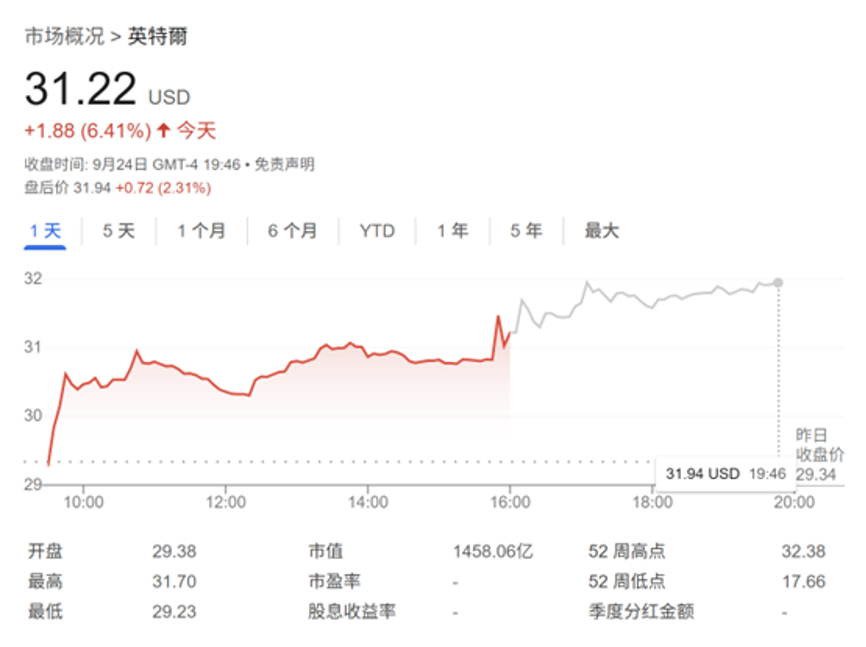
Group 1 - Intel is in early talks with Apple regarding strategic investment and deepening cooperation, focusing on collaboration in the semiconductor sector, particularly advanced packaging technology [1] - Intel's stock price surged by 6.41% to $31.22 per share, with a total market capitalization of $145.8 billion, continuing a rebound that has seen a cumulative increase of over 40% since mid-August and approximately 54% year-to-date [4] - Intel has secured three significant rounds of investment totaling $15.9 billion, including an $8.9 billion investment from the U.S. federal government for a 9.9% stake, and additional investments from SoftBank and NVIDIA amounting to $2 billion and $5 billion respectively [4] Group 2 - The new CEO's revival strategy is a key element in addressing Intel's financial challenges, as the company reported a net loss of $2.92 billion in Q2 2025, with a $1.25 billion loss in its foundry business and facing competition from AMD in the server CPU market [4] - The introduction of investment partners is expected to alleviate financial pressure and support the deployment of Intel's "14A" cutting-edge technology by accumulating customer backing [4]
英特尔正与台积电接洽 讨论潜在的投资或制造合作伙伴关系
Sou Hu Cai Jing· 2025-09-28 01:08
近日有报道称,英特尔已与苹果接洽,探讨可能的投资和深化合作的方式。目前双方的接触仍处于早期 阶段,暂时还无法达成协议。同时英特尔也在联系其他公司,探索潜在的投资和合作交易。 台积电董事长兼首席执行官魏哲家已经明确表示,不会考虑收购或者入股英特尔的制造部门,以避免技 术泄露和潜在的竞争风险。另外由于英特尔参与了众多与国防和国家安全相关的项目,加上美国政府已 是其最大单一股东,台积电对英特尔的相关投资也要经过美国政府的评估和审查。 据TrendForce报道,有业内人士透露,英特尔另外接触的合作方还包括了台积电(TSMC),讨论潜在 的投资或制造合作伙伴关系。英特尔是在与苹果接洽后不久,再与台积电进行了联系。不过对于双方而 言,这都是一个漫长而复杂的过程,台积电的主要担忧是潜在的技术泄露,领先的半导体制造技术是台 积电长期增长的主要动力之一。 外界非常怀疑英特尔是否还有能力提供尖端芯片所需要的生产能力,并提供相应的性能指标,所以一直 在讨论英特尔是否应该将制造部门剥离。英特尔长期以来都面临股东的压力,要求分拆制造部分并专注 于芯片设计。 ...

新浪财经ESG:英特尔 MSCI(明晟)ESG评级调降至AA
Xin Lang Cai Jing· 2025-09-26 23:06
Core Viewpoint - Intel's MSCI ESG rating has been downgraded from AAA to AA as of September 26, 2025 [1] Group 1 - The downgrade reflects a significant change in Intel's environmental, social, and governance performance metrics [1]
新旧巨头联姻 英伟达斥资50亿美元入股英特尔
Zhong Guo Jing Ying Bao· 2025-09-26 19:16
Core Viewpoint - The collaboration between NVIDIA and Intel marks a significant alliance in the semiconductor industry, with NVIDIA investing $5 billion to acquire Intel shares and both companies aiming to develop customized data center and personal computing products to enhance computing capabilities [1][2]. Group 1: Investment and Market Impact - NVIDIA will acquire Intel shares at $23.28 per share, totaling an investment of $5 billion, making NVIDIA the second-largest shareholder of Intel with an expected ownership of over 4% [1]. - Following the announcement, Intel's stock price surged over 30%, increasing its market capitalization by approximately $26.5 billion, indicating positive market sentiment towards the collaboration [1]. - The global data center accelerator card market is projected to grow from $15.2 billion in 2023 to $80 billion by 2030, with a compound annual growth rate of 29.8% [3]. Group 2: Strategic Collaboration - The partnership aims to leverage Intel's CPU capabilities and NVIDIA's GPU strengths, with Intel customizing CPU chips for NVIDIA's AI infrastructure and NVIDIA integrating its GPUs into Intel's personal computing systems [1][5]. - This collaboration is seen as a strategic move to counter the increasing competition from cloud service providers like Amazon, Google, and Microsoft, who are developing their own chips [5][6]. - The integration of CPU and GPU technologies is expected to create a more efficient and powerful computing ecosystem, enhancing performance for cloud service providers [5][6]. Group 3: Industry Trends and Future Outlook - The collaboration is anticipated to reshape the competitive landscape, with a focus on heterogeneous computing becoming mainstream, where CPU and GPU collaboration is crucial [3][4]. - The AI PC market is expected to see significant changes, with predictions indicating that over 70% of PCs will have AI capabilities by 2028, creating substantial market opportunities for both companies [6]. - The partnership may lead to more cross-company collaborations in the semiconductor industry, accelerating innovation and integration of chip design and software ecosystems [7].

双“英”恩仇:英特尔和英伟达的三十年
Jing Ji Guan Cha Wang· 2025-09-26 16:50
Core Insights - Nvidia's founder Jensen Huang announced a $5 billion investment in Intel, marking a significant collaboration between the two companies after decades of rivalry in the chip industry [1] - This partnership aims to develop the revolutionary "Intel x86 with RTX" chip, which could reshape the semiconductor landscape [1] - The historical context of Nvidia and Intel's competition highlights the evolution of the chip industry and the potential for major shifts in market dynamics [1] Historical Context - In 1992, Jensen Huang and his co-founders recognized the growing demand for graphics processing, leading to the establishment of Nvidia [2][3] - Nvidia's early struggles were contrasted with Intel's dominance in the CPU market, which held over 80% market share in the early 1990s [3] - Despite initial indifference, Intel allowed Nvidia to find its footing in the market, leading to the launch of the NV1 chip in 1995 [4] Competitive Dynamics - Nvidia's introduction of the GeForce 256 in 1999 marked its rise in the GPU market, while Intel remained focused on CPUs [5] - The relationship began to sour as Nvidia challenged Intel's chipset business with its nForce chipset in 2001, leading to legal disputes [6][8] - Nvidia's strategic shift towards collaboration with AMD and increased patent control followed its legal battles with Intel [8] Market Evolution - By 2010, Nvidia had established a stronghold in the discrete GPU market, while Intel struggled with its Larrabee project aimed at competing in the GPU space [9][10] - Nvidia's CUDA architecture revolutionized computing by enabling parallel processing, positioning it as a leader in the GPU market [12][13] - The emergence of AI in 2012 further solidified Nvidia's dominance, as its GPUs became essential for deep learning applications [16] Manufacturing Strategies - Intel's manufacturing model faced challenges with delays in its 10nm process, while Nvidia adopted a fabless model, outsourcing production to TSMC [18][19] - This strategic choice allowed Nvidia to focus on innovation and design, while Intel's manufacturing setbacks contributed to its decline [19] Current Landscape - The partnership between Nvidia and Intel represents a significant shift in the semiconductor industry, as both companies seek to adapt to changing market conditions [20][21] - However, the competitive landscape has evolved, with AMD gaining market share and specialized chips emerging as alternatives to traditional GPUs [22][23] - Geopolitical factors also play a crucial role in shaping the future of the semiconductor industry, impacting both companies' strategies [24][26] Conclusion - The collaboration between Nvidia and Intel signifies a new chapter in their long-standing rivalry, but the future remains uncertain as the industry continues to evolve [24][26]
美股异动丨英特尔涨近5%,据报与苹果和台积电讨论投资或合作
Ge Long Hui A P P· 2025-09-26 14:47
Core Viewpoint - Intel's stock experienced a nearly 5% increase, reaching $35.59, following reports of discussions with Apple and TSMC regarding investment or manufacturing collaborations [1] Group 1: Company Developments - Intel has initiated contact with companies including Apple and TSMC to explore potential investment or manufacturing partnerships [1] - These efforts reportedly began prior to President Trump's expressed interest in Intel last month, indicating a proactive approach by the company [1] - The acceleration of these discussions coincides with the U.S. government's acquisition of a 10% stake in Intel, suggesting increased governmental involvement in the company's strategic initiatives [1]

英特尔洽投资或合伙?台积电今日重申无任何相关讨论
Ju Chao Zi Xun· 2025-09-26 14:40
Core Viewpoint - Intel has been in discussions with TSMC regarding potential investment or partnership opportunities, but TSMC has denied any current talks about joint ventures or technology transfers [1][1][1] Group 1: Intel's Engagement with TSMC - Intel has reportedly reached out to TSMC to discuss investment in production or partnership matters [1] - TSMC's Chairman and CEO, C.C. Wei, reiterated that the company has not engaged in discussions with any other firms regarding joint ventures, technology licensing, or technology transfers [1] - There have been multiple market rumors about a potential joint venture between TSMC and Intel, but TSMC has consistently denied these claims [1] Group 2: Intel's Recent Investments - Intel has recently secured investments from the U.S. government, SoftBank, and NVIDIA, indicating strong financial backing for its initiatives [1]
美股异动 | 传特朗普新政剑指半导体进口依赖 格芯(GFS.US)涨近10% 英特尔(INTC.US)涨近4%
智通财经网· 2025-09-26 13:51
智通财经APP获悉,周五,格芯(GFS.US)开盘涨近10%,报35.84美元;英特尔(INTC.US)涨近4%,月内 续涨45%;德州仪器(TXN.US)涨超2%,报185.50美元。消息面上,特朗普政府正在权衡一项新计划,旨 在大幅减少美国对海外制造半导体的依赖,希望借此刺激本土制造业并重塑全球供应链。该政策的目标 是要求芯片企业在美国生产的半导体数量,与其客户自海外厂商进口的数量保持一致。据知情人士透 露,那些未能长期维持"1:1"比例的企业将被迫缴纳关税。目前,英特尔、美光科技、格芯、台积电 (TSM.US)及三星电子均已在美国投入数十亿美元建设芯片工厂。 ...

美股三大指数集体高开,英特尔涨超3%
Feng Huang Wang Cai Jing· 2025-09-26 13:42
Market Performance - The three major U.S. stock indices opened higher, with the Dow Jones up 0.45%, Nasdaq up 0.08%, and S&P 500 up 0.2% [1] Company News - GlobalFoundries saw a rise of over 11% following reports of new U.S. regulations aimed at reducing dependence on overseas chip production [1] - Intel's stock increased by over 3% amid reports of the company seeking investment or collaboration with TSMC [1] - Tesla's stock experienced a decline of nearly 1.5% as data showed a 23% year-over-year drop in electric vehicle registrations in Europe for August, marking the eighth consecutive month of decline [2] - XPeng Motors' stock rose nearly 5% after the announcement of its entry into five new markets: Switzerland, Austria, Hungary, Slovenia, and Croatia [2] Economic Insights - Federal Reserve official Jeff Schmidt indicated that there may not be a need for further interest rate cuts in the short term, as efforts to reduce inflation continue [2] - JPMorgan forecasts structural growth in the global storage market until 2027, driven by advancements in new products like HBM4, manufacturing breakthroughs, and demand from edge AI [2] - Meta is in discussions with Google Cloud to potentially utilize Google's Gemini large model to enhance its advertising business [2]