
CITIC Securities Co., Ltd.(06030)

Search documents
2026年1-2月IPO中介机构排名(A股)
Sou Hu Cai Jing· 2026-02-27 03:49
Summary of Key Points Core Viewpoint - In the first two months of 2026, the A-share market saw a total of 17 new listed companies, marking a 31% increase compared to the same period last year, with total fundraising reaching 13.946 billion yuan, up 118.25% year-on-year [1]. Group 1: New Listings and Fundraising - A total of 17 new companies were listed in January and February 2026, including 4 on the Shanghai Main Board, 4 on the Sci-Tech Innovation Board, 1 on the Shenzhen Main Board, and 8 on the Beijing Stock Exchange [1]. - The net fundraising amount for these new listings was 13.946 billion yuan, significantly higher than the 6.390 billion yuan raised in the same period last year [1]. Group 2: Underwriting Institutions Performance - Eleven underwriting institutions participated in the IPOs of the 17 new companies, with China International Capital Corporation (CICC) leading with 4 deals [2]. - Other notable institutions included Guotou Securities, Dongwu Securities, and CITIC Securities, each handling 2 deals [2][3]. Group 3: Legal Services Performance - Nine law firms provided legal services for the IPOs, with Shanghai Jintiancheng and Beijing Zhonglun both ranking first, each handling 4 cases [5]. - Beijing Kangda followed with 3 cases, while several other firms contributed to the total of 17 cases [5][7]. Group 4: Accounting Firms Performance - Seven accounting firms provided auditing services for the IPOs, with Rongcheng and Lixin both leading with 4 cases each [8]. - Tianjian handled 3 cases, while Xinyong Zhonghe and Zhonghui each managed 2 cases [8][10].



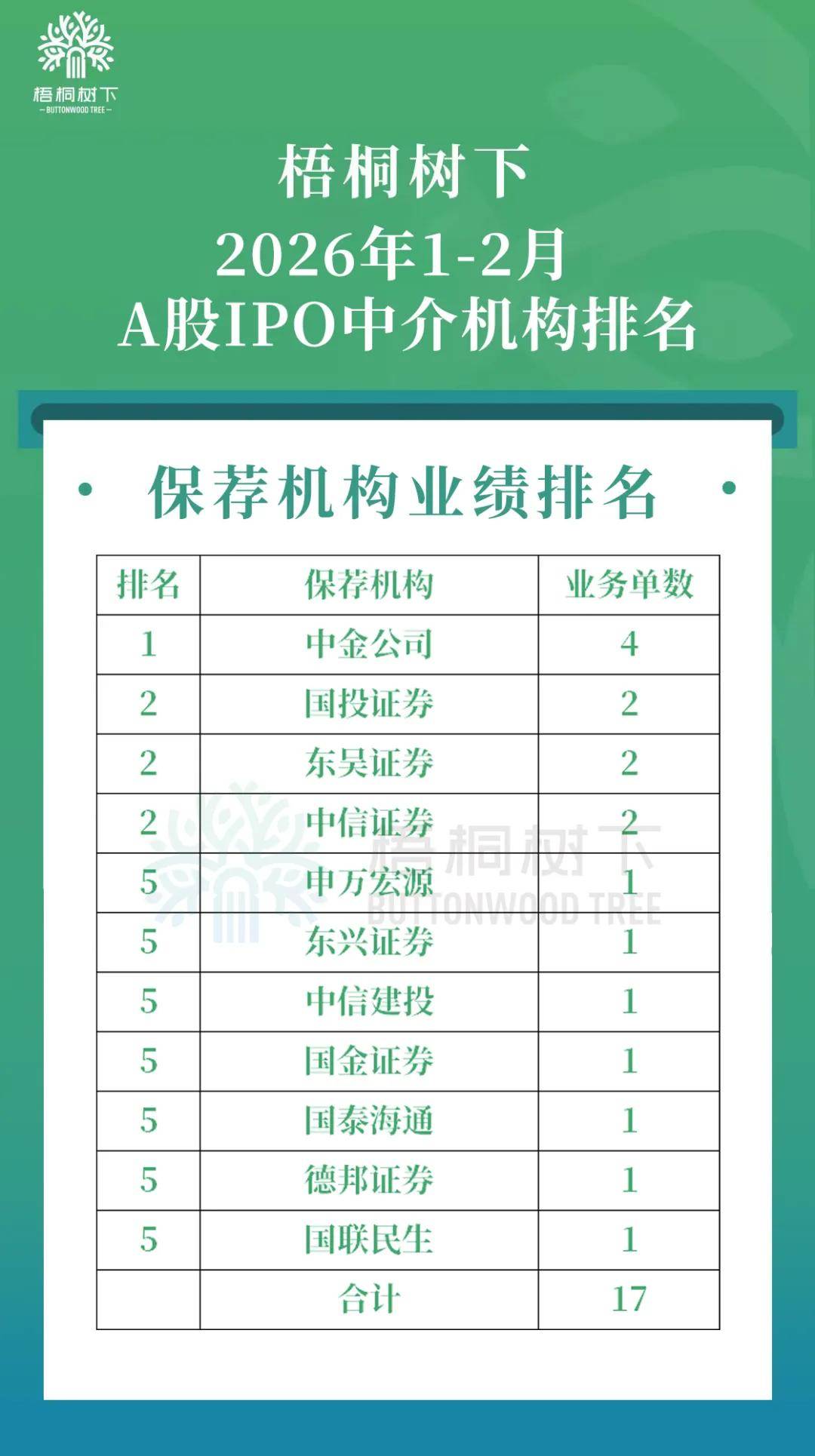
2026年1-2月IPO中介机构排名(A股)
梧桐树下V· 2026-02-27 03:33
Summary of Key Points Core Viewpoint - In the first two months of 2026, the A-share market saw a total of 17 new listed companies, marking a 31% increase compared to the same period last year, with a net fundraising amount of 13.946 billion yuan, up 118.25% year-on-year [1]. Group 1: Underwriting Institutions Performance Ranking - A total of 11 underwriting institutions were involved in the IPO business for the 17 new listed companies [2]. - China International Capital Corporation (CICC) ranked first with 4 deals, while Guotai Junan Securities, Dongwu Securities, and CITIC Securities each handled 2 deals [3][4]. Group 2: Law Firms Performance Ranking - Nine law firms provided legal services for the 17 new listed companies during the same period [5]. - Shanghai Jintiancheng and Beijing Zhonglun ranked first, each with 4 deals, followed by Beijing Kangda with 3 deals [6][8]. Group 3: Accounting Firms Performance Ranking - Seven accounting firms provided auditing services for the 17 new listed companies [9]. - Rongcheng and Lixin both ranked first with 4 deals each, while Tianjian had 3 deals, and Xinyong Zhonghe and Zhonghui each had 2 deals [10][12].

中信证券:维持右侧窗口期判断,AI机遇大于挑战
Ge Long Hui· 2026-02-27 02:03
Core Viewpoint - The narrative surrounding AI has led to a decline in domestic and foreign insurance stocks, primarily due to concerns over interest rate predictions and the sustainability of insurance companies' business models. However, the company believes that the potential negative impacts have been exaggerated, and the opportunities in the insurance sector outweigh the challenges, maintaining that the industry is in a significant opportunity period [1]. Group 1: Market Dynamics - Since early 2026, insurance stocks have experienced a notable correction, influenced by factors such as the stock market decline in Q4 2025 affecting 2025 annual reports, increased ETF volumes leading to funding pressures, and AI narratives causing emotional concerns [1]. - From an interest rate perspective, insurance stocks benefit from the steepening of China's bond yield curve. The company anticipates that China's fiscal deficit will be around 4% in 2026, with long-term bond supply remaining high. In a loose monetary policy environment, the bond yield curve is expected to continue its steepening trend observed since 2025 [1]. - The company projects that due to the unclear real estate situation and low CPI, interest rates in China will likely remain low for an extended period. Leading insurance companies are actively selling policies during this phase, expanding low-cost liabilities through dividend insurance and bank insurance channels, thus enjoying the benefits of term spreads [1]. Group 2: AI Impact on Insurance Value Chain - The company identifies six attributes that redefine the insurance value chain in the AI era, including necessity, amount, human behavior, frequency, service requirements, and trust requirements. The key is to balance human weaknesses (such as procrastination and optimism bias) with risk management needs. Products that counter human tendencies require stronger trust intermediaries and scenario-triggered mechanisms [2]. - AI applications present more opportunities than challenges for both tech companies and traditional insurers, given China's relatively low insurance penetration and diverse customer needs [2]. Group 3: Traditional vs. Tech Insurance Companies - Traditional insurance companies possess a strong competitive advantage, particularly in areas requiring long-term trust and complex service demands. They can continue to invest in extending their value into the physical world and human relationships, while also integrating technology to enhance standardization and data-driven processes [4]. - Tech companies have potential breakthroughs in various combinations of insurance products, including high-risk, scale, barrier, and flow combinations, each with specific characteristics and market opportunities [3]. Group 4: Investment Strategy and Regulatory Environment - The insurance sector is still in a significant opportunity period, with the adjustment of AI narratives creating a right-side investment window. Over the next 3-5 years, insurance companies are expected to benefit from a highly regulated and competitive environment, with market share likely to continue concentrating among the top seven companies [6]. - Regulatory policies are pushing the industry to strengthen asset-liability management and encourage insurance companies to participate as strategic investors in large-scale equity offerings. These policies are expected to act as catalysts for insurance stock prices [7].

破发股中科微至两年连亏 上市超募14亿中信证券保荐
Zhong Guo Jing Ji Wang· 2026-02-27 01:50
Group 1 - The company, Zhongke Weizhi (688211.SH), forecasts a revenue of between 235 million to 285 million yuan for the year 2025, with a projected net loss attributable to shareholders of between 13 million to 8.8 million yuan [1] - For the years 2022 to 2024, Zhongke Weizhi reported revenues of 2.315 billion yuan, 1.957 billion yuan, and 2.474 billion yuan respectively, with net losses attributable to shareholders of -119 million yuan, 20.85 million yuan, and -84.75 million yuan [1] - The company was listed on the Shanghai Stock Exchange's Sci-Tech Innovation Board on October 26, 2021, with an initial issuance of 33 million shares at a price of 90.20 yuan per share [1] Group 2 - On its first day of trading, Zhongke Weizhi opened at 90.00 yuan, which was the highest price since its listing, but is currently in a state of decline [2] - The total funds raised from the initial public offering amounted to 2.977 billion yuan, with a net amount of 2.749 billion yuan after deducting issuance costs, which was 1.409 billion yuan more than originally planned [2] - The company intended to use the raised funds for various projects, including the intelligent equipment manufacturing center and digital workshop construction, as well as for working capital [2]

2026年国际货币秩序重构仍是全球资产主线 | 券商晨会
Sou Hu Cai Jing· 2026-02-27 01:37
Group 1 - The restructuring of the international monetary order will remain a key theme for global assets in 2026, with trends supporting a bull market for Chinese stocks and gold, and favoring Chinese stocks over US stocks [1] Group 2 - In the domestic blood products industry, the proportion of domestic albumin batch approvals is increasing, with stable performance in albumin, immunoglobulin, and fibrinogen approvals expected in 2025 [2] - The growth rate of approvals for VIII factor and PCC is rapid, while the approvals for certain products like immunoglobulin are also showing good growth [2] - Companies are focusing on the development of recombinant products and new immunoglobulins, with ongoing research and development efforts [2] - The blood products industry in 2026 should focus on plasma station expansion, industry mergers and acquisitions, and progress in new product development [2] Group 3 - The insurance sector is expected to continue benefiting from strict regulations and a competitive environment over the next 3-5 years, leading to increased market share concentration among major players [3] - The low interest rate environment is driving savings deposits towards insurance companies, creating a win-win situation for banks, insurance companies, and customers, which is likely to persist long-term [3] - There is high certainty for growth in policy sales, investment income, and profits in 2026, especially given the low base in 2025, with recent adjustments in AI narratives providing investment opportunities [3]


中信证券:低利率环境下,储蓄存款向保险公司迁移趋势有望长期持续
Zhi Tong Cai Jing· 2026-02-27 01:16
Core Viewpoint - The insurance industry is expected to benefit from strict regulations and a competitive environment over the next 3-5 years, leading to increased market share concentration among the top seven companies [1] Group 1: Market Dynamics - The low interest rate environment is driving a migration of savings deposits to insurance companies, resulting in a win-win situation for banks, insurance companies, and customers [1] - This trend is anticipated to continue long-term, supporting capital patience and bolstering the development of the stock and bond markets as well as the real economy [1] Group 2: Regulatory Environment - Ongoing regulatory efforts are pushing the industry to enhance asset-liability management and advance the construction of the second and third phases of solvency regulations [1] - Smaller insurance companies are encouraged to reduce scale while improving quality, and insurance companies are being incentivized to act as strategic investors in large-scale equity financing for listed companies [1] - The southbound trading scheme is expected to increase its quota, allowing insurance companies to allocate more towards overseas high-yield bonds, with these policies acting as catalysts for stock prices in the insurance sector [1] Group 3: Future Outlook - For the first quarter and mid-year reports of 2026, there is a high certainty of growth in policy sales, investment returns, and profits based on a low base in 2025 [1] - Recent adjustments in AI narratives have created an investment window, with a recommendation to focus on leading companies that exhibit rapid growth in new business value, stable profitability and dividends, and low valuations [1]
中信证券:阿里与腾讯押注NPO,关注Scale up网络发展机遇
Xin Lang Cai Jing· 2026-02-27 01:07
Core Viewpoint - The current AI computing network is undergoing a critical transition towards all-optical interconnection, with NPO technology emerging as an ideal compromise to overcome bandwidth physical limitations. Major tech giants like Alibaba and Tencent are accelerating the implementation and standardization of NPO architecture, indicating that this technology has entered the stage of large-scale commercialization [1][7]. Group 1: NPO Technology and Its Advantages - NPO technology demonstrates a strong balance in signal integrity, power consumption, and maintainability, making it a suitable solution for the extreme challenges posed by the evolution of large model architectures in AI [2][8]. - Compared to traditional high-power pluggable optical modules and CPO (Co-Packaged Optics) solutions, NPO (Near-Package Optics) offers significant advantages by relocating the optical engine closer to the switching chip, thus reducing signal transmission distance and power consumption while maintaining the independent replaceability of the optical engine [2][8]. Group 2: Major Players and Developments - Leading CSP manufacturers are rapidly advancing the application of NPO-related solutions. Alibaba has released the "UPN512 Technical Architecture White Paper," aiming to construct a fully interconnected system with 512 xPUs, which is expected to reduce optical interconnection costs by over 30% [3][9]. - Alibaba has successfully activated a 3.2T NPO module that supports silicon photonics and VCSEL technology, with a typical TDECQ of only 1.9dB and a power consumption of just 20W. This module has already been applied in the new generation of domestic four-chip switches [3][9]. - Tencent is also actively exploring the evolution of NPO based on silicon photonics technology and has initiated a standardization project with Alibaba, with prototype systems expected to be operational by Q3 2026 [3][9]. Group 3: Industry Transformation and Opportunities - The acceleration of NPO technology by internet giants signifies its entry into large-scale commercial use, which will profoundly reshape the business models and supply chain structures within the optical communication industry [4][10]. - NPO technology requires optical module manufacturers to possess strong silicon photonics integration capabilities, high-precision packaging processes, and deep collaboration with chip manufacturers, pushing them from merely providing modules to becoming "optical interconnection solution providers" [4][10]. - Domestic leading companies are seizing this historic opportunity, with firms like Zhongji Xuchuang showcasing OpenSocket NPO solutions expected to be deployed on a large scale by 2027, and Huagong Technology's 3.2T NPO optical engine anticipated for large-scale commercialization by 2026 [4][10].

中信证券:中国企业在全球动力及储能电池领域仍将保持领先优势
智通财经网· 2026-02-27 00:48
根据SNE Research数据,四家海外电池企业25Q4合计动力电池装机量约56.2GWh,同比-0.7%,环 比-18.1%,环比下滑明显主要受北美电动车补贴取消影响较大;四家企业全球动力电池装机合计份额 19.0%,同比-3.5ppts;对比来看,中国企业宁德时代2025年全球动力电池装机份额39.2%,同比2024年 进一步提升1.2ppts。储能领域,海外电池企业仍处于起步阶段,市场占有率相对较低;根据SNE Research数据,仅三星SDI和LGES进入2025年全球储能出货量前十,分别位第九、第十名,出货量约 12/10GWh,市场份额各约2%左右,前八均为中国企业。 智通财经APP获悉,中信证券发布研究报告称,展望2026年,预计在动力电池市场,面对中国企业,日 韩企业仍将面临份额持续下滑的压力,北美地缘政策对中国企业的限制给予其储能业务较大机遇,但后 续产品验证、产能建设及订单兑现节奏仍有待观察。中国电池企业在全球动力及储能电池领域仍将保持 较强的领先优势,重点推荐海外份额持续提升、盈利能力领先、具备显著估值优势的国内头部电池企 业。 25Q4海外电池企业经营回顾:收入增长但盈利承压。 四 ...

中信证券:维持通信行业“强于大市”评级 关注Scale up网络发展机遇
智通财经网· 2026-02-27 00:41
Core Viewpoint - CITIC Securities maintains a "stronger than market" rating for the communication industry, highlighting the critical role of NPO technology in achieving all-optical interconnection amidst the evolution of AI large models towards MoE architecture [1] Group 1: AI and NPO Technology - The transformation of Scale-up networks driven by AI large models emphasizes the advantages of NPO technology, which addresses unprecedented challenges in bandwidth density and communication latency [2] - NPO technology, by relocating the optical engine closer to the switching chip, significantly reduces signal transmission distance and power consumption while maintaining signal integrity and serviceability [2] Group 2: Major Players and Innovations - Leading CSP manufacturers, including Alibaba and Tencent, are accelerating the implementation of NPO-related solutions, with Alibaba's UPN512 architecture aiming to reduce optical interconnection costs by over 30% [3] - Alibaba has successfully activated a 3.2T NPO module, which supports silicon photonics and VCSEL technology, with a typical TDECQ of 1.9dB and power consumption of only 20W [3] - Tencent is also exploring NPO evolution based on silicon photonics technology and has initiated a standardization project with Alibaba, with prototype systems expected to be operational by Q3 2026 [3] Group 3: Opportunities for Domestic Optical Module Manufacturers - The accelerated deployment of NPO technology by internet giants signifies the transition to large-scale commercial use, reshaping the business models and supply chain dynamics within the optical communication industry [4] - Domestic optical module manufacturers are seizing this historic opportunity to transition from "module providers" to "optical interconnection solution providers," necessitating strong silicon photonics integration capabilities and high-precision packaging processes [4] - Key domestic players like Zhongji Xuchuang and NewEase are advancing their NPO solutions, with large-scale deployment expected by 2027 and 2026, respectively [4]
中信证券:2025年第四季度海外电池企业收入增长但盈利承压
Xin Lang Cai Jing· 2026-02-27 00:22
Core Viewpoint - The report from CITIC Securities indicates that four overseas battery companies (LGES, Samsung SDI, SKI, Panasonic) are expected to experience a significant decline in overall profitability by Q4 2025, with three of them, excluding Panasonic, projected to be in a loss position due to various market pressures [1] Group 1: Financial Performance - The revenue growth for these companies is driven by the rapid development of the energy storage business, but profitability is under pressure due to a decline in power battery sales following the cancellation of North American electric vehicle subsidies and high initial operating costs of energy storage production lines [1] - In 2026, Japanese and South Korean companies are expected to continue facing pressure on market share against Chinese firms in the power battery market [1] Group 2: Market Opportunities - The geopolitical policies in North America present significant opportunities for Chinese companies in the energy storage business, although the pace of product validation, capacity construction, and order fulfillment remains to be observed [1] - Chinese battery companies are anticipated to maintain a strong leading advantage in the global power and energy storage battery sectors, with a focus on recommending domestic leading battery enterprises that are enhancing their overseas market share, demonstrating superior profitability, and possessing significant valuation advantages [1]