
SUNSHINE INS(06963)

Search documents
阳光保险(06963) - 採纳员工持股计划及2025年第一次临时股东会通告
2025-09-29 10:10
此乃要件 請即處理 閣下如對本通函任何方面有任何疑問,應諮詢 閣下之股票經紀或其他註冊證券商、銀行經 理、律師、專業會計師或其他專業顧問。 閣下如已將名下之陽光保險集團股份有限公司股份全部售出或轉讓,應立即將本通函及隨附的 代表委任表格交予買主或承讓人或經手買賣或轉讓之銀行、股票經紀或其他代理商,以便轉交 買主或承讓人。 香港交易及結算所有限公司及香港聯合交易所有限公司對本通函之內容概不負責,對其準確性 或完整性亦不發表任何聲明,並明確表示,概不對因本通函全部或任何部分內容而產生或因倚 賴該等內容而引致之任何損失承擔任何責任。 Sunshine Insurance Group Company Limited 6963 採納員工持股計劃 及 2025年第一次臨時股東會通告 本公司謹訂於2025年10月22日(星期三)上午10時30分於中國上海市松江區佘苑南路358弄舉行 臨時股東會。臨時股東會通告載於本通函第19至第20頁。 如 閣下擬委任代表出席臨時股東會,須將隨附的代表委任表格按其印列的指示填妥,並於臨 時股東會或其任何續會(視乎情況而定)指定舉行時間24小時前(即2025年10月21日(星期二)) 上午1 ...
阳光保险(06963) - 2025年第一次临时股东会通告
2025-09-29 10:06
香港交易及結算所有限公司及香港聯合交易所有限公司對本通告的內容概不負責,對其 準確性或完整性亦不發表任何聲明,並明確表示概不就因本通告全部或任何部分內容而 產生或因倚賴該等內容而引致的任何損失承擔任何責任。 Sunshine Insurance Group Company Limited 6963 1. 暫停辦理股份過戶登記手續 2025年第一次臨時股東會通告 茲通告陽光保險集團股份有限公司(「本公司」)謹訂於2025年10月22日(星期三)上午10時 30分於中國上海市松江區佘苑南路358弄召開2025年第一次臨時股東會(「臨時股東會」), 以審議並酌情通過下列決議案: 特別決議案 1. 審議及批准採納員工持股計劃 承董事會命 陽光保險集團股份有限公司 聯席公司秘書 舒高勇 香港,2025年9月30日 附註: 為釐定有權出席臨時股東會之股東名單,本公司將於2025年10月17日(星期五)至2025年10 月22日(星期三)(包括首尾兩天)暫停辦理股份過戶登記手續,在此期間將不會辦理任何股 份轉讓登記。凡於2025年10月22日(星期三)名列本公司股東名冊的H股股東均有權出席臨 時股東會及於會上投票。本公司尚 ...
阳光保险(06963) - 2025 - 中期财报
2025-09-29 10:00
(股份代號: 06963) (於中華人民共和國註冊成立的股份有限公司) 中期報告 陽光保險集團股份有限公 司 中期報告 2025 陽光保險集團股份有限公司 | 2025 年中期報告 01 | 釋義 | 2 | | --- | --- | | 關於我們 | | | 公司資料 | 7 | | 業績摘要 | 9 | | 管理層討論與分析 | | | 業務概覽 | 11 | | 業績分析 | 21 | | 專項分析 | 44 | | 重要事項 | 47 | | 未來展望 | 48 | | 內含價值 | 50 | | 其他資料 | 57 | | 財務報表及其他 | | | 獨立審閱報告 | 71 | | 合併財務報表及附註 | 72 | 02 釋義 釋義 「公司章程」或「章程」 指 《陽光保險集團股份有限公司章程》 「董事會」 指 本公司董事會 「監事會」 指 本公司監事會 「《企業管治守則》」 指 上市規則附錄C1所載的企業管治守則 「中國銀保監會」 指 中國銀行保險監督管理委員會,中國銀監會與中國保監會按國務 院於2018年3月24日發佈的《國務院關於機構設置的通知》(國發 [2018]6號)合併成為的監管機構,以 ...
非银行业周报20250928:季度切换在即,积极布局回调后的非银板块-20250928
Minsheng Securities· 2025-09-28 10:59
Investment Rating - The report maintains a "Recommended" rating for the insurance and securities sectors, indicating a positive outlook for these industries [6]. Core Insights - The insurance sector experienced significant growth in premium income, with total insurance premium income reaching 479.98 billion yuan from January to August 2025, a year-on-year increase of 9.6%. In August alone, the premium income was 59.13 billion yuan, up 35.6% year-on-year [1]. - The report highlights the ongoing reforms in the capital market, which are expected to enhance its attractiveness. The direct financing proportion has increased to 31.6%, up 2.8 percentage points from the end of the 13th Five-Year Plan [3]. - The report emphasizes the importance of stable monetary policy and the implementation of tools to maintain capital market stability, which has improved the resilience and risk resistance of the A-share market [4]. Summary by Sections Market Review - The broad market indices showed a rebound, with the Shanghai Composite Index increasing by 0.21% and the ChiNext Index rising by 1.96% during the week [10]. Securities Sector - The total trading volume in the Shanghai and Shenzhen markets reached 11.46 trillion yuan, with a daily average trading amount of 2.29 trillion yuan, reflecting a year-on-year increase of 116.72% [17]. - The IPO underwriting scale for the year reached 69.90 billion yuan, marking a 112% increase compared to 2024 [17]. Insurance Sector - The life insurance premium income for the first eight months of 2025 was 357.97 billion yuan, up 11.4% year-on-year, while property insurance premium income was 122.01 billion yuan, up 4.7% [1]. Liquidity Tracking - The central bank conducted 2.47 trillion yuan in reverse repos and 600 billion yuan in MLF operations, resulting in a net injection of 880.6 billion yuan [28]. Industry News and Company Announcements - The report notes significant achievements in the financial sector during the 14th Five-Year Plan, including a total of 10.6 trillion yuan in dividends and buybacks by listed companies, which is an increase of over 80% compared to the previous plan [2][35]. Investment Recommendations - The report suggests focusing on key insurance companies such as Sunshine Insurance, China Pacific Insurance, and China Life, as well as top securities firms like CITIC Securities and Huatai Securities [38].



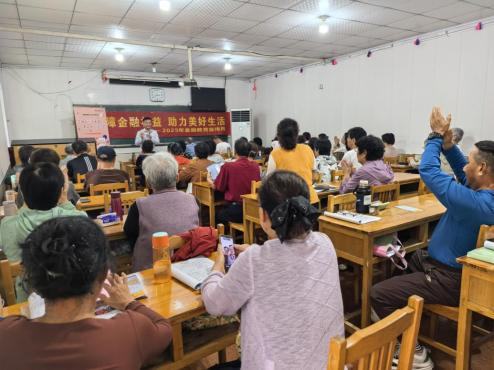
阳光保险(06963)精准发力 聚焦重点人群开展金融教育宣传活动
智通财经网· 2025-09-28 06:15
Core Viewpoint - Sunshine Insurance actively responds to the National Financial Regulatory Administration's initiative for the 2025 "Financial Education Promotion Week," focusing on protecting financial rights and enhancing the quality of life for key groups such as the elderly, youth, new citizens, and foreign residents in China [1] Group 1: Activities for the Elderly - Sunshine Insurance conducts financial education activities in welfare homes, communities, and senior activity centers to raise awareness about preventing pension fraud, identifying illegal fundraising, and protecting personal information [2] - The Jiangsu branch of Sunshine Life Insurance provides hands-on guidance to elderly individuals on recognizing common fraud tactics, thereby strengthening their financial security [2] - Sunshine Property Insurance in Guangdong distributes large-print financial knowledge brochures and practical gifts to help the elderly safeguard their retirement funds [2] Group 2: Youth Financial Education - Sunshine Insurance collaborates with schools to promote financial risk awareness among youth, focusing on preventing telecom fraud and recognizing "campus loans" [4] - The Hunan branch of Sunshine Life Insurance engages with students through real-life case studies related to sports, helping them understand and identify fraud scenarios [4] - The Henan branch organizes a "Financial Fun Sports Day" to teach students financial knowledge through interactive games [4] Group 3: New Citizens and Community Engagement - Sunshine Insurance addresses the financial needs of new citizens by conducting a series of "Financial Knowledge into Thousands of Homes" activities in communities, business districts, and enterprises [5] - The Shandong branch collaborates with local volunteers to educate delivery riders about common financial risks and provides practical anti-fraud tips [5] - Sunshine Property Insurance in Shandong creates financial service handbooks for new citizens, promoting anti-fraud knowledge among employees and merchants in industrial parks [5] Group 4: Support for Foreign Residents - Sunshine Insurance offers multilingual financial guides and face-to-face consultation services for foreign residents, facilitating their access to safe financial services [9] - The Hainan branch conducts financial education activities for foreign friends living in Haikou, explaining the eight basic rights of financial consumers in China [9] Group 5: Commitment to Financial Education - Sunshine Insurance is committed to its "financial for the people" mission, continuously exploring new forms and pathways for financial education promotion [11] - The company aims to deliver financial knowledge effectively to consumers, contributing to a harmonious, stable, and healthy financial environment [11]

加快推进保险法修订;百万圆桌计划推出“MDRT中国特别奖项”;港险新规:储蓄险须标明“保险”|13精周报
13个精算师· 2025-09-27 03:04
Regulatory Dynamics - Nine departments encourage Chinese export credit insurance companies and other insurance institutions to increase support for service exports [8][9] - The central bank maintains the 1-year and 5-year LPR unchanged at 3.0% and 3.5% respectively [10] - The Ministry of Human Resources and Social Security reports that the basic pension insurance fund has achieved positive returns for eight consecutive years, with an average investment return rate of 5.15% [11] - The number of people covered by basic pension insurance in China reaches 1.072 billion, increasing by over 7.3 million since the end of the 13th Five-Year Plan [12] - Over 20 million new employment form workers are covered by occupational injury insurance [13] - The National Medical Insurance Bureau has included 42 rare diseases in the national medical insurance catalog [14] - The National Medical Insurance Bureau releases a long-term care insurance service catalog consisting of 20 life care and 16 medical care items [15] - The Financial Regulatory Administration holds a seminar with ASEAN and China-Japan-Korea financial regulatory agencies [16] - Financial Regulatory Administration head Li Yunzhe meets with Ray Dalio, founder of Bridgewater Associates [17] - The total assets of the banking and insurance industries exceed 500 trillion, with an average growth of nearly 9% over the past five years [18] Company Dynamics - China Ping An increases its stake in Agricultural Bank of China by 115 million HKD [29] - Sunshine Life increases its stake in China Ruyi by 113 million HKD [30] - Great Wall Life raises its stake in New Tian Green Energy to 5.00%, triggering a disclosure requirement [31] - Great Wall Life increases its stake in Qin Port shares by 1 million shares [32] - Ping An Life acquires a stake in Jingchang Logistics [33] - Ping An Overseas issues a 300 million USD 10-year senior unsecured bond with a coupon rate of 5% [34] - Fosun United receives approval for capital increase, with the International Finance Corporation and Asian Development Bank as new shareholders [35] - Ruizhong Life reduces its stake in Qinsong shares by over 9.55 million shares [36] - China Reinsurance receives approval for issuing capital supplement bonds [37] - Bank of China Samsung is approved to issue perpetual capital bonds [38] - China Life establishes a health management company in Nanjing [39] - Sunshine Insurance unveils Sunshine Hengyi Private Fund Management Co., Ltd. [41] - Bank of China Samsung establishes an equity investment partnership in Tianjin with a contribution of 1.1 billion [42] - Tianmao Group's cash option for delisting is executed, involving over 2.3 billion [43] - Huanghe Property Insurance's 125 million shares are up for auction with a starting price of 115 million [44] Industry Dynamics - Social insurance capital's A-share holdings exceed 2 trillion, reaching a historical high [55] - JPMorgan Chase invests approximately 135 billion HKD in China Pacific Insurance H-shares [56] - Mainland insurance companies attract record inflows in Hong Kong stocks [57] - Insurance capital's real estate investment scale significantly increases in the first half of 2025 [58] - The second batch of Sci-Tech Bond ETFs sees substantial institutional investment [59] - Goldman Sachs reports a surge of hedge funds into banking, insurance, and consumer finance sectors [60] - The first commercial insurance innovation drug catalog completes expert review, with five high-cost CAR-T drugs approved [61] - AI applications in the insurance industry are accelerating, with significant productivity potential [62][63] - The health insurance structure is changing, with medical insurance growth surpassing critical illness insurance [65]



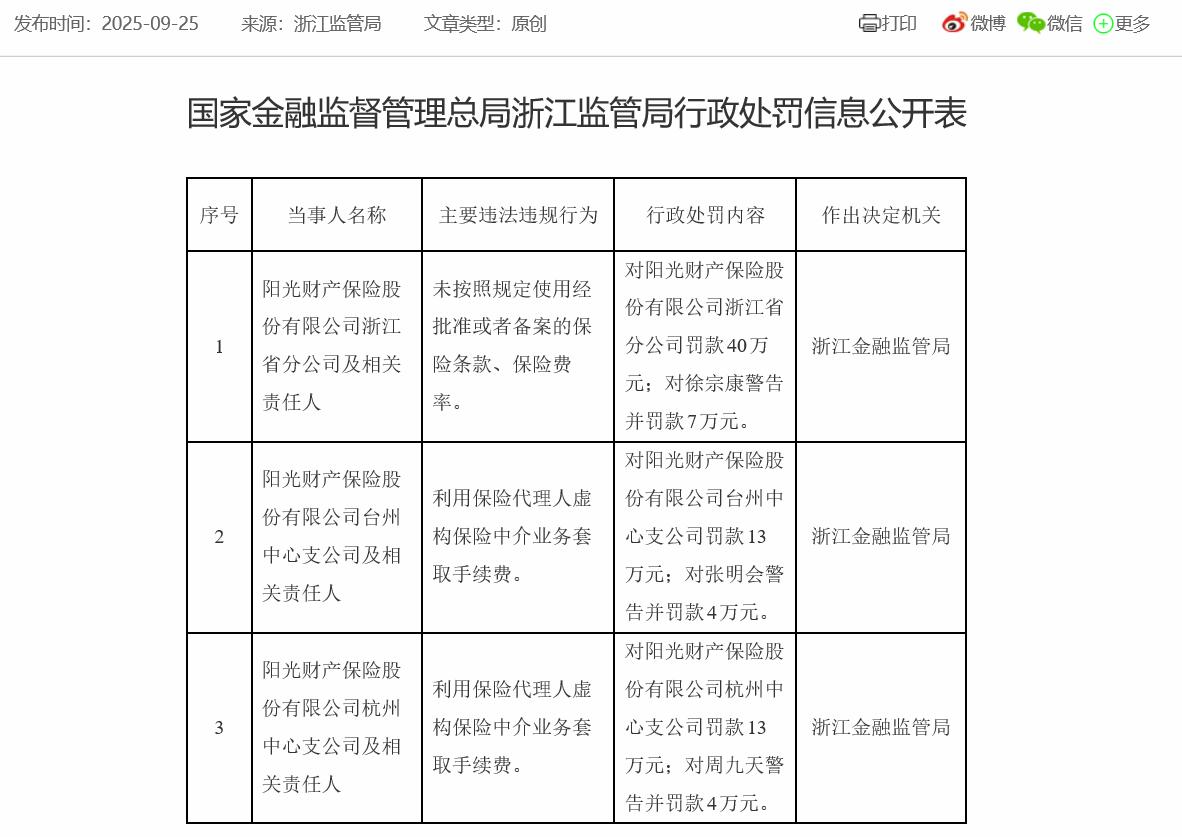
阳光财险浙江省分公司及两中支违规被罚 共收三张罚单
Zhong Guo Jing Ji Wang· 2025-09-25 08:25
Core Viewpoint - The Zhejiang Regulatory Bureau of the National Financial Supervision Administration has imposed fines on Sunshine Property Insurance Co., Ltd. and its related entities for various violations, including improper use of approved insurance terms and fictitious insurance intermediary business to extract fees [1]. Group 1: Violations and Penalties - Sunshine Property Insurance Co., Ltd. Zhejiang Branch and its responsible persons were fined 400,000 yuan for not using approved or filed insurance terms and rates [1]. - Sunshine Property Insurance Co., Ltd. Taizhou Central Branch and its responsible persons were fined 130,000 yuan for using insurance agents to fabricate intermediary business to extract fees, with an additional warning and fine of 40,000 yuan for Zhang Minghui [1]. - Sunshine Property Insurance Co., Ltd. Hangzhou Central Branch and its responsible persons were also fined 130,000 yuan for similar violations involving fictitious intermediary business, with a warning and fine of 40,000 yuan for Zhou Jiutian [1].
阳光保险(06963.HK):兼具NBV成长性、业绩稳定性、利差表现改善三重特征
Ge Long Hui· 2025-09-24 03:53
Group 1 - The company is expected to achieve a year-on-year increase of 45.8% in net profit attributable to shareholders, reaching 5.449 billion yuan in 2024, with a steady profit performance in the first half of 2025, showing a year-on-year growth of 7.8% to 3.389 billion yuan [1] - The company has a high dividend payout ratio of 40.1% in 2024, ranking first among listed insurance companies, with a calculated dividend yield of 5.4%, placing it second in the industry [1] - The company emphasizes shareholder returns, with an anticipated increase in focus on per-share dividend growth in the upcoming period, highlighting its high dividend characteristics [1] Group 2 - The company has shown strong resilience and growth in its individual insurance business, with a year-on-year increase in new business value (NBV) of 44.2% and 43.3% for 2023 and 2024, respectively, and a 47.3% increase in the first half of 2025, reaching 4.008 billion yuan [2] - The bancassurance channel remains a traditional advantage for the company, benefiting significantly from the "reporting and operation integration," with channel NBV growth of 6.4 percentage points and 7.2 percentage points in 2024 and the first half of 2025, respectively [2] - The contribution of the bancassurance channel to total NBV is significantly higher than that of other listed insurance companies, with a total NBV of 2.868 billion yuan and 2.452 billion yuan in 2024 and the first half of 2025, respectively [2] Group 3 - The company has seen a significant decline in liability costs, with a year-on-year decrease in NBV to effective business value ratio of 80 basis points and 11 basis points, reaching 2.91% and 2.85% in 2024, respectively [3] - The net investment yield and the difference between NBV and effective business value yield are expected to improve, with year-on-year increases of 100 basis points and 31 basis points, respectively [3] - The company is focused on asset-liability matching and controlling liability costs, launching dividend-type products with predetermined rates of 1.75% and 1.5% in the second quarter of 2025 to support stable operations [3] Group 4 - The company has increased its equity allocation in the secondary market, with a rise of 1.28 percentage points to 15.1% as of June, and a stock allocation level that continues to improve, reaching 14.1% [4] - The proportion of FVOCI stocks has increased by 1.4 percentage points to 70.38%, significantly higher than that of peers [4] - The company’s Contractual Service Margin (CSM) has shown steady growth, with a year-on-year increase of 12.6% to 50.9 billion yuan, maintaining a stable amortization speed [4]
申万宏源:维持阳光保险“买入”评级 目标价5.35港元
Zhi Tong Cai Jing· 2025-09-24 01:59
Core Viewpoint - The report from Shenwan Hongyuan indicates that Sunshine Insurance (06963) is expected to achieve a net profit attributable to shareholders of 5.734 billion, 6.056 billion, and 6.788 billion yuan for the years 2025-2027, reflecting year-on-year growth of 5.2%, 5.6%, and 12.1% respectively, with a revised company valuation of 57.3 billion yuan and a target price of 5.35 HKD per share, maintaining a "Buy" rating [1] Group 1 - The company is projected to have a stable profit growth with a balanced asset-liability performance, and a dividend yield that ranks among the top in the industry. The net profit attributable to shareholders is expected to increase by 45.8% year-on-year to 5.449 billion yuan in 2024, with a 7.8% year-on-year increase to 3.389 billion yuan in the first half of 2025 [2] - The company emphasizes shareholder returns, with a dividend payout ratio expected to reach 40.1% in 2024, the highest among listed insurance companies, and a calculated dividend yield of 5.4% as of September 22, ranking second in the industry [2] Group 2 - The company has shown strong resilience and growth in its individual insurance performance, with a year-on-year increase in new business value (NBV) of 44.2% and 43.3% for 2023 and 2024 respectively, and a 47.3% increase to 4.008 billion yuan in the first half of 2025, leading the industry [3] - The bancassurance channel remains a traditional strength for the company, benefiting significantly from the "reporting and operation integration," with channel NBV growth of 43.6% and 53.0% for 2024 and the first half of 2025, contributing 60% of the total NBV [3] Group 3 - The company has seen a significant decline in liability costs, with a high proportion of new liabilities, and is expected to optimize the cost of existing liabilities. The NBV to effective business value ratio is projected to be 12.79% in 2024, ranking third among listed insurance companies [4] - The net investment yield and the difference between NBV and VIF yield are expected to improve, with year-on-year increases of 100 basis points and 31 basis points respectively, indicating a favorable trend in interest margins [4] - The company has increased its equity allocation in the secondary market, with a stock allocation ratio of 15.1% as of June, and a significant portion of FVOCI stocks exceeding 70%, indicating a stable performance compared to peers [4]
申万宏源:维持阳光保险(06963)“买入”评级 目标价5.35港元
智通财经网· 2025-09-24 01:57
Core Viewpoint - The report from Shenwan Hongyuan indicates that Sunshine Insurance (06963) is expected to see a steady growth in net profit from 2025 to 2027, with projected figures of 5.734 billion, 6.056 billion, and 6.788 billion yuan respectively, reflecting year-on-year growth rates of 5.2%, 5.6%, and 12.1% [1] Group 1: Profit Growth and Dividend Policy - The company is projected to achieve a year-on-year net profit increase of 45.8% to 5.449 billion yuan in 2024, with a stable profit performance in the first half of 2025, showing a year-on-year growth of 7.8% to 3.389 billion yuan [2] - The dividend payout ratio is expected to reach 40.1% in 2024, ranking first among listed insurance companies, with a calculated dividend yield of 5.4% based on the closing price on September 22, placing it second in the industry [2] Group 2: New Business Value (NBV) and Distribution Channels - The company has demonstrated strong resilience and growth in its life insurance segment, with NBV growth rates of 44.2% and 43.3% for 2023 and 2024 respectively, and a year-on-year increase of 47.3% to 4.008 billion yuan in the first half of 2025, leading the industry [3] - The bancassurance channel remains a traditional strength for the company, benefiting significantly from the "reporting and operation integration," with channel NBV growth rates of 6.4 percentage points and 7.2 percentage points for 2024 and the first half of 2025 respectively [3] Group 3: Liability Costs and Investment Returns - The company has seen a significant decline in new liability costs, with the NBV to effective business value ratio at 12.79% in 2024, ranking third among listed insurance companies, which is expected to further dilute the cost of existing liabilities [4] - The net investment return rate and the difference between NBV and effective business value yield are projected to increase year-on-year by 100 basis points and 31 basis points respectively, indicating an expansion of the interest spread [4] Group 4: Equity Allocation and Performance Stability - As of the end of June, the company's equity allocation in the secondary market has increased by 1.28 percentage points to 15.1%, with a stock allocation level that continues to rise, reaching 14.1% by the end of 2024, and the proportion of FVOCI stocks exceeding 70.38% [5] - The company’s CSM has shown steady growth, with a year-on-year increase of 12.6% to 50.9 billion yuan by the end of 2024, maintaining a stable amortization rate of 8.45% [5]