
SUNSHINE INS(06963)

Search documents
阳光保险20251212
2025-12-15 01:55
Summary of Sunlight Insurance Conference Call Company Overview - **Company**: Sunlight Insurance - **Focus**: Life insurance products, particularly focusing on the elderly demographic and innovative insurance solutions Key Points and Arguments Product Launch and Strategy - Sunlight Insurance is promoting the "Zijin No. 1" dividend-type whole life insurance for 2026, emphasizing customer benefits with features like capital return after three years of payment and immediate returns for five-year payment plans [2][3] - The company is targeting the elderly market with two pension products: an immediate payout dividend pension and a traditional pension product [2][3] - The pricing for "Zijin No. 1" is set at 1.75% with a demonstration interest rate of 3.75%, making it more attractive compared to previous offerings [2][5] Financial Performance and Projections - In 2025, Sunlight Insurance implemented a strategy to push over 10 billion in single premium business to acquire low-cost funding and shorten liability duration, achieving double-digit growth in new premiums and total premiums from the bancassurance channel [2][9] - The company anticipates that the growth rate for regular premium income in 2025 will be flat due to a high base from 2024, but aims for double-digit growth in 2026 driven by low base effects and improved agent capabilities [2][7] - The new business value growth for 2026 is expected to be conservative, projected at single-digit growth due to the increased proportion of dividend insurance affecting value rates [4][24] Market Position and Competitive Advantage - Sunlight Insurance has a significant advantage in the bancassurance channel, focusing on service quality and internal-external staff ratios rather than merely expanding the number of outlets [2][11] - The company plans to enhance cooperation with banks and increase the number of internal and external staff to support network expansion and capacity improvement [2][11] Asset and Liability Management - The company is adjusting its asset-liability management in response to interest rate fluctuations, maintaining a duration of 12.4 years for assets while shortening the liability duration [4][12] - Sunlight Insurance is focusing on optimizing its product structure to manage the duration gap effectively [12][14] Regulatory Environment and Future Outlook - The company is prepared to adapt to potential regulatory changes regarding the selection of yield curves and will adjust its financial reporting accordingly [13][14] - Sunlight Insurance has a history of stable dividend payments, with a current dividend yield of approximately 6%, which is high for the insurance sector [16] Challenges and Risks - The net asset value has declined due to falling interest rates, and the company expects this trend to continue throughout the year [4][12] - The company faces pressure on solvency ratios and plans to optimize internal business structures and consider external capital supplementation tools [19][20] Growth Indicators - Sunlight Insurance's new business metrics are showing strong growth, with a double-digit increase in CSM (Contractual Service Margin) balance expected for the year [25] Investment Strategy - The company maintains a consistent investment strategy despite market fluctuations, focusing on long-term returns and strategic asset allocation [21][22] Additional Important Information - The company has issued various capital supplement tools in recent years, including perpetual bonds and capital supplement bonds, to strengthen its capital base [20] - Sunlight Insurance's approach to product diversification includes plans to introduce more types of insurance products beyond its current offerings [15]
港股收评:指数集体上扬!大金融股、黄金股走强,药品股低迷


Sou Hu Cai Jing· 2025-12-12 09:01
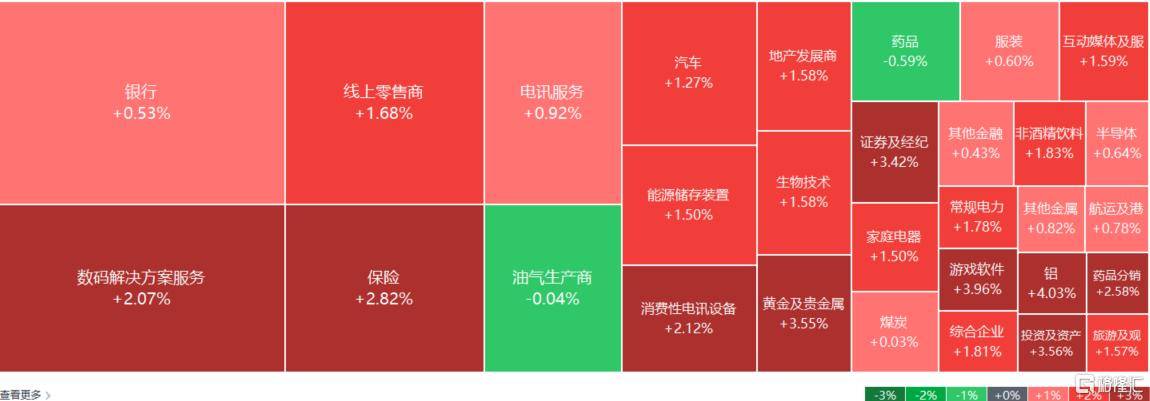
Market Overview - The market sentiment improved significantly due to favorable news from the Central Economic Work Conference, with the Hang Seng Index rising by 1.75% and returning to 26,000 points [1] - Major technology stocks collectively increased, with NetEase rising over 4%, Tencent and Alibaba up over 2%, and other tech companies like Xiaomi, Baidu, JD.com, and Kuaishou also seeing gains [1][3] Sector Performance - **Electric Power Equipment**: Strong performance with Dongfang Electric up over 13% and other companies like Harbin Electric and Shanghai Electric also showing significant gains [1][5] - **Financial Sector**: All major financial stocks, including China Pacific Insurance and CITIC Securities, saw increases, with HSBC reaching a market value of over HKD 2 trillion [1][8] - **Precious Metals**: Gold and silver prices surged, leading to active trading in gold stocks, with China Silver Group rising nearly 6% [1][6] - **Consumer Sector**: Restaurant stocks were active, with companies like Da Shi and Haidilao seeing notable increases, driven by policies aimed at boosting consumption [10] - **Real Estate**: Property stocks rose, with Longguang Group increasing over 4%, supported by policies to stabilize the real estate market [12] Individual Stock Highlights - **NetEase**: Stock price increased by 4.20% to HKD 218.40 [4] - **Dongfang Electric**: Stock price surged by 13.59% to HKD 24.90 [5] - **China Pacific Insurance**: Stock price rose by 5.68% to HKD 34.60 [9] - **China Silver Group**: Stock price increased by 5.80% to HKD 0.730 [7] - **Xuan Bamboo Bio**: Stock price increased by 25.19% to HKD 96.90, reaching a new high [16][19] Economic Policy Impact - The Central Economic Work Conference emphasized the importance of domestic demand and consumer spending, with plans to implement measures to boost consumption and stabilize the real estate market [10][12]

分红险走上“C位”,险企从拼收益转向比服务
Bei Jing Shang Bao· 2025-12-10 11:53
Core Viewpoint - The insurance industry is experiencing a significant shift towards dividend insurance products, which are becoming the dominant market force as companies adapt to a low-interest-rate environment and seek to mitigate risks associated with interest rate spreads [1][2]. Group 1: Market Trends - Major insurance companies such as China Life, Ping An Life, Sunshine Life, and Xinhua Insurance have launched new dividend insurance products, marking a transition from traditional fixed-return savings products to floating-return products [2][3]. - Dividend insurance products, characterized by a dual structure of guaranteed and floating returns, are increasingly favored due to their ability to meet consumer demand for stable long-term returns in a low-interest-rate environment [2][4]. Group 2: Regulatory Environment - Regulatory guidance is pushing the industry towards floating-return products, as highlighted in the State Council's opinions on enhancing regulation and promoting high-quality development in the insurance sector [3][4]. - The recent regulatory framework emphasizes the need for insurance companies to maintain sustainable dividend levels through prudent long-term investment strategies [5]. Group 3: Product Complexity and Competitiveness - The complexity of dividend insurance products requires higher professional standards from insurance agents, as they must effectively communicate the uncertainties associated with dividend payouts to clients [4][5]. - Companies are increasingly focusing on differentiating their products through innovative design and value-added services, creating a competitive landscape that extends beyond mere interest rate comparisons [6][8]. Group 4: Service Integration - Insurance companies are integrating their products with healthcare and elderly care services, enhancing customer value through comprehensive service ecosystems [6][7]. - For instance, Sunshine Life's dividend insurance product offers access to premium medical resources and tailored elderly care services, reflecting a shift towards a more holistic approach to customer needs [7][8]. Group 5: Investment Performance - The performance of dividend insurance products is closely tied to the investment outcomes of the insurance companies, with established firms demonstrating superior long-term investment capabilities [5][6]. - Sunshine Insurance, for example, reported significant growth in net investment income and total investment returns, indicating a strong ability to deliver on dividend promises [5].
保险员工持股计划变迁:活跃、冰封到新生
Xin Lang Cai Jing· 2025-12-10 10:11
Core Viewpoint - Employee stock ownership plans (ESOPs) in the Chinese insurance industry have evolved from a wealth creation mechanism to a complex system that requires careful governance and compliance, reflecting both opportunities and risks for employees and companies alike [3][26][22]. Historical Development - The first ESOP in the Chinese insurance industry was initiated in the early 1990s, aimed at addressing capital shortages and talent retention [4][27]. - By 2007, a notable case saw employees of a leading insurance company become millionaires after the company went public, highlighting the potential of ESOPs to create wealth [5][28]. - The period from 2008 to 2015 was marked by a regulatory freeze on ESOPs due to widespread abuses and governance failures, leading to significant employee disputes [6][30][32]. Regulatory Changes - In December 2008, the China Insurance Regulatory Commission (CIRC) mandated a halt to ESOPs across the industry, citing the need for clearer regulations and oversight [30][31]. - The reintroduction of ESOPs in 2015 was guided by the "56 Document," which established a framework for compliance, emphasizing that employee contributions must come from legitimate salaries and prohibiting companies from providing loans for stock purchases [37][38]. Current Trends - Recent ESOPs are designed to align employee interests with company performance, focusing on long-term value creation rather than short-term gains [19][22]. - Companies like Taikang Insurance and Sunshine Insurance have launched new ESOPs that emphasize risk-sharing and employee engagement, reflecting a shift towards strategic talent retention [16][38]. - The design of ESOPs is increasingly sophisticated, incorporating mechanisms for clear exit strategies and performance-based rewards to mitigate past issues of ambiguity and disputes [12][20][21]. Case Studies - Successful implementations of ESOPs, such as those by ZhongAn Insurance and AIA, demonstrate the effectiveness of aligning employee incentives with company growth, leading to lower turnover rates and enhanced organizational loyalty [38][39]. - Conversely, cases like Bai Nian Life and Fan Hua Holdings illustrate the risks associated with poorly structured ESOPs, which can devolve into illegal fundraising schemes and lead to significant financial losses for employees [10][11][33]. Future Outlook - The insurance industry is expected to continue evolving its approach to ESOPs, focusing on transparency, compliance, and the establishment of independent oversight mechanisms to protect employee interests [20][21]. - As the industry faces challenges such as economic fluctuations and talent competition, ESOPs are being redefined as strategic tools for fostering long-term partnerships between companies and their employees [19][22].

产品结构加速优化,人身险行业迈向价值增长新周期
Zhi Tong Cai Jing· 2025-12-09 06:13
Core Viewpoint - The year 2025 marks a critical transition for the Chinese insurance industry, emphasizing a shift towards high-quality development and a transformation in the life insurance sector, particularly in product structure [1]. Group 1: Industry Transformation - The life insurance industry is undergoing a significant transformation, with a focus on product structure changes driven by a prolonged low-interest-rate environment [1]. - The predetermined interest rates for insurance products have been reduced for three consecutive years, reaching the lowest levels in nearly two decades: ordinary products down from 3.5% to 2.0%, and participating products from 3.0% to 1.75% [1]. Group 2: Market Trends - By 2025, floating yield products such as participating and universal insurance have replaced traditional fixed-rate products as the focal point for life insurance companies [2]. - In the 2025 mid-year reports, China Life's floating yield business saw an increase of over 45 percentage points in first-year premium income compared to the previous year, while Ping An Life's participating insurance accounted for 40% of new business value [2]. Group 3: Company Performance - Sunshine Insurance Group's Sunshine Life has shown significant results in its transformation, with floating yield and protection products exceeding 50% of its individual insurance business, a 26 percentage point increase year-on-year [2]. - The ongoing reforms at Sunshine Insurance have solidified its long-term value foundation, demonstrating a commitment to optimizing product offerings [3]. Group 4: Future Outlook - The continuous deepening of participating insurance is expected to drive structural improvements in the life insurance industry, with new business value (NBV) growth projected to exceed 15% for listed insurance companies in 2026 [3]. - The shift from scale to value in the life insurance sector signifies a maturation of the Chinese insurance market, indicating a healthier and more sustainable growth cycle ahead [3].
不止于保单,让服务重新定义保险的价值边界
Jing Ji Guan Cha Wang· 2025-12-08 04:26
Core Insights - The insurance industry is undergoing a paradigm shift to address the collective challenges faced by families, such as wealth inheritance, health security, and quality elderly care, driven by increasing life expectancy and a low-interest-rate environment [2][7] - Sunshine Life has launched the "Zijing No.1 Whole Life Insurance (Participating)" product to meet the growing wealth management needs of customers, marking a transition from being merely a risk compensator to a comprehensive solution provider throughout the customer lifecycle [3][5] Industry Transformation - The competition in the insurance market has evolved from product and channel disputes to a comprehensive strength competition involving investment and industry chain connections [2][3] - The "Zijing No.1" product offers lifelong coverage with an effective insurance amount increasing at a rate of 1.75% annually, ensuring long-term protection and dividend distribution based on the company's actual operating conditions [3][4] Investment Performance - Sunshine Insurance Group has achieved a 5.7% year-on-year increase in total premium income, reaching 80.81 billion yuan, and a 7.8% increase in net profit to 3.39 billion yuan for the first half of 2025 [4] - The company has maintained a 10-year average total investment return rate that exceeds the industry average by over 1 percentage point, demonstrating its strong investment capabilities [4] Service Enhancement - Sunshine Life is expanding its service offerings beyond traditional insurance products to include health, medical, and elderly care services, thereby enhancing the value proposition of its insurance products [5][6] - The company has established a health service model that includes partnerships with top medical institutions, providing customers with streamlined access to healthcare services [6] Elderly Care Solutions - The company is addressing the challenges of aging populations by offering various elderly care services, including home care, community care, and institutional care, to provide comprehensive support for families [7][8] - The upgraded "Home Care 2.0" program includes a range of services aimed at ensuring the health and safety of elderly clients, thereby enhancing peace of mind for their families [8] Comprehensive Ecosystem - Sunshine Insurance's service ecosystem covers critical pain points across different life stages, emphasizing the importance of long-term commitment and value recognition from customers [9]

险资集体大涨:监管下调风险因子,耐心资本获准“降本入市”
Xin Lang Cai Jing· 2025-12-05 12:09
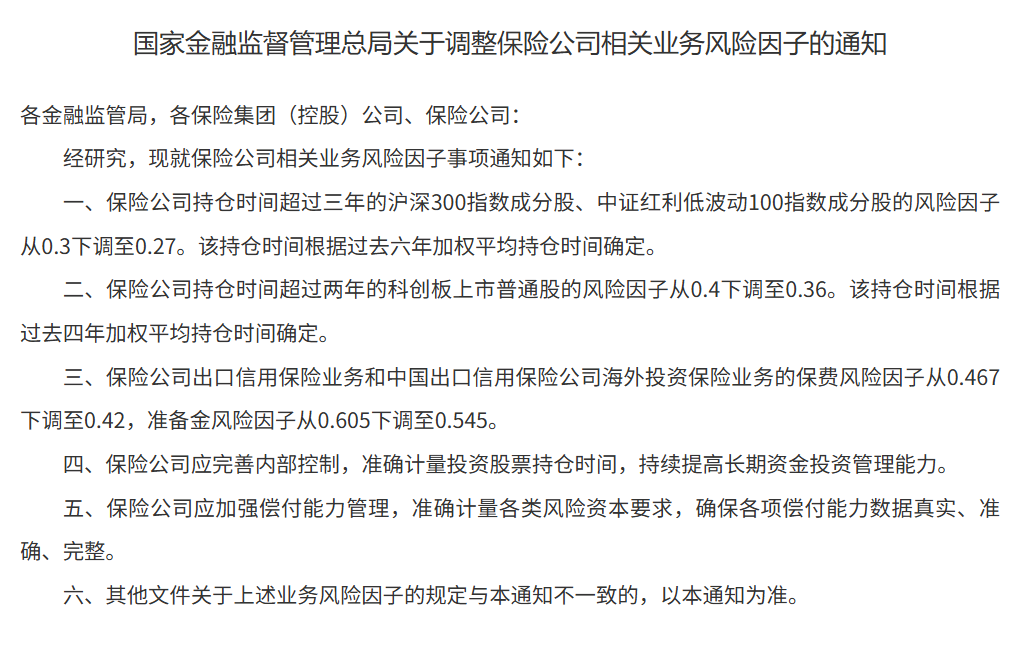
Core Viewpoint - The recent surge in the stock prices of listed insurance companies is attributed to the announcement by the National Financial Regulatory Administration regarding the adjustment of risk factors for insurance companies, effectively "unbinding" capital for insurers [9][11]. Group 1: Policy Adjustments - The core of the policy adjustment is to reduce the capital occupation cost for insurance companies through technical means, guiding funds more precisely [3][11]. - The risk factors for index components held for over three years, such as the CSI 300 and CSI Dividend Index, have been lowered from 0.2 to 0.17, while the risk factor for stocks locked for over five years on the Sci-Tech Innovation Board has been reduced from 0.4 to 0.36 [4][11]. - This adjustment allows insurance companies to release more usable capital without increasing their capital base [5][11]. Group 2: Market Implications - The regulatory intent is clear: to encourage insurers to adhere to "value investing" by lowering the holding costs of blue-chip and dividend stocks, acting as a "ballast" for the market [5][11]. - The adjustment also provides more room for insurers to support "hard technology" and "new economy" sectors, particularly favoring the Sci-Tech Innovation Board [5][11]. - The recent stock price increase reflects a perfect resonance between policy benefits and the transformation needs of insurance companies, especially in a declining interest rate environment [6][11]. Group 3: Future Outlook - The surge on December 5 may be just the beginning of a new round of asset allocation adjustments by insurers, with incremental funds gradually flowing into high-value areas of the A-share market [7][12]. - This situation presents a good opportunity for insurers to optimize their balance sheets and signifies that "patient capital" has better access to the market [7][12]. - However, the effectiveness of this policy relaxation will ultimately depend on the insurers' stock selection capabilities and risk management in a volatile market [7][12].






阳光保险(06963) - 截至二零二五年十一月三十日止月份之股份发行人的证券变动月报表
2025-12-04 08:41
股份發行人及根據《上市規則》第十九B章上市的香港預託證券發行人的證券變動月報表 致:香港交易及結算所有限公司 公司名稱: 陽光保險集團股份有限公司(於中華人民共和國註冊成立的股份有限公司)(「本公司」) 呈交日期: 2025年12月4日 I. 法定/註冊股本變動 | 1. 股份分類 | 普通股 | 股份類別 | 其他類別 (請註明) | | 於香港聯交所上市 (註1) | | 否 | | | --- | --- | --- | --- | --- | --- | --- | --- | --- | | 證券代號 (如上市) | N/A | 說明 | 境內未上市股份 | | | | | | | | | 法定/註冊股份數目 | | 面值 | | | 法定/註冊股本 | | | 上月底結存 | | | 8,022,753,987 RMB | | | 1 RMB | | 8,022,753,987 | | 增加 / 減少 (-) | | | | | | RMB | | | | 本月底結存 | | | 8,022,753,987 RMB | | | 1 RMB | | 8,022,753,987 | 截至月份: 202 ...
港股收评:恒指失守26000点大关,科技金融等权重齐挫!
Ge Long Hui· 2025-12-03 08:45
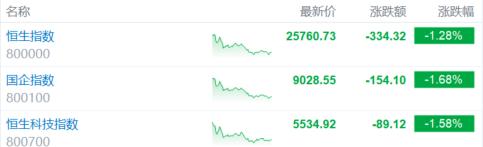
Market Overview - The Hong Kong stock market experienced a significant decline, with the Hang Seng Index falling by 1.28% to close at 25,760.73 points, while the Hang Seng China Enterprises Index and the Hang Seng Tech Index dropped by 1.68% and 1.58%, respectively [1][2]. Sector Performance - Major technology stocks and large financial stocks collectively dragged down market sentiment, with notable declines in companies like Bilibili (-3%), NetEase (-2.94%), and Alibaba (-2.17%) [4][5]. - The financial sector also faced losses, particularly in insurance stocks, with China Pacific Insurance down by 4% and China Life Insurance down by over 3% [6]. - The biopharmaceutical sector saw declines, with WuXi AppTec falling by over 3% and other major players like BeiGene and WuXi Biologics also experiencing losses [7]. Commodity and Other Stocks - In contrast, stocks in the non-ferrous metals and precious metals sectors performed well, with China Molybdenum and China Aluminum rising by over 2% [8]. - Airline stocks strengthened, with China Eastern Airlines and China Southern Airlines both gaining over 2%, supported by a new action plan promoting the integration of cultural tourism and civil aviation [9]. Capital Flows - Southbound capital saw a net inflow of 2.279 billion HKD, indicating continued interest in Hong Kong stocks from mainland investors [9]. Future Outlook - Analysts suggest that the current market adjustments may create opportunities for recovery in 2026, with expectations of a necessary interest rate cut in December due to rising unemployment and declining real wages [11].

阳光保险20251202
2025-12-03 02:12
Summary of Sunshine Insurance Conference Call Company Overview - **Company**: Sunshine Insurance - **Focus**: Insurance industry, specifically life insurance and investment strategies Key Points Industry and Market Position - Sunshine Insurance aims to maintain its market share and ranking in the bancassurance channel for 2026, while targeting positive growth in the individual insurance channel with a premium growth rate close to 10% to support new business value [2][5] - The company has initiated a transformation towards dividend insurance, expecting a significant increase in its proportion by 2026, while promoting a diversified sales strategy [2][7] Sales and Growth Strategies - The 2026 "opening red" strategy will focus on diversification, particularly favoring protection products, and guiding agents towards varied sales approaches [2][8] - Individual insurance channel sales on the first day of the 2026 opening red reached 300 million yuan, with a year-on-year growth rate of approximately 20% to 30% [3] Financial Performance and Projections - Sunshine Insurance's asset duration is 12.4 years, while the liability duration is between 18 to 19 years, with an effective duration of about 16 years [2][10] - The gap between asset and liability durations is estimated to be 6 to 7 years based on modified duration, and 3 to 4 years based on effective duration [11] Regulatory Impact - The recent personal insurance expense allocation guidelines are not expected to significantly impact Sunshine Insurance, as the company has always adhered to refined management and reasonable allocation principles [12] - The integration of the "reporting and operation in unison" policy is anticipated to have a short-term impact on premium growth but is expected to improve profitability in the long run [18][19] Investment Strategy - Over 60% of investment assets are placed in OCI accounts, including 84 billion yuan in secondary market stocks, which account for 14.1% of total investment assets [21] - The average dividend yield of the high-dividend strategy portfolio is projected to be between 5.5% and 5.8% [24] Challenges and Opportunities - The bancassurance channel faces increased competition following the removal of the 1+3 outlet restriction, but Sunshine Insurance plans to enhance its professional team's capabilities to improve productivity [15] - The company is currently experiencing slight losses in its new energy vehicle insurance segment but aims to achieve breakeven in household new energy models by increasing its market presence [20] Future Outlook - Sunshine Insurance expects interest rates to remain low and stable in the near term, which will influence its investment strategies, particularly in long-term bonds [26] - The company plans to maintain a stable dividend growth strategy, reflecting its commitment to shareholder returns while considering development needs and solvency [28] Additional Insights - The return of dividend-type critical illness insurance is seen as a positive development for sales of protection products, as traditional critical illness insurance has become less attractive due to lower preset interest rates [6] - Sunshine Insurance has begun a comprehensive transformation towards dividend insurance, with a significant increase in its proportion in new business structures [7] This summary encapsulates the key insights from the Sunshine Insurance conference call, highlighting the company's strategies, financial performance, regulatory impacts, and market outlook.