
BAMA TEA(06980)

Search documents
视频|八马茶业董事长王文礼:把一杯茶做成一片大产业,致力打造世界第一茶企
Xin Lang Cai Jing· 2026-02-24 08:56
来源:泉媒体 来源:泉媒体 责任编辑:何俊熹 责任编辑:何俊熹 ...

八马茶业(06980) - 截至二零二六年一月三十一日止月份之股份发行人的证券变动月报表
2026-02-04 08:35
截至月份: 2026年1月31日 狀態: 新提交 致:香港交易及結算所有限公司 公司名稱: 八馬茶業股份有限公司 呈交日期: 2026年2月4日 I. 法定/註冊股本變動 股份發行人及根據《上市規則》第十九B章上市的香港預託證券發行人的證券變動月報表 | 1. 股份分類 | 普通股 | 股份類別 | H | | | 於香港聯交所上市 (註1) | | 是 | | | --- | --- | --- | --- | --- | --- | --- | --- | --- | --- | | 證券代號 (如上市) | 06980 | 說明 | H股 | | | | | | | | | | 法定/註冊股份數目 | | | 面值 | | | 法定/註冊股本 | | | 上月底結存 | | | 52,986,875 | RMB | | | 1 RMB | | 52,986,875 | | 增加 / 減少 (-) | | | 0 | | | | RMB | | 0 | | 本月底結存 | | | 52,986,875 | RMB | | | 1 RMB | | 52,986,875 | | 2. 股份分類 | 普通股 | ...
八马茶业上市之路坎坷:高端茶资本化陷估值困境
Sou Hu Cai Jing· 2026-01-31 14:11
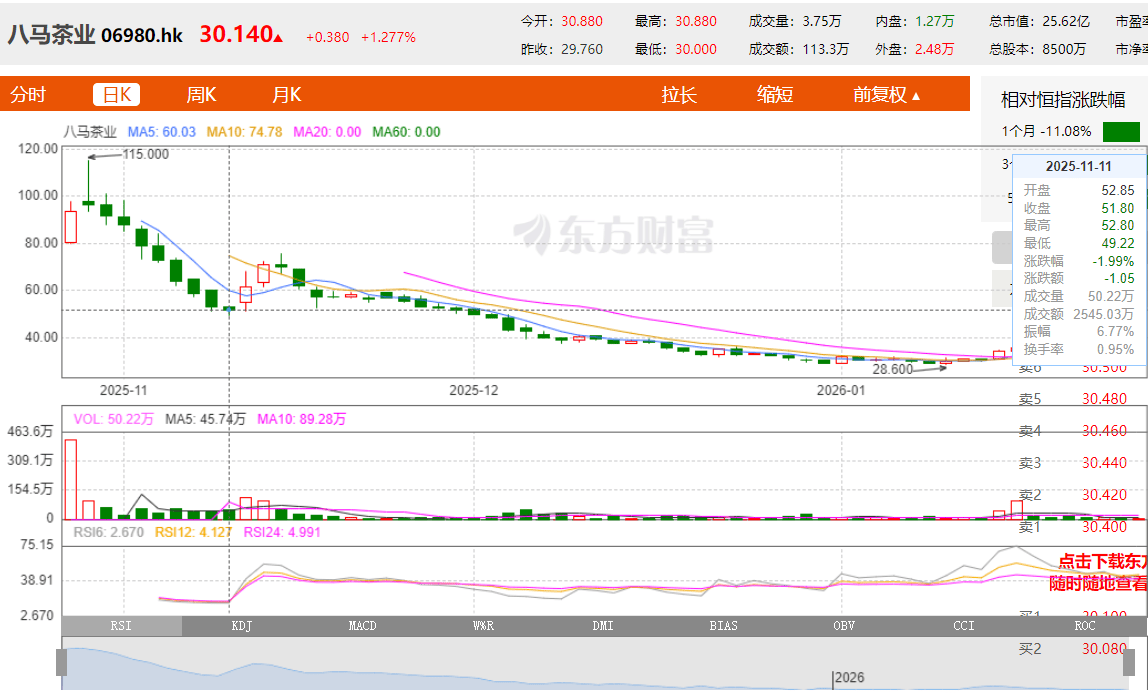
Core Viewpoint - The stock price of Baima Tea has experienced a dramatic decline after an initial surge, raising questions about the sustainability of the high-end Chinese tea business model and highlighting industry pain points [2][4]. Group 1: Stock Performance and Market Reaction - Baima Tea's stock price fell to HKD 30.14 per share, a decline of over 70% from its peak, resulting in a market value loss of nearly HKD 70 billion [2]. - The stock's initial surge was driven by limited liquidity and speculative trading, with only 5,298,700 H-shares available for trading post-IPO, of which approximately 4.4 million were locked up due to shareholder commitments [3]. - On its first trading day, Baima Tea's stock opened at HKD 86.5, a 73% increase from the IPO price of HKD 50, and briefly reached a market capitalization close to HKD 80 billion [3]. Group 2: Financial Performance and Challenges - Baima Tea's revenue growth has slowed, with a reported increase from RMB 1.818 billion in 2022 to RMB 2.143 billion in 2024, but the growth rate has decreased, with only a 1% increase in 2024 [9]. - In the first half of 2025, the company reported a revenue of RMB 1.063 billion, a decrease of 4.2% year-on-year, and a net profit of RMB 120 million, down 17.8% [9]. - High operating costs are eroding profits, with sales and marketing expenses reaching RMB 332 million in the first half of 2025, accounting for 31.2% of revenue [10]. Group 3: Business Model and Strategic Outlook - The franchise model has contributed significantly to Baima Tea's revenue, with franchise sales accounting for approximately 50% of total revenue from 2022 to 2025 [12]. - The company has 3,716 offline stores, with 93.7% being franchise stores, indicating a heavy reliance on franchisees for revenue generation [11]. - Baima Tea plans to use IPO proceeds to expand brand flagship stores in high-tier cities, deepen franchise coverage in lower-tier markets, upgrade supply chains, and promote international branding, particularly in Southeast Asia [15].

八马茶业与飞书达成战略合作
Zheng Quan Ri Bao Wang· 2026-01-28 11:45
Core Insights - The collaboration between Baima Tea and Feishu aims to establish an "AI-driven excellence operation system," marking a significant step towards full-chain digitalization in the tea industry [1][2] - This partnership is seen as a crucial move for Baima Tea to enhance its competitive edge through technological innovation in a fragmented market valued over one trillion yuan [1][4] Group 1: Digital Transformation and AI Integration - Baima Tea has over 3,700 offline stores across all provinces in mainland China, but the expansion has led to management challenges, necessitating a shift from "scale growth" to "high-quality growth" [2][4] - The collaboration focuses on three core areas: building a collaborative foundation through AI, creating an agile network for efficient coordination between headquarters and stores, and achieving zero-code integration to eliminate data silos [2][3] - The AI capabilities will be deeply integrated into Baima Tea's operational system, enhancing decision-making efficiency and management intelligence [1][2] Group 2: Competitive Advantages and Market Position - Baima Tea ranks first in the high-end Chinese tea market, with significant sales in Oolong and black tea, and has over 26 million members, providing a substantial customer base [4][5] - The company has established a smart ecological industrial park and a seventh-generation intelligent production line, enabling digital control of the entire production process, which supports AI optimization [4] - Baima Tea's strong governance and social responsibility have allowed it to maintain a long-term strategic focus, ensuring that its AI digital transformation is aimed at long-term value rather than short-term gains [5] Group 3: International Strategy and Market Adaptation - The AI-driven operational platform will support Baima Tea's international strategy, allowing for rapid replication of successful management models in new markets while adapting to local demands [5] - The company has represented Chinese tea at numerous international events, indicating its global outreach and the importance of a data-driven approach to enhance its international presence [5]
八马茶业与茶源科技订立茶购销框架协议
Zhi Tong Cai Jing· 2026-01-27 13:30
Core Viewpoint - The announcement by Baima Tea Industry (06980) regarding the signing of a tea purchase and sales framework agreement with Tea Source Technology is aimed at enhancing the company's market share and creating additional growth opportunities in the tea industry [1] Group 1: Agreement Details - The tea purchase and sales framework agreement will commence on January 27, 2026, and will last until December 31, 2028 [1] - The agreement allows the company to supply tea to Tea Source Technology on a regular basis during the agreement period [1] Group 2: Strategic Implications - The board of directors, including independent non-executive directors, believes that the terms of the agreement are fair and reasonable, conducted under general or more favorable commercial terms [1] - The transactions under this agreement are expected to support the company's sugar-free tea ingredient supply business, which includes tea bases, concentrated tea powders, or tea extracts [1] - This collaboration is part of the company's proactive business expansion strategy, which is anticipated to bring incremental performance and strengthen overall operational resilience [1] Group 3: Long-term Development - The initiative is expected to contribute to the long-term stable development of the company and provide a clear direction for future business development and strategic planning [1]
八马茶业(06980)与茶源科技订立茶购销框架协议
智通财经网· 2026-01-27 13:26
Core Viewpoint - The announcement by Baima Tea Industry (06980) regarding the signing of a tea purchase and sales framework agreement with Tea Source Technology is aimed at enhancing the company's market share and creating additional growth opportunities in the tea industry [1] Group 1: Agreement Details - The tea purchase and sales framework agreement will commence on January 27, 2026, and will last until December 31, 2028 [1] - The agreement allows the group to supply tea to Tea Source Technology periodically during the agreement's term [1] Group 2: Strategic Implications - The board, including independent non-executive directors, believes the terms of the agreement are fair and reasonable, conducted under general or more favorable commercial terms [1] - The transactions under this agreement are expected to support the group's sugar-free tea ingredient supply business, which includes tea bases, concentrated tea powders, or tea extracts [1] - This collaboration is part of the group's proactive business expansion strategy, aimed at generating incremental performance and strengthening overall operational resilience [1] - The initiative is expected to contribute to the long-term stable development of the group and provide clear direction for future business development and strategic planning [1]
八马茶业(06980) - 持续关连交易 - 茶购销框架协议
2026-01-27 13:21
香港交易及結算所有限公司及香港聯合交易所有限公司對本公告的內容概不負責,對其準確性 或完整性亦不發表任何聲明,並明確表示,概不對因本公告全部或任何部分內容而產生或因倚 賴該等內容而引致的任何損失承擔任何責任。 BAMA TEA CO., LTD. 八馬茶業股份有限公司 (於中華人民共和國註冊成立的股份有限公司) (股份代號:6980) 持續關連交易 茶購銷框架協議 茶購銷框架協議 董事會欣然宣佈,於2026年1月27日(交易時段後),本公司與茶源科技(本公司 的關連附屬公司)訂立茶購銷框架協議,據此,本集團將於茶購銷框架協議期限 (將於2026年1月27日開始,持續至2028年12月31日止)內不時向茶源科技供應 茶葉。 上市規則的涵義 茶源科技為本公司擁有70%股權的附屬公司,餘下30%股權由一葉觀山(一家於 2025年3月24日在中國成立的有限合夥企業)持有。一葉觀山由吳俊暉先生作為 普通合夥人管理,並由吳俊暉先生擁有83.3%合夥權益及由王文吉先生作為有限 合夥人擁有16.7%合夥權益。吳俊暉先生為控股股東之一王小萍女士的兒子。 王文吉先生為泉州八馬、八馬現代及天津鑫八馬的執行董事以及福建八馬的經 理, ...
华西证券:首予八马茶业(06980)“买入”评级 高端茶企的发展现状与增长密码
智通财经网· 2026-01-19 03:06
Group 1 - Core viewpoint: Huaxi Securities initiates coverage on Baima Tea (06980) with a "Buy" rating, highlighting its leading position in the high-end tea industry due to a clear brand matrix and channel advantages [1][2] - Industry perspective: The Chinese tea industry is undergoing a structural upgrade characterized by "overall dispersion and high-end concentration," with significant growth potential in the high-end tea market driven by consumption upgrades [2] - Company quality: Despite facing short-term pressures from macroeconomic fluctuations and intensified competition, the company's core competitiveness remains intact, supported by a clear multi-brand product matrix and a deep integration of offline and online channels [3] Group 2 - Future outlook: The company's development path aligns well with industry trends, leveraging brand, channel, and craftsmanship barriers to increase market share, while the rise of young consumers and women aligns with its product high-end and youthful transformation [4] - Long-term growth drivers: The upcoming Hong Kong IPO is expected to focus on capacity upgrades, brand promotion, channel expansion, and digitalization, providing strong momentum for long-term growth [4]

八马茶业(06980):深度报告:高端茶企的发展现状与增长密码
HUAXI Securities· 2026-01-16 15:15
Investment Rating - The report gives a "Buy" rating for the company [5][6]. Core Insights - The report provides a deep analysis of the operational status, financial performance, industry landscape, company development, and potential risks of Baima Tea Industry, based on its Hong Kong IPO prospectus [1]. Company Overview - Baima Tea Industry is positioned as a leading high-end tea enterprise in China, benefiting from the structural upgrade of the tea industry characterized by "overall dispersion and high-end concentration" [2]. - The company has a well-established marketing system and strong overall profitability, with a gross margin stable around 55% supported by its high-end product structure [3]. Future Outlook - The company’s development path aligns well with industry trends, focusing on brand, channel, and process barriers to continuously increase market share [4]. - The successful IPO will provide strong momentum for capacity upgrades, brand promotion, channel expansion, and digital transformation [4]. Financial Performance - Revenue projections for 2025-2027 are estimated at 2.20 billion, 2.45 billion, and 2.86 billion RMB, with year-on-year growth rates of +2.66%, +11.41%, and +16.53% respectively [5]. - Earnings per share (EPS) for the same period are forecasted to be 2.71, 3.07, and 3.85 RMB, with corresponding price-to-earnings (PE) ratios of 12.54, 11.08, and 8.82 [5]. Industry Analysis - The Chinese tea market is expected to grow from approximately 288.9 billion RMB in 2020 to about 325.8 billion RMB by 2024, with a compound annual growth rate (CAGR) of around 3.0% [46]. - The high-end tea market is projected to grow at a faster rate of 5.6% from 2024 to 2029, driven by consumer upgrades and brand recognition [47][48]. Competitive Position - Baima Tea holds a leading market share of 1.7% in the high-end tea segment, with a revenue of 1.758 billion RMB in 2024, reflecting an 18.2% increase from 2022 [61]. - The company has a robust channel presence with over 3,500 offline stores, the highest in the industry, and a significant number of franchise stores [61].
2025年中国茶叶连锁行业发展历程、产业链、市场规模、重点品牌及趋势研判:绿色消费带动茶叶连锁发展,茶叶供给能力不断增强[图]
Chan Ye Xin Xi Wang· 2026-01-11 01:03
Core Insights - The tea chain industry in China has seen significant growth, with market size increasing from 49.13 billion yuan in 2015 to 91.54 billion yuan in 2022, reflecting a compound annual growth rate (CAGR) of 9.3% [1][11] - However, a projected decline of 2.66% is expected in 2024, with the market size estimated at 87.83 billion yuan, primarily due to rational consumer spending and competition from online channels and new tea beverage brands [1][11] - The industry is anticipated to evolve towards greater branding and specialization, with an emphasis on brand building, market segmentation, and enhanced consumer experiences through smart features [1][11] Industry Overview - The tea chain industry operates through a standardized and chain-based business model, providing tea products and related services across various retail formats [3][11] - It can be categorized by product type (green tea, black tea, etc.), sales channels (direct, franchise, e-commerce), and service forms (tea shops, tea experience stores) [3] Industry Development History - The industry began in the 1990s, gaining momentum in the 21st century as consumer demand diversified and e-commerce emerged as a significant opportunity [5][6] - The current landscape features a more concentrated market with established brands and a need for continuous innovation to address challenges like product homogenization and intense competition [6] Industry Value Chain - The upstream of the tea chain industry includes tea plantations and processing facilities, while the midstream consists of tea chain enterprises responsible for brand management and retail operations [6] - The downstream involves consumers who drive demand and feedback, influencing the entire value chain [6] Market Trends - The tea chain industry is expected to focus on experiential retail, transforming stores into cultural and social spaces that enhance customer engagement [15] - Digital tools will facilitate precise service and supply chain integration, improving operational efficiency and product traceability [15] - There will be a shift towards health-oriented products and innovative forms, catering to modern consumer preferences [16][17] Key Companies - Notable companies in the tea chain industry include Baima Tea, Lancang Ancient Tea, Tianfu, and others, each with unique market strategies and product offerings [2][12] - Baima Tea, for instance, has over 3,700 stores and has established a strong online presence, achieving significant sales growth [12][13]


