BAMA TEA(06980)

Search documents
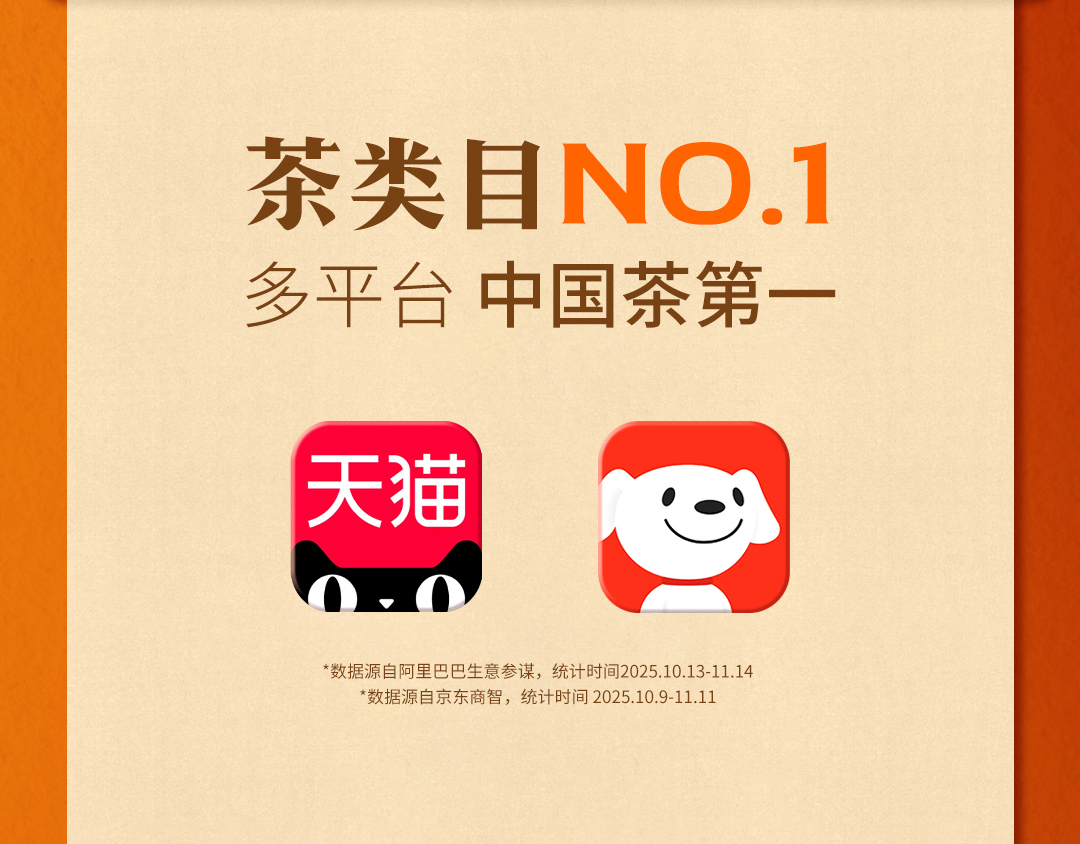
八马茶业“双11”全渠道销售额再创新高 多品类销量第一
Zheng Quan Ri Bao Zhi Sheng· 2025-11-16 11:07
Core Insights - Eight Horses Tea Co., Ltd. achieved impressive results during the "Double 11" shopping festival, leading in multiple categories across various e-commerce platforms, showcasing its strong brand and product capabilities [1][2] - The company maintained its position as the top seller in the tea category on major platforms like Tmall and JD for two consecutive years, reflecting its robust market presence [1] - Eight Horses Tea's innovative "City Reception Hall" model enhances customer engagement and promotes tea culture, aligning with modern consumer preferences for quality and social experiences [2][3] Performance Highlights - During the "Double 11" event, Eight Horses Tea ranked first in multiple tea categories, including Oolong, black tea, Tieguanyin, and Chenpi Gua Pian, demonstrating its comprehensive product strength [1] - The company also excelled in local life platforms, securing the top position in tea categories on Meituan, Dazhong Dianping, Douyin, and other platforms, indicating effective online-to-offline conversion strategies [2] - Eight Horses Tea's supply chain capabilities, including logistics centers and a "black light warehouse" system, support its rapid order fulfillment, achieving a maximum daily order processing capacity of 13,000 [3] Market Trends - The success of Eight Horses Tea reflects a broader transformation in the Chinese consumer market, where health-conscious and culturally rich tea consumption is becoming a new trend [3] - The shift from alcohol-centric social gatherings to tea-based interactions signifies a change in consumer behavior and lifestyle preferences, enhancing the demand for quality tea products [3] - With its comprehensive channel strategy and cultural depth, Eight Horses Tea is well-positioned to lead in the evolving tea market and promote Chinese tea culture [3]

八马茶业双11全渠道销售额再创新高,多品类销量引领行业
Zhong Guo Jin Rong Xin Xi Wang· 2025-11-15 09:20
Core Insights - Eight Horse Tea achieved impressive results during this year's "Double 11" shopping festival, maintaining a strong growth trajectory across multiple platforms and product categories [1][2][10] Performance Highlights - Eight Horse Tea ranked first in sales for tea categories on major platforms like Tmall and JD for two consecutive years, showcasing its leading position in the industry [2] - The company dominated various tea categories, including Oolong tea for 11 years, and achieved first place in Red tea, Tieguanyin, Dahongpao, and Chenpi Gua Pian during this year's event [4] - On JD, Eight Horse Tea also secured first place in Red tea and Tieguanyin categories, reflecting its strong product appeal [6] Multi-Channel Strategy - Eight Horse Tea excelled in local lifestyle platforms, ranking first in tea categories on Meituan, Dazhong Dianping, Douyin, Taobao Flash Sale, and JD Instant Delivery during the "Double 11" event [8] - The company's success is attributed to its ability to understand consumer trends, effectively linking online engagement to offline sales, and driving traffic to over 3,700 Eight Horse chain stores [10] Innovative Retail Model - As the leading tea chain brand in China, Eight Horse Tea has developed a unique "direct sales + franchise" and "online + offline" multi-channel sales system [10] - The introduction of the "City Living Room" model transforms traditional tea stores into comprehensive spaces for product display, cultural experience, and social interaction [11] Cultural Shift in Consumption - The outstanding performance of Eight Horse Tea during "Double 11" reflects a deeper transformation in the Chinese consumer market, with a growing trend towards health-conscious and culturally rich tea consumption [15] - The shift from alcohol-centric social gatherings to tea-centric interactions signifies a change in consumer behavior and lifestyle, positioning Eight Horse Tea favorably for future market competition [15]

八马茶业双11全渠道销售额再创新高,多品类销量第一引领行业
Xin Jing Bao· 2025-11-15 07:07
Core Insights - Eight Horses Tea achieved impressive results during the 2025 Double 11 shopping festival, maintaining a strong growth trajectory and leading in multiple categories across various e-commerce platforms [1][2][3] Group 1: Multi-Category and Multi-Platform Leadership - Eight Horses Tea ranked first in sales across multiple categories on major platforms like Tmall and JD, continuing its dominance in the tea industry [2] - The company has held the top position in Tmall's Oolong tea category for 11 consecutive years and achieved first place in red tea, Tieguanyin, Dahongpao, and Chenpi Gua Pian categories [2] - On JD, Eight Horses Tea also excelled, securing first place in red tea and Tieguanyin categories during the Double 11 event, highlighting its strong consumer appeal [2] Group 2: Breakthroughs in Local Life Platforms - Eight Horses Tea topped the tea category rankings on local life platforms such as Meituan, Dazhong Dianping, Douyin, and Taobao Flash Sale during the Double 11 event [3] - The company's success is attributed to its understanding of consumer trends and effective online-to-offline integration, driving traffic to over 3,700 stores nationwide [3] Group 3: Integrated Channel Development - Eight Horses Tea has established a unique "direct + franchise" and "online + offline" sales system, leveraging its extensive network of over 3,700 stores [4] - The introduction of the "City Reception Hall" model transforms traditional tea shops into comprehensive spaces for product display, cultural experiences, and social interactions [4][6] Group 4: Strong Supply Chain Support - The company is building logistics distribution centers in cities like Shenzhen, Anxi, and Zhengzhou, equipped with "dark warehouses" for 24-hour operations [9] - This supply chain capability allows for efficient order processing, with a maximum daily capacity of 13,000 orders, ensuring next-day delivery for 70% of the country [9] Group 5: Shifts in Consumer Behavior - The outstanding performance of Eight Horses Tea during Double 11 reflects a deeper transformation in the Chinese consumer market towards healthier and culturally rich tea consumption [10][12] - The trend of "meeting over tea" is becoming a new social norm, replacing traditional drinking culture with a focus on health and elegance [12]
智通港股解盘 | 传闻引发光伏下跌 市场猛炒超跌次新消费股
Zhi Tong Cai Jing· 2025-11-12 12:23
Market Overview - Hong Kong stocks showed a positive trend, closing up 0.85% as bulls took control, indicating a lack of negative news is perceived as positive [1] - The U.S. House of Representatives is expected to vote on a compromise plan to end the longest government shutdown in U.S. history, which could restore funding to government agencies [1] - The ADP private sector employment report for October showed a decrease of 45,000 jobs, the largest drop in two and a half years, suggesting a cooling labor market and increasing expectations for a Fed rate cut in December [1] Sector Performance - The banking sector saw a rebound with major banks like Agricultural Bank of China reaching new highs, driven by long-term investments from insurance funds and public funds [1] - Consumer sectors are gaining traction, with companies like "Hushang Auntie" seeing a significant increase of nearly 29%, indicating a recovery in consumer sentiment [2] - Retail sales in Hong Kong are projected to rise by 4% year-on-year in October, benefiting retail rental stocks [3] Company Highlights - Baijie Shenzhou reported a 44.2% increase in total revenue for the first three quarters, driven by sales growth of its self-developed products [3] - Xiaomi announced a significant sales figure of over 29 billion yuan during the Double 11 shopping festival, indicating strong consumer demand [4] - The Ximangdu iron ore project, with reserves exceeding 4.4 billion tons, has commenced production, potentially altering the global iron ore supply landscape and benefiting companies like Maanshan Iron & Steel [5] Industry Developments - The Chinese commercial aerospace sector is set to advance with the upcoming maiden flight of the reusable rocket "Zhuque-3," which aims to reduce launch costs significantly [6] - The sportswear manufacturing sector is expected to see a recovery in demand, with Shenzhou International projecting a 15.3% increase in revenue for the first half of 2025 [7] - The company has expanded its overseas production capacity, with 53% of its garment output coming from international facilities, indicating a strategic shift towards globalization [8]

八马茶业盘中破发
Bei Jing Shang Bao· 2025-11-11 13:49
Core Viewpoint - Baima Tea's stock price experienced significant volatility shortly after its IPO, indicating potential investor uncertainty and market reactions to its initial performance [1] Group 1: Stock Performance - On November 11, Baima Tea's stock closed at 51.8 HKD per share, having reached a low of 49.22 HKD during the trading session [1] - The company went public on October 28, with its stock price surging by 86.7% on the first day, closing at 93.35 HKD per share and achieving a total market capitalization of approximately 79.35 billion HKD [1]
八马茶业盘中破发,上市半月市值较高点蒸发过半
Cai Jing Wang· 2025-11-11 11:08
Core Insights - Baima Tea's stock price has experienced significant volatility since its listing, with a peak increase of 86.7% on the first day, followed by a nearly 50% decline in the subsequent trading days, resulting in a market capitalization drop of approximately 53.72 billion HKD [1][2] Company Overview - Baima Tea is a national chain brand enterprise engaged in the research, design, standard output, and retail of various tea products, covering all categories of tea and related products [1] - According to its prospectus, Baima Tea ranks first in high-end tea sales revenue in China for 2024 and holds multiple segment sales championships [1] Market Position - Despite leading positions in several segments of the high-end tea market, Baima Tea's market share is relatively low, accounting for 1.7% of the total market, which is projected to reach 103.1 billion CNY in 2024 [2] - The top five companies in the high-end tea market collectively hold a market share of 5.6% [2] Franchise Expansion - There are signs of slowing expansion among Baima Tea's franchisees, with a significant decrease in the number of new franchise stores added in 2024 compared to 2023 [2] - The number of directly franchised stores increased by only 5 in 2024, a sharp decline from 265 in 2023 [2] Financial Performance - For the first half of 2025, Baima Tea reported a revenue of 1.063 billion CNY, a year-on-year decline of 4.2%, and a net profit of 120 million CNY, down 17.8% year-on-year [4] - The revenue decrease is attributed to a reduction in sales from self-operated offline stores [5] Stock Liquidity - Baima Tea announced a full circulation plan for H-shares shortly after its listing, which involves converting 31.9331 million domestic shares into H-shares, potentially increasing the total tradable shares from 52.9869 million to 84.92 million [5]

八马茶业港股遇冷股价六连跌 中期净利降18%加盟扩张放缓
Chang Jiang Shang Bao· 2025-11-10 02:45
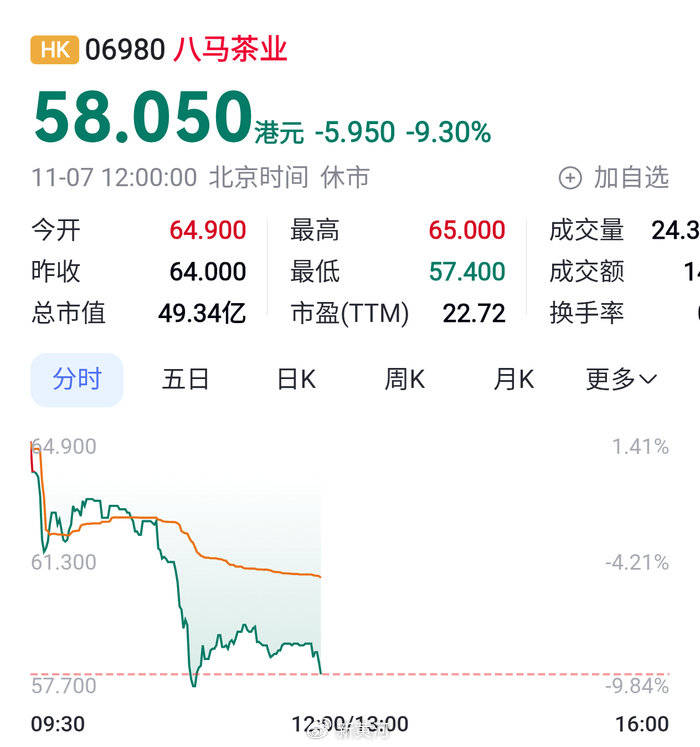
Core Viewpoint - Eight Horses Tea Industry (06980.HK) has faced a significant decline in stock price and performance after its IPO on October 28, 2025, despite being recognized as a leading player in the high-end Chinese tea market [2][3][10]. Company Performance - The company experienced a 49% drop in stock price from a peak of 115 HKD per share on October 30 to 58.50 HKD on November 7, 2025 [2][10]. - For the first half of 2025, Eight Horses reported a revenue of 1.06 billion CNY, a decrease of 4.20% year-on-year, and a net profit of 120 million CNY, down 17.81% year-on-year [11]. - The company's advertising expenses from 2022 to mid-2025 totaled 875 million CNY, with a significant portion allocated to marketing efforts [11][12]. Market Position - Eight Horses Tea is recognized as the top seller in the high-end tea market in China, holding the first position in sales revenue for Oolong and black tea as of 2024 [5][11]. - Despite being the market leader, the company's market share in the high-end tea segment is only 1.7%, indicating a highly competitive environment [11]. Franchise and Store Expansion - As of October 12, 2025, Eight Horses operated 3,716 offline stores, with 93.70% being franchise stores [12]. - The number of franchisees has shown a decline, with a net decrease of 24 franchisees in the first half of 2025, contrasting with previous years' growth [12]. IPO Journey - The company took 13 years to complete its IPO journey, initially attempting to list on the Shenzhen Stock Exchange before finally listing on the Hong Kong Stock Exchange [6][7]. - The IPO raised 450 million HKD at an initial price of 50 HKD per share, but the stock's performance has been disappointing post-listing [7][10].

八马茶业港股上市后股价连跌六日
Sou Hu Cai Jing· 2025-11-07 08:29
Core Viewpoint - Baima Tea's stock price has experienced significant volatility since its listing on the Hong Kong Stock Exchange on October 28, with an initial surge followed by a sharp decline, reflecting investor concerns about liquidity and performance [1][4]. Group 1: Stock Performance - On its first trading day, Baima Tea's stock surged by 86.7%, closing at 93.35 HKD per share, but subsequently fell nearly 50% to 58.05 HKD by November 7 [1][4]. - The stock reached a high of 115 HKD shortly after listing, indicating initial strong market interest [1]. Group 2: Company Announcements - On October 30, Baima Tea announced a plan for full circulation of H-shares, which involves converting 31.93 million domestic shares into H-shares, potentially increasing the circulating shares by 60% [4][5]. - This plan has raised concerns among investors about increased selling pressure in the secondary market [5]. Group 3: Financial Performance - Baima Tea's revenue projections show a growth from 1.818 billion HKD in 2022 to 2.143 billion HKD in 2024, but the growth rate is expected to drop sharply from 16.72% in 2023 to just 0.99% in 2024 [5]. - In the first half of 2025, the company reported a revenue decline of 4.2% year-on-year, with net profit down 17.8% [5]. Group 4: Business Model and Challenges - The company heavily relies on franchisees, with franchise income accounting for about 50% of total revenue [7]. - The growth of franchise numbers has slowed, with a net increase of only 86 franchise stores in the first half of 2025, compared to 475 in 2023 [7].
八马茶业(06980) - 截至二零二五年十月三十一日止月份之股份发行人的证券变动月报表
2025-11-05 09:09
股份發行人及根據《上市規則》第十九B章上市的香港預託證券發行人的證券變動月報表 截至月份: 2025年10月31日 狀態: 新提交 致:香港交易及結算所有限公司 公司名稱: 八馬茶業股份有限公司 呈交日期: 2025年11月5日 I. 法定/註冊股本變動 | 1. 股份分類 | 普通股 | 股份類別 | H | | 於香港聯交所上市 (註1) | | 是 | | | --- | --- | --- | --- | --- | --- | --- | --- | --- | | 證券代號 (如上市) | 06980 | 說明 | H股 | | | | | | | | | 法定/註冊股份數目 | | | 面值 | | 法定/註冊股本 | | | 上月底結存 | | | 52,986,875 | RMB | | 1 RMB | | 52,986,875 | | 增加 / 減少 (-) | | | 0 | | | RMB | | 0 | | 本月底結存 | | | 52,986,875 | RMB | | 1 RMB | | 52,986,875 | | 2. 股份分類 | 普通股 | 股份類別 | 其他類別 (請註 ...
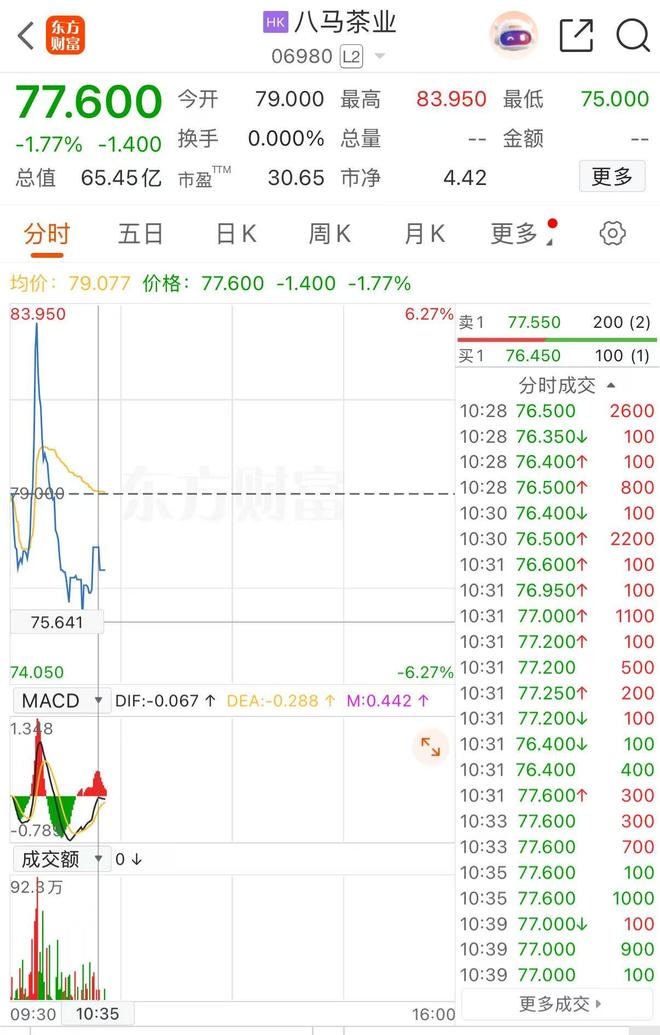
港股异动 | 八马茶业股价早盘振幅超过11%
Xin Lang Cai Jing· 2025-11-05 06:23
Group 1 - The core point of the article is that Baima Tea's stock experienced significant volatility on November 5, opening at 79 HKD per share, reaching a high of 83.95 HKD, and a low of 75 HKD, with a trading range of 11.33% [1][2] - As of 10:35 AM, Baima Tea's stock price decreased by 1.77%, trading at 77.6 HKD per share, with a total market capitalization of approximately 6.545 billion HKD [1][2] - The stock's average price during the trading session was 79.077 HKD, indicating a decline of 1.4 HKD from the previous close [2] Group 2 - Baima Tea recently announced that its board has approved a full circulation plan for H-shares and will submit a filing to the China Securities Regulatory Commission by October 30, 2025, involving the conversion of 31.9331 million domestic shares held by 11 shareholders into H-shares, which represents about 37.57% of the company's total issued shares [4]