
WB(09898)

Search documents
微博三季度营收31.56亿元
Bei Jing Shang Bao· 2025-11-18 10:41
Core Viewpoint - Weibo's Q3 2025 financial report shows a decline in revenue, indicating potential challenges in its advertising and value-added services segments [1] Financial Performance - Total revenue for Q3 2025 is $442 million, representing a year-over-year decrease of 5% [1] - Advertising and marketing revenue amounts to $375 million, while value-added services (VAS) revenue is $66.9 million [1] - Non-GAAP net profit stands at $111 million [1] User Metrics - As of the end of Q3, Weibo has 578 million monthly active users and 257 million daily active users [1]
微博Q3总营收31.56亿元
Di Yi Cai Jing· 2025-11-18 10:15
(文章来源:第一财经) 11月18日,微博发布2025年第三季度财报。三季度微博总营收4.423亿美元,约合人民币31.56亿元,其 中广告营收3.754亿美元,约合人民币26.77亿元,三季度调整后运营利润1.32亿美元,约合人民币9.37亿 元。 用户方面,截至三季度末,微博的月活跃用户达到5.78亿,日活跃用户达到2.57亿。 ...

微博:第三季度来自阿里巴巴的广告及营销收入同比增加112%
Xin Lang Cai Jing· 2025-11-18 09:45
Core Insights - Weibo reported a 6% year-over-year decline in advertising and marketing revenue for Q3 2025, amounting to $375.4 million, primarily due to reduced contributions from the food and beverage sector, which had benefited significantly from the Paris Olympics in the same period last year [1] - This decline was partially offset by robust growth in advertising revenue from the e-commerce and automotive sectors [1] - Excluding advertising revenue from Alibaba, Weibo's advertising and marketing revenue was $329.9 million, reflecting a 13% year-over-year decrease [1] - Advertising revenue from Alibaba reached $45.5 million, marking a 112% year-over-year increase, driven by higher advertising budgets in its local services business and strong marketing demand in its e-commerce operations during Q3 [1]

微博-SW(09898)发布前三季度业绩 股东应占净利润4.54亿美元 同比增加55.43%
智通财经网· 2025-11-18 09:43
Core Insights - Weibo-SW reported a net income of approximately $442 million for Q3 2025, a year-on-year decrease of 4.77% [1] - The net profit attributable to Weibo shareholders was $221 million, reflecting a significant year-on-year increase of 69.33% [1] - Monthly active users reached 578 million in September 2025, with daily active users averaging 257 million [1] Financial Performance - For the first three quarters of 2025, Weibo achieved a net income of $1.284 billion, a slight decrease of 1.07% year-on-year [1] - The net profit attributable to Weibo shareholders for the same period was $454 million, marking a year-on-year increase of 55.43% [1] - Basic earnings per share for Q3 2025 were $0.93, while for the first three quarters, it was $1.90 [1] Advertising and Marketing Revenue - Q3 2025 advertising and marketing revenue was $375 million, down 6% from $399 million in the same period last year [1] - Excluding advertising revenue from Alibaba, the advertising and marketing revenue was approximately $330 million, a decline of 13% from $377 million year-on-year [1] User Engagement and Product Development - The CEO expressed satisfaction with the progress of Weibo's intelligent search, highlighting improvements in user product offerings and the transformation of the homepage information flow [2] - The application of artificial intelligence in search and advertising has led to strong growth in user engagement and search volume [2] - The company is focusing on enhancing content marketing advantages and improving the conversion rates of information flow advertisements [2]
微博-SW发布前三季度业绩 股东应占净利润4.54亿美元 同比增加55.43%
Zhi Tong Cai Jing· 2025-11-18 09:41
Core Insights - Weibo's Q3 2025 financial performance shows a decline in net revenue but a significant increase in net profit compared to the previous year [1] - The company is focusing on enhancing user engagement and monetization through AI technology and improved advertising strategies [2] Financial Performance - Q3 2025 net revenue was approximately $442 million, a year-on-year decrease of 4.77% [1] - Net profit attributable to Weibo shareholders for Q3 2025 was $221 million, a year-on-year increase of 69.33% [1] - Basic earnings per share for Q3 2025 were $0.93 [1] - For the first three quarters of 2025, net revenue totaled $1.284 billion, a year-on-year decrease of 1.07% [1] - Net profit attributable to Weibo shareholders for the first three quarters was $454 million, a year-on-year increase of 55.43% [1] - Basic earnings per share for the first three quarters were $1.90 [1] User Engagement - As of September 2025, Weibo had 578 million monthly active users and 257 million daily active users [1] - The company has made improvements to its homepage information flow product to enhance user content consumption [2] Advertising and Monetization - Q3 2025 advertising and marketing revenue was $375 million, a decrease of 6% from $399 million in the same period last year [1] - Advertising and marketing revenue, excluding income from Alibaba, was approximately $330 million, down 13% from $377 million year-on-year [1] - Weibo is focusing on strengthening its content marketing advantages and improving the conversion rates of information flow advertisements [2] - The application of AI technology in advertising is being enhanced to improve monetization efficiency [2]
微博发布Q3财报 总营收31.56亿元
Huan Qiu Wang· 2025-11-18 09:41
【环球网财经综合报道】11月18日晚间,微博发布2025年第三季度财报。三季度微博总营收4.423亿美元,约合人民币 31.56亿元,其中广告营收3.754亿美元,约合人民币26.77亿元,三季度调整后运营利润1.32亿美元,约合人民币9.37亿 元。 用户方面,截至三季度末,微博的月活跃用户达到5.78亿,日活跃用户达到2.57亿。 值得关注的是,三季度,微博持续推进AI技术在多个业务场景的应用升级。在搜索场景的技术能力升级层面,继续加强 智搜对用户搜索意图的理解以及内容匹配能力,有效提升了搜索结果的相关性与准确性。同时,搜索模式从传统的"单次 信息检索"向"连续性、探索式对话"升级,用户可与智搜进行连贯对话,获得更智能、更连贯的信息获取服务体验。在生 态场景融合层面重点推动智搜在信息流场景的应用,让智搜深度融入平台博文消费场景,通过完善"博文求证"和"内容总 结"功能,利用AI对原博内容进行真实性分析、关键信息提炼与延展解读,帮助用户在浏览博文时快速获取结构化、可靠 的信息支持。 三季度,智搜MAU突破7000万,DAU和检索量环比提升超过50%,微博方面表示,这一增长不仅体现了用户对智搜产品 的认可,更 ...
美股异动丨微博盘前涨3% Q3净利下降但阿里巴巴广告收入激增112%
Ge Long Hui· 2025-11-18 09:22
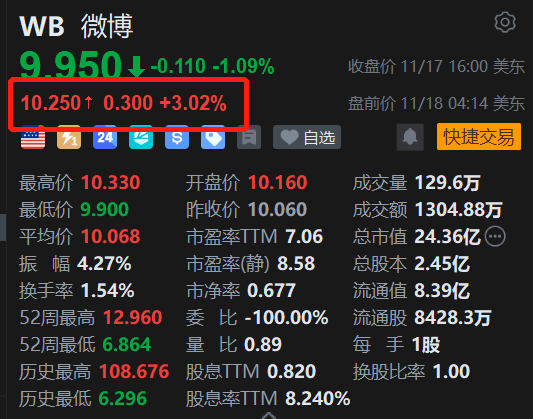
Core Insights - Weibo (WB.US) shares rose by 3% to $10.25 in pre-market trading, despite a year-over-year decline in net revenue for Q3 2025 [1] - The company reported a net income of $442 million, down 5% year-over-year, with advertising revenue at $375 million, a decrease of 6% [1] - Non-GAAP net profit was $111 million, reflecting a 20% decline compared to the previous year [1] - Notably, advertising revenue from Alibaba surged by 112% to $45.5 million, indicating strong growth in this segment [1] - Weibo also launched its first self-developed open-source large model, Vibe Thinker, showcasing its commitment to innovation [1] Financial Performance - Q3 2025 net revenue: $442 million, down 5% year-over-year [1] - Advertising revenue: $375 million, down 6% year-over-year [1] - Non-GAAP net profit: $111 million, down 20% year-over-year [1] - Alibaba advertising revenue: $45.5 million, up 112% year-over-year [1] Stock Performance - Pre-market price: $10.25, up 3% [2] - Closing price on November 17: $9.95, down 1.09% [2] - 52-week high: $12.96; 52-week low: $6.864 [2] - Total market capitalization: $2.436 billion [2] - Price-to-earnings ratio: 8.58 [2] - Dividend yield: 8.24% [2]
微博第三季度实现营收31.56亿元
Zheng Quan Shi Bao Wang· 2025-11-18 09:16
人民财讯11月18日电,11月18日,微博发布2025年第三季度财报显示,今年7月至9月,微博总营收 4.423亿美元,约合人民币31.56亿元,其中广告营收3.754亿美元,约合人民币26.77亿元,三季度调整后 运营利润1.32亿美元,约合人民币9.37亿元。用户方面,截至三季度末,微博的月活跃用户达到5.78 亿,日活跃用户达到2.57亿。 ...
微博-SW(09898.HK):第三季度净收入4.423亿美元
Ge Long Hui· 2025-11-18 09:15
Financial Performance - In Q3 2025, Weibo's net revenue was $442.3 million, a decrease of 5% year-over-year, or a 4% decrease when adjusted for fixed exchange rates [1] - Advertising and marketing revenue amounted to $375.4 million, down 6% year-over-year, or a 5% decrease when adjusted for fixed exchange rates [1] - Value-added services revenue reached $66.9 million, an increase of 2% year-over-year, with no change when adjusted for fixed exchange rates [1] - Operating profit was $117.3 million, with an operating margin of 27% [1] - Net profit attributable to Weibo shareholders was $221.1 million, with diluted earnings per share of $0.83 [1] - Non-GAAP operating profit was $132 million, with a non-GAAP operating margin of 30% [1] - Non-GAAP net profit attributable to Weibo shareholders was $110.7 million, with non-GAAP diluted earnings per share of $0.42 [1] Strategic Developments - The CEO expressed satisfaction with the progress of Weibo's intelligent search, indicating improvements in user product offerings and the transformation of the homepage information flow to enhance user content consumption [2] - There was strong growth in user scale and search volume for Weibo's intelligent search in Q3, which contributed to an overall increase in platform search volume [2] - The company reinforced its content marketing advantages and improved the conversion rates of information flow advertisements [2] - Weibo is enhancing the application of artificial intelligence technology throughout the advertising process to further improve monetization efficiency [2]
WB(WB) - 2025 Q3 - Quarterly Results
2025-11-18 09:07
Exhibit 99.1 Weibo Announces Third Quarter 2025 Unaudited Financial Results BEIJING, China – November 18, 2025 – Weibo Corporation ("Weibo" or the "Company") (Nasdaq: WB and HKEX: 9898), a leading social media in China, today announced its unaudited financial results for the third quarter ended September 30, 2025. "We are pleased with our progress made in our intelligent search front," said Gaofei Wang, CEO of Weibo. "On the user product front, we have completed homepage information feeds product revamp, wi ...