
AKESO(09926)

Search documents
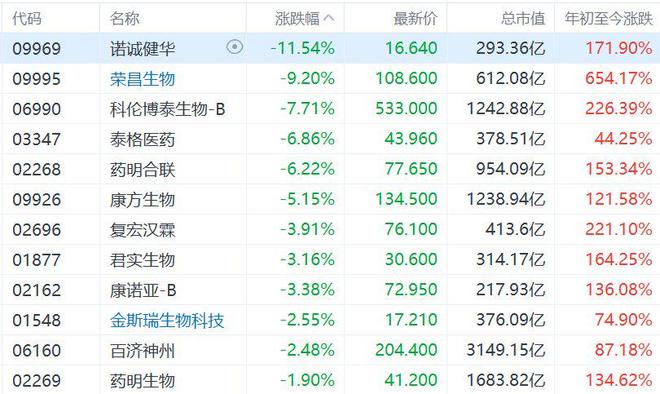
港股生物医药股普跌,荣昌生物跌超9%
Xin Lang Cai Jing· 2025-10-09 03:20
Core Viewpoint - The Hong Kong biopharmaceutical sector experienced a significant decline, with major companies reporting substantial drops in stock prices, indicating a bearish trend in the market [1]. Group 1: Stock Performance - Innovent Biologics (099660) saw a decline of 11.54%, with a latest price of 16.640 and a market capitalization of 293.36 billion, despite a year-to-date increase of 171.90% [2]. - Rongchang Biologics (09995) dropped by 9.20%, priced at 108.600, with a total market value of 612.08 billion, and a remarkable year-to-date increase of 654.17% [2]. - Kelun-Biotech (06990) fell by 7.71%, with a latest price of 533.000 and a market cap of 1,242.88 billion, while still showing a year-to-date increase of 226.39% [2]. - Tigermed (03347) decreased by 6.86%, priced at 43.960, with a market capitalization of 378.51 billion and a year-to-date increase of 44.25% [2]. - WuXi AppTec (02268) experienced a decline of 6.22%, with a latest price of 77.650 and a market cap of 954.09 billion, maintaining a year-to-date increase of 153.34% [2]. - CanSino Biologics (09926) dropped by 5.15%, priced at 134.500, with a market capitalization of 1,238.94 billion, and a year-to-date increase of 121.58% [2]. - Other companies like Junshi Biosciences (01877) and BeiGene (06160) also reported declines, with respective decreases of 3.16% and 2.48% [2].


研判2025!中国免疫检查点抑制剂行业发展历程、产业链及市场规模分析:行业为癌症患者开辟革命性治疗新路径,推动临床需求持续扩容[图]
Chan Ye Xin Xi Wang· 2025-10-09 01:37
Core Insights - The Chinese immune checkpoint inhibitor industry is rapidly developing, with a projected market size of approximately 52.734 billion yuan in 2024, representing a year-on-year growth of 44.14% [1][4][8] - The primary driver of this growth is the innovative therapeutic mechanism of immune checkpoint inhibitors, which reactivate the immune system to identify and attack tumor cells, providing revolutionary treatment options for cancer patients with limited traditional therapies [1][4] Industry Overview - Immune checkpoint inhibitors enhance the immune system's ability to attack cancer cells by blocking immune checkpoint proteins, which are used by tumor cells to evade immune responses [2][5] - The industry has evolved through three stages: initiation, rapid development, and mature expansion, with significant policy support and market entry of domestic products since 2018 [3][4] Market Size - The immune checkpoint inhibitor market in China is expected to reach approximately 52.734 billion yuan in 2024, with a significant increase in clinical application driving market demand [1][8] Key Companies - Leading companies in the industry include Junshi Biosciences, Hengrui Medicine, Innovent Biologics, and BeiGene, which collectively hold over half of the market share [8] - Junshi Biosciences' core product, Toripalimab, has been approved for 12 indications and is the first domestic PD-1 inhibitor to receive FDA approval for kidney cancer treatment [9] - Akeso's dual antibody technology has led to significant advancements, with its PD-1/CTLA-4 dual antibody achieving notable efficacy in cervical cancer [11] Industry Development Trends 1. Continuous technological innovation is driving breakthroughs in precision treatment and combination therapies, with dual antibodies and ADCs becoming more prominent [12] 2. Market expansion and the shift of indications towards early-stage treatments are accelerating internationalization, with several domestic products gaining traction in overseas markets [13] 3. Policy and regulatory developments are promoting industry standardization, with support for new biological agents and reforms in medical insurance payment methods [13]




康方生物(09926) - 截至二零二五年九月三十日止月份股份发行人的证券变动月报表
2025-10-08 08:41
股份發行人及根據《上市規則》第十九B章上市的香港預託證券發行人的證券變動月報表 截至月份: 2025年9月30日 狀態: 新提交 致:香港交易及結算所有限公司 公司名稱: 康方生物科技(開曼)有限公司 呈交日期: 2025年10月8日 I. 法定/註冊股本變動 | 1. 股份分類 | 普通股 | 股份類別 | 不適用 | | | 於香港聯交所上市 (註1) | | 是 | | | --- | --- | --- | --- | --- | --- | --- | --- | --- | --- | | 證券代號 (如上市) | 09926 | 說明 | | | | | | | | | | | 法定/註冊股份數目 | | | 面值 | | | 法定/註冊股本 | | | 上月底結存 | | | 5,000,000,000 | USD | | 0.00001 | USD | | 50,000 | | 增加 / 減少 (-) | | | | | | | USD | | | | 本月底結存 | | | 5,000,000,000 | USD | | 0.00001 | USD | | 50,000 | 本月底法定/註 ...
交银国际:四季度医药行业催化剂丰富 布局优质创新标的
智通财经网· 2025-10-03 06:29
Core Insights - The report from CMB International highlights the release of the first batch of innovative pharmaceutical technology medical insurance payment incentive catalog by Zhejiang Province, which is expected to alleviate the challenges of innovative drugs entering hospitals [1] - Despite the Trump administration's announcement of a 100% tariff on imported innovative drugs, the overall impact on China's pharmaceutical industry chain is considered manageable, with a recommendation to monitor subsequent developments [1] - The upcoming ESMO conference in mid to late October is noted as a key event, with a focus on companies such as CanSino Biologics (09926), Kelun-Biotech (06990), and Rongchang Biologics (688331.SH) that are expected to release significant data [1] Industry Summary - The Hong Kong pharmaceutical sector has shown relatively flat performance in September, but with increasing industry catalysts such as academic conferences and favorable policy implementations in October, a market rebound is anticipated [1] - The report recommends focusing on specific segments: 1) Innovative drugs: Companies like 3SBio (01530) and Eucure Biopharma-B (06996) have rich short-term catalysts and their valuations do not yet reflect the core value of major products; companies like Ascletis Pharma (02096), Hutchison China MediTech (00013), and Legend Biotech are considered significantly undervalued with clear long-term growth logic [1] 2) CXO: Leaders in this segment, such as WuXi AppTec (02268), are expected to benefit from high downstream demand and marginal recovery in financing [1]
康方生物(09926) - 2025 - 中期财报
2025-09-30 08:15
康方生物科技(開曼)有限公司 Akeso, Inc. (於開曼群島註冊成立的有限公司) (Incorporated in the Cayman Islands with limited liability) Stock Code 股份代號 : 9926 2025 中期報告 INTERIM REPORT 康方生物科技(開曼)有限公司 Akeso, Inc. INTERIM REPORT 2025 中期報告 目 錄 | | 頁次 | | --- | --- | | 公司簡介 | 2 | | 釋義 | 3 | | 公司資料 | 6 | | 摘要 | 8 | | 管理層討論及分析 | 9 | | 補充資料 | 27 | | 獨立審閱報告 | 66 | | 中期簡明綜合損益及其他全面收益表 | 67 | | 中期簡明綜合財務狀況表 | 69 | | 中期簡明綜合權益變動表 | 71 | | 中期簡明綜合現金流量表 | 73 | | 中期簡明綜合財務資料附註 | 75 | 公司簡介 康方生物科技(開曼)有限公司是一家致力於研究、開發、生產及商業化讓全球病人可負擔的創新抗體藥的生物製藥 公司。自成立以來,本公司建立了端對端 ...
交银国际:特朗普加征药品关税对中国医药影响有限 建议重点关注康方生物(09926)等
智通财经网· 2025-09-29 03:53
Core Viewpoint - The announcement of a 100% tariff on all branded/patented drugs by Trump starting in October is expected to have limited impact on China's innovative drug industry chain, with no excessive concerns warranted [1] Group 1: Impact on Innovative Drugs - Most Chinese innovative drugs that are currently being exported have either established production capacity in the U.S. or have outsourced production to local CMO companies [1] - The majority of domestic innovative drugs are exported using a business development (BD) model, which mitigates the impact of the tariff [1] Group 2: Impact on CXO Sector - The export products in the CXO sector primarily consist of raw materials and biological raw liquids, which are not affected by the new tariff; the proportion of finished dosage forms exported is low [1] - The investment timeline for multinational corporations (MNCs) to build factories in China will take time, leading to limited direct impact on CXO orders in the short term [1] - Long-term policy changes may influence the pace of factory construction by MNCs [1] Group 3: Upcoming Catalysts - The ESMO conference will take place in mid to late October, with a focus on companies like CanSino Biologics (09926), Kelun-Biotech (06990), and Rongchang Biologics (09995) that are expected to release significant data [1] - The results of medical insurance negotiations and the first version of the commercial insurance innovative drug directory are expected to be announced in October-November [1] Group 4: Mid to Long-term Recommendations - Recommended stocks in the innovative drug sector include 3SBio (01530) and Eucure Biopharma-B (06996), which have rich short-term catalysts and their valuations do not yet reflect the core value of major products [2] - Companies like Ascletis Pharma (02096), Hutchison China MediTech (00013), and Legend Biotech are considered undervalued with clear long-term growth logic [2] - In the CXO sector, WuXi AppTec (02268) is highlighted as a leading player benefiting from high downstream demand and improving financing conditions [2]

交银国际:特朗普加征药品关税对中国医药影响有限 建议重点关注康方生物等
Zhi Tong Cai Jing· 2025-09-29 03:51
Group 1 - The core viewpoint is that the new 100% tariff on all branded/patented drugs announced by Trump will have limited impact on China's innovative drug industry chain, and there is no need for excessive concern [1] - For innovative drugs, most products currently being exported are either produced in the U.S. or outsourced to U.S. CMO, and most domestic innovative drugs are exported using the BD model [1] - For CXO, the main export products are raw materials and herbal extracts, which are not affected by the new tariff; the proportion of finished drug exports is low, and the investment timeline for MNC clients to build factories will take time, leading to limited short-term impact on CXO orders [1] Group 2 - Mid to long-term recommendations include innovative drugs such as 3SBio (01530) and Eucure Biopharma-B (06996), which have rich short-term catalysts and their valuations do not yet reflect the core value of major products [2] - Other recommended companies include Ascletis Pharma (02096), Hutchison China MediTech (00013), and Legend Biotech, which are considered significantly undervalued with clear long-term growth logic [2] - For CXO, companies like WuXi AppTec (02268) are expected to benefit from high downstream demand and improving financing conditions [2]
智通港股通持股解析|9月29日
智通财经网· 2025-09-29 00:33
Core Insights - The top three companies by Hong Kong Stock Connect holding ratios are COSCO Shipping Energy (70.65%), China Telecom (70.49%), and Yangtze Optical Fibre and Cable (70.24%) [1] - Alibaba (W) saw the largest increase in holding amount over the last five trading days, with an increase of 9.659 billion yuan, followed by Tencent Holdings with 2.552 billion yuan, and SMIC with 1.472 billion yuan [1] - The companies with the largest decrease in holding amounts over the same period include Pop Mart (-0.976 billion yuan), CSPC Pharmaceutical (-0.594 billion yuan), and Hang Seng China Enterprises (-0.560 billion yuan) [1] Group 1: Top Holding Ratios - COSCO Shipping Energy (01138) has a holding ratio of 70.65% with 916 million shares [1] - China Telecom (00728) has a holding ratio of 70.49% with 9.784 billion shares [1] - Yangtze Optical Fibre and Cable (06869) has a holding ratio of 70.24% with 247 million shares [1] Group 2: Recent Increases in Holdings - Alibaba (W) (09988) increased its holding amount by 9.659 billion yuan, with a change of 58.0117 million shares [1] - Tencent Holdings (00700) increased its holding amount by 2.552 billion yuan, with a change of 3.9628 million shares [1] - SMIC (00981) increased its holding amount by 1.472 billion yuan, with a change of 2.0176 million shares [1] Group 3: Recent Decreases in Holdings - Pop Mart (09992) decreased its holding amount by 0.976 billion yuan, with a change of -3.6698 million shares [3] - CSPC Pharmaceutical (01093) decreased its holding amount by 0.594 billion yuan, with a change of -6.5368 million shares [3] - Hang Seng China Enterprises (02828) decreased its holding amount by 0.560 billion yuan, with a change of -589,320 shares [3]




港股再融资热潮涌动,新经济企业成绝对主角
Zheng Quan Shi Bao· 2025-09-26 15:42
Core Insights - The Hong Kong stock market is experiencing a significant surge in refinancing activities, driven by ample liquidity, valuation recovery, and corporate strategic expansion needs [1][4][5] Group 1: Refunding Scale - Hong Kong listed companies have raised over 280 billion HKD through various refinancing methods this year, marking a year-on-year increase of over 400% compared to 2022 [1][4] - The total amount raised has already surpassed the entire annual figure for 2024, which was 990.73 billion HKD [4] - Placement of shares has become the primary method for refinancing, accounting for 87.81% of the total, with 249.5 billion HKD raised through this method [4] Group 2: New Economy Enterprises - New economy enterprises are leading the refinancing trend, with BYD raising 43.38 billion HKD, marking the largest equity refinancing project in the global automotive industry in the past decade [6][7] - Xiaomi Group follows closely with 42.6 billion HKD raised, surpassing its total fundraising since its 2019 IPO and setting a record for Chinese tech hardware companies in overseas equity refinancing [7] - Other tech companies like Horizon Robotics and WuXi AppTec have also raised significant amounts, focusing on sectors such as biomedicine and artificial intelligence [7] Group 3: International Capital Involvement - The current refinancing wave has seen unprecedented participation from international institutional investors, including GIC and Al-Futtaim family office [9][10] - BYD's placement attracted numerous top long-term investors, with Al-Futtaim investing 3.5 billion HKD as a strategic investor [9] - Notable long-term funds like Wujin Capital have been actively investing in various companies, indicating strong international interest in the Hong Kong market [10]




交银国际:内地医疗恒指本周跑输大市 重点关注康方生物(09926)等
Zhi Tong Cai Jing· 2025-09-26 03:37
Core Viewpoint - The Hang Seng Healthcare Index fell by 1.4% this week, underperforming the market, with internet medicine, CXO, and traditional Chinese medicine sectors showing better performance [1] Group 1: Market Trends - Since September, the proportion of domestic holdings through the Hong Kong Stock Connect has remained stable, while foreign holdings have slightly decreased since mid-year [1] - Both domestic and foreign investors continue to increase their positions in innovative pharmaceutical companies, indicating a consistent long-term strategy [1] Group 2: Investment Recommendations - The report suggests focusing on companies with significant data releases at the upcoming ESMO conference in mid to late October, specifically mentioning Kangfang Biotech (09926), Kelun-Biotech (06990), and Rongchang Biotech (09995) [1] - The importance of timing and stock selection has increased following a broad rise in the innovative drug sector, with recommendations to gradually build positions during market corrections [1] Group 3: Sector Focus - For the innovative drug sector, the report highlights companies such as 3SBio (01530) and Eucure Biopharma-B (06996) as having rich short-term catalysts and undervalued core products, while companies like Ascletis Pharma (02096), Hutchison China MediTech (00013), and Legend Biotech are noted as significantly undervalued with clear long-term growth logic [1] - In the CXO sector, the report points to leading companies benefiting from high downstream demand and marginal recovery in financing, specifically mentioning WuXi AppTec (02268) [1]