
AKESO(09926)

Search documents
康方生物涨超4% 依沃西HARMONi研究成果以LBA形式入选Plenary oral
Zhi Tong Cai Jing· 2025-08-14 06:09
Core Viewpoint - 康方生物's stock rose over 4%, reaching 164.6 HKD with a trading volume of 1.404 billion HKD, following the announcement of significant clinical trial results to be presented at the 2025 World Lung Cancer Conference [1] Group 1: Clinical Developments - 康方生物's partner, Summit Therapeutics, will present the results of the global first PD-1/VEGF bispecific antibody drug, Ivoris, during the conference, specifically the results from the international multicenter Phase III clinical trial HARMONi, which has been selected for a Late-Breaking Abstract oral presentation [1] - The company will also disclose efficacy data for the combination therapy of Cardonili and Proxilumab (VEGFR2) in patients with immune therapy-resistant lung cancer, which has been included in the Mini Oral session of the conference [1] - The combination therapy of Cardonili has previously been recognized as a breakthrough therapy for advanced squamous non-small cell lung cancer (NSCLC) that has progressed after PD-(L)1 inhibitor treatment, highlighting its significant clinical value [1]

港股异动 | 康方生物(09926)涨超4% 依沃西HARMONi研究成果以LBA形式入选Plenary oral
智通财经网· 2025-08-14 06:05
Core Viewpoint - 康方生物's stock rose over 4%, reaching 164.6 HKD, with a trading volume of 1.404 billion HKD, following the announcement of significant clinical trial results to be presented at the 2025 World Lung Cancer Conference [1] Group 1: Clinical Developments - 康方生物's partner, Summit Therapeutics, will present the results of the global first PD-1/VEGF bispecific antibody new drug, Ivoris, during the conference, which has been selected for a Late-Breaking Abstract oral presentation [1] - The company will also disclose efficacy data for the combination therapy of Cardonili and Proxilumab (VEGFR2) in the context of immune therapy-resistant lung cancer, which has been included in the conference's Mini Oral session [1] - The combination therapy of Cardonili has been recognized as a breakthrough treatment for advanced squamous non-small cell lung cancer (NSCLC) after progression on PD-(L)1 inhibitors, highlighting its significant clinical value [1]
智通港股通资金流向统计(T+2)|8月14日
智通财经网· 2025-08-13 23:37
Key Points - Xiaomi Group-W (01810), Crystal International Holdings (02228), and BYD Electronic (00285) ranked top in net inflow of southbound funds, with net inflows of 562 million, 227 million, and 213 million respectively [1][2] - Xpeng Motors-W (09868), Innovent Biologics (01801), and Ganfeng Lithium (01772) had the highest net outflows, with net outflows of -663 million, -535 million, and -410 million respectively [1][2] - In terms of net inflow ratio, Haitian Flavoring and Food (03288), Jiangsu Nanjing Highway (00177), and Swire Properties B (00087) led the market with ratios of 55.51%, 49.37%, and 46.46% respectively [1][2] - The highest net outflow ratios were recorded by Reshape Energy (02570), Southbound Hang Seng Index ETF (03037), and First Pacific Company (00142) with ratios of -90.77%, -68.70%, and -60.36% respectively [1][3] Net Inflow Rankings - Xiaomi Group-W (01810) had a net inflow of 562 million, representing 8.75% of its closing price of 50.800, which decreased by 0.88% [2] - Crystal International Holdings (02228) saw a net inflow of 227 million, with a net inflow ratio of 11.34% and a closing price of 7.450, which increased by 4.78% [2] - BYD Electronic (00285) recorded a net inflow of 213 million, with a net inflow ratio of 13.41% and a closing price of 38.680, which increased by 6.15% [2] Net Outflow Rankings - Xpeng Motors-W (09868) experienced the largest net outflow of -663 million, with a net outflow ratio of -20.13% and a closing price of 83.600, which increased by 5.36% [2] - Innovent Biologics (01801) had a net outflow of -535 million, with a net outflow ratio of -19.67% and a closing price of 89.950, which decreased by 1.42% [2] - Ganfeng Lithium (01772) recorded a net outflow of -410 million, with a net outflow ratio of -19.45% and a closing price of 34.000, which increased by 20.91% [2] Net Inflow Ratio Rankings - Haitian Flavoring and Food (03288) had a net inflow ratio of 55.51%, with a net inflow of 21.1399 million and a closing price of 33.560, which decreased by 0.47% [3] - Jiangsu Nanjing Highway (00177) recorded a net inflow ratio of 49.37%, with a net inflow of 14.6726 million and a closing price of 9.980, which decreased by 0.40% [3] - Swire Properties B (00087) had a net inflow ratio of 46.46%, with a net inflow of 4.0945 million and a closing price of 12.160, which decreased by 0.57% [3]
8月13日中银创新医疗混合C净值增长3.87%,近6个月累计上涨86.76%
Sou Hu Cai Jing· 2025-08-13 12:22
Group 1 - The core viewpoint of the news is the performance and holdings of the Zhongyin Innovation Medical Mixed Fund C, which has shown significant growth in recent months and has a strong portfolio in the healthcare sector [1][3]. - As of August 13, 2025, the latest net value of Zhongyin Innovation Medical Mixed Fund C is 2.1969 yuan, reflecting a growth of 3.87% [1]. - The fund has achieved a return of 15.09% over the past month, ranking 1008 out of 4699 in its category [1]. - Over the last six months, the fund's return is 86.76%, ranking 26 out of 4543 [1]. - Year-to-date, the fund has returned 85.33%, ranking 30 out of 4501 [1]. - The top ten stock holdings of the fund account for a total of 62.83%, with significant positions in companies such as Innovent Biologics (8.33%), Kelun-Biotech (8.15%), and Hengrui Medicine (8.08%) [1]. Group 2 - The Zhongyin Innovation Medical Mixed Fund C was established on October 30, 2020, and as of June 30, 2025, it has a total scale of 2.686 billion yuan [1]. - The fund manager, Zheng Ning, has a background in asset management and has held various positions in the investment industry, including roles at Taikang Asset Management and Zhonggeng Fund Management [2]. - Zheng Ning has been managing the Zhongyin Innovation Medical Mixed Fund C since July 1, 2022, and has also taken on management roles for other funds within the healthcare sector [2].


国金证券:从IL-2双抗 看TAA、细胞及趋化因子的PD-1升级新方向
Zhi Tong Cai Jing· 2025-08-13 09:14
Core Viewpoint - The report from Guojin Securities highlights the rise of innovative drugs in China, indicating that the industry is in the early stages of realizing innovation outcomes, with significant opportunities for independent development and large-scale licensing transactions in the future [1] Group 1: Industry Trends - The global oncology immunotherapy landscape is entering a new era characterized by the combination of PD-1 and TAA (tumor-associated antigens) with cytokines [2] - Multinational pharmaceutical companies are facing patent cliffs for their blockbuster drugs while new innovative drug assets are rapidly emerging globally, including in China, leading to a trend of licensing agreements to fill pipeline gaps [2] - The global innovative drug business development (BD) upfront payments have reached the billion-dollar level, with China accounting for 40% of the total upfront payments [2] Group 2: Drug Development Focus - The evolution from single antibodies to dual and multi-target molecules is ongoing, with a focus on enhancing efficacy and reducing toxicity [3] - The exploration of new molecular constructs has progressed from combinations of immune checkpoint inhibitors (ICIs) and TAAs to combinations with cytokines like IL-2, aiming for better therapeutic outcomes [3][4] - The next wave of innovation in the post-PD-1 era is just beginning, with numerous companies exploring combinations of PD-1 with IL-2 and other structural innovations [4] Group 3: Potential Investment Targets - The report suggests that promising new products may emerge from segments such as TCE (T-cell engagers), other dual/multi-antibodies, and innovative ADCs (antibody-drug conjugates), with a focus on leading clinical enterprises [5] - Recommended companies to watch include Innovent Biologics (01801), Kintor Pharmaceutical (09926), and Kelun-Biotech (06990) [5]

近15日连续“吸金”累计超10亿,港股创新药50ETF(513780)午盘涨超3%,“医保双目录”申报药品亮相
Sou Hu Cai Jing· 2025-08-13 05:56
Group 1 - The Hong Kong stock market showed strong performance on August 13, with the Hang Seng Index rising by 1.88% and the Hang Seng Tech Index increasing by 2.35%, particularly driven by the healthcare sector [1] - The Hong Kong Innovative Drug 50 ETF (513780) closed up by 3.38% with a turnover rate exceeding 18% and a transaction volume of over 400 million yuan, indicating strong investor interest [1] - Notably, the Hong Kong Innovative Drug 50 ETF (513780) experienced a net inflow of 1.07 billion yuan over the past 15 trading days, and it has gained over 92% year-to-date as of August 12 [1] Group 2 - The National Healthcare Security Administration announced the preliminary review results for the 2025 medical insurance directory and commercial insurance innovative drug directory, with 534 drugs passing the basic medical insurance directory review and 121 drugs passing the commercial insurance innovative drug directory review [2] - High-priced innovative drugs, including CAR-T therapies, are seeking inclusion in the commercial insurance innovative drug directory, indicating a push for diversified payment methods for innovative drugs [2] - Analysts suggest that the rise of innovative drugs is sustainable, recommending attention to companies with rich pipeline layouts, high-potential single innovative drugs, and leading technology platforms in the sector [2]



医保商保“双目录”初审揭幕,高价创新药冲刺入列,创新药ETF沪港深(159622)涨超1.6%持续溢价交易
Sou Hu Cai Jing· 2025-08-13 02:56
Core Viewpoint - The adjustment of the national medical insurance and commercial health insurance drug directories is a significant event for the innovative drug investment landscape in the second half of the year, with over 650 drugs entering the basic medical insurance directory and commercial insurance innovative drug directory [1][2]. Group 1: Medical Insurance Directory Adjustments - A total of 534 drug generic names passed the initial review for the basic medical insurance directory, with 310 drugs being added to the directory, a significant increase from 249 in 2024 [2]. - The directory adjustments allow newly approved innovative drugs to have the opportunity to enter the insurance directory, including several notable drugs such as the lung cancer drug Gorailis and the autoimmune drug Fuanqi [2]. Group 2: Commercial Health Insurance Directory - The commercial health insurance innovative drug directory has approved 121 drugs, including five CAR-T therapies and a domestic vaccine, marking a new approach for market access for preventive biological products [3]. - Notable CAR-T therapies that made it into the directory include products from Fosun Kite, Huyuan Bio, and WuXi AppTec, with the latter's product achieving $808 million in revenue in the first half of the year, reflecting a doubling in growth [3]. Group 3: Future Outlook for Innovative Drugs - The upcoming months will see significant overseas pharmaceutical conferences and further developments in the medical insurance directories, providing ample opportunities for speculation and investment in innovative drugs [4]. - The domestic innovative drug sector is expected to benefit from increased clinical data catalysts and a rebound in funding and secondary market activity, enhancing the demand for new drug development [4].

研报掘金丨华福证券:维持康方生物买入评级,合理市值为2228亿港元
Ge Long Hui· 2025-08-12 15:09
Core Viewpoint - The report from Huafu Securities indicates that Kangfang Biopharma (9926.HK) is leading globally in the development of its self-researched dual antibody AK112, which is expected to capture the largest share of the global second-generation immuno-oncology (IO) market [1] Financial Projections - The projected revenues for Kangfang Biopharma for the years 2025, 2026, and 2027 are estimated to be 35.18 billion, 57.65 billion, and 93.72 billion CNY respectively [1] - The expected net profits attributable to the parent company for the same years are projected to be -1.86 billion, 8.03 billion, and 29.66 billion CNY respectively [1] Valuation - The reasonable market capitalization for Kangfang Biopharma is estimated to be 222.8 billion HKD [1] - The report maintains a "buy" rating for the company's stock [1]
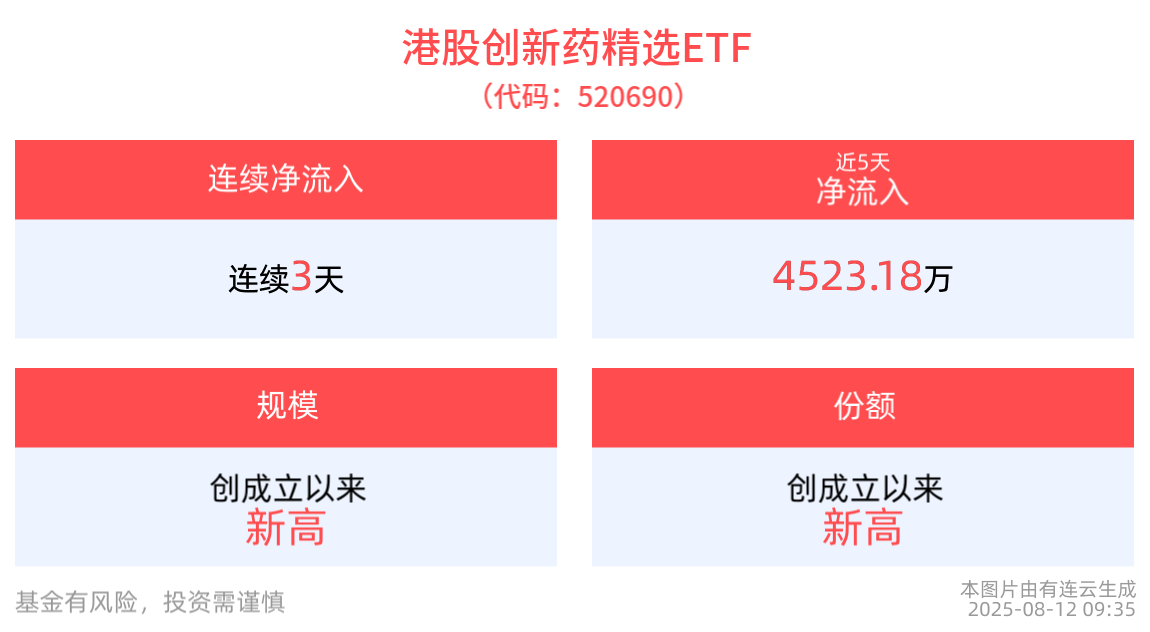
港股创新药精选ETF(520690)连续3天获资金净流入,晶泰控股领涨超7%,预计中期综合收益同比增加至少约387%
Xin Lang Cai Jing· 2025-08-12 02:13
Group 1 - The Hang Seng Hong Kong Stock Connect Innovative Drug Selection Index (HSSCPB) increased by 0.02%, with notable stock performances including Jingtai Holdings (02228) up 7.38% and Fosun Pharma (02196) up 6.00% [3] - The Hong Kong Innovative Drug Selection ETF (520690) rose by 0.52%, reaching a latest price of 0.97 yuan, with a trading volume of 240.45 million yuan and a turnover rate of 0.62% [3] - Jingtai Holdings announced an expected comprehensive income of no less than 500 million yuan for the six months ending June 30, 2025, representing an increase of at least 387% compared to the same period in 2024 [3] Group 2 - The Hong Kong Innovative Drug Selection ETF reached a new high in scale at 385 million yuan and a new high in shares at 399 million [4] - The ETF has seen continuous net inflows over the past three days, with a maximum single-day net inflow of 22.93 million yuan, totaling 42.28 million yuan [4] - The ETF's management fee is 0.50% and the custody fee is 0.10%, which are among the lowest in comparable funds [5] Group 3 - The HSSCPB index aims to reflect the performance of Hong Kong-listed companies involved in innovative drug research, development, and production [5] - The top ten weighted stocks in the HSSCPB index account for 78.05% of the total index weight, including companies like BeiGene (06160) and WuXi Biologics (02269) [5]


智通港股通资金流向统计(T+2)|8月12日
智通财经网· 2025-08-11 23:33
Group 1 - Xiaomi Group-W (01810), SMIC (00981), and Alibaba-W (09988) ranked the top three in net inflow of southbound funds, with net inflows of 1.716 billion, 0.497 billion, and 0.492 billion respectively [1] - The top three stocks with the highest net outflow of southbound funds were the Tracker Fund of Hong Kong (02800), Hang Seng China Enterprises (02828), and China Mobile (00941), with net outflows of -4.725 billion, -1.560 billion, and -0.794 billion respectively [1] - In terms of net inflow ratio, Reshape Energy (02570), Haitian International (01882), and Guofu Hydrogen Energy (02582) led the market with ratios of 69.81%, 56.10%, and 54.91% respectively [1] Group 2 - The top ten stocks by net inflow included Xiaomi Group-W (01810) with 1.716 billion and a closing price of 51.850, down 3.98% [2] - The top ten stocks by net outflow included the Tracker Fund of Hong Kong (02800) with -4.725 billion and a closing price of 25.560, up 0.55% [2] - The highest net inflow ratio was recorded by Reshape Energy (02570) at 69.81% with a closing price of 167.000, up 1.33% [3]




