POP MART(09992)

Search documents
泡泡玛特(09992):2025年业绩亮眼,公司持续深化IP运营能力:泡泡玛特(09992.HK)
Hua Yuan Zheng Quan· 2026-03-27 13:11
Investment Rating - The investment rating for the company is "Buy" (maintained) [5] Core Views - The company achieved impressive performance in 2025, with revenue reaching 37.12 billion RMB, a year-on-year increase of 184.7%, and net profit attributable to shareholders reaching 12.78 billion RMB, up 308.8% [7] - The company is committed to global expansion, with significant revenue growth in both domestic and international markets, including a 748.4% increase in the Americas [7] - The company continues to deepen its IP operation capabilities, with 17 artist IPs generating over 100 million RMB in revenue in 2025 [7] - The company is expected to maintain strong growth, with projected net profits of 16 billion RMB, 19.47 billion RMB, and 23.57 billion RMB for 2026, 2027, and 2028, respectively [7] Financial Summary - Revenue projections for the company are as follows: 46.89 billion RMB in 2026, 56.29 billion RMB in 2027, and 67.27 billion RMB in 2028, with growth rates of 26.32%, 20.05%, and 19.51% respectively [6][9] - The net profit attributable to shareholders is projected to be 16 billion RMB in 2026, 19.47 billion RMB in 2027, and 23.57 billion RMB in 2028, with growth rates of 25.27%, 21.67%, and 21.07% respectively [6][9] - The company's return on equity (ROE) is expected to be 41.8% in 2026, 33.7% in 2027, and 29.0% in 2028 [6][9]
泡泡玛特(09992):持续夯实IP为核心的商业框架,厚积薄发
GF SECURITIES· 2026-03-27 10:09
Investment Rating - The report maintains a "Buy" rating for the company, with a target price of 255.83 HKD per share based on a 20x PE ratio for the adjusted net profit in 2026 [7]. Core Insights - The company is focusing on solidifying its IP-centric business framework, which is expected to drive long-term growth. The core growth engines for 2025 include plush toys, store expansion, and improved store efficiency [7]. - The company achieved a total revenue of 37.1 billion HKD in 2025, representing a year-on-year growth of 185%, with a non-GAAP net profit of 13.08 billion HKD, up 285% year-on-year [7]. - The gross margin improved by 5.3 percentage points to 72.1%, primarily due to a decrease in the cost of goods sold as a percentage of revenue [7]. Financial Summary - **Revenue Forecast**: - 2024: 13.038 billion HKD - 2025: 37.12 billion HKD - 2026: 44.581 billion HKD - 2027: 52.693 billion HKD - 2028: 59.283 billion HKD - **Growth Rates**: - 2024: 106.9% - 2025: 184.7% - 2026: 20.1% - 2027: 18.2% - 2028: 12.5% [2] - **EBITDA**: - 2024: 5.017 billion HKD - 2025: 17.611 billion HKD - 2026: 20.219 billion HKD - 2027: 24.089 billion HKD - 2028: 27.839 billion HKD [2] - **Net Profit**: - 2024: 3.403 billion HKD - 2025: 13.084 billion HKD - 2026: 15.106 billion HKD - 2027: 18.116 billion HKD - 2028: 20.975 billion HKD [2] - **EPS**: - 2024: 2.54 HKD - 2025: 9.84 HKD - 2026: 11.26 HKD - 2027: 13.51 HKD - 2028: 15.64 HKD [2] - **PE Ratio**: - 2024: 32.6x - 2025: 13.5x - 2026: 11.8x - 2027: 9.8x - 2028: 8.5x [2] - **ROE**: - 2024: 30.1% - 2025: 57.7% - 2026: 59.9% - 2027: 58.1% - 2028: 55.3% [2] Business Model and Strategy - The company’s business framework is built around three dimensions: IP, products, and consumer scenarios. This framework aims to expand the monetization pathways for its IP [14]. - The company has transitioned from a single IP model to a diversified IP matrix, aiming for a global presence in the collectible toy market [18]. - The organization has undergone structural adjustments to enhance product innovation and market responsiveness, particularly in the context of its international expansion [22]. Product Development - The company has seen a significant increase in its plush toy category, which accounted for over 50% of total revenue in 2025, with a year-on-year growth of 561% [66]. - The number of new product launches in 2025 reached 415, with a focus on plush toys and a reduction in blind box offerings [25]. - The company is actively exploring new IP collaborations and product innovations to maintain its competitive edge in the market [44].
泡泡玛特(09992) - 翌日披露报表 - [股份购回]
2026-03-27 09:13
FF305 翌日披露報表 (股份發行人 ── 已發行股份或庫存股份變動、股份購回及/或在場内出售庫存股份) 表格類別: 股票 狀態: 新提交 公司名稱: 泡泡瑪特國際集團有限公司 呈交日期: 2026年3月27日 如上市發行人的已發行股份或庫存股份出現變動而須根據《香港聯合交易所有限公司(「香港聯交所」)證券上市規則》(「《主板上市規則》」)第13.25A條 / 《香港聯合交易所有限公司GEM證券 上市規則》(「《GEM上市規則》」)第17.27A條作出披露,必須填妥第一章節 。 | 第一章節 | | | | | | | | | --- | --- | --- | --- | --- | --- | --- | --- | | 1. 股份分類 | 普通股 | 股份類別 不適用 | | | 於香港聯交所上市 | 是 | | | 證券代號 (如上市) | 09992 | 說明 | | | | | | | A. 已發行股份或庫存股份變動 | | | | | | | | | | | 已發行股份(不包括庫存股份)變動 | | | 庫存股份變動 | | | | | 事件 | 已發行股份(不包括庫存股份)數 目 | | 佔 ...
三大指数齐涨 小米涨超1.7% B站、快手涨超1%!锂电板块爆发,赣锋锂业涨超9% | 港股收盘
Mei Ri Jing Ji Xin Wen· 2026-03-27 08:45
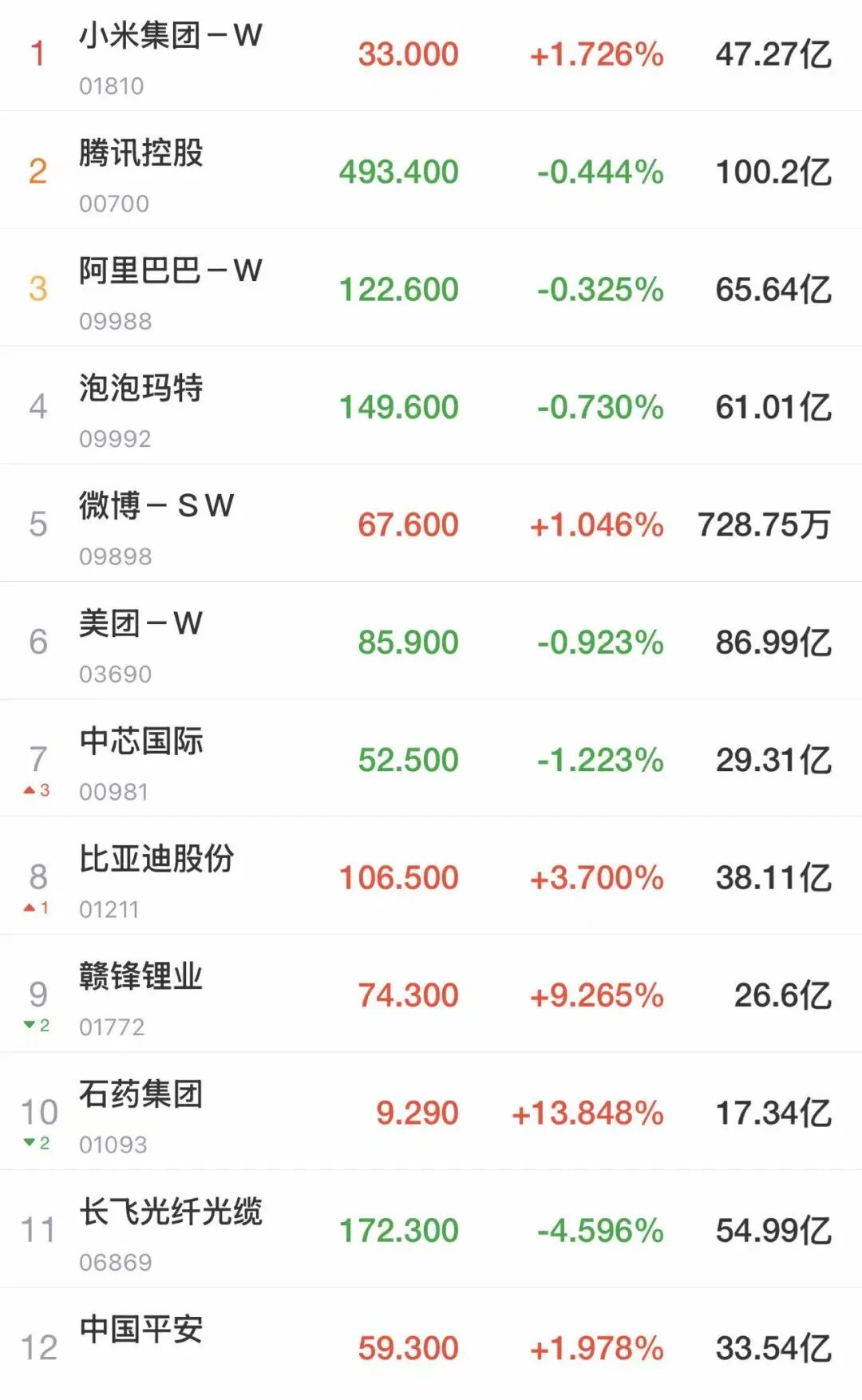
Market Performance - The Hong Kong stock market indices collectively rose on March 27, with the Hang Seng Index increasing by 0.38% to close at 24,951.88 points, the Hang Seng Tech Index up by 0.35%, and the National Enterprises Index rising by 0.76% [1] Sector Performance - Technology stocks showed mixed results, with Kuaishou and Xiaomi both rising over 1%, while Bilibili fell by more than 1% [1] - Innovative pharmaceutical stocks surged, with CSPC Pharmaceutical Group increasing by over 13% [1] - The lithium battery sector performed well, with Ganfeng Lithium rising by over 9% [1] - The commercial aerospace sector faced declines, with Junda Co., Ltd. dropping by over 9% [1] Stock Highlights - Xiaomi Group saw a price increase of 1.726%, closing at HKD 33.00 with a trading volume of 4.727 billion [2] - Ganfeng Lithium reported a price increase of 9.265%, closing at HKD 74.30 with a trading volume of 2.66 billion [2] - CSPC Pharmaceutical Group experienced a significant rise of 13.848%, closing at HKD 9.29 with a trading volume of 1.734 billion [2] Investor Sentiment - Goldman Sachs indicated that international investor interest in Chinese stocks has likely reached a near-high point, with only about 10% of surveyed clients considering the Chinese stock market "non-investable," a significant improvement from approximately 40% two years ago [4] - Haitong International's Chief Economist Zhang Yidong believes that the recent market fluctuations do not alter the long-term trend, with both A-shares and H-shares expected to reach new highs in the second half of the year [4]





特朗普宣布对伊朗能源打击再延10天、kimi据称考虑赴港IPO、中芯国际发布业绩报告
新财富· 2026-03-27 08:05
Major Events Observation - Trump has postponed the strike on Iranian energy facilities by 10 days, now set for April 6, citing progress in negotiations, although reports indicate Iran did not request this delay [2] - South Korea has announced a complete ban on naphtha exports starting March 27 for five months to address domestic supply shortages, halting all previously signed contracts [3] Company Performance - SMIC reported a revenue of 67.323 billion yuan for 2025, a 16.49% increase year-on-year, with a net profit of 5.041 billion yuan, up 36.29%. Capacity utilization rose to 93.5%, and gross margin increased to 22% [4] - Skoda confirmed it will exit the Chinese market by mid-2026, shifting focus to high-growth markets like India and ASEAN, as sales in China have dropped significantly [5] - Pop Mart's stock fell over 30% following its earnings report, prompting a share buyback of 3.94 million shares at a cost of approximately 599 million HKD [6] - Apple has confirmed the discontinuation of the Mac Pro, with no plans for a successor, as it shifts focus to the Mac Studio [7] AI and Technology Developments - Google has launched a memory import feature for Gemini, allowing users to import preferences and chat histories from Chat GPT and Claude [9] - Xiaomi's robotic hand has achieved significant advancements, with a 50% increase in freedom and successful operation in production environments [10] - Moonlight, the parent company of Kimi, is considering an IPO in Hong Kong, with discussions ongoing with investment banks [11] - Google introduced the Turbo Quant compression algorithm, which significantly reduces memory usage for AI models, enhancing deployment efficiency [12][13] - XunTu Technology completed nearly 200 million yuan in Series A financing, indicating strong investor interest and support [14]




泡泡玛特(09992):——泡泡玛特(9992.HK)2025年业绩点评:以健康发展为目标,推动全球化+以IP为核心集团化长期战略
Guohai Securities· 2026-03-27 03:37
Investment Rating - The investment rating for the company is "Buy" (maintained) [1][16][17] Core Insights - The company aims for healthy development while promoting globalization and a long-term strategy centered around intellectual property (IP) [2][16] - In 2025, the company reported revenue of 371.2 billion yuan, a year-on-year increase of 184.7%, and an adjusted net profit of 130.8 billion yuan, up 284.5% year-on-year [5][6] - The adjusted net profit margin improved significantly to 35.2%, an increase of 9.1 percentage points year-on-year, driven by higher gross margins and effective cost control [6][16] Financial Performance - Revenue for the first half of 2025 was 138.8 billion yuan, and for the second half, it was 232.4 billion yuan, with year-on-year growth rates of 204.4% and 174.1% respectively [7] - The online revenue growth rate was significantly higher than offline, with online sales increasing by 295% year-on-year, while offline sales grew by 149% [8][10] - The company’s gross margin for 2025 was 72.1%, up 5.3 percentage points year-on-year, attributed to an increase in overseas revenue and a flexible supply chain strategy [6][16] Market Expansion - The company’s overseas revenue reached 162.7 billion yuan in 2025, a year-on-year increase of 292%, with overseas revenue accounting for 43.8% of total revenue [10][13] - The number of overseas stores increased to 185, a year-on-year increase of 95 stores, with significant growth in the Americas and Europe [13][16] - The company has been exploring innovative business experiences, including theme parks and merchandise stores, to drive long-term growth [12][16] Future Projections - Revenue projections for 2026-2028 are 447 billion yuan, 513 billion yuan, and 560 billion yuan respectively, with adjusted net profits expected to be 151.7 billion yuan, 175.9 billion yuan, and 192.2 billion yuan [15][16] - The adjusted P/E ratio is projected to decrease from 12 in 2026 to 9 in 2028, indicating a favorable valuation trend [15][16]
泡泡玛特:交接覆盖:2025利润低于预期,26年全流程进一步优化-20260327
海通国际· 2026-03-27 00:45
Investment Rating - The investment rating for Pop Mart International has been downgraded to Neutral [2][19]. Core Insights - The company reported a revenue of RMB 37.1 billion for 2025, representing a year-on-year growth of 185%, with a gross margin of 72.1%, up 5.3 percentage points from the previous year [3][14]. - The adjusted net profit reached RMB 13.1 billion, a 285% increase year-on-year, with an adjusted net profit margin of 35.2%, up 9.1 percentage points [3][14]. - The company plans to enter a "business adjustment period" in 2026, expecting revenue growth of no less than 20% while focusing on cost control and avoiding aggressive revenue growth without profit improvement [9][18]. Financial Performance - Revenue projections for 2026 are estimated at RMB 44.9 billion, with a year-on-year growth of 21%, and net profit attributable to shareholders is expected to be RMB 14.5 billion, reflecting a 13% increase [19]. - The gross margin is projected to slightly decline to 69.5% in 2026, with net profit margins expected to be 32.2% [19][13]. Business Strategy - The company is focusing on a multi-IP and multi-category strategy to drive revenue growth, with significant contributions from popular IPs such as Labubu, which accounts for about 30% of revenue [4][15]. - The Americas market achieved revenue of RMB 6.9 billion in 2025, significantly exceeding the RMB 2 billion target, but may face slower growth due to high base effects [6][16]. - The company plans to enhance its online and offline presence, with a focus on flagship store expansions and improving operational efficiency [5][9]. Market Outlook - The company anticipates that the Americas market will require new influential IPs to sustain growth, especially as it expands its store count from 72 to over 100 by 2026 [6][16]. - The overall market strategy includes replicating successful models from China in overseas markets while localizing operations [9][18].
泡泡玛特(09992):交接覆盖:2025利润低于预期,26年全流程进一步优化
Haitong Securities International· 2026-03-27 00:01
Investment Rating - The report downgrades the investment rating to NEUTRAL with a target price of HKD 158.76, reflecting a current price of HKD 150.70 [2][9]. Core Insights - Pop Mart International reported a revenue of RMB 37.1 billion for 2025, representing a year-on-year increase of 185%. The gross margin reached 72.1%, up 5.3 percentage points, while the adjusted net profit was RMB 13.1 billion, up 285% year-on-year [3][14]. - The company plans to enter a "business adjustment period" in 2026, expecting revenue growth of no less than 20% while focusing on cost control and avoiding aggressive revenue growth without profit improvement [18][19]. Financial Performance - For 2025, the revenue was RMB 37,120 million, with a projected increase to RMB 44,923 million in 2026, representing a 21% growth. The net profit for 2025 was RMB 12,776 million, expected to rise to RMB 14,470 million in 2026, reflecting a 13% increase [19][13]. - The gross profit margin is projected to decline slightly to 69.5% in 2026 from 72.1% in 2025, while the net profit margin is expected to be 32.2% in 2026 [19][13]. Business Strategy - The company focuses on a multi-IP and multi-category strategy to drive revenue growth, with significant contributions from popular IPs such as Labubu, which accounts for about 30% of revenue. The revenue from China and overseas markets was RMB 20.85 billion and RMB 16.27 billion, respectively, showing year-on-year growth of 135% and 292% [4][15]. - In the Americas market, revenue reached RMB 6.9 billion in 2025, significantly exceeding the RMB 2 billion target. The company plans to expand its store presence, with flagship stores expected to open in New York by the end of 2026 [6][16]. Market Outlook - The report indicates that while the Americas market has shown rapid growth, it may face challenges in 2026 due to a high base effect. The company needs to introduce new influential IPs to sustain growth in this region [6][16]. - The overall strategy includes enhancing online and offline sales channels, with a focus on improving store efficiency and customer engagement through a robust membership system [5][18].
泡泡玛特(09992):轻舟已过万重山,风物长宜放眼量
ZHONGTAI SECURITIES· 2026-03-26 14:23
Investment Rating - The investment rating for the company is "Buy" (maintained) [4] Core Insights - The company is positioned as a leader in the commercialization of IP, with a comprehensive global operational platform covering the entire toy IP industry chain. The potential for top-tier IP is upward, and there is significant room for expansion internationally [7] - The company achieved total revenue of 371 billion yuan in 2025, representing a year-on-year growth of 185%, and an adjusted net profit of 131 billion yuan, with a year-on-year increase of 284% [6] - The company is expected to achieve total revenues of 446.51 billion yuan, 554.34 billion yuan, and 677.08 billion yuan for the years 2026 to 2028, with year-on-year growth rates of 20%, 24%, and 22% respectively [7] Financial Performance Summary - For 2024A, the company is projected to have a revenue of 13,038 million yuan, with a growth rate of 107% year-on-year. By 2028E, revenue is expected to reach 67,708 million yuan, with a growth rate of 22% [4] - The adjusted net profit is forecasted to be 1,082 million yuan in 2024A, growing to 26,294 million yuan by 2028E, with a growth rate of 29% [4] - The earnings per share (EPS) is expected to increase from 0.81 yuan in 2024A to 19.61 yuan in 2028E [4] Regional Revenue Breakdown - In China, the revenue for 2025 is expected to grow by 135% to 209 billion yuan, with a significant online sales increase of 205% [6] - The Asia-Pacific region is projected to see a revenue increase of 158% to 80 billion yuan in 2025, with online sales growing by 146% [6] - The Americas are anticipated to experience a staggering revenue growth of 748% to 68 billion yuan in 2025, with online sales increasing by 907% [6] - Europe and other regions are expected to see a revenue increase of 506% to 15 billion yuan in 2025, with online sales growing by 675% [6] Product and IP Performance - Revenue from various IPs such as the MONSTERS, MOLLY, and SKULLPANDA is expected to grow significantly, with the total revenue from these IPs increasing by 366% in 2025 [6] - The company’s product categories, including figurines and plush toys, are projected to generate substantial revenue, with figurines alone expected to bring in 120 billion yuan in 2025 [6] Membership and User Engagement - The company saw a net increase of 26.5 million members in mainland China, bringing the total to 72.58 million members, with an average revenue per user (ARPU) increase of 51% [6] - The member repurchase rate increased by 6.3 percentage points to 55.7%, indicating strong user engagement and retention [6]
股价大跌20%后,泡泡玛特火线回购5.99亿港元
21世纪经济报道· 2026-03-26 13:48
Group 1 - The company announced a significant share buyback plan, investing HKD 599 million to repurchase 3.94 million shares at a price range of HKD 148.4 to HKD 157.8 per share, aimed at stabilizing market sentiment and demonstrating confidence in long-term growth [1] - Following the release of its 2025 financial report, which showed total revenue of CNY 37.12 billion (up 184.7% year-on-year) and adjusted net profit of CNY 13.08 billion (up 284.5% year-on-year), the company's stock price experienced a sharp decline of over 20% [3] - Despite strong performance metrics, there are concerns regarding the company's ability to maintain high growth rates in 2026, leading to a significant market reaction and stock price drop [3] Group 2 - The company has been actively repurchasing shares, with a total buyback amount exceeding HKD 900 million, indicating a strategy to support its stock price amidst market volatility [3] - The stock price has shown a notable decline since September 2025, contrasting sharply with the company's reported strong earnings growth, highlighting a disconnect between market perception and financial performance [3]