
SMIC(688981)

Search documents
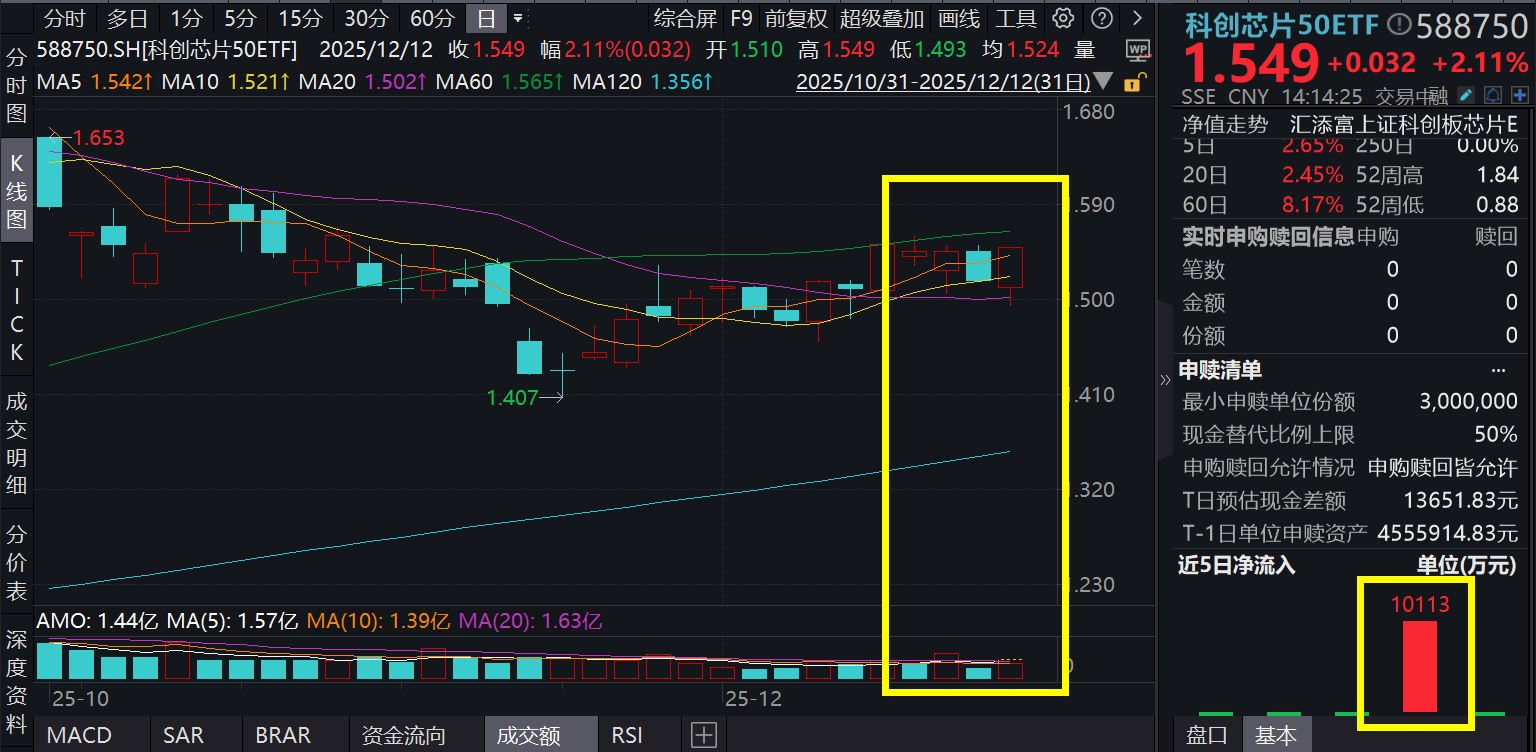
全球“存储荒”愈演愈烈,内存芯片Q4或涨价35%!拓荆科技暴涨超8%,科创芯片50ETF(588750)放量涨超2%,2026年芯片产业怎么看?
Xin Lang Cai Jing· 2025-12-12 06:38
Core Viewpoint - The semiconductor sector is experiencing a short-term surge, with significant gains in stocks such as Tuojing Technology and Chip Origin, while some stocks like Haiguang Information and Cambricon are experiencing pullbacks [2][4]. Group 1: Stock Performance - The majority of the component stocks in the Sci-Tech Chip 50 ETF (588750) have seen price increases, with Tuojing Technology rising over 10% and Chip Origin increasing over 8% [2]. - As of 14:16, the performance of key stocks includes: Haiguang Information down 1.36%, Cambricon down 2.14%, Zhongwei Company up 3.98%, and Zhongxin International up 2.31% [3]. Group 2: Market Trends and Demand - The AI industry's rapid development is driving significant demand for chips, with UBS predicting a continued shortage in DRAM supply until Q1 2027, with a projected 20.7% increase in DDR memory demand [4]. - The NAND flash shortage is expected to persist until Q3 2026, leading to the most intense price increase cycle in nearly 30 years, with DDR contract prices expected to rise by 35% in Q4 this year [4]. Group 3: Investment Opportunities - Huatai Securities highlights three investment opportunities in the semiconductor market for 2026: expansion of advanced process logic related to AI, a storage supercycle, and increased domestic production rates in the Chinese market [5]. - The Sci-Tech Chip sector is positioned to benefit from both AI demand and domestic substitution trends, suggesting a focus on index-based investment strategies to navigate the complexities of the industry [6]. Group 4: Index Characteristics - The Sci-Tech Chip 50 ETF (588750) focuses on the core segments of the semiconductor industry, with a high concentration of 96% in upstream and midstream sectors, indicating stronger growth potential compared to other indices [7]. - The index is adjusted quarterly, allowing it to more effectively reflect trends in the semiconductor supply chain [8]. Group 5: Financial Performance - The net profit growth rate for the Sci-Tech Chip index is projected to reach 94% for the first three quarters of 2025, with an expected annual growth rate of 100%, significantly outperforming peers [10]. - The index has shown a maximum increase of 187.69% since September, indicating strong upward elasticity compared to other industry indices [11].


抢滩A股新风口:硬科技与新材料企业的上市战略机遇
Sou Hu Cai Jing· 2025-12-12 06:00
Group 1 - The investment logic in the A-share market is undergoing a profound transformation, shifting from model innovation and traffic economy to fundamental technological innovation, with hard technology and new materials reshaping the value orientation of China's capital market [2] - The China Securities Regulatory Commission (CSRC) has implemented measures such as establishing the Sci-Tech Innovation Board and optimizing listing standards to facilitate the rapid access of technology-driven enterprises to the capital market [2] - Companies like Duxin Environmental Protection, a leader in the polyvinyl alcohol new materials sector, are accelerating their IPO processes, highlighting the strategic importance of the new materials industry in building a modern industrial system [2] Group 2 - The current A-share market presents an unprecedented friendly environment for hard technology and new materials companies, with a significant tilt in listing reviews towards these sectors and a substantial reduction in review cycles [3] - In the semiconductor industry, over 15 companies have successfully listed on the Sci-Tech Innovation Board in 2023, with an average review time reduced by more than 40% compared to traditional industries [3] - The average first-day increase for hard technology companies on the Sci-Tech Innovation Board has reached 87%, significantly surpassing the average levels of the main board and the ChiNext, indicating a notable valuation premium for technology-leading enterprises [3] Group 3 - Despite the opportunities, challenges exist for hard technology and new materials companies, including the risk of technological iteration, which poses a threat to maintaining a competitive edge in rapidly evolving fields like AI chips and advanced semiconductor materials [4] - Intellectual property disputes are on the rise as Chinese companies engage more in cutting-edge technology, with significant lawsuits potentially disrupting IPO processes [4] - Balancing R&D investment with profitability expectations remains a critical challenge for decision-makers, as regulatory bodies offer greater tolerance for profitability in hard technology firms [4] Group 4 - The current preference of the A-share market for hard technology and new materials is not coincidental, as major economies globally are increasing capital support for key technology sectors [5] - China is providing "ammunition" for innovative enterprises through capital market reforms during this critical policy window, which has a clear time sensitivity [6] - For growing hard technology and new materials companies, now may be the best time to enter the capital market to secure funding for R&D and capacity expansion while establishing a leading position before the industry landscape solidifies [6]
恒生港股通软件及半导体指数将更名 加入阅文等四只股份
Xin Lang Cai Jing· 2025-12-12 03:49
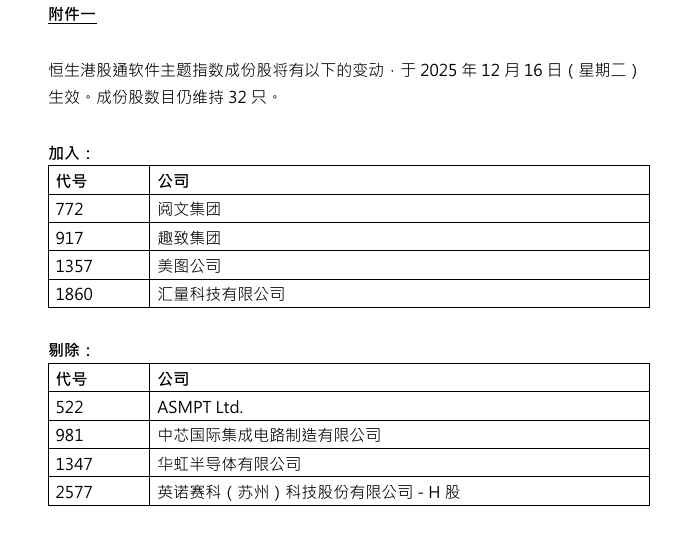
Core Viewpoint - The Hang Seng Index Company announced a rebranding of the Hang Seng Hong Kong Stock Connect Software and Semiconductor Index to the Hang Seng Hong Kong Stock Connect Software Theme Index, with changes in constituent stocks effective December 16, 2025 [1] Group 1 - The number of constituent stocks will be fixed at 40 [1] - Four stocks will be added: Reading Group, Qutoutiao, Meitu, and Huya Technology [1] - Four stocks will be removed: ASMPT, SMIC, Hua Hong Semiconductor, and Innodisk [1]


254只科创板股融资余额环比增加
Zheng Quan Shi Bao Wang· 2025-12-12 02:28
科创板融资余额增幅排名 | 代码 | 简称 | 最新融资余额 | 融资余额环比增 | 最新融券余额 | 融券余额环比增 | 当日涨跌幅 | | --- | --- | --- | --- | --- | --- | --- | | | | (万元) | 减(%) | (万元) | 减(%) | (%) | | 688662 | 富信 | 21449.77 | 25.40 | 0.00 | | 20.00 | | | 科技 | | | | | | | 688361 | 中科 | 40134.85 | 19.99 | 1959.05 | 21.85 | 7.95 | | | 飞测 | | | | | | | 688387 | 信科 | 55556.42 | 19.78 | 740.00 | 33.73 | 14.58 | | | 移动 | | | | | | | 688682 | 霍莱 | 13615.84 | 17.32 | 0.00 | | -5.75 | | | 沃 | | | | | | | 688239 | 航宇 | 25122.61 | 16.03 | 70.37 | 2.60 | 2.60 | | ...


港股芯片股普跌,其中,华虹半导体、天域半导体、英诺赛科跌超3%
Mei Ri Jing Ji Xin Wen· 2025-12-12 02:21
(文章来源:每日经济新闻) 每经AI快讯,12月12日,港股芯片股普跌,其中,华虹半导体、天域半导体、英诺赛科跌超3%, ASMPT跌超2%,宏光半导体、中芯国际跌超1%。 ...
港股策略周报-20251211
Shanghai Securities· 2025-12-11 14:30
Market Overview - The Hong Kong stock market indices showed a mixed performance with the Hang Seng Index rising by 0.87%, the Hang Seng China Enterprises Index increasing by 0.75%, and the Hang Seng Technology Index up by 1.13% during the week of December 1 to December 5, 2025 [4][9] - The Hang Seng Index's current Price-to-Earnings (PE) ratio is 11.87, which is around the 70th percentile since January 1, 2007, while the Price-to-Book (PB) ratio stands at 1.28, approximately at the 58th percentile during the same period [6][11] Key Economic Indicators - The U.S. PCE price index increased by 0.3% month-on-month in September, with the core PCE price index rising by 0.2%, aligning with expectations [4] - The probability of a 25 basis point rate cut by the Federal Reserve in December has risen to 86.2%, which is expected to positively impact liquidity in the Hong Kong stock market [4] Investment Recommendations - The report suggests focusing on sectors such as non-ferrous metals, price-increasing chemical products, and AI infrastructure due to favorable market conditions [4] Capital Flow Analysis - Net inflow of southbound funds amounted to HKD 11.349 billion last week, a decrease of HKD 8.491 billion compared to the previous week [6][13] - The top five net purchases by southbound funds included Xiaomi Group (HKD 4.596 billion), Tracker Fund of Hong Kong (HKD 2.606 billion), Meituan (HKD 2.100 billion), ZTE Corporation (HKD 0.641 billion), and Li Auto (HKD 0.392 billion) [6][17] - The top five net sales were Tencent Holdings (HKD 3.811 billion), SMIC (HKD 1.376 billion), ASMPT (HKD 0.439 billion), Kuaishou Technology (HKD 0.285 billion), and China Pacific Insurance (HKD 0.129 billion) [6][17]



恒生港股通软件及半导体(可投资)指数将更名
Xin Lang Cai Jing· 2025-12-11 12:19
Core Viewpoint - The Hang Seng Index's software and semiconductor index will be renamed to the Hang Seng Software Theme Index, with a fixed number of 40 constituent stocks, effective December 16, 2025 [1] Group 1: Index Changes - The index will include four new companies: Reading Group, Qutoutiao, Meitu, and HuiLiang Technology [1] - Four companies will be removed from the index: ASMPT, SMIC, Hua Hong Semiconductor, and Innodisk [1]
恒生港股通软件及半导体指数将更名 阅文、美图等获纳入 剔除中芯国际、华虹半导体
Zhi Tong Cai Jing· 2025-12-11 11:40
Group 1 - The Hang Seng Index Company announced that the Hang Seng Hong Kong Stock Connect Software and Semiconductor Index will be renamed to the Hang Seng Hong Kong Stock Connect Software Theme Index, with changes to the calculation method and stock selection criteria [2][3] - The number of constituent stocks will be fixed at 40, with the inclusion of four new stocks: Yueda Group (00772), Qutoutiao (00917), Meitu (01357), and iClick Interactive Asia Group (01860) [2][4] - The removal of several stocks including ASMPT (00522), SMIC (00981), and Hua Hong Semiconductor (01347) will take effect on December 16, 2025, while the total number of constituent stocks will remain at 32 [2][5]
中芯国际(688981) - 港股公告:翌日披露报表
2025-12-11 10:46
FF305 翌日披露報表 (股份發行人 ── 已發行股份或庫存股份變動、股份購回及/或在場内出售庫存股份) 表格類別: 股票 狀態: 新提交 公司名稱: 中芯國際集成電路製造有限公司 備註: 在計算上市發行人已發行股份數目變動的百分比時,將參照以上市發行人在發生其最早一宗相關事件前的已發行股份數目總額 (包括於香港聯交所及上海證券交易所上市 的普通股份) 第 2 頁 共 6 頁 v 1.3.0 FF305 呈交日期: 2025年12月11日 如上市發行人的已發行股份或庫存股份出現變動而須根據《香港聯合交易所有限公司(「香港聯交所」)證券上市規則》(「《主板上市規則》」)第13.25A條 / 《香港聯合交易所有限公司GEM證券 上市規則》(「《GEM上市規則》」)第17.27A條作出披露,必須填妥第一章節 。 | 第一章節 | | | | | | | | | | --- | --- | --- | --- | --- | --- | --- | --- | --- | | 1. 股份分類 普通股 | | 股份類別 | 不適用 | | 於香港聯交所上市 | 是 | | | | 證券代號 (如上市) 00981 | ...
中芯国际根据2014股支薪奖励计划而发行1.74万股
Zhi Tong Cai Jing· 2025-12-11 10:37
于2025年12月8日根据2014认股权计划(于2013年6月13日获采纳)发行2000股股份。 中芯国际(00981)发布公告,于2025年12月11日,非本公司董事因行使根据2014以股支薪奖励计划(于 2013年6月13日获采纳)所授予的受限制股份单位而发行约1.74万股股份。 ...