
SMIC(688981)

Search documents
科创板平均股价40.43元,8股股价超300元
Zheng Quan Shi Bao Wang· 2025-11-11 08:43
Core Insights - The average stock price on the STAR Market is 40.43 yuan, with 69 stocks priced over 100 yuan, and the highest priced stock is Cambrian-U at 1330.00 yuan, which fell by 4.42% today [1][2] - Among the stocks priced over 100 yuan, 230 stocks rose while 353 stocks fell, with an average decline of 0.75% for the hundred-yuan stocks today [1][2] - The average premium of the hundred-yuan stocks relative to their issue price is 504.43%, with the highest premiums seen in stocks like Shangwei New Materials (5253.98%), Cambrian-U (1965.54%), and Anji Technology (1482.85%) [1][2] Stock Performance - Cambrian-U closed at 1330.00 yuan, down 4.42%, followed by Yuanjie Technology at 598.00 yuan and Guodun Quantum at 508.71 yuan [1][2] - Among the hundred-yuan stocks, 17 stocks increased in price, with the largest gainers being Shangwei New Materials, Haibo Sichuang, and Guoguang Electric [1][2] - The stocks with the largest declines included Purang Shares, Tengjing Technology, and Zhongke Feicai [1][2] Industry Distribution - The hundred-yuan stocks are primarily concentrated in the electronics, pharmaceutical, and computer industries, with 35, 10, and 8 stocks respectively [1][2] Capital Flow - The net outflow of main funds from the hundred-yuan stocks today totaled 2.742 billion yuan, with the largest net inflows seen in Baiwei Storage, Lanqi Technology, and Guoguang Electric [2] - The total margin balance for hundred-yuan stocks is 93.481 billion yuan, with Cambrian-U, SMIC, and Haiguang Information having the highest margin balances [2] Margin Trading - The latest margin balance for hundred-yuan stocks is 93.481 billion yuan, with Cambrian-U leading at 15.133 billion yuan, followed by SMIC at 13.768 billion yuan [2]



芯片股午后走低,中芯国际周四将发业绩,机构称华虹估值已偏高
Zhi Tong Cai Jing· 2025-11-11 06:38
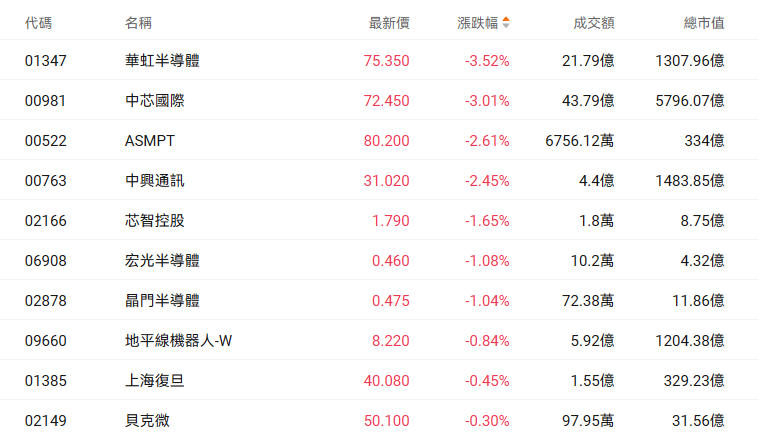
Group 1 - Chip stocks experienced a decline, with losses nearing 4% for some companies as of the report time [1] - Notable declines in specific companies include Huahong Semiconductor down 3.52%, SMIC down 3.01%, and ASMPT down 2.61% [2] - Huahong Semiconductor reported record sales revenue of $635.2 million for Q3, a year-on-year increase of 20.7% and a quarter-on-quarter increase of 12.2% [2] Group 2 - Jianyin International slightly raised Huahong Semiconductor's profit forecast for 2025, citing better-than-expected gross margins for Q3 and Q4 [3] - The acquisition of Huahong's fifth factory is expected to enhance the company's return on equity, with completion anticipated in 2026 [3] - The target price for Huahong Semiconductor was raised by 46% from HKD 50 to HKD 73, although the rating was downgraded from "outperform" to "neutral" due to high valuation levels [3]

德国蔡司:DUV比EUV重要,美国的错误制裁,让中国成为了市场赢家
Xin Lang Cai Jing· 2025-11-11 06:26
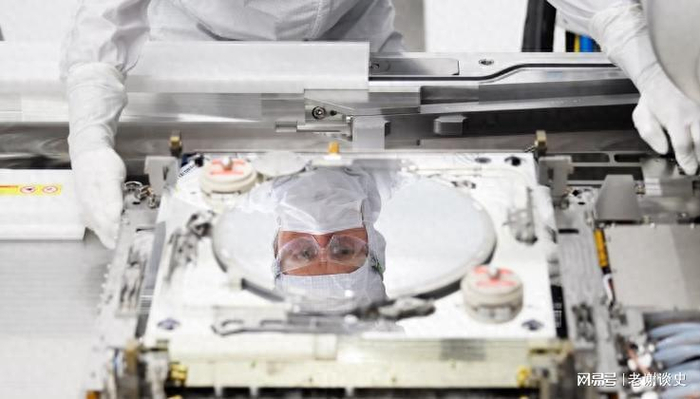
Core Insights - The article emphasizes the critical role of DUV lithography in semiconductor manufacturing, highlighting that it accounts for 80% of microelectronic chips produced globally, with 90% of the production layers still relying on DUV technology despite the emergence of EUV [1][3][11]. DUV Technology - DUV lithography machines operate at wavelengths from 365 nm to 193 nm, covering mainstream processes from 0.35 microns to 14 nm, making them both effective and cost-efficient [3][11]. - The immersion technology introduced by TSMC in 2002 significantly improved DUV's resolution to below 40 nm, doubling efficiency and enhancing yield rates [6][7]. - DUV's maturity and widespread deployment, with thousands of machines in operation, cater to various sectors, including consumer electronics and industrial control [11][13]. Market Dynamics - The demand for mature nodes (28 nm and above) is substantial, with production numbers starting from trillions of chips, driven by industries such as automotive and home appliances [9][24]. - DUV's cost-effectiveness, with machines priced at about half that of EUV, and quicker installation times make it accessible for smaller manufacturers [13][15]. Supply Chain and Geopolitical Factors - The U.S. restrictions on EUV technology have led Chinese companies to pivot towards DUV, resulting in a surge in imports, with China importing approximately 100 DUV machines worth €2.1 billion in 2022 [15][17]. - In 2023, Chinese imports of DUV machines reached €5.28 billion, nearly double the previous year's total, indicating a strong demand amidst geopolitical tensions [17][19]. Future Projections - By 2025, China's production capacity for mature chips (28 nm and above) is expected to account for 33% of the global market, up from 27% in 2023, with major contributions from companies like SMIC [22][24]. - The automotive sector is projected to see significant growth, with 70% of the demand for electric vehicles relying on 28 nm chips, further solidifying DUV's importance in the semiconductor landscape [24][26].


芯片股午后走低 中芯国际周四将发业绩 机构称华虹估值已偏高
Zhi Tong Cai Jing· 2025-11-11 05:47
Core Viewpoint - Semiconductor stocks experienced a decline in afternoon trading, with notable drops in companies such as Hua Hong Semiconductor and SMIC, amidst upcoming earnings announcements and mixed financial results [1] Group 1: Company Performance - Hua Hong Semiconductor reported a record high sales revenue of $635.2 million for Q3, representing a year-on-year increase of 20.7% and a quarter-on-quarter increase of 12.2% [1] - The net profit attributable to shareholders for Hua Hong Semiconductor was $25.7 million, showing a year-on-year decline of 42.6% but a quarter-on-quarter increase of 223.5% [1] Group 2: Analyst Insights - Jianyin International slightly raised the profit forecast for Hua Hong Semiconductor for 2025, citing better-than-expected gross margin projections for Q3 and Q4 of 2025 [1] - The acquisition of Hua Hong's fifth factory is expected to enhance the company's return on equity, with completion anticipated in 2026 [1] - The target price for Hua Hong Semiconductor was raised by 46% from HKD 50 to HKD 73, although the rating was downgraded from "outperform" to "neutral" due to high valuation levels [1]
港股异动 | 芯片股午后走低 中芯国际(00981)周四将发业绩 机构称华虹(01347)估值已偏高
智通财经网· 2025-11-11 05:42
Core Viewpoint - Semiconductor stocks experienced a decline in afternoon trading, with notable drops in companies such as Hua Hong Semiconductor and SMIC, amidst upcoming earnings announcements and mixed financial results [1] Group 1: Company Performance - Hua Hong Semiconductor reported a record high sales revenue of $635.2 million for Q3, representing a year-on-year increase of 20.7% and a quarter-on-quarter increase of 12.2% [1] - The net profit attributable to shareholders for Hua Hong Semiconductor was $25.7 million, showing a year-on-year decrease of 42.6% but a quarter-on-quarter increase of 223.5% [1] Group 2: Analyst Insights - Jianyin International slightly raised the profit forecast for Hua Hong Semiconductor for 2025, citing better-than-expected gross margin projections for Q3 and Q4 of 2025 [1] - The acquisition of Hua Hong's fifth factory is expected to enhance the company's return on equity, with completion anticipated in 2026 [1] - Jianyin International adjusted the target price for Hua Hong Semiconductor from HKD 50 to HKD 73, an increase of 46%, but downgraded the rating from "Outperform" to "Neutral" due to high valuation levels [1]
中芯国际披露重磅收购最新进展|全市场首只港股信息技术ETF(159131)11月13日“芯”动上市!
Xin Lang Cai Jing· 2025-11-11 05:17
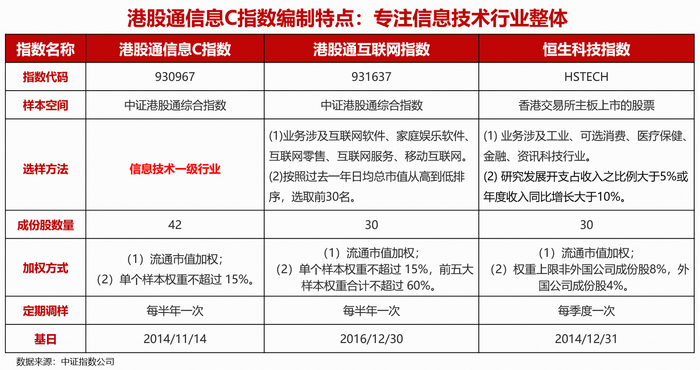
Group 1: Industry Overview - The semiconductor industry in China has shown strong performance in Q3, with total revenue reaching 439.2 billion yuan and net profit of 39.8 billion yuan, marking year-on-year growth of nearly 14% and approximately 53% respectively [1] - The "14th Five-Year Plan" emphasizes extraordinary measures to promote breakthroughs in key technologies across various sectors, including integrated circuits and advanced materials, which significantly enhances the growth potential of China's chip industry [1] - The launch of the first ETF focusing on the Hong Kong chip industry, managed by Huabao Fund, is set for November 13, providing investors with a new tool to capture investment opportunities in "hard technology assets" in Hong Kong [1] Group 2: ETF Details - The Hong Kong Information Technology ETF (159131) tracks the CSI Hong Kong Stock Connect Information Technology Composite Index, which consists of 42 hard technology companies, with a composition of 70% hardware and 30% software [3][4] - The index excludes large internet companies, making it more focused on capturing the AI hard technology market [3] - The top five weighted stocks in the index account for 50.03% of the total weight, indicating a high concentration of leading technology companies [10] Group 3: Company Specifics - Semiconductor Manufacturing International Corporation (SMIC) plans to acquire a 49% stake in SMIC North Integrated Circuit Manufacturing, enhancing its control over a significant 12-inch wafer manufacturing base [7][8] - SMIC North has a monthly production capacity of 70,000 wafers, with technology covering 40nm and 28nm processes, which are widely used in various electronic applications [8] - The acquisition will increase SMIC's ownership from 51% to 100%, allowing for full control over its operations [8]
就要闪耀(9131)!全市场首只聚焦“港股芯片”产业链的港股信息技术ETF(159131)11月13日开创上市
Xin Lang Ji Jin· 2025-11-11 02:03
Group 1: Semiconductor Industry Performance - The semiconductor industry in China has shown strong performance in Q3, with total revenue reaching 439.2 billion yuan and net profit of 39.8 billion yuan, representing year-on-year growth of nearly 14% and approximately 53% respectively [1] - The "14th Five-Year Plan" emphasizes extraordinary measures to promote breakthroughs in key technologies across various sectors, including integrated circuits and advanced materials, which significantly enhances the growth potential of China's chip industry [1] Group 2: ETF Launch and Market Position - Hua Bao Fund is set to launch the first ETF focused on the Hong Kong chip industry, tracking the CSI Hong Kong Stock Connect Information Technology Composite Index, which consists of 42 hard tech companies [1][3] - As of October 31, 2025, Hua Bao Fund's equity ETFs have reached an asset management scale of 131.49 billion yuan, ranking among the top ten in the industry [2] Group 3: Index Composition and Characteristics - The CSI Hong Kong Stock Connect Information Technology Composite Index is composed of 70% hardware and 30% software, focusing on semiconductor, electronics, and computer software sectors, which allows for better capture of AI hard tech trends [3][6] - The index has a high concentration of leading companies, with the top five stocks accounting for 50.03% of the total weight, indicating a strong alignment with the growth of industry leaders [6] Group 4: Company Developments - Semiconductor Manufacturing International Corporation (SMIC) plans to acquire a 49% stake in SMIC North Integrated Circuit Manufacturing, enhancing its control over a significant 12-inch wafer manufacturing base [7] - The acquisition will increase SMIC's ownership from 51% to 100%, allowing for full control over production capabilities, which include advanced technology processes [7]
306只科创板股融资余额环比增加
Zheng Quan Shi Bao Wang· 2025-11-11 01:45
Core Insights - The total margin financing balance on the STAR Market decreased by 0.33 billion yuan, while the margin short selling balance increased by 11.064 million yuan as of November 10 [1][2] Financing Balance Summary - The total margin financing balance reached 260.063 billion yuan, with a decrease of 0.327 billion yuan from the previous trading day [1] - The highest margin financing balance was held by Cambrian (寒武纪) at 15.133 billion yuan, followed by SMIC (中芯国际) and Haiguang Information (海光信息) with balances of 13.768 billion yuan and 8.585 billion yuan respectively [1] - A total of 306 stocks saw an increase in margin financing balance, while 280 stocks experienced a decrease [1] - Notable increases in margin financing balance were observed in Fumiao Technology (富淼科技), Huasheng Lithium (华盛锂电), and Zhuoyue New Energy (卓越新能) with increases of 30.85%, 30.08%, and 29.26% respectively [1] - Significant decreases were noted in Zhongke Feimiao (中科飞测), Pinming Technology (品茗科技), and Hanghua Co. (杭华股份) with declines of 15.48%, 14.70%, and 13.69% respectively [1] Short Selling Balance Summary - The highest margin short selling balance was recorded for Haiguang Information at 4.3 million yuan, followed by Cambrian and SMIC with balances of 3.7 million yuan and 3.1 million yuan respectively [2] - A total of 147 stocks saw an increase in margin short selling balance, while 130 stocks experienced a decrease [2] - The largest increases in margin short selling balance were seen in Zhenlei Technology (臻镭科技), Kewell (科威尔), and Sitwei (思特威) with increases of 350.02%, 237.39%, and 212.93% respectively [2] - The most significant decreases were observed in Youkede (优刻得), Liyuanheng (利元亨), and Lante Optics (蓝特光学) with declines of 74.90%, 67.59%, and 64.52% respectively [2]


科创ETF(588050)开盘涨0.35%,重仓股中芯国际涨0.49%,海光信息涨0.50%
Xin Lang Cai Jing· 2025-11-11 01:38
Group 1 - The core point of the article highlights the performance of the Science and Technology Innovation ETF (588050), which opened with a slight increase of 0.35% at 1.451 yuan [1] - The major holdings of the ETF include companies such as SMIC, Haiguang Information, and Cambrian, with respective opening increases of 0.49%, 0.50%, and 0.47% [1] - The ETF's performance benchmark is the Shanghai Stock Exchange Science and Technology Innovation Board 50 Index, managed by ICBC Credit Suisse Asset Management Company, with a return of 0.65% since its inception on September 28, 2020, and a return of -3.07% over the past month [1] Group 2 - The article provides specific stock performance data for the ETF's holdings, including a 1.17% increase for Lattice Semiconductor and a 1.13% increase for Zhongwei Company, while Unisound and Kingsoft Office experienced declines of 0.47% and 0.45%, respectively [1] - The article emphasizes the importance of monitoring market conditions, as the ETF's recent performance reflects broader market trends [1]


研判2025!中国电子束光刻系统行业产业链、市场规模及重点企业分析:技术突破与挑战并存,展望高质量发展未来[图]
Chan Ye Xin Xi Wang· 2025-11-11 01:16
Core Insights - The Chinese electron beam lithography (EBL) system industry is transitioning from "catching up" to "keeping pace" with international standards, achieving breakthroughs in technology such as 0.6 nm resolution and a production capacity of 60 wafers per hour, nearing global advanced levels [1][7][11] - The market size of the Chinese EBL system industry is projected to reach approximately 294 million yuan in 2024, representing a year-on-year growth of 59.78% [1][8] - Despite advancements, the industry faces challenges such as insufficient domestic production of EUV photoresists (less than 1%) and technical hurdles in processes below 2 nm [1][5][14] Industry Overview - EBL systems utilize high-energy electron beams for nanoscale structure fabrication, offering advantages like ultra-high resolution (less than 10 nm) and flexibility without masks, widely applied in semiconductor manufacturing and quantum device preparation [2][3] - The upstream supply chain includes materials like high-purity quartz glass and photoresists, while the downstream applications focus on semiconductor manufacturing and research [3][4] Market Size - The Chinese EBL system market is expected to grow significantly, with a forecasted market size of 294 million yuan in 2024, marking a 59.78% increase from the previous year [1][8] - The domestic demand for semiconductor chips continues to rise, driven by emerging technologies such as 5G and AI, which further supports the growth of the EBL system market [7][12] Key Companies and Institutions - Notable advancements have been made by companies like Zeyou Technology and Zhejiang University, with the "Xizhi" EBL machine achieving 0.6 nm precision and 8 nm linewidth technology, marking significant progress in domestic capabilities [8][11][9] - Zeyou Technology's EBL system has achieved over 95% localization rate and is being applied in various high-tech fields, breaking the monopoly of foreign companies [9][10] Industry Development Trends 1. **Technological Breakthroughs**: The focus will be on achieving resolutions below 0.6 nm and enhancing multi-beam parallel technology, with the aim of increasing production capacity to 120 wafers per hour [11][12] 2. **Expanding Market Demand**: The demand for high-precision chips in sectors like quantum computing and advanced packaging is expected to surge, driven by government support and industry collaboration [12][14] 3. **Complete Supply Chain Development**: The industry aims to achieve self-sufficiency across the entire supply chain, enhancing the localization of critical materials and addressing challenges in EUV photoresist production [14]
