
SPD BANK(600000)

Search documents
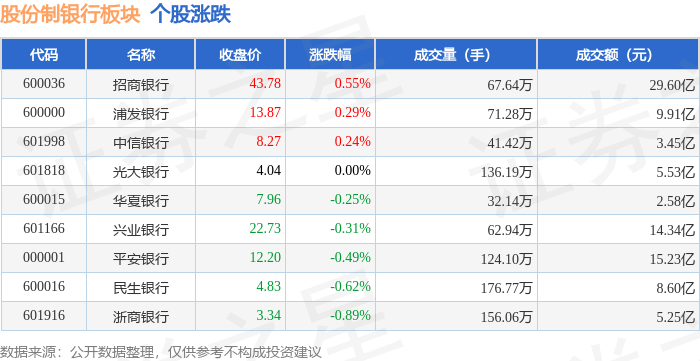
股份制银行板块8月14日涨0.08%,招商银行领涨,主力资金净流出1.73亿元
Zheng Xing Xing Ye Ri Bao· 2025-08-14 08:33
证券之星消息,8月14日股份制银行板块较上一交易日上涨0.08%,招商银行领涨。当日上证指数报收于3666.44,下跌0.46%。深证成指报收于 11451.43,下跌0.87%。股份制银行板块个股涨跌见下表: | 代码 | 名称 | 收盘价 | 涨跌幅 | 成交量(手) | 成交额(元) | | --- | --- | --- | --- | --- | --- | | 600036 | 指商银行 | 43.78 | 0.55% | 67.64万 | 29.60亿 | | 600000 | 浦发银行 | 13.87 | 0.29% | 71.28万 | 9.91亿 | | 661698 | 中信银行 | 8.27 | 0.24% | 41.42万 | 3.45 Z | | 601818 | 光大银行 | 4.04 | 0.00% | 136.19万 | 5.53亿 | | 600015 | 华夏银行 | 7.96 | -0.25% | 32.14万 | 2.58亿 | | 601166 | 兴 银行 | 22.73 | -0.31% | 62.94万 | 14.34亿 | | 000001 | 平安银行 | ...





重大利好,如何享受?看完这篇,立刻学会
天天基金网· 2025-08-14 05:09
Core Viewpoint - The article discusses the implementation plan for the personal consumption loan interest subsidy policy aimed at supporting resident consumption from September 1, 2025, to August 31, 2026, detailing eligibility, subsidy rules, and application processes [1]. Summary by Sections Support Scope - The policy applies to personal consumption loans issued by recognized financial institutions, excluding credit card transactions, where the loan is used for actual consumption. Eligible consumption includes both small daily expenses and larger purchases such as vehicles, home renovations, and electronics. Each individual can receive a maximum subsidy of 500 yuan per transaction, with multiple transactions eligible for cumulative benefits [2]. Subsidy Rules - For transactions under 50,000 yuan, the subsidy is calculated based on the actual amount, with a maximum of 1,000 yuan for multiple transactions at the same institution. For transactions over 50,000 yuan, the subsidy is capped at 3,000 yuan, calculated based on a maximum of 50,000 yuan per transaction. The policy may be extended or expanded based on its effectiveness [3]. Loan Processing Institutions - The policy is limited to 23 recognized financial institutions, including 18 banks and 5 other personal consumption loan providers. The policy supports reasonable borrowing needs and actual consumption behaviors, excluding any non-consumption or fraudulent activities [4]. Subsidy Standards - The average interest rate for personal consumption loans is around 3%. The subsidy rate is set at 1 percentage point, which is approximately one-third of the current commercial bank loan rates, with the central and provincial governments covering 90% and 10% of the subsidy, respectively [5]. Cumulative Subsidy Limits - Each borrower can receive a total subsidy of up to 3,000 yuan from one institution, corresponding to a cumulative consumption amount of 300,000 yuan. For loans under 50,000 yuan, the maximum cumulative subsidy is 1,000 yuan, linked to a consumption amount of 100,000 yuan [6]. Key Areas for Subsidy - The subsidy focuses on several key areas, including household vehicles, home renovations, electronic products, health care, and education training, among others [7][11]. Application Process - Borrowers must authorize the loan processing institution to access transaction information when applying for a personal consumption loan. Existing loans can also be adjusted through supplementary agreements. The institution will calculate the subsidy based on actual consumption and apply it directly to the interest payments, simplifying the process for borrowers [8][9]. Administrative Efficiency - To reduce the burden on borrowers and enhance policy effectiveness, the calculation and application of subsidy funds are primarily managed by the loan processing institutions and local government departments, minimizing additional steps for borrowers [9].





六大行,集体官宣
天天基金网· 2025-08-14 05:09
Core Viewpoint - The article discusses the implementation of a fiscal subsidy policy for personal consumption loans, initiated by the Ministry of Finance, the People's Bank of China, and the Financial Regulatory Bureau, aimed at boosting consumer confidence and stimulating domestic demand [1][24]. Group 1: Implementation of the Policy - The Agricultural Bank of China announced that it will implement the subsidy for eligible personal consumption loans starting from September 1, 2025, following market-oriented and legal principles [2]. - Postal Savings Bank is actively organizing the implementation of the fiscal subsidy policy for personal consumption loans and service industry loans, ensuring that the benefits reach consumers efficiently [4]. - The Bank of Communications stated it will comply with the policy and streamline the loan application process for eligible personal consumption loans [6]. Group 2: Other Banks' Responses - The Industrial and Commercial Bank of China is progressing with the fiscal subsidy work in an orderly manner, ensuring no service fees are charged for the loan subsidy process [8]. - The Bank of China will begin the fiscal subsidy for eligible personal consumption loans on September 1, 2025, aiming to stimulate consumer potential [11]. - China Construction Bank is also set to implement the subsidy for qualifying customers starting September 1, 2025 [14]. Group 3: Broader Participation - Several other banks, including Shanghai Pudong Development Bank, China Merchants Bank, and Guangfa Bank, have announced their commitment to implementing the personal consumption loan subsidy policy [16][18][21]. - A total of 23 financial institutions have been selected as loan processing agencies, including six major state-owned banks and twelve national joint-stock commercial banks [24].



浦发银行开卡测评:办信用卡后,可办单日转出限额1万一类卡
Nan Fang Du Shi Bao· 2025-08-14 02:32
Group 1 - The article discusses the tightening of bank account opening processes to prevent risks such as telecom fraud and money laundering, leading to excessive restrictions on transaction limits in some branches [2] - A survey conducted by a media outlet evaluated eight bank branches in Dongguan based on efficiency, compliance, fraud prevention execution, and service quality, revealing a significant disparity in performance among the banks [2] - The results showed that while banks excelled in fraud prevention measures, the excessive transaction limits became a pain point, with most new accounts having a single transaction/daily limit of 5,000 yuan, and some banks allowing limit increases after 3-6 months of usage [2] Group 2 - At the Shanghai Pudong Development Bank's Nancheng branch, the account opening process took approximately 50 minutes, with a total score of 65 points, and required proof of employment, social security records, and identification [3] - The staff indicated that only a type II card could be issued initially, with the possibility of upgrading to a type I card after some time, and that a credit card could facilitate the process of obtaining a type I card [5] - The article highlights concerns regarding potential coercive sales practices, as the staff linked the account functionality to the requirement of obtaining a credit card, which could be seen as a form of bundled sales [5]

东莞8家银行开卡实测:有银行需绑定信用卡、查验租赁合同
Nan Fang Du Shi Bao· 2025-08-14 01:52
Core Viewpoint - The article highlights the evaluation of banking services in Dongguan, focusing on the efficiency, compliance, anti-fraud execution, and service quality of eight banks, aiming to improve customer experience and address public concerns [2][4][8]. Evaluation of Banking Services - A new column titled "民呼我测 共建美好东莞" was launched to assess public services and address citizen concerns through on-site evaluations of banking services [2]. - Eight banks were evaluated based on four criteria: processing efficiency, compliance, anti-fraud execution, and service quality, with scores ranging from 59 to 90 [4][8]. Performance Summary - The highest score was 90, while the lowest was 59, indicating a significant disparity in service quality among the banks evaluated [4][8]. - Huaxia Bank Dongguan branch received the lowest score of 59 due to poor efficiency and service quality, taking approximately 90 minutes to process a card application [7][29]. - In contrast, Everbright Bank and Dongguan Bank achieved the highest scores, completing card applications in about 25 minutes [8][14]. Compliance Issues - Some banks, like Pudong Development Bank, were noted for potential compliance issues, such as suggesting credit card applications to access higher-tier accounts, which may imply disguised bundling sales [3][19][20]. - Overall, banks required various documents for account opening, including social security and work information, to ensure compliance with regulations [15][20]. Anti-Fraud Measures - The evaluation revealed that all banks implemented anti-fraud measures, requiring customers to sign anti-fraud education confirmations during the card application process [25][26]. - Most banks set daily transfer limits for new accounts at 5,000 yuan, with some allowing increases after a probationary period of 3-6 months [25][27]. Service Quality Insights - Service quality varied significantly, with some banks providing streamlined processes and better customer service, while others, like Huaxia Bank, faced criticism for lengthy and inefficient procedures [9][29]. - The article emphasizes the importance of optimizing banking processes to enhance customer satisfaction and address public grievances effectively [2][4].


中国银联携手12家商业银行发行“上海之夏”主题卡 助力上海打造国际消费中心城市
Jing Ji Guan Cha Wang· 2025-08-14 01:50
经济观察网 8月14日,中国银联宣布,2025年"上海之夏"国际消费季期间,中国银联联合工商银行、农 业银行、中国银行、建设银行、交通银行、招商银行、浦发银行、民生银行、兴业银行、广发银行、上 海银行(601229)、上海农商银行等十二家商业银行,正式发行"上海之夏"主题借记卡。此次主题借记 卡发行策应上海建设国际消费中心城市的战略目标,以"三重权益体系+特色卡面设计"为核心,构建"支 付优惠+场景消费+文旅体验"的全链条消费生态,不仅为市民与游客带来丰厚的消费福利,更以金融创 新助力上海打造国际化、便利化消费标杆,为提振内需、释放消费潜力注入强劲动能。(编辑 胡群) ...



江西银行股东将股票由浦发银行转入中信证券经纪香港 转仓市值8458.99万港元
Zhi Tong Cai Jing· 2025-08-14 00:50
Core Viewpoint - The recent transfer of shares in Jiangxi Bank indicates a strategic shift in shareholder investment, with a significant portion of shares moving from Shanghai Pudong Development Bank to CITIC Securities Brokerage in Hong Kong, reflecting a market adjustment [1] Group 1: Shareholder Activity - On August 13, Jiangxi Bank's shares worth HKD 84.5899 million were transferred, representing 8.38% of the total shares [1] Group 2: Board of Directors - On June 27, Jiangxi Bank announced the approval of new board members during the annual general meeting, including Ms. Zeng Hui and Mr. Luo Xiaolin as executive directors, and several others as non-executive and independent directors [1]
中原银行(01216)股东将股票由浦发银行转入中信证券经纪香港 转仓市值1.62亿港元
智通财经网· 2025-08-14 00:45
Group 1 - The Hong Kong Stock Exchange reported that on August 13, the shareholders of China Zhongyuan Bank (01216) transferred shares from Shanghai Pudong Development Bank to CITIC Securities Brokerage Hong Kong, with a transfer market value of HKD 162 million, accounting for 6.68% of the total shares [1] - China Zhongyuan Bank announced that it will distribute a final dividend of RMB 0.12 per 10 shares on August 5, 2025 [1]
青岛银行(03866)股东将股票由浦发银行转入艾德证券期货 转仓市值15.58亿港元
智通财经网· 2025-08-14 00:45
Group 1 - The core point of the article highlights the transfer of shares of Qingdao Bank from Pudong Development Bank to Ade Securities Futures, with a market value of HKD 1.558 billion, accounting for 16.07% of the total shares [1] - On July 31, Qingdao Bank released its semi-annual performance report for 2025, reporting an operating income of RMB 7.662 billion, an increase of RMB 534 million, representing a growth of 7.50% [1] - The net profit attributable to the shareholders of the parent company was RMB 3.065 billion, an increase of RMB 424 million, reflecting a growth of 16.05% [1] - The basic earnings per share stood at RMB 0.53, indicating a steady improvement in profitability [1]
江西银行(01916)股东将股票由浦发银行转入中信证券经纪香港 转仓市值8458.99万港元
智通财经网· 2025-08-14 00:45
Group 1 - The core point of the article highlights the transfer of shares of Jiangxi Bank from Shanghai Pudong Development Bank to CITIC Securities Brokerage in Hong Kong, with a market value of HKD 84.5899 million, representing 8.38% of the total shares [1] - On June 27, Jiangxi Bank announced the approval of new executive and non-executive directors for its fourth board of directors during the annual general meeting [1] - The newly appointed executive directors include Ms. Zeng Hui and Mr. Luo Xiaolin, while the non-executive directors consist of Mr. Yin Guangxing, Mr. Shu Quan, Ms. Xiong Jiemin, Mr. Li Shuiping, and Mr. Peng Xiyuan [1] Group 2 - The independent non-executive directors appointed to the fourth board include Mr. Liu Xinghua, Mr. Yang Ailin, Mr. He Enliang, and Ms. Wang Fei Milan [1]