CMBC(600016)

Search documents
谁在加杠杆,谁在领涨:从宏观债务周期看银行股九轮行情与选股逻辑
HUAXI Securities· 2026-03-14 00:20
Investment Rating - The industry rating is positive, with a focus on high dividend low valuation state-owned banks and policy-driven specialty targets [4][5]. Core Insights - The report reveals the deep connection between macro leverage cycles and the differentiation in bank stock performance from 2005 to 2025, identifying five key sectors driving leverage: residents, non-local government financing vehicles, central government, local government, and urban investment [1][11]. - The pricing logic of bank stocks has evolved from growth/model premium to dividend/certainty premium, influenced by three major shifts in macro leverage [1][11]. - The current macro leverage cycle indicates a continuation of government leverage, a reduction in resident leverage, and a focus on high dividend low valuation state-owned banks as new leaders in the market [3][5]. Summary by Sections Macro Leverage Cycle: Underlying Logic of Bank Stock Differentiation - The macro leverage cycle from 2005 to 2025 shows distinct phases, with the first phase (2005-2007) characterized by low leverage and a gradual increase, primarily driven by the resident sector [13][14]. - The second phase (2008-2015) saw significant leverage from government and urban investment, with a notable increase in bank stock performance [14][42]. - The third phase (2016-2021) involved a simultaneous increase in resident leverage and a decrease in non-local government financing vehicles, leading to a focus on retail banks [15][16]. - The fourth phase (2022-2025) indicates a shift where the government becomes the main leverage driver, while residents and urban investment vehicles stabilize or reduce leverage [15][16]. Stock Selection Logic Based on Macro Leverage Cycle - The report establishes a three-dimensional stock selection system: identifying core leverage sectors at the macro level, focusing on fundamental strengths at the micro level, and dynamically adjusting portfolios based on leverage shifts [2][11]. - The recommended stock selection lines include high dividend low valuation state-owned banks, policy-driven specialty targets, and quality regional commercial banks benefiting from structural leverage in non-local enterprises [5][11]. Investment Recommendations - The report emphasizes the importance of aligning with the current leverage cycle, suggesting three main stock selection lines: high dividend low valuation state-owned banks, policy-oriented targets, and quality regional commercial banks [5][11].






杠杆资金净买入前十:海博思创(2.97亿元)、民生银行(2.04亿元)
Jin Rong Jie· 2026-03-12 00:35
Core Viewpoint - The article highlights the top ten stocks with net financing purchases on March 11, indicating strong investor interest in these companies [1] Group 1: Top Stocks by Net Financing Purchases - Haibo Technology leads with a net purchase of 297 million yuan [1] - Minsheng Bank follows with a net purchase of 204 million yuan [1] - China Power Construction ranks third with a net purchase of 185 million yuan [1] - Huahong Semiconductor has a net purchase of 180 million yuan [1] - Ningbo Construction reports a net purchase of 157 million yuan [1] - Aero Engine Corporation of China sees a net purchase of 149 million yuan [1] - Kingsoft Office has a net purchase of 142 million yuan [1] - GaoNeng Environment reports a net purchase of 142 million yuan [1] - Kweichow Moutai has a net purchase of 139 million yuan [1] - Cambridge Technology rounds out the list with a net purchase of 131 million yuan [1]



民生银行深圳分行助力光明区“3·15”系列活动 守护安心消费环境
Sou Hu Cai Jing· 2026-03-11 11:28
Group 1 - The event "Towards Brightness, Joyful Shopping" was launched in Shenzhen's Guangming District, focusing on consumer rights and financial safety in home purchases [1] - The theme of the event was "Clear and Safe Network, Protecting Peaceful Consumption," aimed at enhancing citizens' risk prevention abilities and promoting rational consumption awareness [1][3] - Minsheng Bank's Shenzhen branch actively participated by providing financial education and promoting consumer rights protection, emphasizing its commitment to serving the public [1][5] Group 2 - The event featured a "Business Market" where Minsheng Bank's financial knowledge booth attracted many citizens, who engaged in consultations about financial safety and fraud prevention [3] - The bank's staff provided practical knowledge on preventing telecom network fraud, recognizing illegal financial advertisements, and protecting personal sensitive information [3] - The Guangming District Consumer Committee launched the "Quality Products, Quality Services" initiative for 2026, encouraging businesses to maintain quality and enhance service [4] Group 3 - Minsheng Bank's participation in the event reflects its ongoing efforts to promote financial knowledge and fulfill social responsibilities [5] - The bank has been conducting various consumer protection promotional activities tailored to different groups, ensuring financial knowledge reaches the general public [5][6] - Moving forward, Minsheng Bank aims to continue using educational outreach to build a safe and harmonious financial consumption environment [6]


增持民生银行后,贝莱德闪退了
Xin Lang Cai Jing· 2026-03-10 10:59
Core Viewpoint - BlackRock has reduced its stake in Minsheng Bank, indicating a potential shift in investor sentiment towards the bank amid recent stock performance issues and index exclusion [1][5][12]. Group 1: Shareholding Changes - On March 3, BlackRock sold 10.308193 million shares of Minsheng Bank at a price of HKD 4.0415 per share, totaling approximately HKD 41.66 million, reducing its holding to about 497 million shares, or 5.97% [1][12]. - Prior to the reduction, on February 13, BlackRock had increased its stake by purchasing 1.814 million shares at an average price of HKD 4.1662 per share, raising its holding from 5.98% to 6.00% [2][13]. - The rapid succession of buying and selling within a month suggests a strategy of adjusting positions and possibly mitigating losses [4][5]. Group 2: Stock Performance and Market Reaction - Following the announcement of being removed from the FTSE China 50 Index, Minsheng Bank's stock experienced significant declines, with A-shares dropping 2.04% and H-shares falling 3.01% on March 4 [5][6]. - The removal from the index typically indicates a change in market performance or fundamentals, leading to a cautious outlook from investors [6]. Group 3: Financial Performance - For the first three quarters of 2025, Minsheng Bank reported operating revenue of CNY 108.509 billion, a year-on-year increase of 6.74%, but net profit attributable to shareholders decreased by 6.38% to CNY 28.542 billion, indicating revenue growth without profit growth [8][14]. - As of September 30, 2025, the bank's total assets were CNY 7.87 trillion, reflecting a modest growth of 0.74% compared to the end of 2024 [8][14]. - The bank's loan and advance balances were CNY 4.44 trillion, down 0.31% year-on-year, with corporate loans increasing by 1.58% to CNY 2.72 trillion, while personal loans decreased by 3.17% to CNY 1.71 trillion [8][14]. Group 4: Asset Quality Concerns - As of September 30, 2025, Minsheng Bank's non-performing loans totaled CNY 65.857 billion, an increase of 0.38% from the end of the previous year, with a non-performing loan ratio of 1.48%, up 0.01 percentage points [9][15]. - The bank's non-performing loans are primarily concentrated in the real estate, manufacturing, and leasing and business services sectors [10][16].
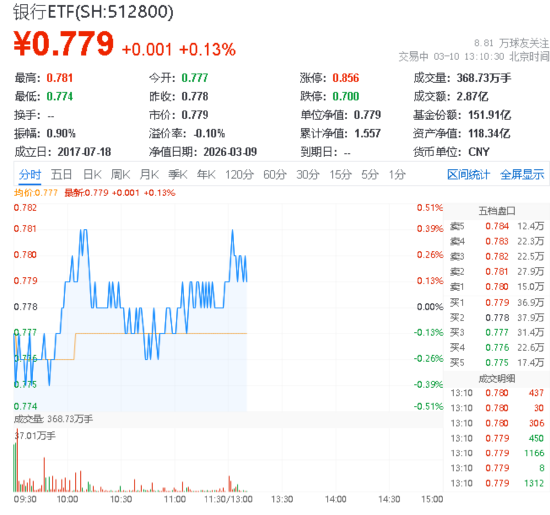
民生银行领涨1.55%,内外资本注入预期升温,华宝基金银行ETF(512800)迎价值重估契机
Xin Lang Ji Jin· 2026-03-10 06:16
Group 1 - The banking sector is showing active performance, with the China Securities Banking Index rising by 0.2% as of 1:07 PM on March 10, 2023. Notable gainers include Minsheng Bank up by 1.55%, Huaxia Bank up by 1.46%, and Pudong Development Bank up by 1.22% [1] - The government plans to issue special bonds worth 300 billion yuan to support the capital replenishment of state-owned commercial banks, with Industrial and Agricultural Banks expected to be the main beneficiaries of this funding [3] - Several listed banks are expected to report positive performance in 2025, with stable revenue and profit growth, improving asset quality, and a gradual bottoming out of interest margins, providing fundamental support for the sector [3] Group 2 - Investors are encouraged to consider the Bank ETF (512800) and its associated funds, which track the China Securities Banking Index and include a diverse portfolio of 42 listed banks, focusing on both high dividend opportunities and high-growth banks [3] - The Bank ETF has approximately 30% of its holdings in major state-owned banks like Industrial Bank and Agricultural Bank, while about 70% is allocated to high-growth joint-stock banks and city commercial banks, making it an efficient investment tool for tracking the banking sector [3]


民生银行遭贝莱德减持约1030.82万股 每股作价约4.04港元
Xin Lang Cai Jing· 2026-03-10 00:09
Group 1 - BlackRock reduced its stake in Minsheng Bank (01988) by 10,308,193 shares at a price of HKD 4.0415 per share, totaling approximately HKD 41.66 million [1] - After the reduction, BlackRock's latest shareholding stands at approximately 497 million shares, representing a holding percentage of 5.97% [1]
民生银行(01988.HK)遭贝莱德减持1030.82万股
Ge Long Hui· 2026-03-09 13:23
| 表格序號 | 大股東/董事/最高行政人員名稱 作出披露的 買入 / 賣出或涉及的股 每股的平均價 | | | 持有權益的股份數目 佔已發行的 有關事件的 | | --- | --- | --- | --- | --- | | | 份數目 | 原因 | | ( 請參閱上述 * 註解 ) 有投票權股 (日 / 月 / | | | | | | 份自分比 | | | | | | 96 ) | | CS20260306E00410 | BlackRock, Inc. 10,308,193(L) | 1201(L) | HKD 4.0415 | 496,925,461(L) 5.97(L)03/03/202 | | | | | | 0.32(S) 26,893,500(S) | 格隆汇3月9日丨根据联交所最新权益披露资料显示,2026年3月3日,民生银行(01988.HK)遭BlackRock, Inc.在场内以每股均价4.0415港元减持好仓1030.82万 股,涉资约4166.1万港元。 减持后,BlackRock, Inc.最新持好仓数目为496,925,461股,持好仓比例由6.10%下降至5.97%。 | ...

贝莱德减持民生银行(01988)约1030.82万股 每股作价约4.04港元
Xin Lang Cai Jing· 2026-03-09 11:32
Group 1 - BlackRock reduced its stake in Minsheng Bank (01988) by 10,308,193 shares at a price of HKD 4.0415 per share, totaling approximately HKD 41.66 million [1] - After the reduction, BlackRock's latest shareholding stands at approximately 497 million shares, representing a holding percentage of 5.97% [1]

贝莱德减持民生银行约1030.82万股 每股作价约4.04港元
Zhi Tong Cai Jing· 2026-03-09 11:21
Group 1 - BlackRock reduced its stake in Minsheng Bank by 10,308,193 shares at a price of HKD 4.0415 per share, totaling approximately HKD 41.66 million [1] - After the reduction, BlackRock's latest holding in Minsheng Bank is approximately 497 million shares, representing a holding percentage of 5.97% [1]
金融风向标2026-W09:“两会”释放的金融信号
CMS· 2026-03-08 12:38
Investment Rating - The report maintains a recommendation for the banking sector, indicating a defensive value amidst external uncertainties affecting the A-share market [2][5]. Core Insights - The "Two Sessions" have provided financial signals, focusing on monetary policy, financial risk prevention, and institutional reforms. The monetary policy is expected to remain moderately loose, prioritizing stable economic growth and reasonable price recovery [5][11]. - The report anticipates that the frequency of reserve requirement ratio (RRR) and interest rate cuts will remain consistent with the previous year, with a lower probability of implementation in the first half of the year. The growth rate of social financing (社融) and M2 may fall below 8% [5][11]. - Structural monetary policy tools will be emphasized, with an expected net investment scale exceeding 540.5 billion in 2025, focusing on supporting domestic demand, technological innovation, and small and micro enterprises [6][11]. Summary by Sections Regulatory Dynamics - The report highlights the successful convening of the "Two Sessions" and the focus on monetary policy and financial risk prevention by the People's Bank of China [3][14]. Market Dynamics - The report notes a decline of 2.30% in the Wind All A Index, while the Shenwan banking sector increased by 1.64% [17]. Data Overview - The central bank's net withdrawal this week was 1.56 trillion, with a decrease in various interest rates, including the Shibor rates [4][25]. - The report provides detailed data on the performance of various banking stocks, including their dividend rates and price-to-earnings ratios [22]. Banking Sector Trends - The report indicates that the net interest margin decline is stabilizing, suggesting that revenue challenges for commercial banks may be easing. It recommends focusing on city commercial banks in key development areas and national banks with lower non-performing asset pressures [11].