Sinopec Corp.(600028)

Search documents
加快打造现代新国企
Ren Min Ri Bao· 2025-12-17 01:53
Group 1 - The core viewpoint emphasizes the need for deepening state-owned enterprise (SOE) reforms to strengthen and optimize state-owned enterprises and capital, enhancing their core functions and competitiveness during the 14th Five-Year Plan period [1][3] - The comprehensive strength and innovation capabilities of state-owned enterprises have significantly improved, with total assets of central enterprises increasing from less than 70 trillion yuan to over 90 trillion yuan, and fixed asset investments reaching 19 trillion yuan, averaging a growth rate of 6.3% [1][2] - Central enterprises have contributed approximately 80% of crude oil, 70% of natural gas, and 60% of electricity supply, ensuring energy security [1] Group 2 - Central enterprises have a substantial procurement volume exceeding 15 trillion yuan annually, directly impacting around 2 million businesses and indirectly affecting nearly 7 million enterprises in the supply chain [2] - The role of state-owned economy is crucial in national security, economic lifelines, and public welfare, with a call for SOEs to enhance their competitiveness, innovation, and risk resistance [3][4] - The focus on technological and industrial innovation integration is highlighted, with significant contributions from central enterprises in major projects and advancements [4][5] Group 3 - Central enterprises have increased R&D spending, averaging a growth of 6.5% annually, with investments exceeding 1 trillion yuan for three consecutive years, and a focus on basic research [5][6] - The number of R&D personnel in central enterprises stands at 1.44 million, accounting for one-fifth of the national total [6] - Central enterprises have received over half of the national awards for technological invention and progress, indicating a strong innovation capability, though there are calls for improved efficiency and incentive mechanisms [7] Group 4 - The emphasis on breaking through key technologies and addressing industrial bottlenecks, particularly in semiconductor silicon wafers, is noted, with successful applications of domestically produced 300mm silicon wafers [9] - The establishment of 134 pilot verification platforms by central enterprises aims to facilitate the transition from technology to product, enhancing collaboration and risk-sharing [10] - Central enterprises are creating over 800 application scenarios in key industries to promote the adoption of domestic innovations, positioning themselves as supportive markets for new products [11] Group 5 - The optimization of the state-owned economy's layout and structural adjustments is underway, with a focus on strategic emerging industries, such as hydrogen energy and quantum technology [12][14] - Central enterprises are expected to play a significant role in social construction and national strategy, with a shift towards prioritizing investments in critical sectors and public services [13][14] - The transition of state-owned enterprises from "going out" to "integrating in" the international market is emphasized, requiring alignment with international standards and active participation in global economic cooperation [14]
中石化启动市值提升专项行动 中金预计化工行业周期拐点有望到来(附概念股)
Zhi Tong Cai Jing· 2025-12-17 00:19
12月16日,中国石化(600028)集团首次上市公司投资者联合交流活动在京举行。 活动上,中国石化上市公司市值提升专项行动启动。 中国石油化工集团有限公司党组成员、总会计师蔡勇表示,专项行动旨在提升投资价值、增强股东回 报。主要包括三方面: 一是将继续提升治理效能,强化上市公司管理,持续完善上市公司常态化管理体系,聚焦战略发展定位 规划,资本运作与市值管理,资本市场人才队伍建设三大核心业务,推动中国石化上市公司长效管理机 制落实落地; 三是将继续优化资本布局,释放板块价值,持续开展并购重组、权益融资等资本运作,在调整产业布 局、助力产业链向高端化和精细化延伸的同时优化上市公司结构,力争"十五五"期间上市公司的市场价 值总体持续提升。 参与启动活动的包括中国石化、石化油服(600871)、中石化炼化工程、上海石化(600688)、石化机 械(000852)、中石化冠德、泰山石油(000554)、岳阳兴长(000819)、四川美丰(000731)等中国 石化集团旗下9家上市公司高管。国资证券监管机构,中央企业、产业伙伴、证券金融基金机构等多家 单位代表出席活动。 中金公司(601995)发布2026年展望称,石 ...
中国石化上海石油化工股份有限公司仓储服务日常关联交易公告
Shang Hai Zheng Quan Bao· 2025-12-16 19:57
证券代码:600688 股票简称:上海石化 编号:临2025-054 中国石化上海石油化工股份有限公司 仓储服务日常关联交易公告 本公司董事会及全体董事保证本公告内容不存在任何虚假记载、误导性陈述或者重大遗漏,并对其内容 的真实性、准确性和完整性承担法律责任。 重要内容提示: ● 中国石化上海石油化工股份有限公司(以下简称"上海石化"、"本公司"或"公司")与中国石化集团石 油商业储备有限公司白沙湾分公司("白沙湾分公司")及中国石化集团石油商业储备有限公司(以下简 称"中石化储备")签署的2024协议将于2025年12月31日到期,详见公司于2024年12月28日披露的日常关 联交易公告。本公司第十一届董事会第二十二次会议于2025年12月16日召开,审议并批准本公司拟与白 沙湾分公司及中石化储备签署仓储服务协议(以下简称"新框架协议")以及截至2026年12月31日止该年 度的有关日常关联交易的年度上限。新框架协议将于2025年12月31日前签署。 ● 白沙湾分公司是中石化储备的分公司。于本公告披露之日,中石化集团是本公司的实际控制人,中石 化储备是中石化集团的全资子公司,中石化储备为上海上市规则下本公司 ...

民营加油站直面生存危机
虎嗅APP· 2025-12-16 13:38
Core Viewpoint - The article discusses the significant challenges facing the refined oil industry in China due to the rapid rise of electric vehicles (EVs) and the shift towards cleaner energy, leading to a peak and subsequent decline in refined oil consumption [4][5]. Industry Overview - In 2024, China's apparent oil consumption is projected to be 756 million tons, with refined oil consumption at 390 million tons, reflecting a year-on-year decrease of 2.4% [5]. - The rapid advancement of energy alternatives has weakened the demand for traditional energy sources, compounded by fluctuating international oil prices, which have further pressured the refining sector [5][10]. Market Dynamics - The penetration rate of new energy vehicles reached a historic high of 53.2% in November, with sales of 1.823 million units, marking a 20.6% year-on-year increase [8]. - By mid-2025, the total number of vehicles in China is expected to reach 359 million, with new energy vehicles accounting for 10.27% of this total, up from 8.9% at the end of 2024 [9]. Consumption Trends - The gasoline consumption is projected to decline significantly, with estimates suggesting that by 2025, new energy vehicles will replace approximately 34.58 million tons of gasoline, equating to 21% of the national gasoline demand in 2024 [9][10]. - The monthly average gasoline consumption in China has already shown a decline of 5.04% year-on-year as of October 2025 [10]. Industry Challenges - The refined oil industry is entering a "reduction development" phase, with major oil companies experiencing shrinking profits. For instance, China Petroleum's net profit dropped by 32.23% in the first three quarters of the year [14]. - The number of gas stations in China is expected to decrease significantly, with projections indicating a reduction of 20,000 stations by 2030, leading to a daily loss of approximately 10 stations [22]. Competitive Landscape - The majority of gas stations in China are privately owned, yet they account for only 25% of total refined oil sales, highlighting a disparity in sales volume despite their large numbers [19]. - The shift towards alternative energy sources is intensifying competition among gas stations, with many facing severe sales declines, some reporting drops of over 50% from peak levels [20][21]. Transition to New Energy - The industry consensus is shifting from traditional fuel suppliers to comprehensive energy service providers, although the transition poses significant challenges, particularly for smaller private gas stations [25][31]. - Major oil companies are investing heavily in the development of charging infrastructure, with China Petroleum planning to invest approximately 71.88 billion yuan in energy stations and charging facilities in 2024 [27]. Future Outlook - The article suggests that the future of gas stations, especially private ones, is precarious, with many unable to adapt to the rapid changes in energy consumption patterns [33].


上海石油化工股份(00338.HK)将与中石化股份签署新科技研发框架协议
Ge Long Hui· 2025-12-16 12:29
格隆汇12月16日丨上海石油化工股份(00338.HK)公告,关于公司与中石化股份签署的2025科技研发框架 协议将于2025年12月31日到期,公司将与中石化股份签署新科技研发框架协议。公司第十一届董事会第 二十二次会议于2025年12月16日召开,审议并批准公司拟与中石化股份签署新科技研发框架协议及其项 下截至2026年12月31日止的年度上限。 ...
中国石化集团启动上市公司市值提升专项行动
Zheng Quan Ri Bao Wang· 2025-12-16 12:19
Core Viewpoint - China Petroleum & Chemical Corporation (Sinopec) has launched a special action to enhance the market value of its listed companies, aiming to improve investment value and shareholder returns [1][2] Group 1: Market Value Enhancement Initiatives - The special action focuses on improving governance efficiency, strengthening management, and enhancing the regular management system of listed companies [1] - Key areas of focus include strategic development planning, capital operations, and building a talent team for capital markets [1] - The company aims to implement a long-term management mechanism for its listed companies [1] Group 2: Shareholder Return Strategies - Sinopec plans to improve its return system, share development results, and enhance the quality of information disclosure [1] - The company will continue to maintain a stable and predictable cash dividend policy and will conduct share buybacks to steadily increase shareholder returns [1] - Efforts will be made to optimize capital layout and release the value of various segments through mergers, acquisitions, and equity financing [1] Group 3: Collaborative Efforts and Stakeholder Engagement - The launch event included executives from nine listed companies under Sinopec, as well as representatives from state-owned securities regulatory bodies, central enterprises, and financial institutions [2] - The event facilitated multi-dimensional communication with investors, aiming to create a model for central enterprise listed companies and promote Sinopec's stable and innovative operations in both industry and capital markets [2]
中国石化(600028) - 中国石化H股公告-翌日披露表格
2025-12-16 11:16
Instrument: Equity issuer Status: New Submission Name of Issuer: China Petroleum & Chemical Corporation Date Submitted: 16 December 2025 Section I must be completed by a listed issuer where there has been a change in its issued shares or treasury shares which is discloseable pursuant to rule 13.25A of the Rules Governing the Listing of Securities on The Stock Exchange of Hong Kong Limited (the "Exchange") (the "Main Board Rules") or rule 17.27A of the Rules Governing the Listing of Securities on GEM of the ...
中国石油化工股份(00386) - 翌日披露报表
2025-12-16 10:35
FF305 翌日披露報表 (股份發行人 ── 已發行股份或庫存股份變動、股份購回及/或在場内出售庫存股份) 表格類別: 股票 狀態: 新提交 公司名稱: 中國石油化工股份有限公司 呈交日期: 2025年12月16日 如上市發行人的已發行股份或庫存股份出現變動而須根據《香港聯合交易所有限公司(「香港聯交所」)證券上市規則》(「《主板上市規則》」)第13.25A條 / 《香港聯合交易所有限公司GEM證券 上市規則》(「《GEM上市規則》」)第17.27A條作出披露,必須填妥第一章節 。 | 第一章節 | | | | | | | | | --- | --- | --- | --- | --- | --- | --- | --- | | 1. 股份分類 | 普通股 | 股份類別 | H | | 於香港聯交所上市 | 是 | | | 證券代號 (如上市) | 00386 | 說明 | | | | | | | A. 已發行股份或庫存股份變動 | | | | | | | | | | | | 已發行股份(不包括庫存股份)變動 | | 庫存股份變動 | | | | | 事件 | 已發行股份(不包括庫存股份)數 目 | 佔有關事 ...
江汉油田油气伴生矿藏研究获奖
Zhong Guo Hua Gong Bao· 2025-12-16 05:14
中化新网讯 近日,自然资源部发布2024年度自然资源科学技术奖获奖名单,江汉油田参与的"油气共伴 生氦气和卤水资源成藏成矿机制与技术创新及应用"获自然资源科技进步奖二等奖。 针对目前国内没有氦气选区的评价方法、评价的参数和指标,科研人员首次创建了氦气的分级选区评价 方法,形成了一套氦气的选区评价技术体系,优选有利区带和勘探目标。"我们建立了考虑资源和品位 双因素的参数体系和选区评价方法,用这两个因素建立标准区间,优选出了较为有利的开采目标 区。"研究院战略规划所所长丁一介绍说。 同时,团队建立了地质、开采、生态因素的参数体系和选区评价方法,基于指标选择的系统性、可得 性、易操作性原则,确定一级指标与二级指标。运用层次分析法确定指标权重,结合确定的各指标参考 评价标准,优选出最具开发价值的矿区和较为有利的开采目标区。目前,油田还开展了卤水提锂中试试 验,在现场试验成功,产出合格的碳酸锂产品。 江汉油田对油气共伴生资源的研究成果,有力支撑了中国石化(600028)首个提氦工厂的建设,同时助 力江汉卤水提锂工业化应用技术体系的形成。 近年来,随着新能源产业的迅猛发展,国家对氦气、卤水等战略资源的需求加大。江汉油田围 ...
港股石油股走低,三桶油中国海洋石油、中国石油化工、中国石油股份均跌超2%!国际石油价格徘徊在2021年以来最低水平附近
Ge Long Hui· 2025-12-16 02:35
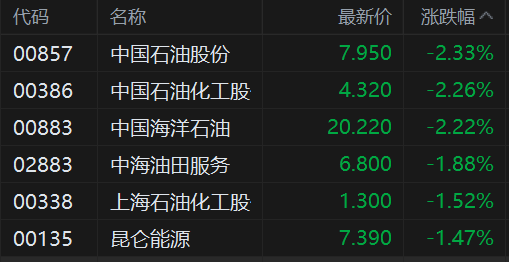
Group 1 - International oil prices have declined, leading to a collective drop in Hong Kong oil stocks, with China National Offshore Oil Corporation, China Petroleum & Chemical Corporation, and China Petroleum & Natural Gas Corporation all falling over 2% [1][2] - Specific stock performance includes China Petroleum & Natural Gas Corporation at 7.950, down 2.33%; China Petroleum & Chemical Corporation at 4.320, down 2.26%; and China National Offshore Oil Corporation at 20.220, down 2.22% [2] - WTI January crude oil futures closed down $0.62, a decrease of 1.08%, at $56.82 per barrel; Brent February crude oil futures fell $0.56, down 0.92%, to $60.56 per barrel [2] Group 2 - Oil prices are hovering near their lowest levels since 2021, as traders assess the potential for a ceasefire in Ukraine, which could ease export restrictions on Russian oil and increase market pressure due to oversupply [2] - Expectations of global oil surplus are growing due to OPEC+ restoring idle production capacity and other oil-producing countries increasing output, indicating a trend towards an annual decline in oil prices [2]