
CEA(600115)

Search documents
东航“渝沪快线”焕新:每日达14班,截载缩短至起飞前30分钟
Zhong Guo Min Hang Wang· 2025-11-17 10:38
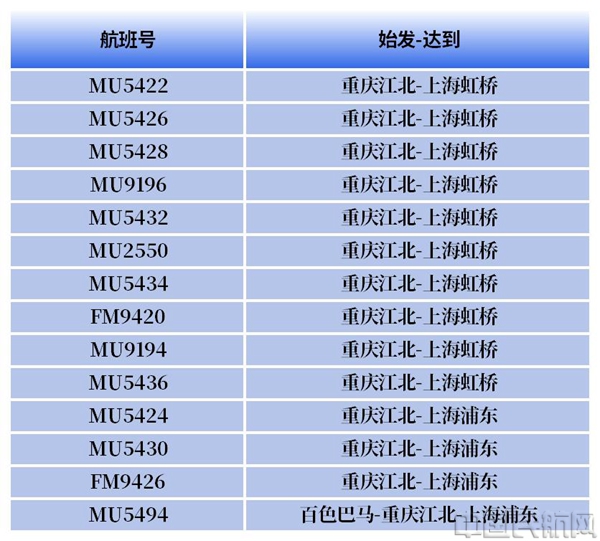
Core Points - China Eastern Airlines has upgraded its "Chongqing-Shanghai Fast Line" service, increasing the total number of daily flights to 14 and reducing the check-in cut-off time to 30 minutes before departure, enhancing the travel experience for passengers [1][4] Group 1: Flight Operations - The "Chongqing-Shanghai Fast Line" now operates 14 flights daily, with 10 flights to Shanghai Hongqiao and 4 flights to Shanghai Pudong, improving frequency and flexibility for travelers [1][4] - The new schedule includes specific flight numbers such as MU5422, MU5426, MU9196, and others, all connecting Chongqing Jiangbei to Shanghai [2] Group 2: Service Enhancements - The check-in cut-off time has been reduced from 40 minutes to 30 minutes, providing greater flexibility for time-sensitive business travelers [4] - All domestic "Fast Line" flights operated by wide-body aircraft now offer free basic Wi-Fi service, allowing passengers to work, shop, or entertain themselves during the flight [4] Group 3: Aircraft Utilization - China Eastern Airlines is the global launch customer for the domestically produced C919 aircraft and operates the largest fleet of C919s worldwide, with specific flights on the "Chongqing-Shanghai Fast Line" planned to be operated by this aircraft [5]


11月17日晚间重要公告一览
Xi Niu Cai Jing· 2025-11-17 10:20
Group 1 - Yongtai Technology's wholly-owned subsidiary has received approval for trial production of a lithium battery additive project with an annual capacity of 5,000 tons, set to begin trial production [1] - Mengke Pharmaceutical has decided to terminate its plan to issue shares to a specific entity due to ongoing disagreements among major shareholders, which could impact the company's stable operations [1] - Anhui Construction's subsidiary has been approved to register and issue debt financing tools totaling 15 billion yuan, including 5 billion yuan in short-term financing notes and 10 billion yuan in medium-term notes [2] Group 2 - Koli'er plans to repurchase shares worth between 10 million and 20 million yuan, with a maximum repurchase price of 20.94 yuan per share, to implement an employee stock ownership plan [2] - Xinhua Pharmaceutical has received approval for the production of fumaric acid volnoral raw materials, which are used to treat gastroesophageal reflux disease [3] - Lianhuan Pharmaceutical has received approval for additional specifications of tadalafil tablets, expanding its product offerings for treating erectile dysfunction and benign prostatic hyperplasia [5] Group 3 - Greenland Holdings reported an increase of 1,834 lawsuits with a total amount of 6.587 billion yuan from October 21 to November 13, 2025 [7] - Lianke Technology plans to invest up to 600 million yuan of idle funds in low-risk financial products [8] - Yinglian Co. signed a strategic procurement contract for 5,000 million square meters of composite aluminum foil with a leading new energy technology company [10] Group 4 - China Eastern Airlines reported a 10.58% year-on-year increase in passenger turnover for October, with a capacity increase of 6.84% [12] - China National Airlines reported an 8.7% year-on-year increase in passenger turnover for October, with domestic and international capacity also showing growth [15] - Oupai Home plans to use 320 million yuan of idle funds to purchase structured deposits with expected annual yields between 0.65% and 2.50% [16] Group 5 - Tianwei Food has submitted H-share issuance application materials to the Hong Kong Stock Exchange, which have been accepted by the China Securities Regulatory Commission [18] - Guizhou Aviation plans to establish a subsidiary focused on the research, production, and market expansion of intelligent automotive components, with initial operating funds of 40 million yuan [20] - Daimai Co. plans to invest 100 million yuan to establish a wholly-owned subsidiary in Shanghai focused on robotics technology [22] Group 6 - Founder Securities has received approval to issue company bonds totaling up to 30 billion yuan [24] - Hengrui Medicine has received clinical trial approvals for multiple drugs, indicating ongoing research and development efforts [26] - Zhaojing Pharmaceutical's product ZG006 has received orphan drug designation from the FDA, providing various benefits for its development in the U.S. market [39]





中国东航(600115) - 中国东方航空股份有限公司2025年10月运营数据公告
2025-11-17 09:00
中国东方航空股份有限公司 China Eastern Airlines Co., Ltd. 证券代码:600115 证券简称:中国东航 公告编号:临 2025-075 中国东方航空股份有限公司 2025 年 10 月运营数据公告 本公司董事会及全体董事保证本公告内容不存在任何虚假记载、 误导性陈述或者重大遗漏,并对其内容的真实性、准确性和完整 性承担法律责任。 一、运营情况 中国东方航空股份有限公司(以下简称"本公司") 2025 年 10 月客运运力投 入(按可用座公里计)同比上升 6.84%;旅客周转量(按客运人公里计)同比上 升 10.58%;客座率为 87.52%,同比上升 2.97 个百分点。2025 年 10 月货邮周转量 (按货邮载运吨公里计)同比上升 14.59%。 2025 年 10 月,国内市场:新开成都天府-沧源、成都天府-天津、杭州-乌鲁 木齐、合肥-福州、合肥-晋江等航线;复飞上海浦东-南充、昆明-洛阳、青岛-揭 阳潮汕、烟台-宁波等航线;加密上海虹桥-北京大兴、上海虹桥-广州、上海虹桥- 三亚、上海虹桥-长沙、上海浦东-西安、上海浦东-昆明、上海浦东-三亚等航线。 国际地区市场:新 ...
中国东航(600115.SH)10月旅客周转量同比上升10.58%
Zhi Tong Cai Jing· 2025-11-17 08:52
Core Insights - China Eastern Airlines reported an increase in passenger capacity for October 2025, with a year-on-year growth of 6.84% in available seat kilometers [1] - The passenger turnover for the same period rose by 10.58% in revenue passenger kilometers [1] - The passenger load factor reached 87.52%, reflecting an increase of 2.97 percentage points year-on-year [1] - Cargo and mail turnover also saw a significant increase, with a year-on-year growth of 14.59% in cargo ton kilometers [1]
中国东航10月旅客周转量同比上升10.58%
Zhi Tong Cai Jing· 2025-11-17 08:52
Core Insights - China Eastern Airlines (600115.SH) reported an increase in passenger capacity for October 2025, with a year-on-year rise of 6.84% in available seat kilometers [1] - The passenger turnover for October 2025 also saw a significant increase, with a year-on-year growth of 10.58% in revenue passenger kilometers [1] - The airline's load factor reached 87.52%, which is an increase of 2.97 percentage points compared to the previous year [1] - Additionally, the cargo and mail turnover for October 2025 increased by 14.59% year-on-year, measured in cargo ton kilometers [1]
航空机场板块11月17日跌0.89%,春秋航空领跌,主力资金净流出1.78亿元
Zheng Xing Xing Ye Ri Bao· 2025-11-17 08:49
Market Overview - The aviation and airport sector experienced a decline of 0.89% on November 17, with Spring Airlines leading the drop [1] - The Shanghai Composite Index closed at 3972.03, down 0.46%, while the Shenzhen Component Index closed at 13202.0, down 0.11% [1] Stock Performance - Xiamen Airport (600897) saw a closing price of 18.14, with an increase of 3.66% and a trading volume of 207,300 shares, totaling a transaction value of 371 million yuan [1] - China Eastern Airlines (600115) closed at 5.35, up 2.10%, with a trading volume of 1,842,700 shares, amounting to 966 million yuan [1] - Southern Airlines (600029) closed at 7.27, up 0.69%, with a trading volume of 776,900 shares [1] - Spring Airlines (601021) led the decline with a closing price of 56.20, down 5.04%, and a trading volume of 139,000 shares, totaling 787 million yuan [2] Capital Flow - The aviation and airport sector saw a net outflow of 178 million yuan from institutional investors and 131 million yuan from retail investors, while retail investors had a net inflow of 309 million yuan [2] - Southern Airlines had a net inflow of 38.50 million yuan from institutional investors, while Spring Airlines experienced a net outflow of 78.21 million yuan from institutional investors [3] - Xiamen Airport had a net inflow of 17.88 million yuan from institutional investors, while China Eastern Airlines had a net inflow of 24.59 million yuan [3]




中国东航:10月旅客周转量同比上升10.58%
Zheng Quan Shi Bao Wang· 2025-11-17 08:48
Core Viewpoint - China Eastern Airlines (600115) reported an increase in passenger capacity and turnover for October 2025, indicating growth in operational performance [1] Group 1: Passenger Metrics - The passenger capacity input (measured in available seat kilometers) for October 2025 is projected to rise by 6.84% year-on-year [1] - The passenger turnover (measured in revenue passenger kilometers) is expected to increase by 10.58% year-on-year [1] - The passenger load factor stands at 87.52%, reflecting a year-on-year increase of 2.97 percentage points [1] Group 2: Cargo Metrics - The cargo and mail turnover (measured in cargo mail ton kilometers) is anticipated to grow by 14.59% year-on-year for October 2025 [1]
中国东航(600115.SH):10月客运运力投入同比上升6.84%
Ge Long Hui A P P· 2025-11-17 08:45
Core Insights - China Eastern Airlines (600115.SH) reported a year-on-year increase in passenger capacity input (measured in available seat kilometers) of 6.84% for October 2025 [1] - The passenger turnover (measured in revenue passenger kilometers) increased by 10.58% year-on-year [1] - The passenger load factor reached 87.52%, reflecting a year-on-year increase of 2.97 percentage points [1] - The cargo and mail turnover (measured in cargo mail ton kilometers) saw a year-on-year increase of 14.59% for October 2025 [1]
中国东航:10月客运运力投入同比上升6.84%
Ge Long Hui A P P· 2025-11-17 08:45
Core Viewpoint - China Eastern Airlines announced an increase in passenger capacity and operational metrics for October 2025, indicating growth in both passenger and cargo operations [1] Group 1: Passenger Operations - The passenger capacity input (measured in available seat kilometers) for October 2025 is projected to rise by 6.84% year-on-year [1] - The passenger turnover (measured in revenue passenger kilometers) is expected to increase by 10.58% year-on-year [1] - The passenger load factor stands at 87.52%, reflecting a year-on-year increase of 2.97 percentage points [1] Group 2: Cargo Operations - The cargo and mail turnover (measured in cargo mail ton kilometers) is anticipated to grow by 14.59% year-on-year for October 2025 [1] Group 3: Fleet Management - In October 2025, the company introduced 4 A320 series aircraft while retiring 2 A320 series aircraft [1] - As of the end of October 2025, the total operational fleet consists of 822 aircraft [1]
中国东航:2025年10月客运运力投入同比上升6.84%
Xin Lang Cai Jing· 2025-11-17 08:45
Core Insights - China Eastern Airlines announced a 6.84% year-on-year increase in passenger capacity for October 2025, measured in available seat kilometers [1] - The passenger turnover, measured in passenger kilometers, is expected to rise by 10.58% year-on-year for the same period [1] - The passenger load factor is projected to be 87.52%, reflecting a year-on-year increase of 2.97 percentage points [1] - The cargo and mail turnover, measured in cargo and mail ton kilometers, is anticipated to increase by 14.59% year-on-year for October 2025 [1]