China Spacesat(600118)

Search documents
航天航空概念股走低,相关ETF跌约1.5%
Mei Ri Jing Ji Xin Wen· 2025-08-14 06:38
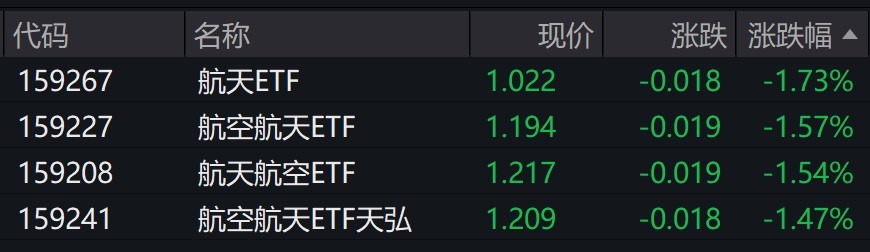
Group 1 - Aerospace and defense stocks have declined, with Zhongbing Hongjian down over 4%, Aerospace Electronics down over 3%, and China Satellite down over 2% [1] - The ETFs tracking the national aerospace and defense industry index have also dropped approximately 1.5% [1] Group 2 - Specific ETFs related to aerospace and defense show the following price changes: Aerospace ETF (159267) at 1.022, down 1.73%; Aerospace ETF (159227) at 1.194, down 1.57%; Aerospace ETF (159208) at 1.217, down 1.54%; Aerospace ETF Tianhong (159241) at 1.209, down 1.47% [2] - Analysts suggest that by 2025, new markets from military trade and military technology conversion may offer greater flexibility, with Chinese military enterprises showing technological advantages in drones and fighter jets, making the aerospace sector a core beneficiary [2] - Future investments in the military sector should focus more on seizing "air supremacy" [2]


中美星链明争暗斗
3 6 Ke· 2025-08-14 04:21
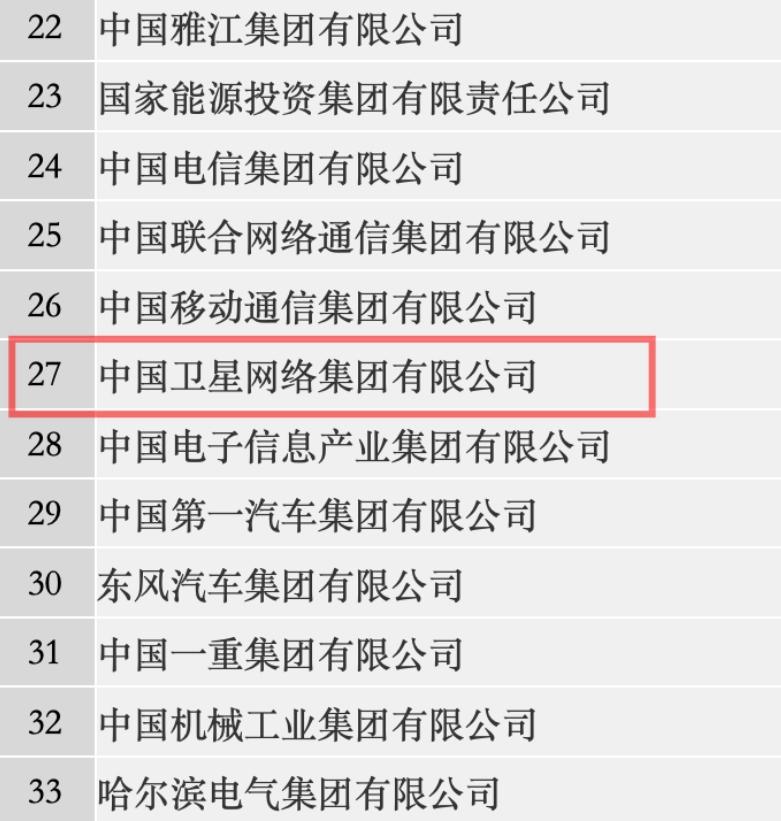
Core Viewpoint - The competition between China's satellite internet initiatives and SpaceX's Starlink is intensifying, with significant developments in satellite deployment and strategic partnerships in both countries [1][4][29]. Group 1: Industry Developments - SpaceX has launched over 7,000 Starlink satellites since its first deployment in 2019, with plans to eventually deploy 42,000 satellites [1][8]. - China has established the China Satellite Network Group in 2021, positioning it as a key player in satellite internet and communications, ranking after major telecom companies [1][4]. - China's satellite internet ecosystem, including the China Starlink system, is rapidly developing, with plans to launch over 27,000 satellites in the future [2][4][8]. Group 2: Satellite Deployment and Capabilities - China has successfully completed multiple satellite launches within a short timeframe, indicating a robust deployment strategy [4][9]. - The GW constellation, led by the China Satellite Network Group, aims to deploy 12,992 satellites, with a significant portion in low Earth orbit [5][9]. - The total number of China's operational communication satellites has surpassed 800, accounting for 24% of the global total [4][9]. Group 3: Market Opportunities - There is a pressing demand for satellite communications in various sectors, including mining, shipping, and military applications, driven by the need for reliable internet access in remote areas [10][11][14]. - The global satellite manufacturing market is projected to grow significantly, with estimates reaching $24.493 billion in 2024 and $38.969 billion by 2029, indicating a strong growth trajectory [20]. - China's satellite internet initiatives are closely linked to the globalization of Chinese enterprises, enhancing their operational capabilities in international markets [10][19]. Group 4: Competitive Landscape - SpaceX's Starlink currently has over 6 million users globally, with projected revenues of $8.2 billion in 2024, highlighting the commercial potential of satellite internet [11][29]. - Chinese companies are also making strides in the satellite communications sector, with various private and state-owned enterprises collaborating to enhance capabilities and market reach [5][24]. - The competition is not only about satellite deployment but also about securing frequency and orbital slots, marking the beginning of a "space race" [8][9].

卫星互联网低轨08组卫星发射成功
Ke Ji Ri Bao· 2025-08-13 10:14
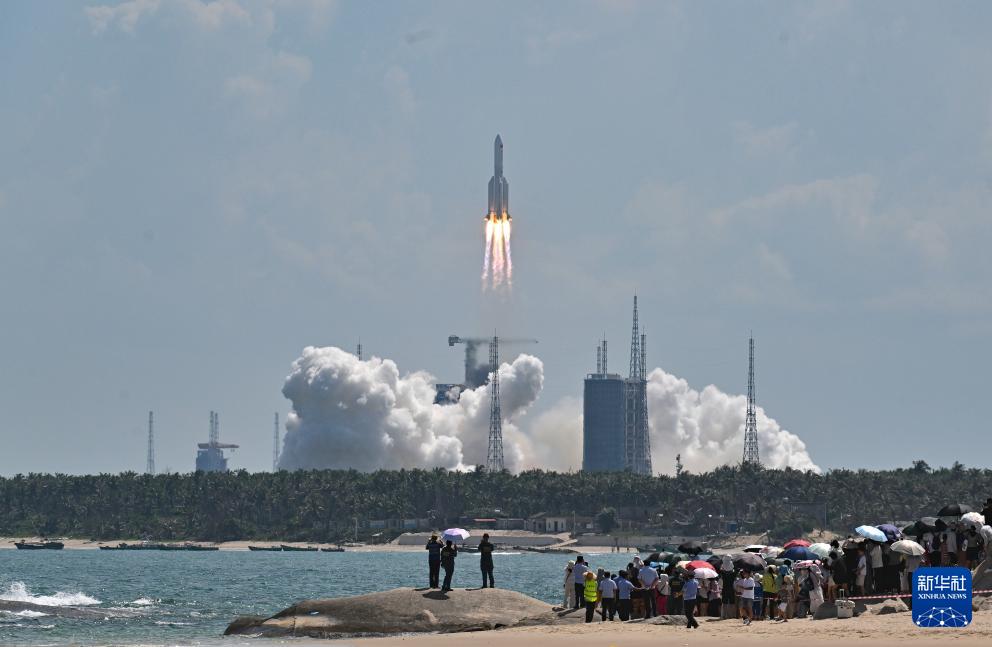
Group 1 - The successful launch of the Long March 5B rocket and the Yuan Zheng 2 upper stage took place on August 13, 2023, at 14:43, sending the low Earth orbit satellite internet group 08 into its designated orbit [1][3] - The Long March 5B rocket is a large cryogenic launch vehicle that builds on the foundation of the Long March 5 rocket, while the Yuan Zheng 2 upper stage is the largest and most powerful conventional liquid upper stage currently available [3] - This mission marks the 588th launch of the Long March series of launch vehicles, showcasing the capabilities of the launch system to execute various orbital missions, including near-Earth and sun-synchronous orbits [3] Group 2 - The launch system supports multiple deployment configurations, including single satellite launches, multiple satellite launches, and constellation deployments, with capabilities for serial, parallel, side-mounted, and combined configurations [3] - The satellite internet low Earth orbit group 08 was developed by the Fifth Academy of China Aerospace Science and Technology Corporation [1]
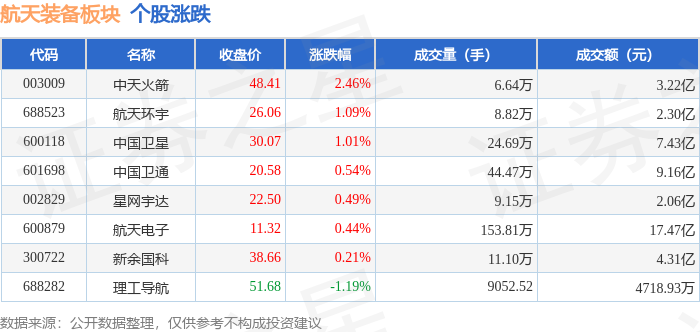
航天装备板块8月13日涨0.65%,中天火箭领涨,主力资金净流出1.3亿元
Zheng Xing Xing Ye Ri Bao· 2025-08-13 08:41
Group 1 - The aerospace equipment sector rose by 0.65% on August 13, with Zhongtian Rocket leading the gains [1] - The Shanghai Composite Index closed at 3683.46, up 0.48%, while the Shenzhen Component Index closed at 11551.36, up 1.76% [1] - Key stocks in the aerospace equipment sector showed varied performance, with Zhongtian Rocket closing at 48.41, up 2.46% on a trading volume of 66,400 shares and a transaction value of 322 million yuan [1] Group 2 - The net capital flow in the aerospace equipment sector showed a net outflow of 130 million yuan from institutional investors and 63.53 million yuan from retail investors, while individual investors saw a net inflow of 194 million yuan [1] - Specific stock performances indicated that China Satellite experienced a net outflow of 9.43 million yuan from institutional investors, while individual investors contributed a net inflow of 24.89 million yuan [2] - Zhongtian Rocket had a net inflow of 1.56 million yuan from institutional investors, but a net outflow of 6.86 million yuan from retail investors [2]



上证智能交通指数上涨0.44%,前十大权重包含航天电子等
Jin Rong Jie· 2025-08-12 16:31
Group 1 - The Shanghai Intelligent Transportation Index (H50035) rose by 0.44% to 1892.42 points, with a trading volume of 17.419 billion yuan [1] - The index has increased by 8.14% over the past month, 10.83% over the past three months, and 12.35% year-to-date [1] - The index series reflects the performance of listed companies influenced by changes in economic and consumption structures during the urbanization process, focusing on themes such as intensive, intelligent, and green low-carbon development [1] Group 2 - The top ten weighted companies in the Shanghai Intelligent Transportation Index include SAIC Motor (10.39%), Hongfa Technology (9.56%), Aerospace Electronics (9.15%), and others [1] - The index is composed entirely of companies listed on the Shanghai Stock Exchange, with a 100% representation [1] - The industry composition of the index sample shows that industrial companies account for 31.00%, consumer discretionary for 29.43%, information technology for 28.24%, and communication services for 11.33% [2] Group 3 - The index sample is adjusted biannually, with changes implemented on the next trading day following the second Friday of June and December [2] - Weight factors are generally fixed until the next scheduled adjustment, with special circumstances allowing for temporary adjustments [2] - Companies that are delisted or undergo mergers, acquisitions, or splits are handled according to specific calculation and maintenance guidelines [2]



正式发布!我国主导制定→
Ke Ji Ri Bao· 2025-08-12 10:29
Core Points - The China Aerospace Science and Technology Corporation has led the development of two international standards recently published by the International Organization for Standardization (ISO) [1] - A total of 30 international standards in the aerospace field have been published under China's leadership, with a cumulative total of 38 standards either published or in development [1] Group 1 - The first standard, "Aerospace Systems - Launch Window Estimation and Collision Avoidance" (ISO 21740:2025), outlines requirements for launch window analysis and safety launch timing identification, as well as a collision avoidance risk assessment matrix [1] - This standard is applicable to collision risk analysis between newly launched objects and any space objects along the flight path, facilitating the determination of optimal launch windows and timing [1] - The standard was jointly proposed by China, the United States, France, and Japan, with the China Aerospace Standardization Research Institute responsible for the drafting [1] Group 2 - The second standard, "Aerospace Systems - Requirements for Stable Operation of Satellite Attitude and Orbit Control Systems" (ISO 16615:2025), defines the stable operation of satellite attitude and orbit control systems in orbit [2] - It establishes principles and requirements for constructing the stable operation capability of satellite attitude and orbit control systems based on influencing factors [2]
正式发布!我国主导制定两项国际标准
Huan Qiu Wang Zi Xun· 2025-08-12 01:27
Core Points - The China Aerospace Science and Technology Corporation has led the development of two international standards recently published by the International Organization for Standardization (ISO) [1] - A total of 30 international standards in the aerospace field have been published under China's leadership, with a cumulative total of 38 standards either published or in development [1] Group 1: Launch Window and Collision Avoidance - The standard titled "Aerospace Systems - Launch Window Estimation and Collision Avoidance" (ISO 21740:2025) outlines requirements for launch window analysis and identification of safe launch timing, including a collision avoidance risk assessment matrix [1] - This standard is applicable for collision risk analysis between newly launched objects and any space objects along the flight path, facilitating the determination of optimal launch windows and timing [1] Group 2: Satellite Attitude and Orbit Control - The standard "Aerospace Systems - Requirements for Stable Operation of Satellite Attitude and Orbit Control Systems" (ISO 16615:2025) defines the stable operation of satellite attitude and orbit control systems [2] - It establishes principles and requirements for constructing the stable operation capability of satellite attitude and orbit control systems based on influencing factors [2] - The standard was primarily drafted by the Beijing Institute of Control Engineering, with the China Aerospace Standardization Research Institute coordinating technical discussions with the ISO [2]
我国主导制定的航天领域两项国际标准发布
Ke Ji Ri Bao· 2025-08-11 23:56
Core Points - The China Aerospace Science and Technology Corporation has led the development of two international standards recently published by the International Organization for Standardization (ISO) [1][2] - A total of 30 international standards in the aerospace field have been published under China's leadership, with 38 standards either published or in development [1] Group 1: Standard Details - The first standard, "Aerospace Systems - Launch Window Estimation and Collision Avoidance" (ISO 21740:2025), outlines requirements for launch window analysis and safety launch timing identification, including a collision avoidance risk assessment matrix [1] - This standard is applicable to collision risk analysis between newly launched objects and any space objects along the flight path, facilitating the determination of optimal launch windows and timing [1] - The standard was jointly proposed by China, the United States, France, and Japan, with the China Aerospace Standardization Research Institute responsible for drafting [1] Group 2: Stability Requirements - The second standard, "Aerospace Systems - Requirements for Stable Operation of Satellite Attitude and Orbit Control Systems" (ISO 16615:2025), defines the stable operation of satellite attitude and orbit control systems [2] - It establishes principles and requirements for building the stability capabilities of these systems based on influencing factors [2] - The Beijing Control Engineering Research Institute led the preparation of this standard, with the China Aerospace Standardization Research Institute coordinating technical discussions with the ISO [2]
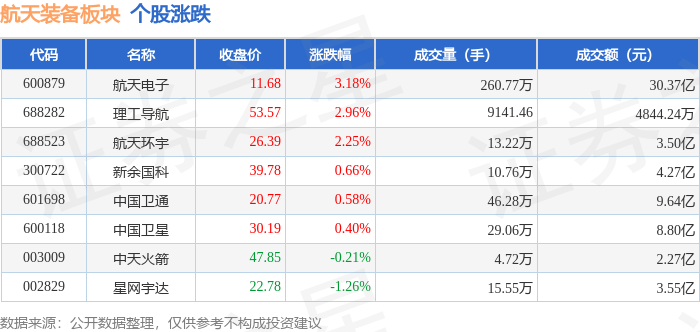
航天装备板块8月11日涨1.05%,航天电子领涨,主力资金净流出4003.33万元
Zheng Xing Xing Ye Ri Bao· 2025-08-11 08:40
Market Performance - The aerospace equipment sector increased by 1.05% on August 11, with Aerospace Electronics leading the gains [1] - The Shanghai Composite Index closed at 3647.55, up 0.34%, while the Shenzhen Component Index closed at 11291.43, up 1.46% [1] Stock Performance - Key stocks in the aerospace equipment sector showed varied performance, with Aerospace Electronics (600879) closing at 11.68, up 3.18% on a trading volume of 2.6077 million shares and a transaction value of 30.37 million yuan [1] - Other notable performers included: - Rigong Navigation (688282) at 53.57, up 2.96% with a transaction value of 48.44 million yuan [1] - Aerospace Huanyu (688523) at 26.39, up 2.25% with a transaction value of 350 million yuan [1] - Newyu Guoke (300722) at 39.78, up 0.66% with a transaction value of 427 million yuan [1] Fund Flow Analysis - The aerospace equipment sector experienced a net outflow of 40.0333 million yuan from institutional investors and 96.76 million yuan from retail investors, while individual investors saw a net inflow of 137 million yuan [1] - Detailed fund flow for key stocks included: - Aerospace Electronics (600879) had a net inflow of 58.1141 million yuan from institutional investors, but a net outflow of 20.6243 million yuan from retail investors [2] - Aerospace Huanyu (688523) saw a net inflow of 12.2263 million yuan from institutional investors, with retail investors contributing a net inflow of 1.79502 million yuan [2] - Newyu Guoke (300722) had a net inflow of 7.6283 million yuan from institutional investors, while retail investors had a net inflow of 1.52048 million yuan [2]


中国首型,海上发射成功!
券商中国· 2025-08-09 02:15
Core Viewpoint - The successful launch of the Jielong-3 rocket marks a significant milestone in China's space capabilities, particularly as it is the first instance of a maritime launch from the Rizhao coastal area, showcasing advancements in technology and operational flexibility [1][2]. Group 1 - The Jielong-3 rocket was developed by the China Aerospace Science and Technology Corporation and is the first rocket in China to achieve a maritime hot launch [1]. - The rocket features a four-stage solid engine configuration, primarily designed for launching satellites into sun-synchronous and low Earth orbits [1]. - This mission represents the sixth flight of the Jielong-3 rocket, indicating its growing reliability and operational history [2].