Jiangxi Tungsten Rare And Precious Equipment(600397)

Search documents
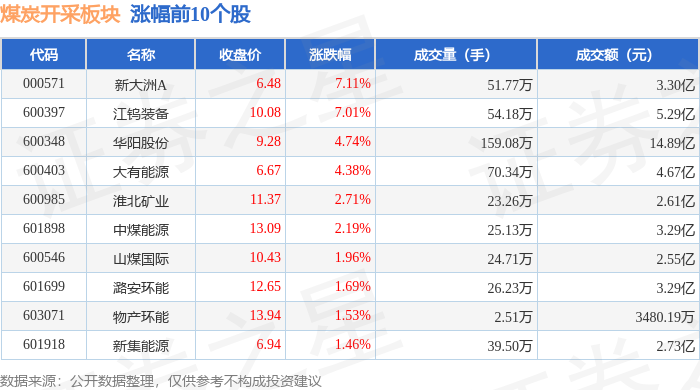
煤炭开采板块1月19日涨0.33%,新大洲A领涨,主力资金净流入1.03亿元
Zheng Xing Xing Ye Ri Bao· 2026-01-19 08:58
Group 1 - The coal mining sector saw a slight increase of 0.33% on January 19, with Xinda Zhou A leading the gains [1] - The Shanghai Composite Index closed at 4114.0, up 0.29%, while the Shenzhen Component Index closed at 14294.05, up 0.09% [1] - Key stocks in the coal mining sector showed varied performance, with Xinda Zhou A closing at 6.48, up 7.11%, and Jiangte Equipment at 10.08, up 7.01% [1] Group 2 - Major coal companies like China Shenhua and Shaanxi Coal experienced slight declines, with China Shenhua closing at 40.70, down 0.73% [2] - The coal mining sector experienced a net inflow of 1.03 billion yuan from institutional investors, while retail investors saw a net inflow of 773.97 million yuan [2][3] - The top net inflows from institutional investors were led by Shaanxi Coal with 80.36 million yuan, while retail investors showed significant outflows in several stocks [3]




煤炭开采板块1月9日涨1.23%,江钨装备领涨,主力资金净流出3.24亿元
Zheng Xing Xing Ye Ri Bao· 2026-01-09 09:01
Group 1 - The coal mining sector increased by 1.23% on January 9, with Jiangte Equipment leading the gains [1] - The Shanghai Composite Index closed at 4120.43, up 0.92%, while the Shenzhen Component Index closed at 14120.15, up 1.15% [1] - Jiangte Equipment's stock price rose by 9.95% to 9.06, with a trading volume of 448,900 shares and a transaction value of 397 million yuan [1] Group 2 - Major coal companies such as China Shenhua and Xinda Zhou A also saw increases, with China Shenhua up 2.41% to 42.45 and a transaction value of 1.551 billion yuan [1] - Conversely, some companies like Dayou Energy and Shanxi Coking Coal experienced declines, with Dayou Energy down 3.23% to 8.10 and a transaction value of 859 million yuan [2] - The coal mining sector experienced a net outflow of 324 million yuan from major funds, while retail investors saw a net inflow of 397 million yuan [2][3] Group 3 - Jiangte Equipment had a net inflow of 109 million yuan from major funds, while retail investors had a net outflow of 46 million yuan [3] - China Shenhua also saw a net inflow of 34.67 million yuan from major funds, with retail investors experiencing a slight outflow [3] - The overall trend indicates a mixed sentiment in the coal mining sector, with significant retail interest despite the net outflow from major funds [2][3]



能源矿产 | 煤炭上市公司深度研究系列:财务篇(下),周期落幕和价值重估
Sou Hu Cai Jing· 2026-01-08 04:48
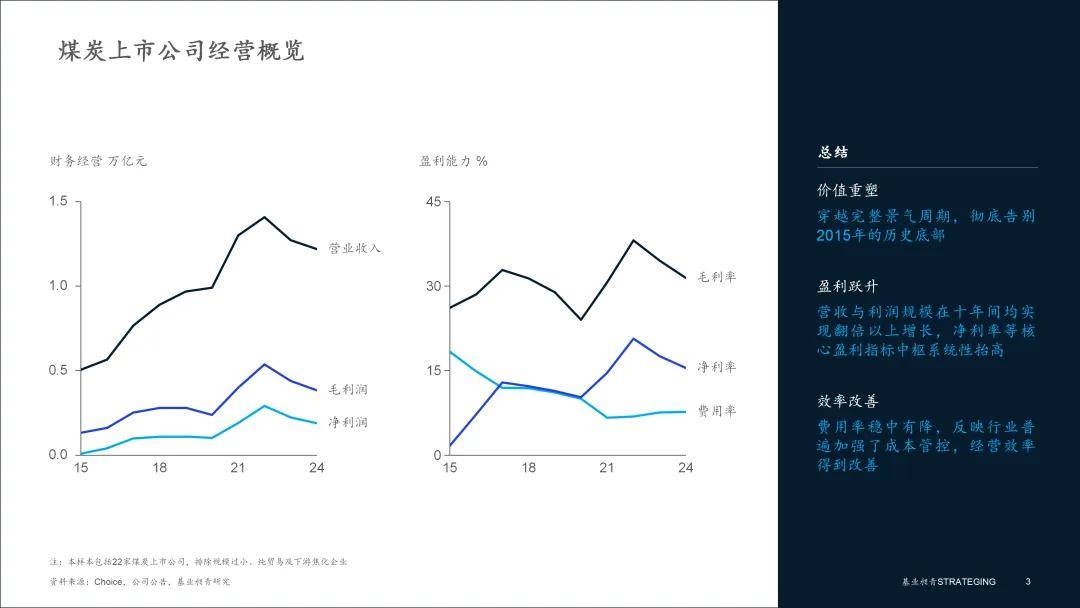
Core Insights - The coal industry has undergone a significant transformation from 2015 to 2024, moving from a historical low in profitability to a new phase characterized by elevated profit levels and improved development quality [2][29] - The industry's overall prosperity is giving way to pronounced differentiation among companies, driven by strategic choices in business models, cost control, and asset management [29] Industry Performance - The coal industry's total revenue reached a peak of 1,408.3 billion yuan in 2022, a 179% increase from 2015, with net profit soaring to 291.2 billion yuan, 34.5 times that of 2015 [2] - Despite a downturn in 2023-2024, key financial metrics remain significantly above the starting point of the cycle, indicating a fundamental reshaping of the industry's value center [2][4] Financial Characteristics - Revenue growth peaked, with a compound annual growth rate (CAGR) of 15.8% from 2015 to 2022, primarily driven by rising coal prices [3] - Profitability has shown significant elasticity, with net profit margins increasing from 2% in 2015 to a peak of 21% in 2022, demonstrating a qualitative change in profitability [3] - Operational efficiency has improved, with the overall expense ratio declining from 18% in 2015 to 7%-8% post-2021, indicating a shift from extensive to refined development models [3][4] Revenue Structure Analysis - In 2024, total revenue for sample companies is expected to remain above 1.2 trillion yuan, although growth momentum is slowing [6] - Major players like China Shenhua and China Coal Energy dominate the revenue rankings, benefiting from integrated business models that combine coal production with stable electricity and transportation operations [6][7] Profitability Insights - Profitability is highly concentrated among leading firms, with China Shenhua and Shaanxi Coal Industry together accounting for over 1 billion yuan in net profit, highlighting the significant head effect [9] - Integrated leaders demonstrate resilience during market downturns, with minor profit declines, showcasing the advantages of their business models [9][10] Cost and Efficiency Analysis - High gross margins are linked to resource endowments, with companies like Jinko Coal enjoying high margins due to the scarcity and high value of their products [15][16] - Cost control is critical, as evidenced by Shaanxi Coal's ability to maintain a gross margin of 32.7% despite being a standard coal producer [17] - Companies with high expense ratios, such as Anyuan Coal and Dayou Energy, face significant profitability challenges due to poor cost management [18][19] Strategic Choices and Future Outlook - The future of coal companies hinges on strategic decisions regarding business model evolution, cost control, and proactive asset management [29] - Companies must transition from reliance on price fluctuations to building robust operational defenses, leveraging digital and intelligent technologies for integrated operations [29]

焦煤期货涨停,煤炭股上涨,陕西黑猫涨停,山西焦煤涨超7%
Ge Long Hui· 2026-01-07 03:54
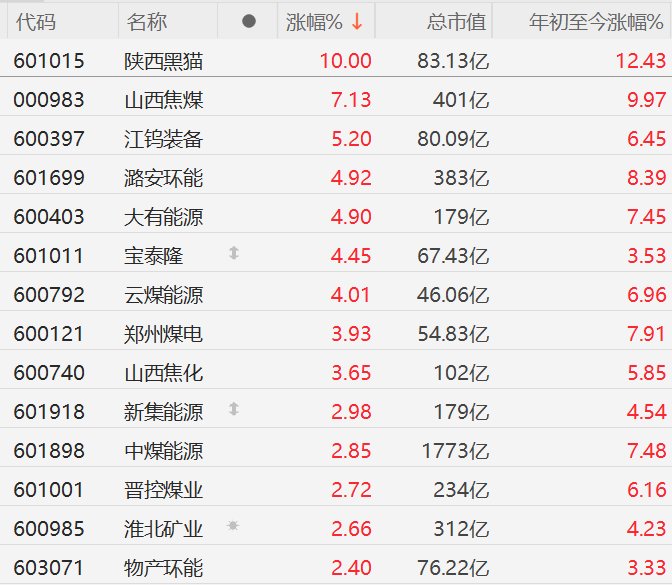
Group 1 - The A-share market saw a collective rise in coal stocks on January 7, with notable increases in various companies, including a 10% surge for Shaanxi Black Cat and over 7% for Shanxi Coking Coal [1] - Futures for coking coal reached a limit increase of 8%, priced at 1164 yuan/ton, while coking coal futures main contract rose over 7% to 1757 yuan/ton [1] Group 2 - Shaanxi Black Cat (601015) had a market cap of 8.313 billion yuan and a year-to-date increase of 12.43% [2] - Shanxi Coking Coal (000983) reported a market cap of 40.1 billion yuan with a year-to-date increase of 9.97% [2] - Jiangxi Tungsten Equipment (600397) had a market cap of 8.009 billion yuan and a year-to-date increase of 6.45% [2] - Lu'an Environmental Energy (601699) reported a market cap of 38.3 billion yuan with a year-to-date increase of 8.39% [2] - Dayou Energy (600403) had a market cap of 1.79 billion yuan and a year-to-date increase of 7.45% [2] - Baotailong (601011) reported a market cap of 6.743 billion yuan with a year-to-date increase of 3.53% [2] - Yunmei Energy (600792) had a market cap of 4.606 billion yuan and a year-to-date increase of 6.96% [2] - Zhengzhou Coal Power (600121) reported a market cap of 5.483 billion yuan with a year-to-date increase of 7.91% [2] - Shanxi Coking (600740) had a market cap of 10.2 billion yuan and a year-to-date increase of 5.85% [2]


A股异动丨焦煤期货涨停,煤炭股上涨,陕西黑猫涨停,山西焦煤涨超7%
Ge Long Hui A P P· 2026-01-07 03:50
Core Viewpoint - The coal stocks in the A-share market experienced a collective rise, driven by significant increases in futures prices for coking coal and coke [1][2]. Group 1: Market Performance - As of the half-day close, Shaanxi Black Cat reached the daily limit with a 10% increase, while Shanxi Coking Coal rose by over 7% [1]. - Other notable performers included Jiangxi Tungsten Equipment with a rise of over 5%, and Lu'an Environmental Energy, Dayou Energy, Baotailong, and Yunmei Energy all increasing by over 4% [1]. - Zhengzhou Coal Power and Shanxi Coking also saw gains of over 3% [1]. Group 2: Futures Market - Coking coal futures hit the daily limit with an 8% increase, reaching 1164 yuan/ton [1]. - The main contract for coke futures rose by over 7%, closing at 1757 yuan/ton [1]. Group 3: Company Data - Shaanxi Black Cat (601015) had a market cap of 8.313 billion yuan and a year-to-date increase of 12.43% [2]. - Shanxi Coking Coal (000983) had a market cap of 40.1 billion yuan with a year-to-date increase of 9.97% [2]. - Jiangxi Tungsten Equipment (600397) had a market cap of 8.009 billion yuan and a year-to-date increase of 6.45% [2]. - Lu'an Environmental Energy (601699) had a market cap of 38.3 billion yuan with a year-to-date increase of 8.39% [2]. - Dayou Energy (600403) had a market cap of 17.9 billion yuan and a year-to-date increase of 7.45% [2].
赣能股份:拟以0元非公开协议转让方式将所持巨源煤业20%股权至江西煤业
Xin Lang Cai Jing· 2025-12-26 10:28
Core Viewpoint - The company aims to optimize its asset structure and focus on core business development by transferring its 20% stake in Juyuan Coal Industry to Jiangxi Coal Industry at a transaction price of 0 yuan, resulting in the company no longer holding any equity in Juyuan Coal Industry [1] Group 1 - The company is transferring a 20% equity stake in Juyuan Coal Industry [1] - The transaction will be executed through a non-public agreement [1] - The transaction price for the equity transfer is set at 0 yuan [1]

煤炭开采板块12月25日跌0.38%,中煤能源领跌,主力资金净流出3.59亿元
Zheng Xing Xing Ye Ri Bao· 2025-12-25 09:15
Core Viewpoint - The coal mining sector experienced a decline of 0.38% on December 25, with China Coal Energy leading the drop. Meanwhile, the Shanghai Composite Index rose by 0.47% and the Shenzhen Component Index increased by 0.33% [1]. Group 1: Market Performance - The coal mining sector's stocks showed mixed performance, with notable declines in major companies such as China Coal Energy, which fell by 1.40% to a closing price of 12.70 [2]. - The trading volume for China Coal Energy was 160,500 shares, with a transaction value of 205 million yuan [2]. - Other companies in the sector, like Jiangxi Tungsten Equipment and Jinko Energy, also saw declines of 1.17% and 0.97%, respectively [2]. Group 2: Capital Flow - The coal mining sector experienced a net outflow of 359 million yuan from major funds, while retail investors contributed a net inflow of 380 million yuan [2]. - The table of capital flow indicates that retail investors were more active, with significant inflows into stocks like Xin Dazhou A, which saw a net inflow of 852,620 yuan from major funds [3]. - Conversely, stocks like Huaihe Energy and Shanmei International faced net outflows from major and speculative funds, indicating a shift in investor sentiment [3].

煤炭行业资金流入榜:云维股份等6股净流入资金超千万元
Zheng Quan Shi Bao Wang· 2025-12-17 09:43
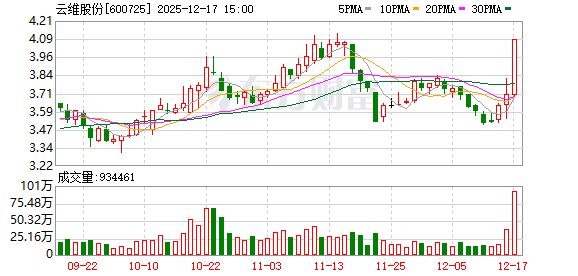
Market Overview - The Shanghai Composite Index rose by 1.19% on December 17, with 28 out of 31 sectors experiencing gains, led by the communication and non-ferrous metals sectors, which increased by 5.07% and 3.03% respectively [2] - The coal industry ranked third in terms of decline, with a decrease of 0.11% [2] Capital Flow - The net inflow of capital in the two markets was 9.51 billion yuan, with 16 sectors seeing net inflows. The communication sector had the highest net inflow of 6.45 billion yuan, corresponding to its 5.07% increase [2] - The electronic sector also saw a significant net inflow of 6.34 billion yuan, with a daily increase of 2.48% [2] - Conversely, 15 sectors experienced net outflows, with the defense and military industry leading with a net outflow of 4.87 billion yuan, followed by the retail sector with 2.31 billion yuan [2] Coal Industry Analysis - The coal industry saw a slight decline of 0.11%, with a total net inflow of 29.70 million yuan. Out of 37 stocks in this sector, 20 rose, including one that hit the daily limit [3] - The top three stocks with the highest net inflow in the coal sector were Yunwei Co., Ltd. (5.43 million yuan), Xinjie Energy (2.82 million yuan), and Jiangtong Equipment (2.59 million yuan) [3] - Major stocks with net outflows included China Shenhua (45.75 million yuan), Yongtai Energy (30.31 million yuan), and Lu'an Environmental Energy (15.22 million yuan) [3][4] Individual Stock Performance - The top-performing stock in the coal sector was Yunwei Co., Ltd., which increased by 9.97% with a turnover rate of 7.58% and a net inflow of 5.43 million yuan [3][4] - Other notable stocks included Xinjie Energy (0.15% increase, 1.13% turnover, 2.82 million yuan inflow) and Jiangtong Equipment (1.95% increase, 2.02% turnover, 2.59 million yuan inflow) [3][4] - Stocks with significant net outflows included China Shenhua (-0.42% decrease, 0.12% turnover, 45.75 million yuan outflow) and Yongtai Energy (0.00% change, 1.91% turnover, 30.31 million yuan outflow) [4]


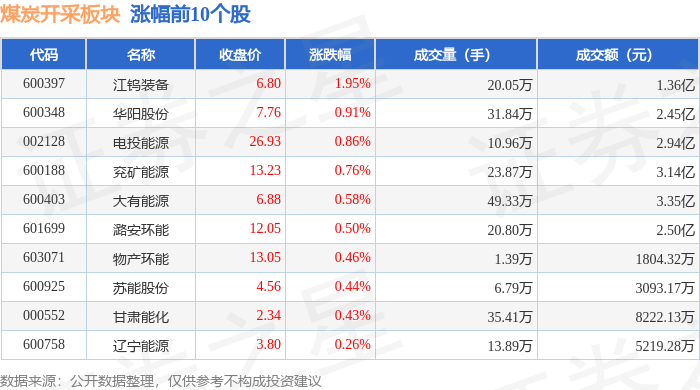
煤炭开采板块12月17日跌0.27%,晋控煤业领跌,主力资金净流出6517.29万元
Zheng Xing Xing Ye Ri Bao· 2025-12-17 09:14
Group 1 - The coal mining sector experienced a decline of 0.27% on December 17, with Jin控煤业 leading the drop [1] - The Shanghai Composite Index closed at 3870.28, up 1.19%, while the Shenzhen Component Index closed at 13224.51, up 2.4% [1] - Key stocks in the coal mining sector showed varied performance, with Jiangxi Tungsten Equipment closing at 6.80, up 1.95%, and Jin控煤业 closing at 13.86, down 2.12% [2] Group 2 - The coal mining sector saw a net outflow of 65.17 million yuan from main funds, while retail investors had a net inflow of 22.2 million yuan [2] - The trading volume and turnover for major coal stocks varied, with Shaanxi Coal Industry recording a turnover of 606 million yuan [2] - The main fund inflow for Jiangxi Tungsten Equipment was 27.76 million yuan, while Jin控煤业 saw a net outflow of 17.05 million yuan [3]

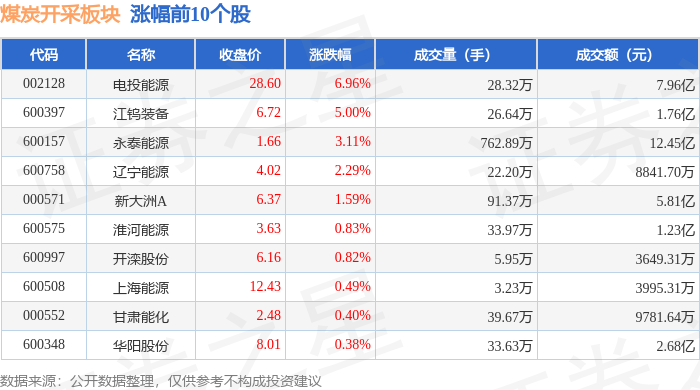
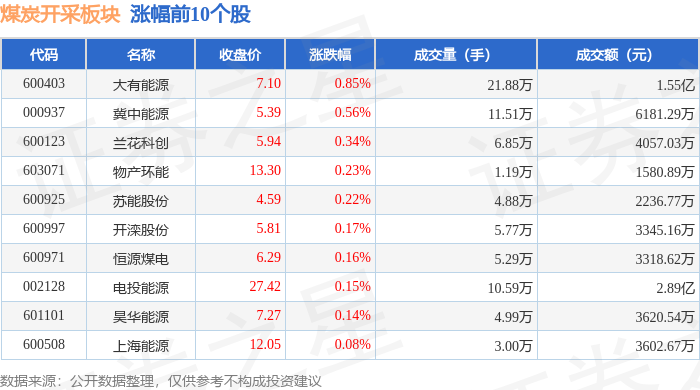
煤炭开采板块12月5日涨0.12%,电投能源领涨,主力资金净流出3073.51万元
Zheng Xing Xing Ye Ri Bao· 2025-12-05 09:13
Group 1 - The coal mining sector increased by 0.12% on December 5, with Electric Power Investment leading the gains [1] - The Shanghai Composite Index closed at 3902.81, up 0.7%, while the Shenzhen Component Index closed at 13147.68, up 1.08% [1] - Electric Power Investment's stock price rose by 6.96% to 28.60, with a trading volume of 283,200 shares and a transaction value of 796 million [1] Group 2 - The coal mining sector experienced a net outflow of 30.73 million from institutional investors, while retail investors saw a net inflow of 22.3 million [2] - Major stocks in the coal mining sector showed varied performance, with some stocks like Daya Energy and China Shenhua experiencing declines of 1.81% and 0.53% respectively [2] - The trading volume and transaction values for various coal mining stocks were significant, with Daya Energy recording a transaction value of 649 million [2] Group 3 - Individual stock performance showed that Yongtai Energy had a net inflow of 14.216 million from institutional investors, while retail investors had a net outflow of 6.71 million [3] - New Dazhou A and Jiangtong Equipment also had mixed net inflows and outflows from different investor types [3] - The data indicates a trend of institutional investors pulling back while retail investors are more active in the coal mining sector [3]