
ZTT(600522)

Search documents
大摩闭门会-金融-地产-交运-线缆行业更新
2026-03-04 14:17
Summary of Key Points from Conference Call Records Industry Overview - **Macro Debt Risk**: The macro debt risk is converging, with an expected addition of 160 trillion in debt from 2020 to 2025, of which 140 trillion is anticipated to convert into household deposits. Infrastructure investment is expected to remain a core demand driver through 2026 [1][2][3]. Company Insights Zhongtian Technology (中天科技) - **Profit Forecast Adjustment**: The profit forecast for Zhongtian Technology has been significantly raised, with net profit expectations for 2026 increased to 5.6 billion (+27%). This adjustment is primarily driven by the optical communication segment, where gross margin estimates have been revised from 27% to 37% due to price adjustments in collective procurement [1][7]. - **Business Structure**: Zhongtian Technology operates in four main segments: optical communication, power transmission, marine business, and new energy. The optical communication segment, particularly fiber optic cables, is highlighted as a key focus due to ongoing price increases [6][9]. - **Market Position**: The company is well-positioned in both domestic and international markets, with significant orders from European operators in the marine segment [6][8]. Financial Sector - **Insurance Sector Outlook**: The insurance industry is expected to show resilience with a growth rate of 15%-20%. The financial sector is anticipated to recover gradually, with income projected to return to 4-5% over the next 3-5 years [5][20]. - **Banking Sector**: Ningbo Bank, which supports industrial upgrades, is expected to yield better returns compared to its peers [5]. Real Estate Sector - **Sales Decline**: The top 100 developers experienced a 32% year-on-year decline in sales from January to February, with expectations of a further 30% decline in the first quarter of 2026. The real estate sector is advised to reduce holdings due to high valuations compared to historical averages [1][15][19]. - **Valuation Concerns**: Current valuations of real estate stocks are significantly higher than those during the 2016-2020 upcycle, with companies like Vanke and Jindi showing valuations approximately 5 times higher than historical levels [19][20]. - **New City Holdings**: Long-term attention is recommended for New City Holdings due to recent capital market activities that have alleviated liquidity risks and potential for asset value enhancement through restructuring [20]. Shipping and Oil Transportation - **Market Dynamics**: The oil shipping market is influenced by geopolitical tensions, particularly in the Middle East, which has led to increased freight rates and operational challenges. SynoCor controls about 20% of spot market capacity, impacting pricing strategies [9][11][12]. - **Impact of Geopolitical Events**: The escalation of conflicts in the Middle East has caused immediate changes in oil transport dynamics, with shipping rates reflecting risk premiums and operational inefficiencies [9][10][11]. Infrastructure Investment - **Continued Importance**: Infrastructure investment is viewed as a critical support for demand in 2026, providing employment and stabilizing industrial profits. The government is expected to gradually shift fiscal resources from infrastructure to consumption to mitigate uncertainties [3][4]. Conclusion - The conference call highlighted significant adjustments in profit forecasts for Zhongtian Technology, ongoing challenges in the real estate sector, and the impact of geopolitical tensions on the shipping industry. The financial sector shows potential for recovery, particularly in insurance, while infrastructure investment remains a key focus for economic stability.


中国银河证券:市场需求高增叠加集采提价 光纤光缆上行周期打开
Zhi Tong Cai Jing· 2026-03-02 09:00
Core Viewpoint - China Telecom has announced an emergency procurement project for fiber optic cables in its Guangdong branch for Q1 2026, indicating a significant price increase in the fiber optic market, with the maximum price for GJYXFCH-1 core cable set at 310 yuan per kilometer, reflecting a 45.36% increase from previous prices [1][2]. Group 1: Procurement Details - The procurement focuses on FTTH butterfly-shaped fiber optic cables, with a maximum response price of 1,726,955.49 yuan for the project [2]. - The previous maximum price for GJYXFCH-1 core cable was 213.27 yuan per kilometer, highlighting a substantial price increase in the current procurement [2]. Group 2: Market Trends - The demand for fiber optic cables is increasing, with operators raising procurement prices; for instance, China Telecom's procurement prices for G.652.D cables have risen by over 31% year-on-year, with some prices increasing by as much as 64.29% [3]. - The price of G.652.D fiber has exceeded 50 yuan per core kilometer, compared to 20 yuan in November 2025 and 35.6 yuan in January 2026, indicating a robust market [3]. Group 3: Industry Outlook - The fiber optic market is experiencing sustained price increases due to rapid growth in AI and computing networks, with a projected global demand increase of 4.1% for fiber optic cables by 2025, and a 75.9% increase in data center fiber cable demand [4]. - Supply constraints are expected to persist due to the long expansion cycle for optical fiber preform, which is approximately two years, suggesting continued price potential for fiber optic cables [4]. Group 4: Key Companies - The report highlights several core manufacturers in the fiber optic cable sector, including Zhongtian Technology, Hengtong Optic-Electric, Yangtze Optical Fibre and Cable, TeFa Information Technology, Yongding Co., and FiberHome Technologies [5].



中天科技20260227
2026-03-01 17:22
Summary of Zhongtian Technology Conference Call Company Overview - Zhongtian Technology operates in a diversified business model, with power cables as the primary revenue source, followed by optical communication and submarine cables [2][3] - The marine business's profit contribution is subject to cyclical fluctuations, while the power transmission segment shows stable growth, becoming the main profit contributor [2] Industry Insights - The global optical fiber and cable industry is rebounding, driven by demand from AI data centers and special applications, with a significant shift in demand structure [2][4] - Operator demand has decreased from approximately 90% in 2021 to about 70%, while data center and special demand now account for about 25%-30% of the market [4] - The industry is expected to enter a new price increase cycle starting in the second half of 2025 [4] Financial Performance and Projections - The overall performance from 2021 to 2024 has shown slight fluctuations due to varying profit contributions from different segments [4] - For 2026-2027, it is anticipated that the marine business's profit contribution will significantly increase, while the power cable segment will remain the largest contributor [6] - The marine segment's revenue growth is projected to reach 40%-50% in 2026, driven by a robust order backlog and the delivery of major projects [7] Competitive Position - Zhongtian Technology ranks among the top players in the domestic optical fiber and submarine cable markets, with a strong competitive position in optical communication [3][5] - The company has established a balanced global presence with production facilities in various countries, including Morocco, Indonesia, India, Brazil, and Uzbekistan, to mitigate anti-dumping risks and enhance local production capabilities [5] Segment Analysis Marine Business - The marine segment is expected to see a significant increase in profit contribution, with a strong order backlog of approximately 100-140 billion yuan [6][7] - Major projects are set to commence delivery in 2026, with an anticipated increase in the delivery of 500kV submarine cables, which will improve the segment's gross margin [6] Power Transmission - The power transmission segment's revenue growth is expected to align with the overall growth of grid investments, maintaining a compound annual growth rate of about 15% [8] - The segment's gross margin is projected to remain stable at around 13%-14% [8] New Energy - The new energy segment, which includes solar power, energy storage, and related copper foil businesses, is expected to grow at a rate of 20%-30% but will contribute less than 10% to overall revenue and profit [9] Key Takeaways - The main focus for the next 1-2 years will be on the optical communication and marine segments, particularly submarine cable business, which are expected to drive significant revenue growth and profitability [9] - The anticipated price increases in optical fibers and the recovery of the marine business are expected to provide substantial earnings elasticity for the company [9]
欧洲海风本土单桩产能再紧张,“十五五”期间将加大氢能政策支持力度





GOLDEN SUN SECURITIES· 2026-03-01 08:49
Investment Rating - The report maintains a positive outlook on the renewable energy sector, particularly in solar and wind energy, with specific recommendations for companies involved in these industries [1][2][3]. Core Insights - The report highlights the tightening of local monopile production capacity in European offshore wind, suggesting a favorable environment for Chinese companies to expand internationally [2]. - In the solar sector, silicon wafer prices are under pressure while battery component prices remain stable, indicating a potential market adjustment [1][14]. - The hydrogen energy sector is set to receive increased policy support during the 14th Five-Year Plan, with a projected doubling of renewable hydrogen production capacity by the end of 2025 [3][18]. - The energy storage market is experiencing significant growth, with a marked increase in project scale and a forecasted rise in lithium carbonate prices impacting storage system costs [4][20]. Summary by Sections Solar Energy - Silicon prices are declining, with N-type G10L monocrystalline silicon wafers averaging 1.10 RMB per piece, down 8.33% from previous levels [1][14]. - The average price for N-type battery cells remains stable at 0.44 RMB per watt, with distributed component prices ranging from 0.75 to 0.88 RMB per watt [1][14]. - Key companies to watch include Tongwei Co., GCL-Poly, LONGi Green Energy, and JA Solar, focusing on supply-side reform and new technology opportunities [1][15]. Wind Energy & Grid - Ørsted has terminated its contract with SeAH Wind for the Hornsea 3 offshore wind project due to production delays, highlighting the challenges in local monopile production [2][16]. - The report suggests monitoring companies like Dajin Heavy Industry and Tianjun Wind Power as they expand internationally [2][16]. - The wind turbine sector is expected to see profitability improvements in 2026, with companies like Goldwind and Mingyang Smart Energy being key players [2][17]. Hydrogen Energy - The National Energy Administration plans to enhance policy support for hydrogen energy during the 14th Five-Year Plan, aiming for over 250,000 tons of renewable hydrogen production capacity by 2025 [3][18]. - Recommended companies include Shuangliang Eco-Energy and Huadian Heavy Industries, focusing on equipment manufacturing and hydrogen compression technology [3][18]. Energy Storage - In January 2026, the domestic energy storage EPC bidding scale reached 4.92 GW, with a total installed capacity of 12.42 GWh, reflecting over 30% growth compared to the previous year [4][19]. - The report emphasizes the importance of companies like Sungrow Power Supply and Aiko Solar in the energy storage market, which is expected to grow significantly [4][24]. New Energy Vehicles - In March 2026, domestic battery production is projected to reach 149.59 GWh, with a 21.93% month-on-month increase, indicating strong demand despite concerns over subsidy reductions [5][25]. - Key players in the battery sector include CATL and BYD, with a focus on maintaining resilience in battery demand [5][26].
中天科技公布国际专利申请:“天线组件及测试系统”
Sou Hu Cai Jing· 2026-02-27 21:56
Group 1 - The core point of the article is that Zhongtian Technology (600522) has filed an international patent application for an "Antenna Assembly and Testing System" with the application number PCT/CN2025/080525, which is set to be published internationally on February 26, 2026 [1] - In 2023, Zhongtian Technology has announced a total of 10 international patent applications, representing a decrease of 23.08% compared to the same period last year [1] - The company invested 965 million yuan in research and development in the first half of 2025, which is a slight decrease of 0.96% year-on-year [1]


AI算力需求驱动光纤行业步入景气周期
Zheng Quan Ri Bao· 2026-02-27 16:28
Group 1 - The fiber optic market is experiencing significant price increases, with G.652.D single-mode fiber prices rising from 18 yuan/km to a peak of about 50 yuan/km due to increased demand from data centers [1] - The growth in demand for fiber optics is driven by AI model training, intelligent computing center construction, and data center interconnect (DCI), marking a shift from traditional telecom network demands [1][2] - The supply side faces rigid constraints, as the expansion cycle for fiber preform rods takes 1.5 to 2 years, leading to a supply-demand imbalance in the market [1] Group 2 - Compared to traditional data centers, intelligent computing centers require significantly more fiber, with a typical GPU cluster needing tens of thousands of fiber kilometers for internal connections [2] - The demand for fiber optics in AI-driven data centers and DCI is expected to increase from less than 5% in 2024 to 35% by 2027 [2] - China's fiber optic shipments are projected to account for 56.3% of global shipments by 2025, with a year-on-year growth of 7.5% [2] Group 3 - Companies are advised to view the price increases rationally, as different product models have varying prices, and telecom operators primarily determine prices through centralized procurement [3] - The overall outlook for the fiber optic industry remains positive, with expectations of a new demand upcycle driven by the growth of data center interconnect needs [3]
商业航天已连续走强近三月,3月行情能否继续延续?国内外重磅事件提前汇总,一文深度解读后市机会
Xin Lang Cai Jing· 2026-02-27 10:42
Group 1 - China Satcom (601698) is a key player in satellite communication, holding scarce orbital positions and spectrum resources, crucial for commercial space ventures. The demand for satellite communication and data services is rapidly increasing due to the acceleration of low-orbit satellite networks and mobile direct satellite connections [1][44] - The company has a complete ground station network and high-throughput satellite resources, deeply integrated with national satellite internet projects, ensuring stable and sustainable cash flow [1][45] - With the ongoing scale-up of commercial space, the demand for satellite operation, data distribution, and industry applications continues to grow, supported by favorable policies for satellite internet [1][45] Group 2 - China Satellite (600118) focuses on the entire satellite manufacturing and application chain, covering communication, navigation, and remote sensing, making it a core player in satellite manufacturing [2][46] - The demand for small satellite launches is surging as low-orbit satellite constellations reach their peak, leading to explosive growth in satellite assembly and core component supply [2][46] - The company leverages its technological and resource advantages from the Aerospace Science and Technology Corporation, participating in major national space projects and expanding its service offerings [2][46] Group 3 - Aerospace Electronics (600879) specializes in aerospace measurement and control, covering key areas such as rocket control and satellite attitude control, with a supply rate exceeding 90% [3][47] - The demand for aerospace measurement and satellite electronics is increasing due to the rise in commercial rocket launches and large-scale low-orbit satellite networks [3][47] - The company has a strong order backlog and is actively expanding into the commercial space market, providing services to private rocket and satellite companies [3][47] Group 4 - ZTE Corporation (000063) is a global leader in communication equipment, deeply involved in the ground core network and terminal equipment for satellite internet, making it a key participant in commercial space ground systems [4][48] - The demand for satellite communication ground stations, core network equipment, and terminal chips is surging due to the acceleration of low-orbit satellite construction [4][48] - The company is leveraging its 5G and communication technology expertise to quickly enter the satellite communication field, participating in national satellite network projects and expanding into overseas markets [4][48] Group 5 - AVIC Optoelectronics (002179) focuses on high-reliability connectors and cable components, widely used in rockets, satellites, and spacecraft, making it a core supplier in commercial aerospace connection systems [5][49] - The demand for high-reliability connectors is growing as the complexity and reliability requirements of commercial aerospace equipment increase [5][49] - The company is actively expanding into the private aerospace market, providing services to commercial rocket and satellite companies, enhancing its market share [5][49] Group 6 - Aerospace Development (000547) is the only publicly listed platform for commercial aerospace under the Aerospace Science and Industry Corporation, covering the entire satellite manufacturing, operation, and ground terminal chain [6][50] - The company has seen a significant increase in commercial aerospace orders, leveraging its military qualifications and resource advantages [6][50] - With the gradual establishment of the "Tianmu-1" low-orbit meteorological satellite constellation, the company is enhancing its satellite data service capabilities [6][50] Group 7 - Guangqi Technology (002625) specializes in metamaterials, widely used in aerospace equipment for stealth and structural enhancement, making it a core player in the new materials sector of commercial aerospace [7][51] - The demand for metamaterials is continuously increasing as commercial aerospace equipment requires lightweight, stealthy, and high-performance materials [7][51] - The company is actively expanding into the civilian commercial aerospace market, providing metamaterial solutions to private rocket and satellite companies [7][51] Group 8 - Chengchang Technology (001270) is a leading supplier of spaceborne T/R chips, with a market share exceeding 70%, making it a core supplier in the commercial aerospace RF chip sector [8][53] - The demand for spaceborne T/R chips is experiencing exponential growth due to the large-scale networking of low-orbit constellations [8][53] - The company is expanding into overseas markets and entering the global commercial satellite supply chain, further enhancing its market share [8][53] Group 9 - Tianyin Electromechanical (300342) specializes in satellite attitude control star sensors, holding a market share exceeding 60%, making it a leading enterprise in core components for commercial aerospace satellites [9][54] - The demand for star sensors is robust, with each satellite requiring one, and the company is seeing significant growth in order volume due to the batch launch of low-orbit satellites [9][54] - The company is actively expanding its product layout to include other core satellite components, further enhancing its market share [9][54]


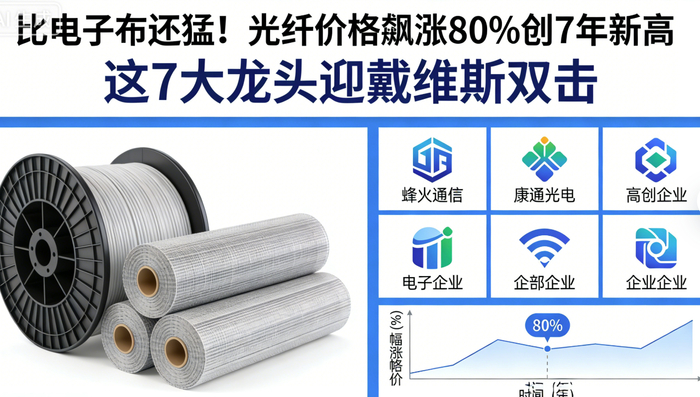
比电子布还猛!光纤价格飙涨80%创7年新高 7大寡头迎戴维斯双击
Xin Lang Cai Jing· 2026-02-27 02:26
Core Viewpoint - The rapid development of AI is driving an increased demand for upstream raw materials, leading to a rise in prices for these materials, particularly in the optical fiber market, which has reached a seven-year high with prices exceeding 40 yuan per core kilometer, reflecting an annual increase of over 80% [3][6]. Demand Side - The growth in AI computing power is significantly increasing the demand for high-speed connections within data centers and in non-traditional communication fields, leading to a surge in demand for new types of optical fibers such as multi-mode fibers and G.654.E fibers [6]. - Major tech companies like Microsoft are planning to deploy extensive lengths of hollow-core fiber for their AI data centers, indicating a strong market demand [6]. - The "East Data West Computing" national project in China is expected to generate a concentrated procurement demand for over 3 million core kilometers of ultra-low loss optical fibers by 2025 [6]. Supply Side - The production capacity of optical fibers is constrained by the availability of optical fiber preform rods, which are critical raw materials and represent a bottleneck in the supply chain [7]. - The expansion cycle for optical fiber preform rods is approximately two years, and the industry has seen cautious capital investment since 2019, resulting in a mismatch between supply and demand [7]. - The introduction of hollow-core fibers, which offer advantages such as low latency and low loss, is expected to change the market dynamics, although their high cost remains a barrier [7]. Market Concentration - Domestic manufacturers hold 80% of the global optical fiber preform capacity, enhancing their market power and limiting the expansion of traditional and hollow-core fiber production [8]. - The global optical fiber market is highly concentrated, with the top four manufacturers accounting for over 50% of the market share, and the top ten companies exceeding 90% [8]. Company Highlights - **Changfei Fiber**: A leading global company in the optical fiber industry, expected to reach a production capacity of 100 million core kilometers per year by 2025, benefiting from price increases [12]. - **Hengtong Optic-Electric**: Among the top three in optical fiber communication and submarine cables, with a projected capacity of 95 million core kilometers per year by 2025 [15]. - **ZTT**: A major player with a comprehensive product range and a projected capacity of 90 million core kilometers per year by 2025 [17]. - **FiberHome**: Unique in integrating optical communication systems, with a projected capacity of 85 million core kilometers per year by 2025 [19]. - **Tongding Interconnection**: Established a complete industry chain, with a projected capacity of 75 million core kilometers per year by 2025 [21]. - **Yongding Co., Ltd.**: Recognized as a national champion in fire-resistant communication cables, with a projected capacity of 70 million core kilometers per year by 2025 [23]. - **TeFa Information**: Focused on high-end optical communication products, with a projected capacity of 65 million core kilometers per year by 2025 [25].


中天科技中标东南地区智算中心项目
Xin Lang Cai Jing· 2026-02-26 12:35
Core Viewpoint - Zhongtian Technology has successfully won the bid for the first phase of the electromechanical general contracting project for the intelligent computing center at Changle Airport, marking a significant milestone in the high-end intelligent computing and data center electromechanical field [1] Group 1 - The project is a benchmark for the digital economy in Fuzhou New Area, aiming to establish a high-performance artificial intelligence computing hub in Southeast China [1] - The first phase of the project will utilize a liquid-cooled cabinet matrix and AI servers to achieve a computing power of 15,000 PetaFLOPS, combining efficiency and energy-saving advantages [1] - Zhongtian Technology leverages its technological accumulation in optical communication and smart grid sectors to further solidify its leading position in the industry [1] Group 2 - This project opens new opportunities for Zhongtian Technology to expand its computing infrastructure business in Southeast China [1]
行业研究|行业周报|通信设备III:通信周观点:算力硬件满载扩产,AI模型SOTA投资升温-20260226
Changjiang Securities· 2026-02-26 11:02
Investment Rating - The industry investment rating is "Positive" and maintained [12] Core Insights - The communication sector saw a 2.35% increase in the 6th-7th week of 2026, ranking 6th among primary industries in the Yangtze River region; since the beginning of 2026, it has risen by 0.44%, ranking 27th [2][6] - Tower's silicon photonics revenue doubled, with a high demand for 1.6T, and capacity expansion plans have been adjusted with prepayments secured; silicon photonics modules continue to penetrate the market [2][10] - Vertiv's orders and backlog reached new highs, with a shipment-to-order ratio rising to 2.9 times [2][10] - ByteDance's Seedance 2.0 has industry-leading generation availability, while Google's Gemini 3.1 Pro tops the charts, and Anthropic's annual revenue is growing rapidly at $14 billion [2][10] - OpenAI's cumulative computing expenditure is expected to exceed $600 billion by 2030, with an upward revision of revenue forecasts [2][10] Summary by Sections Market Performance - In the 6th-7th week of 2026, the communication sector increased by 2.35%, ranking 6th among primary industries; since the start of 2026, it has risen by 0.44%, ranking 27th [2][6] - Among companies with a market capitalization above 8 billion, the top three gainers this week were Dawei Technology (+39.4%), Shengke Communication (+31.7%), and Shenling Environment (+29.6%); the top three decliners were Tongyu Communication (-11.7%), Dingtong Technology (-9.7%), and Xinke Mobile (-9.3%) [6] Company Highlights - **Tower**: In Q4 2025, revenue reached $440 million, a year-on-year increase of 13.7%, with GAAP net profit of $80 million, up 45.3%. The company expects silicon photonics revenue to reach $228 million in 2025, doubling from 2024, and has raised its capacity target from 3 times to over 5 times the Q4 2025 shipment [7] - **Vertiv**: In Q4 2025, revenue was $2.88 billion, a year-on-year increase of 22.7%, with GAAP net profit of $450 million, up 203.1%. The company reported a significant increase in organic orders, with a year-on-year growth of 252% [7] AI Model Developments - On February 12, ByteDance launched Seedance 2.0, achieving industry-leading performance in complex scenarios with a high generation availability rate [8] - Anthropic completed a $30 billion Series G financing round with a post-money valuation of $380 billion, reporting an annual revenue of approximately $14 billion [8] - On February 19, Google released Gemini 3.1 Pro, which ranked first in AI analysis, showing significant improvements in reasoning capabilities [8] Future Projections - OpenAI updated its financial outlook, projecting cumulative computing-related expenditures to exceed $600 billion by 2030, with training costs expected to rise significantly in 2025 and 2026 [9]


