
去库存化

Search documents
有色金属行业双周报(2025、11、14-2025、11、27):美联储降息预期反复,金属价格持续震荡-20251128
Dongguan Securities· 2025-11-28 08:21
Investment Rating - The report maintains a "Market Weight" rating for the non-ferrous metals industry, indicating that the industry index is expected to perform within ±10% of the market index over the next six months [63]. Core Insights - The non-ferrous metals industry has experienced a decline of 6.87% over the past two weeks, underperforming the CSI 300 index by 2.90 percentage points, ranking 28th among 31 industries [3][13]. - The report highlights that the Federal Reserve's fluctuating interest rate expectations have led to continued volatility in metal prices, particularly in industrial metals, which are expected to maintain upward momentum due to improving supply-demand dynamics [6][56]. - Precious metals have shown resilience, with gold prices rising significantly, supported by a declining dollar credit, while lithium prices are recovering due to tightening supply conditions and new growth opportunities in energy storage [57][58]. Market Review - As of November 27, 2025, the LME copper price was $10,930/ton, aluminum at $2,831.50/ton, lead at $1,983.50/ton, zinc at $3,022/ton, nickel at $14,840/ton, and tin at $37,925/ton [24]. - The COMEX gold price reached $4,189.60/oz, up $175.9 since early November, while silver was at $53.83/oz, up $5.92 [33][57]. - Lithium carbonate futures were priced at ¥95,800/ton, reflecting a recovery of ¥13,500 since early November, and cobalt prices increased to ¥401,300/ton [37][58]. Industry Analysis by Subsector Industrial Metals - The report notes that the supply-demand balance for copper and aluminum continues to improve, with prices expected to have upward momentum due to macroeconomic easing [6][56]. Precious Metals - The report indicates that despite short-term risks, the long-term outlook for gold remains positive, with prices expected to continue rising due to a weakening dollar [57][58]. Energy Metals - The report emphasizes the upward trend in lithium prices driven by tightening supply and new growth opportunities in energy storage and solid-state batteries [58]. Minor Metals - The rare earth price index was reported at 207.92, with some prices like praseodymium-neodymium oxide increasing, while others like dysprosium and terbium saw declines [41][58]. Company Recommendations - The report suggests focusing on companies such as Western Mining (601168) and Luoyang Molybdenum (603993) in the industrial metals sector, and Ganfeng Lithium (002460) and Tianqi Lithium (002466) in the energy metals sector due to their strong performance and growth potential [6][59].
沪镍、不锈钢早报-20251112
Da Yue Qi Huo· 2025-11-12 02:22
1. Report Industry Investment Rating No relevant content provided. 2. Core Views of the Report - **Nickel Futures (沪镍2512)**: It is expected to fluctuate weakly and test the cost support. The overall fundamental situation is bearish in the medium - to - long term, although there are some bullish factors in the basis [2]. - **Stainless Steel Futures (不锈钢2601)**: It is expected to have a wide - range oscillation around the 20 - day moving average. The fundamental situation is neutral, with a bullish basis and a bearish trend on the chart [4]. 3. Summary by Related Catalogs 3.1 Price Overview - **Nickel**: On November 11, 2025, the price of SHFE nickel main contract was 119,380 yuan, down 60 yuan from the previous day; LME nickel was 15,025 US dollars, down 75 US dollars. Spot SMM1 electrolytic nickel was 121,300 yuan, up 100 yuan [12]. - **Stainless Steel**: The price of stainless steel main contract was 12,520 yuan on November 11, 2025, down 45 yuan from the previous day. The average price of cold - rolled 304*2B stainless steel in different regions showed mixed trends [12]. 3.2 Inventory Situation - **Nickel**: As of November 11, LME nickel inventory was 253,308 tons, down 96 tons; SHFE nickel warehouse receipts were 32,292 tons, down 241 tons. The total inventory was 285,600 tons, down 337 tons [15]. - **Stainless Steel**: As of November 11, stainless steel warehouse receipts were 71,735 tons, down 296 tons. As of November 7, the national stainless steel inventory was 1.034 million tons, up 0.29 million tons month - on - month, with the 300 - series inventory at 639,500 tons, down 12,400 tons month - on - month [19][20]. 3.3 Cost Analysis - **Nickel Ore and Nickel Iron**: The prices of red - soil nickel ore with different grades and the freight rates from the Philippines to Chinese ports remained stable on November 11, 2025. The price of high - nickel iron decreased by 2.5 yuan per nickel point, while the price of low - nickel iron remained unchanged [23]. - **Stainless Steel Production**: The traditional production cost of stainless steel was 12,716 yuan, the scrap - steel production cost was 12,894 yuan, and the low - nickel + pure - nickel production cost was 16,544 yuan [25]. - **Nickel Import**: The calculated import price of nickel was 120,492 yuan per ton [28]. 3.4 Factors Affecting Market - **Bullish Factors**: The nickel ore price is firm, providing cost support. There is new nickel production capacity coming on stream, and at the same time, some production is cut, so the short - term output may decline [7]. - **Bearish Factors**: The domestic nickel production continues to increase significantly year - on - year, there is no new growth point in demand, and the long - term oversupply pattern remains unchanged. The inventory at home and abroad continues to accumulate [7].
白酒黄金时代终结?十年最差三季报来了
3 6 Ke· 2025-11-06 12:25
Core Viewpoint - The Chinese liquor industry, particularly the baijiu sector, is experiencing a significant downturn, with major companies reporting their worst third-quarter financial results in a decade, indicating a shift into a new cycle of challenges and market dynamics [1][6]. Industry Performance - In the first three quarters of the year, 20 A-share baijiu companies reported a total revenue of approximately 317.8 billion yuan, a year-on-year decline of 5.90%, and a net profit of about 12.26 billion yuan, down 6.93% [1]. - The overall revenue for the third quarter was around 77.98 billion yuan, reflecting an 18.47% year-on-year decrease, while net profit fell to approximately 28.01 billion yuan, a decline of 22.22% [1]. Market Dynamics - The baijiu industry is entering a phase of differentiation, with top brands like Moutai and Wuliangye showing weak growth, and regional brands experiencing severe declines in performance [3][4]. - The traditional strategies of price increases and inventory control are losing effectiveness as consumer preferences shift towards value and taste rather than brand prestige [4][5]. Consumer Behavior Changes - There is a notable decline in high-end gifting demand and a shift in consumer confidence, leading to reduced sales in high-end dining and business banquet scenarios [2][8]. - Younger consumers are increasingly favoring lower-alcohol beverages and are less inclined to participate in traditional drinking culture, with over 60% preferring non-alcoholic options in social settings [8][9]. Inventory and Pricing Issues - The industry is facing significant inventory challenges, with many companies reporting extended inventory turnover periods, leading to increased pressure on cash flow and necessitating promotional discounts [11][14]. - The reliance on price increases for profit has backfired as demand slows, resulting in a rapid erosion of previously established profit margins [12][13]. Future Outlook - The baijiu sector is transitioning from a period of guaranteed growth to a more competitive landscape where companies must adapt to changing consumer preferences and market conditions [6][10]. - The traditional high-margin structure of the industry is under threat, with many smaller brands struggling to survive amid rising costs and declining sales [14][15].





沪镍、不锈钢早报-20251106
Da Yue Qi Huo· 2025-11-06 02:31
Group 1: Industry Investment Rating - No relevant content provided Group 2: Core Views - For Shanghai Nickel 2512, it is expected to operate in a volatile and weak manner, testing cost support [2] - For Stainless Steel 2512, it is expected to operate in a wide - range oscillation around the 20 - day moving average [4] Group 3: Summary by Related Catalogs Shanghai Nickel - **Fundamentals**: The external market continues to decline. Nickel ore prices are firm, the Philippine rainy season is approaching, tender prices are firm, and shipping costs are stable. Nickel iron prices continue to fall, and the cost line loosens and moves down. Stainless steel inventories rise slightly. Primary nickel accumulates inventory both at home and abroad. New energy vehicle production and sales data are good, but the overall boost is limited. The medium - to - long - term oversupply pattern remains unchanged [2] - **Basis**: The spot price is 120,950, and the basis is 920, indicating a bullish signal [2] - **Inventory**: LME inventory is 253,128 (+378), and Shanghai Futures Exchange warehouse receipts are 32,929 (+1,977), indicating a bearish signal [2] - **Market**: The closing price is below the 20 - day moving average, and the 20 - day moving average is downward, indicating a bearish signal [2] - **Main Position**: The main position is net short, and short positions are decreasing, indicating a bearish signal [2] Stainless Steel - **Fundamentals**: The spot stainless steel price remains flat. In the short term, nickel ore prices are firm, shipping costs are stable, nickel iron prices fall, the cost line loosens further, and stainless steel inventories rise slightly [4] - **Basis**: The average stainless steel price is 13,700, and the basis is 1,165, indicating a bullish signal [4] - **Inventory**: The futures warehouse receipts are 73,300 (unchanged), indicating a neutral signal [4] - **Market**: The closing price is below the 20 - day moving average, and the 20 - day moving average is downward, indicating a bearish signal [4] Price and Inventory Data - **Nickel and Stainless Steel Prices**: On November 5, the Shanghai Nickel main contract was 120,030 (up 330 from the previous day), the LME nickel was 15,015 (down 45), the stainless steel main contract was 12,535 (down 10). Spot prices of various nickel products and stainless steel cold - rolled coils mostly declined [11] - **Nickel Inventory**: As of October 31, the Shanghai Futures Exchange nickel inventory was 36,751 tons, with futures inventory at 31,388 tons, an increase of 676 tons and 4,578 tons respectively. On November 5, LME inventory was 253,128 (up 378), and Shanghai Futures Exchange warehouse receipts were 32,929 (up 1,977) [13][14] - **Stainless Steel Inventory**: On October 31, the Wuxi inventory was 598,700 tons, the Foshan inventory was 306,100 tons, and the national inventory was 1,031,100 tons, a month - on - month increase of 3,700 tons. The 300 - series inventory was 651,900 tons, a month - on - month increase of 2,600 tons. On November 5, the stainless steel warehouse receipts were 73,300 (unchanged) [19][20] Cost - related Data - **Nickel Ore and Nickel Iron Prices**: On November 5, the price of red - soil nickel ore CIF (Ni1.5%) was 58 US dollars/wet ton, and (Ni0.9%) was 30 US dollars/wet ton, both unchanged from the previous day. Shipping costs from the Philippines to Lianyungang and Tianjin Port remained stable. High - nickel wet - ton prices were 920 yuan/nickel point (down 2), and low - nickel wet - ton prices were 3,050 yuan/ton (unchanged) [23] - **Stainless Steel Production Cost**: The traditional cost was 12,765, the scrap steel production cost was 12,893, and the low - nickel + pure - nickel cost was 16,538 [25] - **Nickel Import Cost**: The converted import price was 120,425 yuan/ton [28] Factors Affecting the Market - **Positive Factors**: The firm ore price provides cost support [6] - **Negative Factors**: Domestic production continues to increase significantly year - on - year, there are no new demand growth points, and the long - term oversupply pattern remains unchanged [6]
欧元区10月制造业PMI终值50,德、法持续萎缩,新订单疲软拖累复苏进程
Hua Er Jie Jian Wen· 2025-11-03 10:31
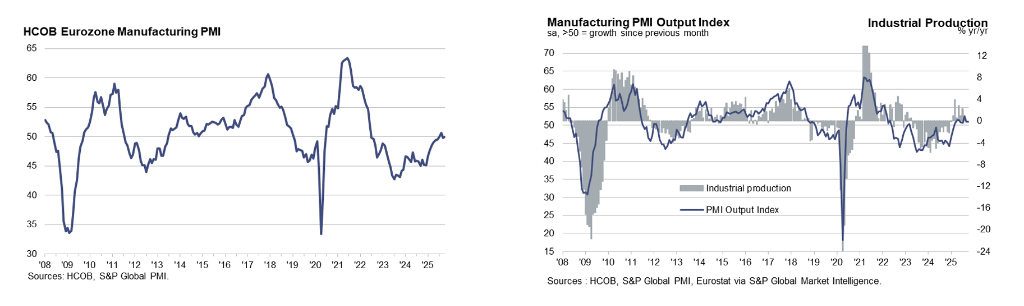
Core Insights - Eurozone manufacturing stagnated in October, with the PMI at the neutral mark of 50.0, slightly above September's 49.8, indicating fragile recovery despite eight months of weak expansion [1][4] - New orders stabilized after over three years of decline, but export orders fell for the fourth consecutive month, leading to increased layoffs in the manufacturing sector [4][5] - The European Central Bank (ECB) is likely to maintain a patient policy stance due to easing inflation pressures, as indicated by stable input costs and a slight increase in factory prices [5][6] Manufacturing Performance - Eurozone manufacturing PMI for October was 50.0, with Germany and France's PMIs at 49.6 and 48.8, respectively, both indicating contraction [1][6] - New orders showed no growth in October, particularly affected by weak external demand, with export orders declining for four months [4][5] - Employment in the manufacturing sector has been contracting for nearly two and a half years, with layoffs accelerating in response to weak demand [4][5] Economic Divergence - There is significant divergence within the Eurozone, with Greece and Spain showing strong manufacturing performance (PMIs of 53.5 and 52.1) while Germany and France continue to struggle [6] - Germany's PMI rose slightly to 49.6, indicating a second consecutive month of improvement but still below the neutral level, with production growth slowing [6] - France's PMI at 48.8 reflects ongoing demand weakness, particularly from domestic markets, with manufacturers expressing negative outlooks for the next 12 months [6][12]

全球作物保护市场或迎转折
Zhong Guo Hua Gong Bao· 2025-08-04 06:11
Group 1 - The global crop protection product inventory levels are showing signs of normalization after an unprecedented destocking in 2023, with manufacturers cautiously optimistic about the market in the second half of 2025 [2] - The global crop protection market is expected to decline by 6.0% year-on-year in 2024, reaching approximately $75.4 billion, due to macroeconomic factors and low agricultural prices affecting farmer incomes [2] - Crop protection companies have faced challenges over the past two years, with executives acknowledging the difficult period for the industry, but there are expectations for performance improvement in 2025 due to stabilized inventory and demand recovery [2] Group 2 - The U.S. crop protection market is projected to grow by 2.1% in 2025, reaching $77 billion, despite ongoing inflation and trade tensions impacting farmer incomes [3] - Tariff impacts on crop protection companies have been manageable, with estimates of tariff effects on Corteva's crop protection business reduced from $50 million to $25-30 million, aided by supply chain diversification [3] - U.S. farmers are proceeding with their planting plans, which is a positive sign for the crop protection market recovery [3] Group 3 - European crop protection companies face greater challenges, with Bayer anticipating increased price competition due to a surge in generic product capacity, particularly in glyphosate [4] - Bayer has announced a restructuring of its crop protection production and R&D in Germany to address the competitive pressures from Asian generic manufacturers [4]