JCET(600584)

Search documents
磷化铟,火了
3 6 Ke· 2026-01-23 03:28
Core Insights - The future of computing power will be determined by optical transmission efficiency, highlighting the critical role of optical interconnect technology and the growing market enthusiasm for indium phosphide (InP) materials [1][2] - The global AI infrastructure spending is expected to exceed $1 trillion by 2026, driving the rapid iteration of data center optical modules to 800G/1.6T and beyond [1] - The demand for InP materials is surging due to their unique properties, with a significant supply-demand gap projected to persist until 2026 [1][9] Group 1: InP Material Advantages - InP exhibits over ten times the electron mobility of silicon, making it suitable for high-frequency and high-speed applications, particularly in optical communication at critical wavelengths [3][4] - InP's high thermal resistance and radiation tolerance are essential for AI servers and data centers operating in high-temperature environments [3] - InP is positioned as the core material for high-end long-distance communication, outperforming silicon and gallium arsenide in efficiency and adaptability [4] Group 2: Market Demand Drivers - The explosive growth of AI data centers is the primary driver for the increasing demand for InP, with 800G optical modules becoming standard [6] - The introduction of Co-Packaged Optics (CPO) technology is expected to significantly increase the demand density for InP substrates, with a projected market growth of 166 times by 2030 [7] - In addition to data centers, InP is penetrating advanced fields such as LiDAR, 5G/6G mobile communications, low Earth orbit satellite communications, and quantum computing [8] Group 3: Global Market Dynamics - The global InP industry is characterized by a high degree of oligopoly, with major players like Sumitomo Electric and AXT dominating over 95% of the market [9] - A significant supply-demand gap is anticipated, with a projected need for 2 million InP devices by 2025 against a production capacity of only 600,000 [9] - Major manufacturers are ramping up production capacity to address this gap, with AXT planning to double its capacity by 2026 [9][10] Group 4: Domestic Industry Developments - Chinese companies are accelerating efforts to break the foreign monopoly in the InP market, with several firms achieving significant milestones in production capacity and technology [10][11] - The domestic market is witnessing a collaborative push towards a full-chain upgrade in the InP industry, enhancing quality and efficiency [12] - Government policies are supporting the development of InP materials, including tax reductions and funding for research in high-purity indium production [12] Group 5: Future Outlook and Challenges - The InP industry is on the brink of a significant scale-up, driven by the urgent need for high-performance materials in AI and optical communication [18] - Despite the promising outlook, challenges such as low crystal growth yield and high costs remain, necessitating technological advancements and cost reductions [14][15] - Geopolitical factors and export controls are creating uncertainties in the global supply chain, impacting the InP industry's growth trajectory [16]



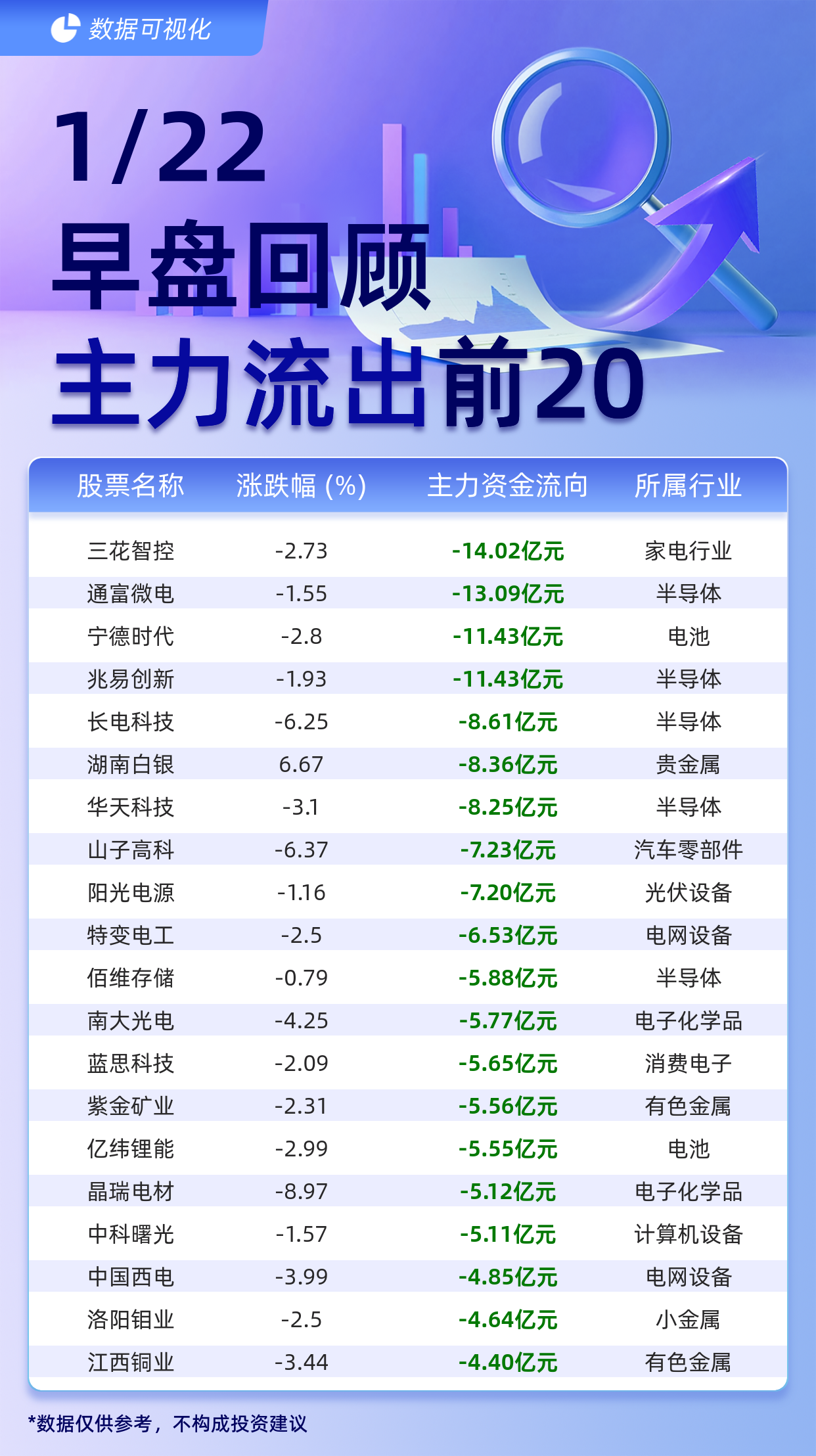
主力个股资金流出前20:三花智控流出14.02亿元、通富微电流出13.09亿元
Jin Rong Jie· 2026-01-22 03:45
Core Viewpoint - The data indicates significant outflows of capital from various stocks, with notable amounts withdrawn from companies across different industries, suggesting a potential shift in investor sentiment and market dynamics [1][2][3] Group 1: Major Stocks with Capital Outflows - Sanhua Intelligent Control experienced a capital outflow of 1.402 billion, with a decline of 2.73% in stock price [2] - Tongfu Microelectronics saw a capital outflow of 1.309 billion, with a decrease of 1.55% [2] - Contemporary Amperex Technology reported a capital outflow of 1.143 billion, with a drop of 2.8% [2] - Zhaoyi Innovation also faced a capital outflow of 1.143 billion, with a decline of 1.93% [2] - Changdian Technology had a significant outflow of 861 million, with a sharp decrease of 6.25% [2] Group 2: Other Notable Stocks - Hunan Silver experienced a capital outflow of 836 million, but its stock price increased by 6.67% [2] - Huada Technology saw an outflow of 825 million, with a decline of 3.1% [2] - Yango Technology faced a capital outflow of 723 million, with a significant drop of 6.37% [2] - Sungrow Power Supply had an outflow of 720 million, with a decrease of 1.16% [2] - TBEA reported a capital outflow of 653 million, with a decline of 2.5% [2] Group 3: Additional Stocks with Capital Outflows - Baiwei Storage experienced a capital outflow of 588 million, with a slight decrease of 0.79% [2] - Nanda Optoelectronics saw an outflow of 577 million, with a decline of 4.25% [3] - Lens Technology faced a capital outflow of 565 million, with a decrease of 2.09% [3] - Zijin Mining reported an outflow of 556 million, with a decline of 2.31% [3] - EVE Energy experienced a capital outflow of 555 million, with a drop of 2.99% [3]





芯片热“带飞”长电科技,华润系坐享资本盛宴
Huan Qiu Lao Hu Cai Jing· 2026-01-21 12:25
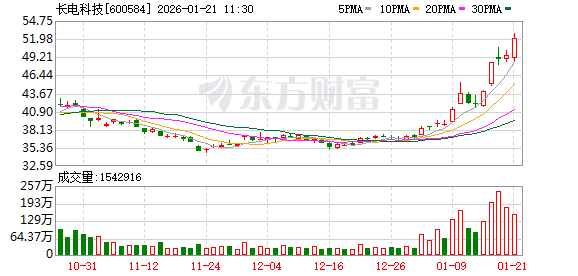
Core Viewpoint - Changdian Technology's stock price reached a historical high on January 21, with a monthly increase of over 43%, driven by its leading position in the industry and a series of favorable developments that reignited market enthusiasm [1][2]. Group 1: Stock Performance and Market Sentiment - On January 21, Changdian Technology's stock rose by 6.3% to close at 52.61 yuan, pushing its market capitalization above 94 billion yuan, marking a historical high [2]. - Since the semiconductor industry's recovery signal was confirmed in the second half of 2025, the company's stock has surged over 64% from a low of approximately 32 yuan [2]. - The recent rally was supported by positive news in the AI sector, including TSMC's Q4 2025 earnings exceeding expectations and Micron's announcement of ongoing memory chip shortages [2]. Group 2: Financial Performance and Industry Position - In the first three quarters of 2025, Changdian Technology reported revenue of 28.59 billion yuan, ranking first in the packaging and testing industry, nearly 40% ahead of the second-place competitor, Tongfu Microelectronics [3]. - The company's revenue growth rate was 14.78% year-on-year, reflecting strong fundamentals that bolster investor confidence [3]. Group 3: Strategic Acquisitions and Corporate Development - The company's success is partly attributed to its strategic acquisition of the fourth-largest packaging and testing company, STATS ChipPAC, in 2015 for $780 million, which significantly increased its market share from 3.9% to 10% [4]. - In March 2024, China Resources Group acquired a controlling stake in Changdian Technology, enhancing its resource advantages and providing a solid backing for the company [3][4]. - The acquisition of 80% of the shares in Western Digital's semiconductor division for $624 million further solidified Changdian Technology's market position and integrated it into major supply chains, including those of Apple and Samsung [4]. Group 4: Competitive Landscape and Future Prospects - The market is speculating on potential competition between Changdian Technology and China Resources Microelectronics, which also operates in the semiconductor sector [5][6]. - China Resources Group has committed to restructuring its semiconductor resources over the next five years, which may involve integrating China Resources Microelectronics' packaging and testing operations into Changdian Technology [6]. - The positive market reaction to the acquisition has led to a significant increase in Changdian Technology's stock price, reaching a peak of 38.55 yuan shortly after the announcement [6].
长电科技完成硅光引擎产品客户交付
Bei Jing Shang Bao· 2026-01-21 11:20
Core Viewpoint - Changdian Technology (600584) has made significant progress in the field of Co-packaged Optics (CPO) technology, with its silicon photonic engine products successfully delivered to clients and passing tests [1] Group 1: Company Developments - The company has completed customer sample delivery based on the XDFOI multi-dimensional heterogeneous advanced packaging process platform [1] - The successful testing of the silicon photonic engine products indicates a positive reception from clients [1] Group 2: Industry Trends - There is a growing demand for high bandwidth, low latency, and energy-efficient optical interconnect technologies driven by the rapid increase in artificial intelligence and high-performance computing workloads [1] - CPO technology integrates optical devices with chips through advanced packaging, providing a more compact and efficient solution for next-generation high-performance computing systems [1]
CPO,长电官宣
半导体芯闻· 2026-01-21 10:13
Core Insights - Changdian Technology has made significant progress in the CPO (Co-Packaged Optics) product technology field, successfully delivering XDFOI process silicon photonic engine samples that have passed client testing [1] - The XDFOI is a unique high-density multi-chiplet packaging solution that integrates optical devices with logic chips, optimizing energy efficiency and bandwidth performance [1] Market Demand and Growth - The demand for CPO is expected to surge by 166 times by 2030 compared to 2024, driven by increased investments in data centers and AI [2] - The global market for optical transceivers is projected to grow 2.6 times by 2030, with significant demand for 400G and 800G products [3] - The CPO market is anticipated to reach 14 trillion 1,850 billion yen by 2030, with a compound annual growth rate (CAGR) of 32.9% expected by 2025 [2] Product Trends - The 800G optical transceiver products are primarily adopted by major North American cloud service providers and Nvidia, with expectations for continued growth as network speeds increase [3] - Next-generation products such as 1.6T and 3.2T are expected to be introduced starting in 2026 and 2029, respectively [3]
封测涨价30%,国产算力产业链持续看好
East Money Securities· 2026-01-21 09:47
Investment Rating - The report maintains a rating of "Outperform" for the electronic industry, indicating a positive outlook compared to the broader market [2]. Core Insights - The report emphasizes that AI inference is driving innovation, with a focus on demand-driven Opex-related sectors, particularly in storage, power, ASIC, and supernodes [2][30]. - The semiconductor packaging industry is experiencing a significant price increase of 30%, driven by supply-demand imbalances and rising costs of raw materials [23][24][27]. - The report highlights the expected growth in the domestic computing power supply chain, particularly in storage and ASIC sectors, as companies like Yangtze Memory Technologies and ChangXin Memory Technologies expand production [2][30]. Summary by Sections Market Review - The Shanghai Composite Index decreased by 0.45%, while the Shenzhen Component Index increased by 1.14%. The Shenwan Electronics Index rose by 3.77%, ranking second among 31 Shenwan industries [1][13]. Weekly Focus - TSMC reported a 35% increase in profits, driven by strong demand for AI chips, with expected capital expenditures of $52 billion to $56 billion in 2026 [23]. - The packaging industry is benefiting from a recovery in demand, with companies like Li Cheng and Hua Dong Technology seeing increased capacity utilization and order visibility [23][24]. Storage Sector - The report anticipates a significant expansion year for NAND and DRAM production, driven by rising demand for SSDs and HBM products [30]. - Key players in the NAND and DRAM semiconductor supply chain include companies like Zhongwei Technology and Tuo Jing Technology [30]. Power Sector - The report identifies growth opportunities in the power sector, focusing on new technologies in both generation and consumption [31]. ASIC and Supernodes - The report expresses optimism regarding the full-stack model of ASIC inference, predicting an increase in market share for ASICs [31]. - It also notes the anticipated evolution of cabinet models, with growth expected in high-speed interconnects, cabinet manufacturing, and liquid cooling technologies [31]. Domestic Supply Chain - The report highlights improvements in domestic advanced process yields and capacity, which are expected to enhance the supply of domestic computing power chips [30][32].


A股CPO概念股走强,通富微电、可川科技涨停
Ge Long Hui· 2026-01-21 05:57
Core Viewpoint - The CPO concept stocks in the A-share market have shown strong performance, with several companies experiencing significant price increases [1] Group 1: Stock Performance - Robotech and Lantech both surged over 14% [1] - Huada Technology, Woge Optoelectronics, Tongfu Microelectronics, and Kechuan Technology reached the 10% daily limit up [1] - Benkawa Intelligent increased by over 8% [1] - Changdian Technology, Huamao Technology, and Hengtong Optoelectronics rose over 6% [1] - Tiantong Co., Shuguang Digital Creation, Cambridge Technology, Juguang Technology, and Taicheng Technology all gained over 5% [1]




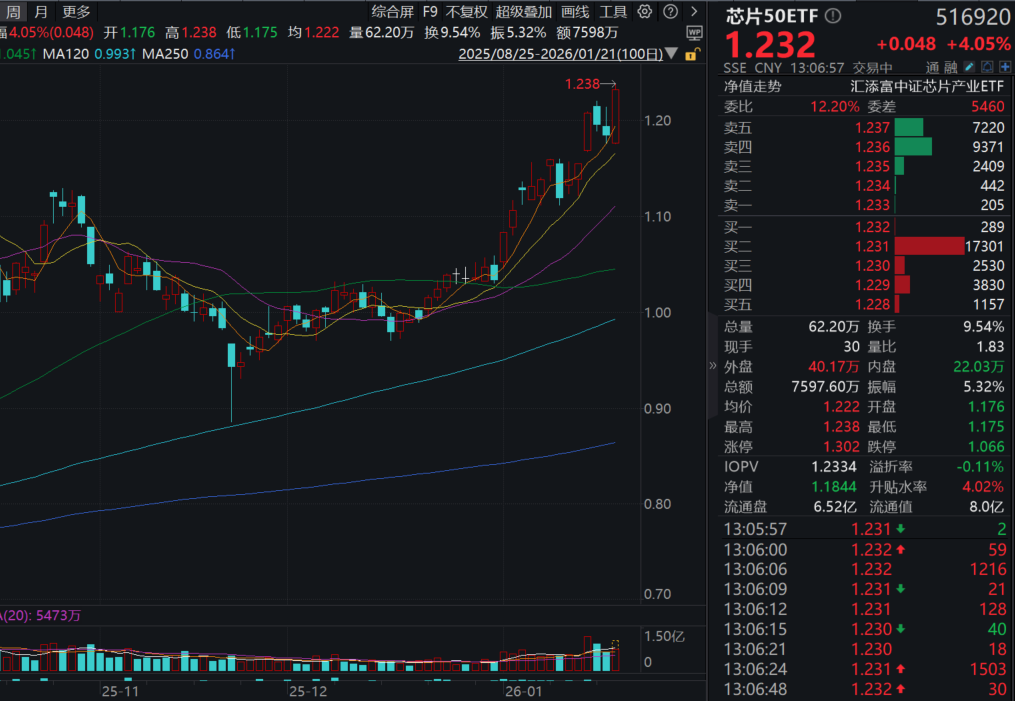
AI驱动存储芯片结构性短缺,CPU涨价潮将至,新一轮风口来袭!全市场费率最低档的芯片50ETF(516920)放量飙涨超4%!
Xin Lang Cai Jing· 2026-01-21 05:38
Core Viewpoint - The semiconductor sector is experiencing significant growth, with the Chip 50 ETF (516920) seeing a surge of over 4% and attracting substantial capital inflow, indicating strong market interest in semiconductor investments [1][3]. Group 1: Market Performance - The Chip 50 ETF (516920) recorded a trading volume of 80 million yuan, with a total capital inflow of over 38 million yuan in the last two days [1]. - Key stocks within the Chip 50 ETF showed positive performance, with notable increases such as Haiguang Information rising over 16% and Lanke Technology increasing over 11% [3]. Group 2: Supply and Demand Dynamics - Intel and AMD plan to raise server CPU prices by 10%-15% to address supply-demand imbalances and ensure stable future supply, with their server CPU capacity for 2026 already largely pre-sold [3]. - The global demand for storage is structurally increasing, driven by the growth of artificial intelligence, which is significantly underappreciated by the market [3]. Group 3: CPU Importance in AI Era - The importance of CPUs is expected to rise in the AI era, as new computing scenarios demand higher processing speed and accuracy, making CPU innovation a key focus for the computing industry [4][5]. - High-end AI servers typically follow a configuration of "2 high-end CPUs for every 8 GPUs," highlighting the CPU's critical role in system stability and performance [5]. Group 4: Market Trends and Projections - The general server market is recovering, with a projected over 9% year-on-year growth in global server shipments, driven by data center upgrades and the replacement of existing server CPUs [6]. - Cloud vendors are expected to increase capital expenditures to meet AI demand, with global AI server shipments projected to grow over 20% year-on-year by 2026, accounting for 17% of total server shipments [7].





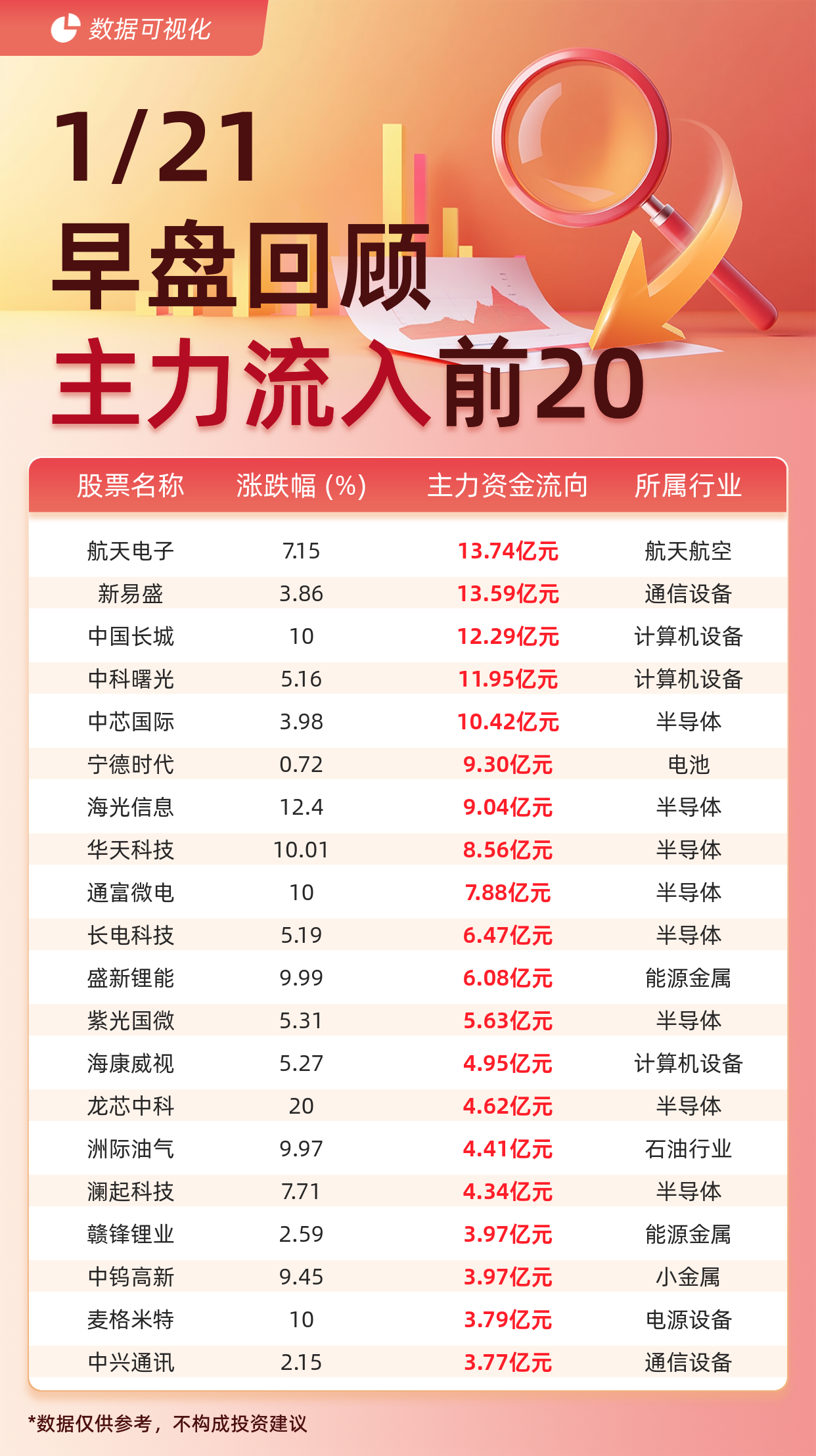
主力资金流入前20:航天电子流入13.74亿元、新易盛流入13.59亿元
Jin Rong Jie· 2026-01-21 04:04
Core Insights - The main focus of the news is on the significant inflow of capital into specific stocks, indicating strong investor interest and potential growth in these companies. Group 1: Stock Performance and Capital Inflow - Aerospace Electronic (航天电子) saw a capital inflow of 1.374 billion yuan with a price increase of 7.15% [1][2] - New Yisheng (新易盛) experienced a capital inflow of 1.359 billion yuan and a price rise of 3.86% [1][2] - China Great Wall (中国长城) had a capital inflow of 1.229 billion yuan, with a notable increase of 10% in its stock price [1][2] - Zhongke Shuguang (中科曙光) attracted 1.195 billion yuan in capital, reflecting a 5.16% increase [1][2] - SMIC (中芯国际) received 1.042 billion yuan with a stock price increase of 3.98% [1][2] - CATL (宁德时代) had a capital inflow of 930 million yuan, with a modest increase of 0.72% [1][2] - Haiguang Information (海光信息) saw a significant capital inflow of 904 million yuan and a price increase of 12.4% [1][3] - Huatian Technology (华天科技) attracted 856 million yuan with a stock price increase of 10.01% [1][3] - Tongfu Microelectronics (通富微电) had a capital inflow of 788 million yuan and a price increase of 10% [1][3] - Changdian Technology (长电科技) received 647 million yuan with a 5.19% increase in stock price [1][3] - Shengxin Lithium Energy (盛新锂能) saw a capital inflow of 608 million yuan and a price increase of 9.99% [1][3] Group 2: Additional Stocks and Their Performance - Unigroup Guowei (紫光国微) had a capital inflow of 563 million yuan with a price increase of 5.31% [3] - Hikvision (海康威视) attracted 495 million yuan with a stock price increase of 5.27% [3] - Loongson Technology (龙芯中科) saw a significant capital inflow of 462 million yuan and a remarkable price increase of 20% [3] - Intercontinental Oil and Gas (洲际油气) had a capital inflow of 441 million yuan with a price increase of 9.97% [3] - Lanke Technology (澜起科技) received 434 million yuan with a stock price increase of 7.71% [3] - Ganfeng Lithium (赣锋锂业) attracted 397 million yuan with a modest price increase of 2.59% [3] - Zhongtung High-tech (中钨高新) saw a capital inflow of 397 million yuan and a price increase of 9.45% [3] - Magpow (麦格米特) had a capital inflow of 379 million yuan with a price increase of 10% [3] - ZTE Corporation (中兴通讯) attracted 377 million yuan with a stock price increase of 2.15% [3]




长电科技盘中创历史新高
Zheng Quan Shi Bao Wang· 2026-01-21 03:36
公司发布的三季报数据显示,前三季度公司共实现营业收入286.69亿元,同比增长14.78%,实现净利润 9.54亿元,同比下降11.39%,基本每股收益为0.5300元,加权平均净资产收益率3.41%。 证券时报·数据宝统计显示,长电科技所属的电子行业,目前整体涨幅为2.69%,行业内,目前股价上涨 的有430只,涨停的有中熔电气、龙芯中科等16只。股价下跌的有56只,跌幅居前的有信维通信、联动 科技、矽电股份等,跌幅分别为7.98%、5.44%、5.41%。 两融数据显示,该股最新(1月20日)两融余额为37.09亿元,其中,融资余额为37.00亿元,近10日增加 4.32亿元,环比增长13.22%。 长电科技股价创出历史新高,截至11:14,该股上涨6.30%,股价报52.61元,成交量1.46亿股,成交金额 74.80亿元,换手率8.16%,该股最新A股总市值达941.41亿元,该股A股流通市值941.41亿元。 (文章来源:证券时报网) ...