
JCET(600584)

Search documents
集成电路ETF(159546)开盘涨0.45%,重仓股寒武纪涨1.67%,中芯国际涨0.23%
Xin Lang Cai Jing· 2026-02-10 01:36
Group 1 - The Integrated Circuit ETF (159546) opened with a gain of 0.45%, priced at 2.023 yuan [1] - Key stocks in the ETF include: Cambrian rising by 1.67%, SMIC increasing by 0.23%, Haiguang Information up by 1.90%, while Zhaoyi Innovation fell by 2.00% and Lanke Technology decreased by 0.55% [1] - The ETF's performance benchmark is the CSI All Share Integrated Circuit Index return, managed by Guotai Fund Management Company, with a return of 101.55% since its establishment on October 11, 2023, and a 0.75% return over the past month [1]




半导体龙头ETF工银(159665)开盘涨1.82%,重仓股中芯国际涨1.86%,海光信息涨3.43%
Xin Lang Cai Jing· 2026-02-09 06:49
Group 1 - The core viewpoint of the article highlights the performance of the semiconductor leader ETF, 工银 (159665), which opened with a gain of 1.82% at 1.954 yuan [1] - The top holdings of the ETF include companies such as 中芯国际, 海光信息, and 澜起科技, with respective opening gains of 1.86%, 3.43%, and 4.49% [1] - The ETF's performance benchmark is the 国证半导体芯片指数, managed by 工银瑞信基金管理有限公司, with a return of 91.91% since its inception on December 22, 2022, and a 0.17% return over the past month [1]


A股半导体股集体走强,摩尔线程、天岳先进、寒武纪涨超5%
Jin Rong Jie· 2026-02-09 03:45
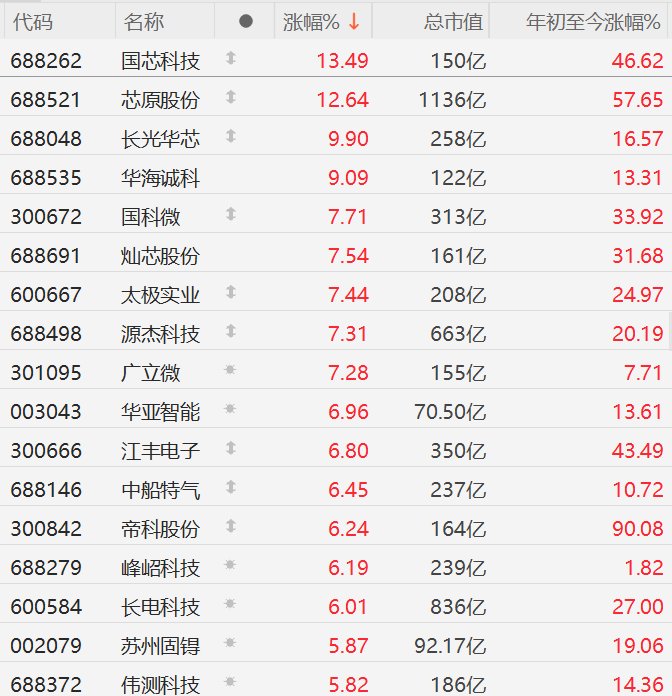
Core Viewpoint - The A-share market has seen a significant rally in semiconductor stocks, indicating strong investor interest and potential growth in this sector [1] Group 1: Stock Performance - Guoxin Technology has increased by over 13% [1] - Xinyuan Technology has risen by more than 12% [1] - Changguang Huaxin and Huahai Chengke have both gained over 9% [1] - Guoke Microelectronics, Canxin Technology, Taiji Industry, Yuanjie Technology, and Guangliwei have all seen increases of over 7% [1] - Huaya Intelligent, Jiangfeng Electronics, China Shipbuilding Industry, Dike Co., Changdian Technology have all risen by over 6% [1] - Moer Thread, Tianyue Advanced, Zhaoyi Innovation, and Cambrian have all increased by over 5% [1]




半导体股集体走强,摩尔线程、天岳先进、寒武纪涨超5%
Ge Long Hui· 2026-02-09 03:26
Group 1 - The A-share semiconductor market is experiencing a collective surge, with notable stocks such as Guoxin Technology rising over 13% and Xinyuan shares increasing by more than 12% [1] - The semiconductor industry is projected to reach a revenue of $1 trillion for the first time this year, driven by the widespread application of artificial intelligence and computer chips across various economic sectors [1] - The Semiconductor Industry Association (SIA) forecasts that total sales in the semiconductor industry will reach $791.7 billion by 2025, with a further 26% growth expected in 2026 [1] Group 2 - SIA CEO John Neuffer stated that the speed at which the semiconductor market is surpassing the $1 trillion mark is much faster than anticipated, which is a positive sign for the entire business world [1] - The significant demand for new data center computers is generating substantial profits for companies like NVIDIA and Micron Technology, allowing the industry to consistently exceed growth expectations [1] - Previous forecasts suggested that it would take an additional four years for the industry to reach the $1 trillion scale, indicating a remarkable acceleration in growth [1]

A股异动丨半导体股集体走强,摩尔线程、天岳先进、寒武纪涨超5%
Ge Long Hui A P P· 2026-02-09 03:24
Group 1 - The semiconductor sector in the A-share market has shown significant strength, with notable stock increases such as Guoxin Technology rising over 13% and Xinyuan shares increasing over 12% [1] - The semiconductor industry is projected to reach a revenue of $1 trillion this year, driven by the widespread application of artificial intelligence and computer chips across various economic sectors [1] - The Semiconductor Industry Association (SIA) forecasts that total sales in the semiconductor industry will reach $791.7 billion by 2025, with a further 26% growth expected in 2026 [1] Group 2 - SIA CEO John Neuffer stated that the semiconductor market's rapid growth to surpass the $1 trillion mark is a positive sign for the entire business world, with demand for new data center computers significantly benefiting companies like NVIDIA and Micron Technology [1] - Previous forecasts suggested that it would take an additional four years for the industry to reach the $1 trillion scale, indicating a faster-than-expected growth trajectory [1]
最新!长电、通富、华天同步调整华进半导体持股!
是说芯语· 2026-02-08 10:27
Core Viewpoint - The recent adjustment of shareholding ratios by major players in the domestic semiconductor packaging and testing industry, namely Changdian Technology, Tongfu Microelectronics, and Huada Semiconductor, aims to optimize the equity structure of Huajin Semiconductor, enhancing its technological research and development capabilities and driving high-quality industry growth [1][13]. Shareholding Changes - The shareholding ratio of Changdian Technology, Tongfu Microelectronics, and Huada Semiconductor in Huajin Semiconductor has been reduced from approximately 4.325% to 2.747% [1]. - Other notable shareholders include Beijing Zhongke Micro Investment Management Co., Ltd. and Wuxi Guochuang Chip Investment Management Partnership, which also experienced changes in their shareholding percentages [4][14]. Company Background - Huajin Semiconductor was established in 2012 as a collaborative effort among leading packaging and testing companies and research institutions, with a registered capital of 462.4682 million yuan [14]. - The company focuses on advanced packaging technologies such as TSV, 2.5D/3D, and Chiplet, and plays a crucial role in key technology breakthroughs and standard formulation within the industry [14][16]. Technological Capabilities - Huajin Semiconductor has built a leading semiconductor packaging and testing research center in China, with a team of nearly 100 researchers, over half of whom hold doctoral or master's degrees [16]. - The company has applied for over 1,300 patents, ranking among the top globally in the number of patents related to 2.5D/3D packaging and TSV technologies [16].



算力需求强劲,关注CPO等新技术演进
Orient Securities· 2026-02-07 09:53
Investment Rating - The report maintains a "Positive" investment rating for the electronic industry, indicating an expectation of returns stronger than the market benchmark by over 5% [5]. Core Insights - Strong demand for computing power driven by AI applications is expected to continue, with significant investments from major cloud providers [8]. - The hardware supply-demand imbalance is spreading across various sectors, leading to price increases [8]. - New technologies such as CPO (Co-Packaged Optics) are anticipated to create additional demand [8]. Summary by Sections Investment Recommendations and Targets - Key investment targets include: - Semiconductor manufacturing: SMIC (688981, Buy), Hua Hong Semiconductor (01347, Buy) - Testing and packaging: Changdian Technology (600584, Buy), Tongfu Microelectronics (002156, Buy), and others [9]. - Server storage: Lianqi Technology (688008, Buy) - CPUs: Haiguang Information (688041, Buy), Longxin Technology (688047, Not Rated), and others [9]. - Passive components: Sanhua Group (300408, Buy), Fenghua Advanced Technology (000636, Not Rated) [9]. - Server manufacturing: Industrial Fulian (601138, Buy), Huaqin Technology (603296, Buy) [9]. - Analog and power chips: Naxin Micro (688052, Buy), Sierui Technology (688536, Not Rated), and others [9]. - Semiconductor equipment: Zhongwei Company (688012, Buy), Northern Huachuang (002371, Buy), and others [9]. - Optical devices/chips: Zhishang Technology (301486, Not Rated), Tianfu Communication (300394, Not Rated), and others [9]. AI Applications and Edge Computing - Key targets in edge AI applications include: - AI main control chips: Amlogic (688099, Buy), Hengxuan Technology (688608, Buy) - Edge storage: Zhaoyi Innovation (603986, Buy), Bawei Storage (688525, Buy) [10]. - Terminal manufacturers: Hikvision (002415, Buy), Luxshare Precision (002475, Buy), BYD Electronics (00285, Not Rated), and others [10]. - Core components for AI edge: Huanxu Electronics (601231, Buy), Sunny Optical Technology (02382, Buy), and others [10].




半导体ETF(159813)开盘跌1.34%,重仓股中芯国际跌1.48%,海光信息跌1.00%
Xin Lang Cai Jing· 2026-02-06 05:40
Group 1 - The semiconductor ETF (159813) opened down 1.34% at 1.182 yuan on February 6 [1] - Major holdings in the semiconductor ETF experienced declines, including SMIC down 1.48%, Haiguang Information down 1.00%, and Cambrian down 1.49% [1] - The performance benchmark for the semiconductor ETF is the National Securities Semiconductor Chip Index return rate, managed by Penghua Fund Management Co., Ltd. [1] Group 2 - Since its establishment on April 17, 2020, the semiconductor ETF has returned 79.62%, with a return of 3.35% over the past month [1]
韩国股市上涨6.8%!DRAM暴涨95%,三星收缩产能,存储芯片涨价潮最强确定性逻辑还要持续多久?
Xin Lang Cai Jing· 2026-02-03 12:52
Group 1 - Northern Huachuang is a leading domestic semiconductor equipment manufacturer, covering core process equipment such as etching machines, thin film deposition equipment, and cleaning machines, which are essential for memory chip manufacturing [1] - The company is expected to benefit from the growth in equipment orders driven by the expansion and technological upgrades of domestic memory manufacturers during the memory chip price increase cycle [1] - Northern Huachuang has made breakthroughs in advanced process equipment for 3D NAND and HBM, establishing a core competitive advantage in the global memory equipment market [1] Group 2 - Hua Hong Semiconductor is a leading domestic specialty process manufacturer with mature memory chip foundry capabilities, focusing on NOR Flash, eMMC, and SPI NAND [2] - The company is expected to benefit from the rising demand for memory chip foundry services as domestic memory manufacturers expand production [2] - Hua Hong's layout in automotive-grade memory chip foundry will further enhance its resilience against economic cycles [2] Group 3 - Zhongwei Company is a core supplier of etching equipment, with its 5nm etching machine already integrated into the supply chain of memory manufacturers [3] - The demand for high-end equipment is expected to grow due to the trend of upgrading memory chips to advanced processes like 3D NAND and HBM [3] - Zhongwei's layout in thin film deposition equipment enhances its service capabilities for memory manufacturers [3] Group 4 - Lanke Technology is a global leader in memory interface chips, with its products widely used in servers and PCs, holding a leading share in the DDR5 interface chip market [4] - The demand for DDR5 interface chips is expected to surge due to the explosion in AI server and high-end PC demand during the memory chip price increase cycle [4] - Lanke's breakthroughs in HBM interface chips will further open up growth opportunities [4] Group 5 - GigaDevice is a leading domestic memory chip design company, focusing on NOR Flash while also expanding into NAND Flash and DRAM [5] - The company is expected to benefit from the price increase of NOR Flash products driven by the recovery of consumer electronics and AI terminal demand [5] - GigaDevice's layout in automotive-grade memory chips will further expand its downstream application space [5] Group 6 - Shengyi Technology is a leading domestic copper-clad laminate manufacturer, with its products being core raw materials for memory chip packaging [6][7] - The growth in demand for copper-clad laminates is expected to be driven by the expansion of memory manufacturers and the increase in packaging needs during the memory chip price increase cycle [6][7] - Shengyi's breakthroughs in high-frequency and high-speed copper-clad laminates will adapt to the upgrade demands of memory chips [6][7] Group 7 - Shenzhen South Circuit is a leading domestic PCB manufacturer, with its high-end PCB products being core carriers for storage servers and modules [8] - The demand for high-end PCBs is expected to grow due to the explosion in AI server demand and the expansion of memory manufacturers during the memory chip price increase cycle [8] - Shenzhen South Circuit's layout in storage packaging substrates further enhances its position in the memory industry chain [8] Group 8 - Jiangbolong is a leading domestic storage module manufacturer, focusing on the development and manufacturing of storage modules for various applications [9] - The company is expected to benefit from the recovery in consumer electronics and the explosion of AI terminal demand during the memory chip price increase cycle [9] - Jiangbolong's layout in automotive-grade storage modules will further open up downstream application spaces [9] Group 9 - Xi'an Yicai is a core enterprise in semiconductor materials, focusing on silicon-based materials essential for memory chip manufacturing [10] - The demand for silicon-based materials is expected to grow due to the expansion and technological upgrades of memory manufacturers during the memory chip price increase cycle [10] - Xi'an Yicai's breakthroughs in 300mm large silicon wafers will adapt to the advanced process needs of domestic storage [10] Group 10 - Tuojing Technology is a leading domestic thin film deposition equipment manufacturer, with its PECVD and ALD equipment being core process equipment for memory chip manufacturing [11] - The demand for equipment orders is expected to grow due to the expansion of memory manufacturers and the upgrade of 3D NAND technology during the memory chip price increase cycle [11] - Tuojing's layout in HBM-related equipment will further adapt to the upgrade demands driven by AI [11] Group 11 - Maiwei Co. is a core domestic semiconductor equipment enterprise, with its equipment already integrated into the supply chain of leading domestic memory manufacturers [12] - The growth in equipment orders is expected to be driven by the expansion of memory manufacturers and the increase in advanced packaging demand during the memory chip price increase cycle [12] - Maiwei's breakthroughs in HBM packaging equipment will adapt to the upgrade demands driven by AI [12] Group 12 - Shengmei Shanghai is a leading domestic semiconductor cleaning equipment manufacturer, with its single-wafer cleaning equipment integrated into the supply chain of leading memory manufacturers [13] - The demand for cleaning equipment is expected to grow due to the expansion of memory manufacturers and the upgrade of advanced processes during the memory chip price increase cycle [13] - Shengmei's breakthroughs in 3D NAND cleaning technology will adapt to the technical iteration needs of memory chips [13] Group 13 - Changdian Technology is a leading domestic packaging and testing enterprise, covering the packaging and testing of various memory chip types [14] - The growth in packaging orders is expected to be driven by the price increase of memory chips during the memory chip price increase cycle [14] - Changdian's breakthroughs in advanced packaging will adapt to the needs of high-end memory chips [14] Group 14 - Changchuan Technology is a leading domestic semiconductor testing equipment manufacturer, with its testing equipment covering memory and logic chips [15] - The demand for testing equipment is expected to grow due to the expansion of memory manufacturers and the upgrade of advanced processes during the memory chip price increase cycle [15] - Changchuan's breakthroughs in DDR5 and HBM testing technologies will adapt to the upgrade demands driven by AI [15] Group 15 - Baiwei Storage is a leading domestic storage chip design and module manufacturer, focusing on various storage modules for different applications [16] - The company is expected to benefit from the recovery in consumer electronics and the explosion of AI terminal demand during the memory chip price increase cycle [16] - Baiwei's layout in automotive-grade storage will further open up downstream application spaces [16] Group 16 - China Resources Microelectronics is a leading domestic power semiconductor and storage chip manufacturer, focusing on NOR Flash and eMMC [17] - The company is expected to benefit from the recovery in consumer electronics and industrial control demand during the memory chip price increase cycle [17] - China Resources' layout in automotive-grade storage chips will enhance its resilience against economic cycles [17] Group 17 - Tongfu Microelectronics is a core domestic packaging enterprise, covering the packaging of various memory chip types [18] - The growth in packaging orders is expected to be driven by the price increase of memory chips during the memory chip price increase cycle [18] - Tongfu's breakthroughs in advanced packaging will adapt to the needs of high-end memory chips [18] Group 18 - Yitang Co. is a core domestic semiconductor equipment enterprise, focusing on thin film deposition and rapid thermal processing equipment [19] - The demand for equipment orders is expected to grow due to the expansion of memory manufacturers and the upgrade of advanced processes during the memory chip price increase cycle [19] - Yitang's breakthroughs in 3D NAND-related equipment will adapt to the technical iteration needs of memory chips [19] Group 19 - Jingsheng Mechanical and Electrical is a leading domestic semiconductor silicon wafer equipment manufacturer, with its equipment integrated into the supply chain of leading memory manufacturers [20] - The demand for equipment orders is expected to grow due to the expansion of memory manufacturers and the increase in silicon wafer demand during the memory chip price increase cycle [20] - Jingsheng's breakthroughs in 300mm large silicon wafer equipment will adapt to the advanced process needs of domestic storage [20] Group 20 - Xichuang Data is a leading domestic storage module and smart terminal manufacturer, focusing on various storage modules for different applications [21] - The company is expected to benefit from the recovery in consumer electronics and the explosion of AI terminal demand during the memory chip price increase cycle [21] - Xichuang's layout in automotive-grade storage will further open up downstream application spaces [21] Group 21 - Shannon Chip is a leading domestic storage chip distribution and solution provider, focusing on distribution and technical services for storage chips [22] - The growth in distribution revenue is expected to be driven by the price increase of memory chips during the memory chip price increase cycle [22] - Shannon's layout in storage module solutions will enhance customer stickiness [22] Group 22 - Hushi Silicon Industry is a leading domestic semiconductor silicon wafer manufacturer, covering various specifications essential for memory chip manufacturing [23] - The demand for silicon wafers is expected to grow due to the expansion and technological upgrades of memory manufacturers during the memory chip price increase cycle [23] - Hushi's breakthroughs in 300mm large silicon wafers will adapt to the advanced process needs of domestic storage [23] Group 23 - Unisoc is a leading domestic security chip and storage chip manufacturer, focusing on eMMC and UFS [24] - The company is expected to benefit from the recovery in consumer electronics and the growth in security storage demand during the memory chip price increase cycle [24] - Unisoc's layout in automotive-grade storage chips will enhance its resilience against economic cycles [24] Group 24 - Fudan Microelectronics is a leading domestic FPGA and storage chip manufacturer, covering various storage chip types [25] - The growth in demand for storage products is expected to be driven by the increase in industrial control demand and the acceleration of domestic substitution during the memory chip price increase cycle [25] - Fudan's layout in automotive-grade storage chips will further open up downstream application spaces [25] Group 25 - Zhongke Feicai is a leading domestic semiconductor testing equipment manufacturer, covering testing equipment for memory and logic chips [26] - The demand for testing equipment is expected to grow due to the expansion of memory manufacturers and the upgrade of advanced processes during the memory chip price increase cycle [26] - Zhongke's breakthroughs in 3D NAND testing technology will adapt to the technical iteration needs of memory chips [26] Group 26 - Huahai Qingke is a leading domestic chemical mechanical polishing (CMP) equipment manufacturer, with its CMP equipment integrated into the supply chain of leading memory manufacturers [27] - The demand for CMP equipment is expected to grow due to the expansion of memory manufacturers and the upgrade of advanced processes during the memory chip price increase cycle [27] - Huahai's breakthroughs in 3D NAND polishing technology will adapt to the technical iteration needs of memory chips [27]



先进封装龙头积极抢滩布局,产业进入“扩产+提价”新阶段 | 投研报告
Zhong Guo Neng Yuan Wang· 2026-02-03 09:50
Core Insights - The semiconductor industry is experiencing a surge in demand for AI chips, leading to price increases of 5-20% by companies like ASE, while Taiwanese firms such as Powertech and Nan Ya are also raising prices by up to 30% due to full order books and near-capacity production [1][3] - TSMC has significantly raised its capital expenditure guidance for 2026 to between $52 billion and $56 billion, a 36.9% increase from 2025, with 10-20% allocated to advanced packaging and testing [2] - The demand for advanced packaging is expected to grow, with major companies like Changdian Technology and Tongfu Microelectronics actively expanding their production capacities to meet this demand [2][3] Industry Developments - The semiconductor packaging industry is seeing structural demand growth, particularly for AI and storage chips, which is tightening the capacity for standard storage chip packaging [3] - Rising prices of raw materials such as gold, silver, and copper are contributing to increased packaging costs, prompting packaging companies to raise prices to maintain profitability [3] - Companies are focusing on high-margin businesses and optimizing product structures in response to the favorable market conditions [3] Investment Recommendations - Investors are advised to focus on domestic companies actively investing in high-end advanced packaging, such as Changdian Technology and Tongfu Microelectronics, as well as the IPO progress of Shenghe Microelectronics [4] - Beneficiary stocks include Yongxi Electronics, Huatian Technology, Shenzhen Technology, and Huicheng Co., among others [4] - Equipment and materials beneficiaries include companies like Changchuan Technology, Jingzhida, and ASMPT, which are positioned to gain from the industry's growth [4]

