Yonyou(600588)

Search documents
用友网络: 用友网络关于股份回购实施结果暨股份变动的公告
Zheng Quan Zhi Xing· 2025-09-04 16:21
Core Viewpoint - The announcement details the share repurchase results of Yongyou Network Technology Co., Ltd., indicating a total repurchase of 4,144,090 shares, which represents 0.121% of the total share capital, with a total expenditure of approximately 50.06 million yuan [1]. Summary by Sections Share Repurchase Plan - The share repurchase plan was first disclosed on September 5, 2024, with a planned expenditure between 50 million yuan and 100 million yuan, and a maximum repurchase price of 23 yuan per share [1]. - The repurchase is intended for employee stock ownership plans or equity incentives [1]. Implementation of the Repurchase - The company began the repurchase on September 27, 2024, and completed it by September 4, 2025, with the actual repurchase price ranging from 9.87 yuan to 18.44 yuan per share [1]. - The total amount spent on the repurchase was 50,062,199 yuan, excluding transaction fees [1]. - The repurchase was conducted in compliance with relevant laws and regulations, and the execution matched the originally disclosed plan [1]. Shareholder Transactions - During the repurchase period, there were no stock transactions by the company's controlling shareholders, actual controllers, directors, or senior management [1]. Share Changes - Before the repurchase, the total shares were 3,418,521,359, with 1,523,950 restricted shares and 3,416,997,409 unrestricted shares. After the repurchase, the total shares remained the same, but the number of restricted shares was adjusted due to the cancellation of 1,523,950 restricted shares [1]. Handling of Repurchased Shares - The repurchased shares will be stored in a dedicated account and are intended for employee stock ownership plans or equity incentives. If not utilized within 36 months, the unutilized shares will be canceled [1].


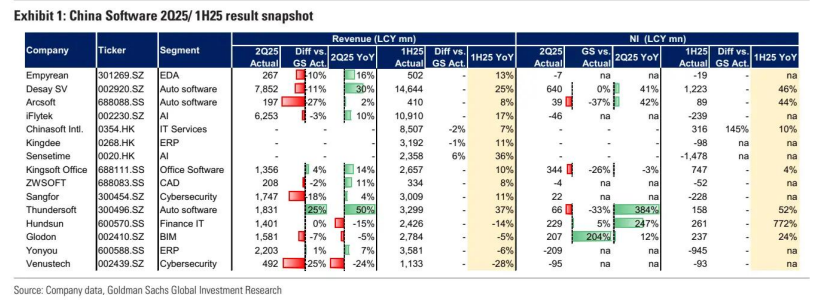
高盛最新报告:中国软件业 2025 年 AI 变现提速!用友等 14 家企业全梳理
Zhi Tong Cai Jing· 2025-09-04 13:55
Group 1: Overall Performance of China's Software Industry in 2025 - In the first half of 2025, the average revenue of covered Chinese software companies grew by 9% year-on-year, while the average net profit margin was -3% due to seasonal industry weakness [1] - Notable outperformers included Kingsoft Office, Thundersoft, and Sensetime, driven by increased AI investments, while Glodon and Sangfor saw improved net profit performance in Q2 2025 due to enhanced employee productivity [1] Group 2: Industry Outlook - ERP suppliers like Yonyou and Kingdee, along with AI providers such as Sensetime and iFlytek, are optimistic about revenue growth in the second half of 2025, driven by rising demand for AI functionalities and the proliferation of cloud platforms [2] Group 3: Strategic Focus Areas - Companies are focusing on three strategic directions: monetizing AI tools, diversifying into overseas markets or new business areas, and integrating AI with core software products to enhance customer willingness to pay and market share [3] Group 4: Valuation Levels - As of the report's release, the average P/E ratio for Chinese software companies rose to 55-60 times, with an average EV/Sales ratio of 8-9 times, although these remain below the 12-18 times levels seen in 2020-2021 [4] - Goldman Sachs believes there is further upside potential for valuations as AI-related revenues grow and companies transition to subscription-based models [5] Group 5: Key Software Companies Performance and Valuation Analysis - Yonyou's revenue for 2025 is projected at 22.03 billion RMB, a 7% increase, with a narrowed net loss of 2.09 billion RMB, driven by growth in SMB business and recovery in large client demand [6][7] - Glodon's revenue is expected to decline by 5% in 2025, primarily due to challenges in the construction cost software business, although net profit margin improved to 13% in Q2 2025 [10] - Thundersoft's revenue is projected to reach 1.831 billion RMB in 2025, a 50% increase, with a significant contribution from AIoT business, despite a decline in overall gross margin [18][19] Group 6: Other Key Company Summaries - ZWSOFT is expected to generate 208 million RMB in revenue in 2025, with a focus on low-margin solutions [26] - Sangfor's revenue is projected at 1.747 billion RMB, with a 4% year-on-year increase, benefiting from cloud computing growth [26] - Kingdee's revenue for the first half of 2025 is expected to be 3.192 billion RMB, driven by cloud business and AI functionalities [26] - Empyrean's revenue is projected at 267 million RMB, with a 13% year-on-year increase, supported by AI-driven demand in chip design [26]


用友网络:公司完成回购
Zheng Quan Ri Bao· 2025-09-04 12:41
证券日报网讯 9月4日晚间,用友网络发布公告称,截至2025年9月4日,回购期限已届满,公司完成回 购,公司股份回购专用证券账户通过集中竞价交易方式已实际回购公司股份数量为4,144,090股,占 公司总股本的比例为0.121%。 (文章来源:证券日报) ...
用友网络(600588) - 用友网络关于股份回购实施结果暨股份变动的公告
2025-09-04 10:32
证券代码:600588 证券简称:用友网络 公告编号:2025-073 用友网络科技股份有限公司 关于股份回购实施结果暨股份变动的公告 (二)截至 2025 年 9 月 4 日,回购期限已届满,公司完成回购,公司股份回 购专用证券账户通过集中竞价交易方式已实际回购公司股份数量为 4,144,090 股, 占公司总股本的比例为 0.121%,购买的最高价为 18.44 元/股,最低价为 9.87 元/ 股,使用资金总额为 50,062,199 元(不含佣金等交易费用)。 (三)本次股份回购过程中,公司严格按照相关法律、法规的规定回购股份, 符合《上海证券交易所上市公司自律监管指引第 7 号——回购股份》的规定及公 司回购方案的内容,回购方案实际执行情况与原披露的回购方案不存在差异,公 司已按披露的方案完成回购。 (四)公司本次回购股份所使用的资金为公司自有资金和银行专项回购贷款, 本次回购事项不会对公司的经营、盈利能力、财务、研发、债务履行能力和未来 发展产生重大影响,不会导致公司控制权发生变化,也不会改变公司的上市公司 地位,股权分布情况仍然符合上市条件。 三、 回购期间相关主体买卖股票情况 本公司董事会及全 ...
用友网络(600588.SH):已实际回购5006.22万元公司股份
Ge Long Hui A P P· 2025-09-04 10:14
Group 1 - The company, Yongyou Network (600588.SH), has completed its share repurchase program as of September 4, 2025 [1] - A total of 4.1441 million shares were repurchased, representing 0.121% of the company's total share capital [1] - The highest purchase price was 18.44 CNY per share, while the lowest was 9.87 CNY per share, with a total expenditure of 50.0622 million CNY (excluding transaction fees) [1]
研报掘金丨太平洋:维持用友网络“买入”评级,Q2收入恢复增长,AI产品化收入取得进展
Ge Long Hui A P P· 2025-09-04 07:54
Core Viewpoint - Pacific Securities report indicates that Yonyou Network's revenue for the first half of the year was 3.581 billion yuan, a year-on-year decrease of 5.9%, with a net profit attributable to shareholders of -949.5 million yuan [1] Financial Performance - In the second quarter, the company's revenue recovered to 2.203 billion yuan, representing a year-on-year growth of 7.1% [1] - The total number of employees at the end of the reporting period was 19,105, a decrease of 2,178 from the beginning of 2025 [1] Customer and Product Development - The cumulative number of paid customers for the company's cloud services reached 954,800, with an addition of 82,300 new paid customers [1] - The company launched a new generation of Yonyou BIP intelligent platform, which seamlessly integrates with over 4,000 enterprise-level application APIs, enabling businesses to build an enterprise-level intelligent system in 10 minutes [1] - The data platform has significantly enhanced the level of intelligent applications, with the development of platforms such as ChatBI and DataAgent [1] Future Outlook - The company is currently focusing on exploring AI technologies [1] - EPS forecasts for 2025-2027 are projected to be -0.12, 0.05, and 0.13 yuan respectively, maintaining a "buy" rating [1]
用友网络股价连续4天下跌累计跌幅10.72%,国泰基金旗下1只基金持326.94万股,浮亏损失585.22万元
Xin Lang Cai Jing· 2025-09-03 07:53
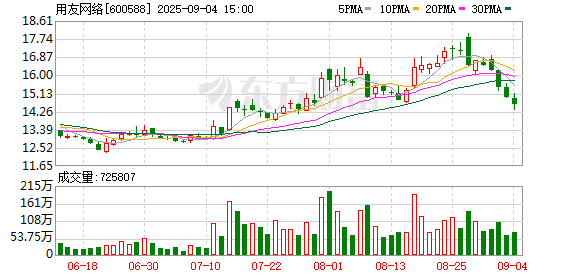
Group 1 - The core viewpoint of the news is that Yongyou Network has experienced a significant decline in stock price, dropping 3.37% on September 3, with a cumulative decline of 10.72% over four consecutive days [1] - As of the report, Yongyou Network's stock price is at 14.92 yuan per share, with a trading volume of 9.48 billion yuan and a turnover rate of 1.82%, resulting in a total market capitalization of 509.82 billion yuan [1] - Yongyou Network, established on January 18, 1995, and listed on May 18, 2001, primarily focuses on providing enterprise cloud services and solutions, with revenue composition including technical services and training (61.11%), product licensing (31.41%), and others (4.50% and 2.98%) [1] Group 2 - From the perspective of major fund holdings, one fund under Guotai Fund has heavily invested in Yongyou Network, specifically the Guotai CSI Software ETF (515230), which increased its holdings by 12,300 shares in the second quarter, totaling 3.2694 million shares, accounting for 3% of the fund's net value [2] - The estimated floating loss for the fund today is approximately 1.7001 million yuan, with a total floating loss of 5.8522 million yuan during the four-day decline [2] - The Guotai CSI Software ETF (515230) was established on February 3, 2021, with a current scale of 1.457 billion yuan, achieving a year-to-date return of 25.47% and a one-year return of 101.54% [2]
用友网络跌4.93% 某券商维持增持评级话音刚落
Zhong Guo Jing Ji Wang· 2025-09-02 09:21
某券商9月1日发布研报《用友网络:二季度业绩拐点已现BIPAI实现规模化落地》称,维持用友网络"增 持"评级。 中国经济网北京9月2日讯用友网络(600588)(600588.SH)今日收报15.44元,跌幅4.93%。 ...
用友网络股价跌5.05%,合煦智远基金旗下1只基金重仓,持有17.03万股浮亏损失13.96万元
Xin Lang Cai Jing· 2025-09-02 07:04
Group 1 - The core point of the news is that Yongyou Network's stock price dropped by 5.05% to 15.42 CNY per share, with a trading volume of 1.24 billion CNY and a turnover rate of 2.30%, resulting in a total market capitalization of 52.69 billion CNY [1] - Yongyou Network Technology Co., Ltd. is based in Haidian District, Beijing, and was established on January 18, 1995, with its listing date on May 18, 2001. The company focuses on providing enterprise cloud services and solutions, with its main business revenue composition being: technical services and training (61.11%), product licensing (31.41%), and others (4.50%) [1] Group 2 - From the perspective of major fund holdings, the He Xu Zhi Yuan Fund has one fund heavily invested in Yongyou Network. The He Xu Zhi Yuan Financial Technology Index (LOF) A (168701) reduced its holdings by 31,000 shares in the second quarter, holding a total of 170,300 shares, which represents 2.14% of the fund's net value, ranking as the ninth largest holding. The estimated floating loss today is approximately 139,600 CNY [2] - The He Xu Zhi Yuan Financial Technology Index (LOF) A (168701) was established on April 3, 2020, with a latest scale of 57.81 million CNY. Year-to-date returns are 29.7%, ranking 1430 out of 4222 in its category; the one-year return is 99.22%, ranking 275 out of 3781; and the return since inception is 38.16% [2]
板块业绩复苏明显,AI+ 含量逐步提高
2025-09-02 00:42
Summary of Conference Call Records Industry Overview - The computer industry has shown a strong performance in 2025, with a growth rate of 37.42%, outperforming most sectors despite varying market perceptions [1][2] - The total revenue of 399 companies in the computer sector reached 1.04 trillion yuan, a year-on-year increase of 18.32%, while net profit attributable to shareholders grew by 28.13% to 28.413 billion yuan [1][5] Key Companies and Performance - Major companies like Haiguang and Inspur have significantly outperformed the index, contributing to the sector's overall success [3] - The DFC market trend in the first half of the year has propelled the sector index to new highs [3] AI Integration and Trends - AI technology is increasingly integrated, with 87.69% of computer companies mentioning AI in their half-year reports [1][10] - Companies such as Kingsoft Office, Hikvision, and Yonyou have reported AI-related revenues and orders, indicating a trend of investment in AI in the first half of the year, with expected implementation in the second half and significant growth in 2026 [1][6] Government Policy Impact - The State Council's recent opinions on AI development set clear targets for AI application rates by 2027 and 2030, which will accelerate technological innovation and market application among enterprises [9][13] Notable Financial Metrics - Among the 399 companies, 216 reported positive net profit growth, with an overall growth average of 16.51% [5] - The average revenue for these companies was 6.3 billion yuan, with a median of 3.7 billion yuan [5] Future Outlook - The current state is viewed as a bottom phase for AI applications, with strong potential for growth in the application sector, particularly among leading companies [7] - Investors are advised to focus on leading companies in niche markets, such as Kingsoft Office in office software and Hikvision in video surveillance [12][13] Key Takeaways for Investors - Emphasis on the importance of the State Council's AI action plan and its implications for the industry through 2035 [9][13] - Attention should be given to leading companies in their respective segments, as they possess strong competitive advantages [12][13]