
Tianjin Port (600717)

Search documents
中远海运特运拜访天津地区港航单位
Xin Lang Cai Jing· 2026-02-11 10:32
Core Viewpoint - The meetings held by COSCO Shipping Specialized Carriers in Tianjin focused on enhancing collaboration with local maritime authorities and port entities to improve shipping safety, logistics efficiency, and regional economic development [1][2][4][5]. Group 1: Meetings with Tianjin Maritime Bureau - COSCO Shipping Specialized Carriers' General Manager Huang Nan led a meeting with the Tianjin Maritime Bureau to discuss maritime safety regulation, ship operation compliance, regional shipping collaboration, and emergency response mechanisms [1][4]. - Huang expressed gratitude for the support from the Tianjin Maritime Bureau and provided updates on the company's ship safety management and regional business development [1][4]. - Both parties agreed to strengthen cooperation in safety governance, information sharing, and policy coordination to support the coordinated development of the Beijing-Tianjin-Hebei region and marine economy [1][4]. Group 2: Engagements with Tianjin Port Free Trade Zone and Tianjin Port Group - From February 9 to 10, Huang and his team visited the Tianjin Port Free Trade Zone Administrative Committee to discuss logistics system optimization and the integration of port industries [2][5]. - Huang highlighted the company's business layout in specialized cargo transportation and global supply chain services, expressing a willingness to deepen cooperation with the Free Trade Zone [2][5]. - A subsequent meeting with Tianjin Port Group focused on port and shipping synergy, route optimization, and smart logistics collaboration, with both parties agreeing to enhance strategic cooperation to support the construction of the Tianjin Northern International Shipping Hub [2][5].


总投资25.7亿元 京津冀“粮食枢纽”开工
Xin Jing Bao· 2026-02-09 07:48
Core Viewpoint - The Tianjin Port Free Trade Zone is initiating a significant project, the Tianjin Port Modern Grain Logistics Demonstration Park, with a total investment of 2.57 billion yuan, aimed at enhancing grain logistics efficiency in the Beijing-Tianjin-Hebei region [1] Group 1: Project Overview - The project will include the construction of docks, storage facilities, and supporting service buildings, with a grain storage capacity of 300,000 tons upon completion [1] - The project is expected to be completed by the second half of 2028 and will serve as a crucial grain hub for the region [1] - The construction is divided into two parts: the dock and the land area, with plans to complete 220,000 square meters of storage and auxiliary facilities by the end of the year [1] Group 2: Logistics and Operations - The logistics network will allow for grain to be transported by sea to the port, then transferred to silos and processed or transported to external enterprises [1] - Future plans include the construction of a railway line for seamless sea-rail intermodal transport [1] - The project incorporates a "dual-use" design to ensure national food security, allowing for rapid conversion to a strategic reserve in emergencies [2] Group 3: Regional Impact - The Dagu Port area is a key grain import port and storage cluster in northern China, currently having a total grain storage capacity of 2.146 million tons [2] - The multi-modal transport project will enhance the quality and upgrade the port's grain and oil industry, attracting more grain production, processing, and trade enterprises [2] - This development will further solidify Tianjin Port's position as a significant import port for bulk grain [2]
港口行业2026年度信用风险展望(2026年2月):吞吐量增速放缓,基建与内需托底行业基本面
Lian He Zi Xin· 2026-02-06 09:26
Investment Rating - The report indicates a stable outlook for the port industry, with a focus on infrastructure and domestic demand supporting the industry fundamentals [7][8]. Core Insights - The growth rate of cargo and container throughput in Chinese ports is slowing down, influenced by GDP and import-export growth deceleration. Coastal ports dominate in terms of throughput, with significant differentiation in growth rates among major ports [8][9]. - Since 2018, investment in inland waterway transportation has consistently exceeded that of coastal ports, leading to structural overcapacity in coastal ports. However, there remains a demand for terminal upgrades, optimization of port layouts, and channel construction, with a clear trend towards larger and more specialized port berths [8][9]. - The overall revenue of sampled port enterprises is steadily increasing, with strong operational cash flow capabilities. Future capital expenditures are expected to remain substantial due to increased financing driven by port-related project investments [8][9]. - The report anticipates that global economic growth will remain low, with uncertainties surrounding trade policies potentially impacting China's foreign trade. However, domestic demand is expected to expand, providing some support for port throughput [8][9]. Industry Overview Macroeconomic Environment - In 2025, China's economy is projected to stabilize, with domestic demand expected to support cargo throughput at ports. The economic policies are characterized by a multi-dimensional collaborative approach, focusing on stabilizing growth and enhancing domestic consumption [9][10]. - The port industry is highly sensitive to macroeconomic cycles, with the performance of cargo and container throughput closely linked to economic conditions and foreign trade developments [10][11]. Industry Policies and Regulatory Environment - The government has introduced various policies to guide the development of smart, green, safe, and efficient ports, aiming to enhance the competitive capabilities of ports through a market-oriented pricing system [11][12]. - Recent policies emphasize the integration of rail-water transport and the construction of a modern comprehensive transportation system, with significant investments expected in port infrastructure [11][12]. Industry Operating Conditions - The throughput growth of Chinese ports has shown signs of slowing down, with a notable differentiation in growth rates among major coastal ports. In 2024, the total cargo throughput reached 1,759.5 million tons, growing by 3.7% [16][20]. - Container throughput growth has also slowed, with a total of 33.2 million TEUs in 2024, reflecting a 7.0% increase [17][20]. Financial Performance - Sampled port enterprises have shown steady revenue growth, with total revenue reaching 643.36 billion yuan in the first nine months of 2025, maintaining a stable operational performance [34][36]. - The cash flow from operating activities has been strong, with a cash income ratio exceeding 100%, indicating that cash flow can meet capital expenditure needs [36][39]. Debt Levels - The total debt of sampled port enterprises has increased, with a total debt of 1,162.86 billion yuan by September 2025, primarily for new terminal construction and upgrades [41][43]. - The short-term debt ratio is moderate, with a significant portion of financing coming from bank loans and bond issuances [41][43]. Debt Repayment Capacity - Most sampled port enterprises face manageable short-term repayment pressures, with strong long-term repayment capabilities. However, some enterprises have heavier debt burdens and historical personnel liabilities that require attention [44][45]. Bond Market Performance - The report notes a decrease in bond issuance rates for port enterprises, with a total of 180 bonds issued in 2025, reflecting a 7.57% increase in issuance scale [48][49].




9国使节的津门"盲盒":从天津港到泥人张,他们打开了什么?
Xin Lang Cai Jing· 2026-02-05 12:01
Core Viewpoint - Tianjin is emerging as a vital hub for international trade and cultural exchange, particularly with countries like South Korea, Mongolia, and Colombia, showcasing its potential for economic collaboration and cultural integration [1][3][13]. Group 1: Economic Cooperation - The cargo volume from South Korea to Tianjin has been steadily increasing, with the efficiency of the Sino-Korean shipping route doubling [3]. - By 2026, South Korea is expected to remain one of Tianjin's most significant trade partners and sources of foreign investment [3]. - The establishment of direct shipping routes to Latin America has facilitated the import of Colombian coffee and fresh produce, with Colombia becoming the third-largest source of coffee imports for China [7]. Group 2: Cultural Exchange - The "Luban Workshop" in Tianjin serves as a bridge connecting vocational education and international collaboration, with 37 workshops established in 31 countries focusing on high-speed rail and artificial intelligence [5]. - Various cultural activities, such as traditional Chinese performances and hands-on experiences with local crafts, have been highlighted during the visit of foreign diplomats, emphasizing the rich cultural heritage of Tianjin [9][11]. - The visit of diplomats from nine countries reflects a growing interest in cultural and educational exchanges, with plans for future collaborations in various fields [13]. Group 3: Diplomatic Engagement - The presence of diplomats from countries like Mongolia, Greece, and Turkey indicates a strengthening of international relations, with discussions on potential partnerships in vocational education and cultural events [5][13]. - The Turkish ambassador expressed a desire to celebrate the Spring Festival with Chinese friends, highlighting the cultural ties and mutual respect between nations [13]. - The engagement of diplomats in local cultural experiences demonstrates a commitment to fostering deeper connections and understanding between Tianjin and the international community [11][13].


水果快线怎样甜蜜到家
Jing Ji Ri Bao· 2026-02-02 22:13
Core Viewpoint - The article highlights the efficient logistics and supply chain management of cherry imports from Chile to China through Tianjin Port, showcasing the streamlined processes that enhance freshness and reduce delivery times. Group 1: Logistics and Supply Chain Management - Tianjin Port Group has developed a comprehensive organizational support mechanism to ensure the efficient operation of the "Fruit Express" service, covering market business, cargo booking, terminal loading and unloading, and logistics distribution [1][3] - The implementation of the "Five Guarantees and Five Immediate" measures and customized "one ship, one policy" plans has reduced the terminal operation time for a single container of cherries to under 20 minutes, allowing delivery to major markets in the Beijing-Tianjin-Hebei region within 5 hours and covering East China, South China, Northwest, and Northeast regions within 30 hours [1][3] Group 2: Transportation and Handling Process - The transportation process for cherries involves three main steps: hand-picking by farmers, cooling and sorting at packaging facilities, and shipping via direct route to Tianjin Port, which takes approximately 23 days [2] - The Tianjin Dongjiang Free Trade Port Area International Trade Service Co., Ltd. has optimized the sales process for cherries, enabling delivery to consumers within 12 hours after the ship docks, and expanding sales channels to include e-commerce platforms [2] Group 3: Customs and Regulatory Support - Tianjin Customs has established a "green channel" for fresh fruit clearance and introduced an innovative "people wait for containers" supervision model to facilitate smooth customs processes [3] - The Tianjin Maritime Bureau has implemented a refined dynamic schedule for vessels, considering weather forecasts, traffic conditions, and port operation progress to minimize waiting times for ships [3]
天津港集团生产用电场景实现绿电使用全覆盖
Zhong Guo Jing Ji Wang· 2026-02-02 11:37
Core Viewpoint - Tianjin Port Group has made significant progress in green port construction, achieving full coverage of green electricity usage in production scenarios [1] Group 1: Green Electricity Supply - The group has established a comprehensive green electricity supply framework through self-generated power, external introduction of additional capacity, and network expansion [1] - A comprehensive "zero-carbon port area" construction plan is being implemented to promote the layout of internal renewable energy generation facilities, enabling local production and consumption of clean electricity [1] Group 2: Future Development Plans - Tianjin Port Group will continue to deepen the integration of transportation and energy development, focusing on optimizing green electricity supply and expanding application scenarios [1] - The company aims to explore collaborative control paths for energy storage systems, wind and solar power stations, and charging networks to further enhance renewable energy consumption capacity [1]
天津港跌2.07%,成交额6039.93万元,主力资金净流出346.89万元
Xin Lang Cai Jing· 2026-02-02 06:00
Core Viewpoint - Tianjin Port's stock price has experienced fluctuations, with a recent decline of 2.07% and a total market value of 13.689 billion yuan, reflecting mixed investor sentiment and market activity [1]. Financial Performance - For the period from January to September 2025, Tianjin Port reported operating revenue of 9.372 billion yuan, representing a year-on-year growth of 4.34%. However, the net profit attributable to shareholders decreased by 12.65% to 780 million yuan [2]. Stock and Shareholder Information - As of October 31, 2025, the number of shareholders for Tianjin Port was 78,000, a decrease of 1.26% from the previous period. The average number of circulating shares per person increased by 1.28% to 37,102 shares [2]. - The company has distributed a total of 5.133 billion yuan in dividends since its A-share listing, with 819 million yuan distributed over the past three years [3]. Institutional Holdings - As of September 30, 2025, the second-largest circulating shareholder was Hong Kong Central Clearing Limited, holding 46.2223 million shares, a decrease of 14.1118 million shares from the previous period. Other notable shareholders include Southern CSI 1000 ETF and Huaxia CSI 1000 ETF, both of which also saw reductions in their holdings [3]. Business Overview - Tianjin Port, established on September 29, 1982, and listed on June 14, 1996, operates in various sectors including cargo storage, transportation, and logistics services. The main revenue sources are loading and unloading services (59.05%), sales (21.59%), and port logistics (19.66%) [1].
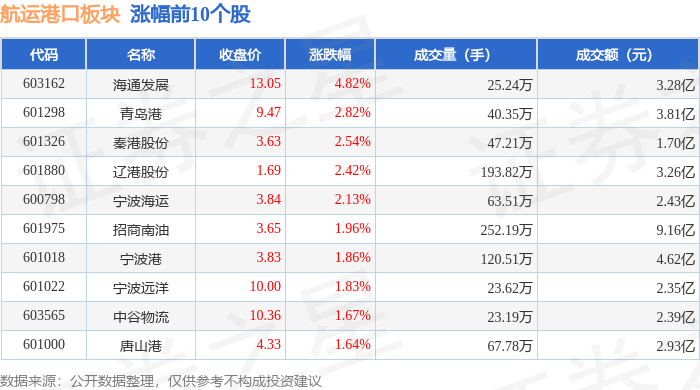
航运港口板块1月28日涨0.59%,海通发展领涨,主力资金净流出4.76亿元
Zheng Xing Xing Ye Ri Bao· 2026-01-28 09:04
Core Insights - The shipping and port sector experienced a rise of 0.59% on January 28, with Haitong Development leading the gains [1] - The Shanghai Composite Index closed at 4151.24, up 0.27%, while the Shenzhen Component Index closed at 14342.9, up 0.09% [1] Stock Performance - Haitong Development (603162) closed at 13.05, up 4.82% with a trading volume of 252,400 shares and a transaction value of 328 million yuan [1] - Qingdao Port (601298) closed at 9.47, up 2.82% with a trading volume of 403,500 shares and a transaction value of 381 million yuan [1] - Qin Port Co. (601326) closed at 3.63, up 2.54% with a trading volume of 472,100 shares and a transaction value of 170 million yuan [1] - Liaoning Port Co. (601880) closed at 1.69, up 2.42% with a trading volume of 1,938,200 shares and a transaction value of 326 million yuan [1] - Ningbo Shipping (600798) closed at 3.84, up 2.13% with a trading volume of 635,100 shares and a transaction value of 243 million yuan [1] Capital Flow - The shipping and port sector saw a net outflow of 476 million yuan from institutional investors, while retail investors contributed a net inflow of 88.99 million yuan [2] - The sector's overall capital flow indicates a mixed sentiment, with institutional investors withdrawing funds while retail investors showed interest [2][3] Individual Stock Capital Flow - Zhonggu Logistics (603565) experienced a net outflow of 41.62 million yuan from institutional investors, while retail investors had a net outflow of 11.08 million yuan [3] - Liaoning Port Co. (601880) saw a net inflow of 34.01 million yuan from institutional investors, indicating strong interest [3] - Haitong Development (603162) had a net inflow of 22.27 million yuan from institutional investors, but a net outflow of 24.31 million yuan from retail investors [3]


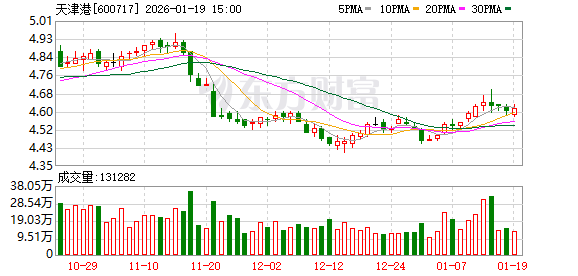
天津港:天津港为港口码头运营商
Zheng Quan Ri Bao· 2026-01-19 12:37
Group 1 - The core viewpoint of the article is that Tianjin Port is primarily engaged in the operation of port terminals, focusing on the loading and unloading of containers and bulk cargo [2] Group 2 - Tianjin Port responded to investor inquiries on an interactive platform, confirming its role as a port terminal operator [2] - The company specializes in handling various types of cargo, including containers and bulk goods [2]
天津港保税区电闪修新能源科技有限公司成立,注册资本500万人民币
Sou Hu Cai Jing· 2026-01-16 02:17
Group 1 - The establishment of Tianjin Port Free Trade Zone Dian Shan Xiu New Energy Technology Co., Ltd. has been registered with a capital of 5 million RMB, fully owned by Xiangyongche (Dalian) New Energy Technology Co., Ltd. [1] - The company is involved in various sectors including emerging energy technology research and development, sales of electric vehicle accessories, and recycling technology research and development [1] - The registered address of the company is located in the Tianjin Free Trade Zone (Airport Economic Zone), indicating a strategic position for business operations [1] Group 2 - The company operates under the legal framework of a limited liability company (sole proprietorship) with a business duration until January 15, 2026, with no fixed term thereafter [1] - The business scope includes a wide range of services such as technical services, energy recovery system research, battery sales, and electric vehicle charging facilities sales [1] - The company is registered with the Tianjin Free Trade Zone Market Supervision Administration, which may provide regulatory advantages for its operations [1]