WINGTECH(600745)

Search documents
荷兰政府突然“冻结”中企子公司,背后推手曝光
Huan Qiu Shi Bao· 2025-10-15 04:18
Core Points - The recent freezing and takeover of Anshi Semiconductor, a subsidiary of China's Wentai Technology, by the Dutch government has sparked significant attention in both Chinese and European media, with analyses suggesting that U.S. pressure is a driving factor behind this event [1][2] - The Dutch court revealed that the U.S. government had informed the Dutch Foreign Ministry in June about impending adjustments to its export control "entity list," which would affect subsidiaries of companies listed on that list if they are more than 50% owned [1] - Wentai Technology was added to the U.S. entity list in 2024, which is believed to have triggered a series of events surrounding Anshi Semiconductor [1] - The U.S. Department of Commerce recently expanded restrictions on "entity list" companies to include their subsidiaries, further complicating the situation for Anshi Semiconductor [1] - Reports indicate that the U.S. suggested that Anshi Semiconductor could obtain an exemption if it replaced its Chinese CEO, Zhang Xuezheng, who is also the founder and chairman of Wentai Technology [1] Company Responses - Wentai Technology issued a statement condemning attempts by certain foreign management to alter Anshi Semiconductor's ownership structure through legal means, asserting that such actions are politically motivated and infringe on shareholder rights [2] - The China Semiconductor Industry Association expressed strong support for Wentai Technology's legal rights and opposed the selective discrimination against Chinese companies under the guise of "national security" [2] - The China-EU Chamber of Commerce criticized the Dutch government's actions as driven by geopolitical calculations and urged the Dutch authorities to reverse their decision and restore a cooperative environment [2]

超3200只个股上涨
第一财经· 2025-10-15 03:54
Market Overview - The Shanghai Composite Index rose by 0.1%, while the Shenzhen Component remained flat, and the ChiNext Index increased by 0.22% [2] - The total trading volume in the Shanghai and Shenzhen markets reached 1.27 trillion, a decrease of 398.5 billion compared to the previous trading day, with over 3,200 stocks rising [3] Sector Performance - The pharmaceutical sector saw a collective rebound, with notable gains in CRO and innovative drug concepts leading the market [2] - Specific sectors such as cell immunotherapy (+2.87%), chemical pharmaceuticals (+2.64%), and innovative drugs (+2.35%) showed significant increases [3] - The technology sector continued to adjust, with declines in photolithography and nuclear fusion concepts, while military and rare earth sectors experienced notable pullbacks [2] Stock Highlights - The stock of Guangda Special Materials opened down over 9% due to the implementation of detention measures against its chairman [11] - The Hong Kong stock market opened strong, with the Hang Seng Technology Index expanding its intraday gains to 2% [5][17] - The new Hong Kong stock Xuan Bamboo Biotechnology-B opened with a remarkable increase of 153.97%, attributed to its development of over ten drug assets [15][16] Economic Indicators - The People's Bank of China conducted a 435 billion yuan reverse repurchase operation with a rate of 1.40%, with no reverse repos maturing today [18] - The onshore RMB against the USD was set at 7.0995, an increase of 26 basis points from the previous trading day [19] - Spot gold prices surpassed $4,180 per ounce, reaching a new historical high [20]


闻泰科技股价涨5.66%,华泰柏瑞基金旗下1只基金重仓,持有42.17万股浮盈赚取89.83万元
Xin Lang Cai Jing· 2025-10-15 03:05
Group 1 - Wentech Technology's stock increased by 5.66%, reaching 39.78 CNY per share, with a trading volume of 6.96 billion CNY and a turnover rate of 15.60%, resulting in a total market capitalization of 49.51 billion CNY [1] - The company, founded on January 11, 1993, and listed on August 28, 1996, is based in Shenzhen, Guangdong Province, and its main business includes real estate development and operation, research and manufacturing of mobile internet devices primarily focused on smartphones, and upstream semiconductor products [1] - The revenue composition of Wentech Technology is as follows: smart terminals account for 69.00%, semiconductor products for 30.88%, and other sources for 0.12% [1] Group 2 - According to data from the top ten holdings of funds, one fund under Huatai-PB has a significant position in Wentech Technology, with a reduction of 30,500 shares in the second quarter, holding 421,700 shares, which represents 4.05% of the fund's net value, making it the seventh-largest holding [2] - The fund, named Intelligent Driving (516520), was established on February 9, 2021, with a current scale of 350 million CNY, and has achieved a year-to-date return of 24.56%, ranking 1991 out of 4220 in its category, and a one-year return of 31.44%, ranking 1468 out of 3857 [2] Group 3 - The fund manager of Intelligent Driving (516520) is Tan Hongxiang, who has been in the position for 4 years and 221 days, managing total assets of 27.34 billion CNY, with the best fund return during his tenure being 105.82% and the worst being -37.2% [3]
荷兰政府突然“冻结”中企子公司,背后推手曝光!
Huan Qiu Shi Bao· 2025-10-15 02:50
Core Points - The recent freezing and takeover of Anshi Semiconductor by the Dutch government has drawn significant attention from both Chinese and European media, with analyses suggesting that U.S. pressure is a driving factor behind the incident [2] - The Amsterdam Court of Appeal revealed that the U.S. government had informed the Dutch Foreign Ministry in June about impending adjustments to its export control "entity list," which would affect subsidiaries of companies listed on the list if they are controlled by U.S. entities [2] - Anshi Semiconductor's parent company, Wentai Technology, was added to the U.S. entity list in 2024, which triggered a series of events leading to the current situation [2] - The U.S. Department of Commerce recently expanded restrictions on "entity list" companies to include their subsidiaries, further complicating the operational landscape for Anshi Semiconductor [2] - Reports indicate that the U.S. proposed that Anshi Semiconductor could receive an exemption if it replaced its Chinese CEO, Zhang Xuezheng, who is also the founder and chairman of Wentai Technology [2] Company Response - Wentai Technology issued a statement condemning the actions of certain foreign management attempting to alter Anshi Semiconductor's ownership structure through legal means, asserting that these actions are politically motivated and infringe upon shareholder rights [3] Industry Reaction - The China Semiconductor Industry Association expressed strong support for Wentai Technology's legal rights and opposed the selective discrimination against Chinese companies abroad under the guise of "national security" [4] - The China-EU Chamber of Commerce criticized the Dutch government's actions as driven by geopolitical calculations, urging the Dutch authorities to reverse their decision and restore a rational and cooperative environment [4] - Bloomberg noted that the Anshi Semiconductor incident, along with the previous case of ASML being pressured to halt advanced chip manufacturing equipment sales to China, highlights the challenges faced by European tech companies amid deteriorating U.S.-China relations [4]

“闻泰们”的焦虑
半导体行业观察· 2025-10-15 02:48
Core Viewpoint - The article discusses the challenges and transformation paths of three major ODM companies in the smartphone industry: Wistron Technology, Huaqin Technology, and Longqi Technology, highlighting their struggles with low profit margins and the need for strategic shifts in a saturated market [1][2][3]. Group 1: Challenges Faced by ODM Giants - ODM companies are positioned in a "sandwich" layer of the supply chain, handling extensive processes from design to manufacturing, but lacking brand power and pricing authority, leading to low profit margins and high leverage [2][3]. - In 2024, Huaqin Technology and Longqi Technology reported net profit margins of 2.65% and 1.06%, respectively, while Wistron Technology faced a negative margin of -3.88% [2][4]. - The smartphone market's saturation and slow growth exacerbate the difficulties faced by ODM companies, with global smartphone sales hitting a low not seen since 2013 [3][4]. Group 2: Financial Performance of ODM Companies - In 2024, Huaqin Technology achieved a revenue of 109.88 billion yuan, a 28.80% increase, with a net profit of 29.30 million yuan, an 8.10% increase. Wistron Technology's revenue was 73.60 billion yuan, with a net loss of 28.33 billion yuan, and Longqi Technology's revenue reached 46.40 billion yuan, with a net profit of 5.01 million yuan [4][5]. - Despite significant revenue growth, the profit margins remain low, with Huaqin's gross margin at 7.4% and Wistron's at 2.49% [6][17]. Group 3: Transformation Strategies - Wistron Technology has divested its ODM business to focus on the semiconductor sector, marking a significant strategic shift in response to declining traditional business performance [10][12]. - Huaqin Technology is pursuing a diversified expansion strategy, aiming to integrate vertically across the supply chain while maintaining its core smartphone business [17][22]. - Longqi Technology is adopting a "1+2+X" strategy, focusing on its core smartphone business while expanding into personal computing and automotive electronics, as well as AIoT [42][43]. Group 4: Future Outlook and Market Positioning - Wistron Technology's shift towards semiconductors has shown promising results, with a significant increase in net profit and a higher revenue contribution from this sector [14][15]. - Huaqin Technology aims to achieve 500 billion yuan in revenue by 2034, indicating ambitious growth targets despite current challenges [32][40]. - Longqi Technology's focus on AI hardware and its strategic partnerships position it well for future growth, with a notable increase in revenue from AIoT products [44].


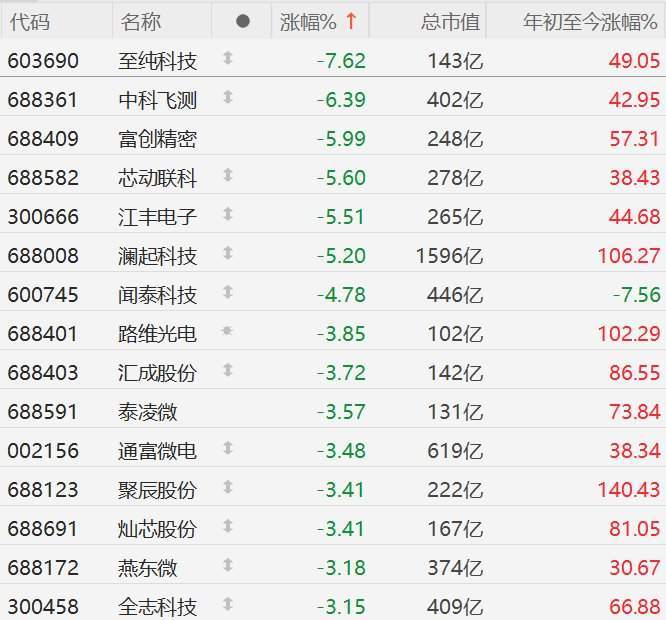
A股市场部分半导体股下跌,至纯科技跌超7%,中科飞测跌超6%,富创精密、芯动联科、江丰电子、澜起科技跌超5%,闻泰科技跌超4%
Ge Long Hui· 2025-10-15 02:08
Group 1 - A-share market sees a decline in several semiconductor stocks, with notable drops including Zhichun Technology down over 7% and Zhongke Feicai down over 6% [1] - Other semiconductor companies experiencing significant declines include Fuchuang Precision, Xindong Link, Jiangfeng Electronics, and Lanke Technology, all down over 5% [1] - Wentai Technology also reported a decline of over 4% [1] Group 2 - Specific stock performance data shows Zhichun Technology down 7.62% with a market cap of 14.3 billion, and Zhongke Feicai down 6.39% with a market cap of 40.2 billion [2] - Fuchuang Precision decreased by 5.99% with a market cap of 24.8 billion, while Xindong Link fell by 5.60% with a market cap of 27.8 billion [2] - Jiangfeng Electronics dropped by 5.51% with a market cap of 26.5 billion, and Lanke Technology decreased by 5.20% with a market cap of 159.6 billion [2]



A股部分半导体股下跌,至纯科技跌超7%
Ge Long Hui· 2025-10-15 02:00
Core Viewpoint - The A-share market has seen a decline in several semiconductor stocks, indicating potential volatility in the sector [1] Group 1: Stock Performance - Zhichun Technology has dropped over 7% [1] - Zhongke Feicai has decreased by more than 6% [1] - Fuchuang Precision, Xindong Link, Jiangfeng Electronics, and Lankai Technology have all fallen by over 5% [1] - Wentai Technology has seen a decline of more than 4% [1]

滚动更新丨A股三大指数小幅高开,贵金属、稀土板块重启涨势
Di Yi Cai Jing Zi Xun· 2025-10-15 01:40
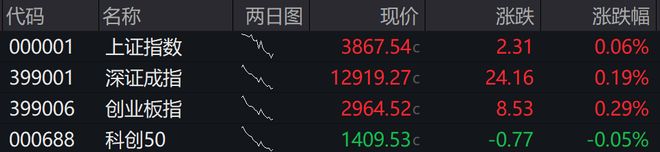
Group 1 - Guangda Special Materials opened down over 9% due to the implementation of detention measures against its actual controller and chairman Xu Weiming [1] - The A-share market opened with slight gains, with the Shanghai Composite Index up 0.06%, Shenzhen Component Index up 0.19%, and ChiNext Index up 0.29% [2][3] - The market saw a resurgence in precious metals and rare earth sectors, while technology stocks continued to adjust, with significant declines in storage chips, photolithography machines, and consumer electronics concepts [3] Group 2 - The Hong Kong stock market opened with the Hang Seng Index up 1.08% and the Hang Seng Tech Index up 1.31%, indicating a stabilization in tech stocks [6][7] - ASMPT rose over 3%, while financial and real estate sectors generally opened higher, with New China Life Insurance up nearly 2% and Midea Real Estate up nearly 4% [6] - Shandong Gold opened down over 5% after disclosing its third-quarter earnings forecast [6]


147亿半导体资产被无理“锁喉”, 闻泰科技的困局和应对
Zhong Guo Jing Ying Bao· 2025-10-15 00:09
Core Viewpoint - Wentech Technology faces significant challenges due to the Dutch government's directive to freeze the operations of its subsidiary, Nexperia, citing national security concerns, leading to a drastic drop in its stock price and market value [2][5][6] Group 1: Company Situation - Wentech Technology's stock price peaked at 171.88 CNY per share in early 2020 after acquiring Nexperia, reaching a market capitalization of over 200 billion CNY, but has since plummeted to 41.83 CNY per share as of October 13, 2023 [2][5] - The Dutch government issued a directive on September 30, 2023, freezing Nexperia's global operations, affecting 30 entities, including subsidiaries and offices, for one year [5][6] - Wentech Technology is currently focused on legal avenues to protect its interests and maintain operational integrity amid these challenges [2][5] Group 2: Operational Impact - The freeze on Nexperia's operations is a result of an internal power struggle initiated by foreign executives, which has led to a temporary loss of governance rights for Wentech Technology [5][6] - The Dutch court's ruling has resulted in a significant alteration of decision-making processes and resource allocation within Nexperia, although daily operations continue [5][6] - The situation has raised concerns about the potential impact on Nexperia's market share and the broader power device market, with analysts predicting a likely decline in market position if the freeze persists [7][6] Group 3: Industry Context - The incident reflects a growing trend of "technology protectionism," particularly affecting Chinese enterprises in sensitive sectors like semiconductors, which are crucial for industries such as automotive and consumer electronics [6][7] - The Chinese Semiconductor Industry Association has expressed support for Wentech Technology, advocating for fair competition and a stable global supply chain [6][7] - The case highlights the need for Chinese companies to strengthen control mechanisms in cross-border mergers and acquisitions to avoid governance issues and external interventions in the future [7][6]

荷兰的玻璃门:从欢迎投资到冻结资产,中企出海遭遇模式切换
Sou Hu Cai Jing· 2025-10-15 00:05
Core Viewpoint - The recent asset freeze by the Dutch government against Anshi Semiconductor, valued at 14.7 billion RMB, highlights the complex interplay between multinational business and geopolitical tensions [1][3][7]. Group 1: Asset Freeze and Legal Actions - The Dutch government issued a directive on September 30 to freeze Anshi Semiconductor's assets and intellectual property for one year, amounting to 14.7 billion RMB [1][3]. - The swift response from the Dutch courts included the immediate suspension of CEO Zhang Xuezheng's duties, showcasing an efficient judicial process in Europe [3][5]. Group 2: Geopolitical Context - The asset freeze is part of a broader trend where Western countries are tightening controls on technology exports to China, aiming to restrict its advancement in the semiconductor industry [5][7]. - The incident reflects the escalating global semiconductor competition, particularly as the Netherlands becomes a frontline in the US-China tech rivalry [7][13]. Group 3: Internal Struggles and Management Issues - A group of foreign executives at Anshi Semiconductor has initiated a "palace coup," demanding the transfer of shares held by Wentai Technology and the suspension of CEO Zhang Xuezheng [1][5]. - The internal conflict coinciding with the asset freeze suggests potential external influences, raising questions about the stability of control in cross-border acquisitions [5][11]. Group 4: Future Implications for the Semiconductor Industry - The freezing of 14.7 billion RMB in assets poses a significant challenge not only for Wentai Technology but also for China's semiconductor sector as a whole [3][8]. - The ongoing geopolitical pressures may catalyze a spirit of innovation within China's semiconductor industry, which could become a focal point in global tech competition over the next decade [8][13].