SCSF(600779)

Search documents
水井坊回应“剑南春收购”传闻,当日股价曾涨停
Xin Lang Cai Jing· 2025-12-26 04:11
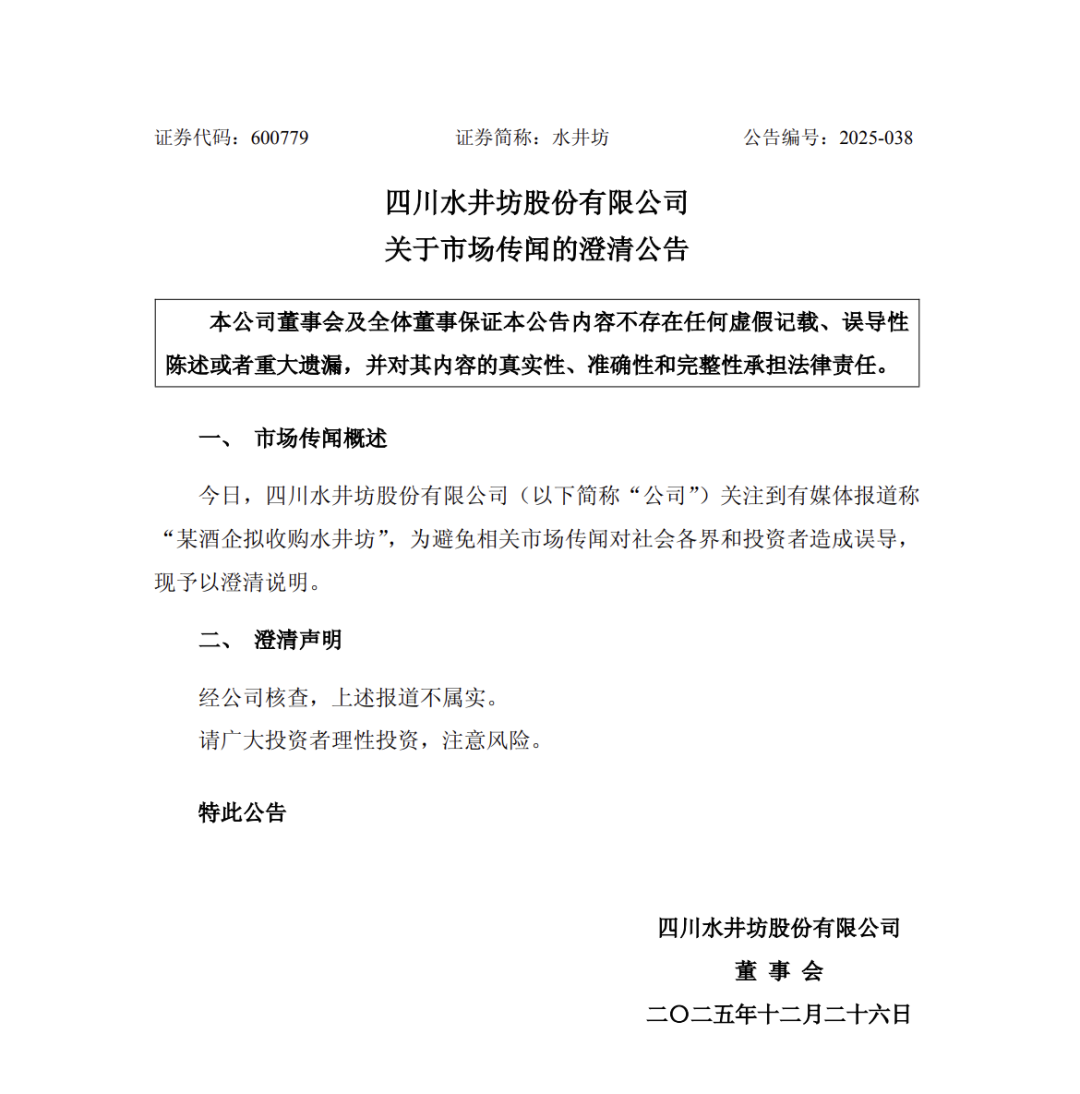
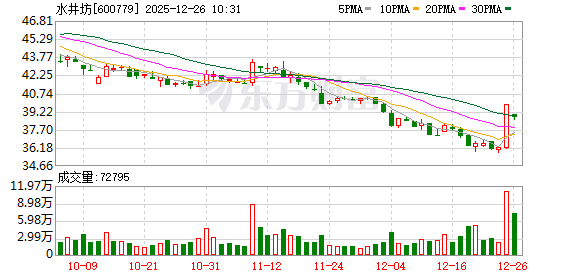
Group 1 - Water Well Company (水井坊) issued a clarification announcement denying media reports about a potential acquisition by another liquor company, specifically Jian Nan Chun, stating that the reports are untrue [1] - Following the acquisition rumors, Water Well's stock price surged to a closing price of 39.8 yuan, with a total market capitalization of 19.4 billion yuan, but subsequently fell to 38.95 yuan the next day after the clarification [1][2] - The company has been facing performance pressure, with a reported revenue of 2.348 billion yuan for the first three quarters of the year, a year-on-year decline of 38.01%, and a net profit of 326 million yuan, down 71.02% [2] Group 2 - The white liquor industry is currently undergoing adjustments, with the number of large-scale enterprises decreasing by over 100 to 887, and production volume down by 5.8% to 1.9159 million kiloliters [3] - Sales revenue for the industry showed a slight increase of 0.19% to 330.42 billion yuan, while profits decreased by 10.93% to 87.687 billion yuan [3] - Analysts suggest that consumer behavior is shifting towards more rational spending, impacting the mid-to-high-end market, which is experiencing inventory issues and price inversions due to previous overproduction [3]

水井坊紧急辟谣,股价跌超2%,前一日涨停
Xin Lang Cai Jing· 2025-12-26 03:12
Core Viewpoint - Water Margin (600779.SH) experienced a significant stock price fluctuation, initially dropping by 2.79% to 38.69 CNY per share, following a surge that led to a trading halt the previous day, attributed to rumors of a potential acquisition by Jian Nan Chun [1][8][14]. Group 1: Company Developments - On December 25, Water Margin issued a clarification denying rumors of being acquired by Jian Nan Chun, stating that the reports were untrue [10][1]. - Water Margin's stock surged to a trading halt on December 25, leading the entire liquor sector, amidst unverified acquisition rumors [5][14]. - The company is projected to achieve over 5 billion CNY in revenue for 2024, marking its best performance historically, although it contributes only a single-digit percentage to Diageo's global revenue [5][15]. Group 2: Market Context - Diageo has held approximately 63% of Water Margin's shares since the early 2000s, viewing it as a strategic asset in the Chinese market [5][15]. - Jian Nan Chun, a larger liquor company with over 16.9 billion CNY in sales in 2023, has faced speculation regarding its potential IPO, which remains uncertain due to various regulatory and operational challenges [6][16]. - The liquor production sector has not seen any successful IPOs in A-shares since 2016, with many companies shifting focus to Hong Kong listings due to regulatory restrictions [16].


某酒企拟收购水井坊?水井坊深夜发布澄清公告:不属实!
Sou Hu Cai Jing· 2025-12-26 03:11
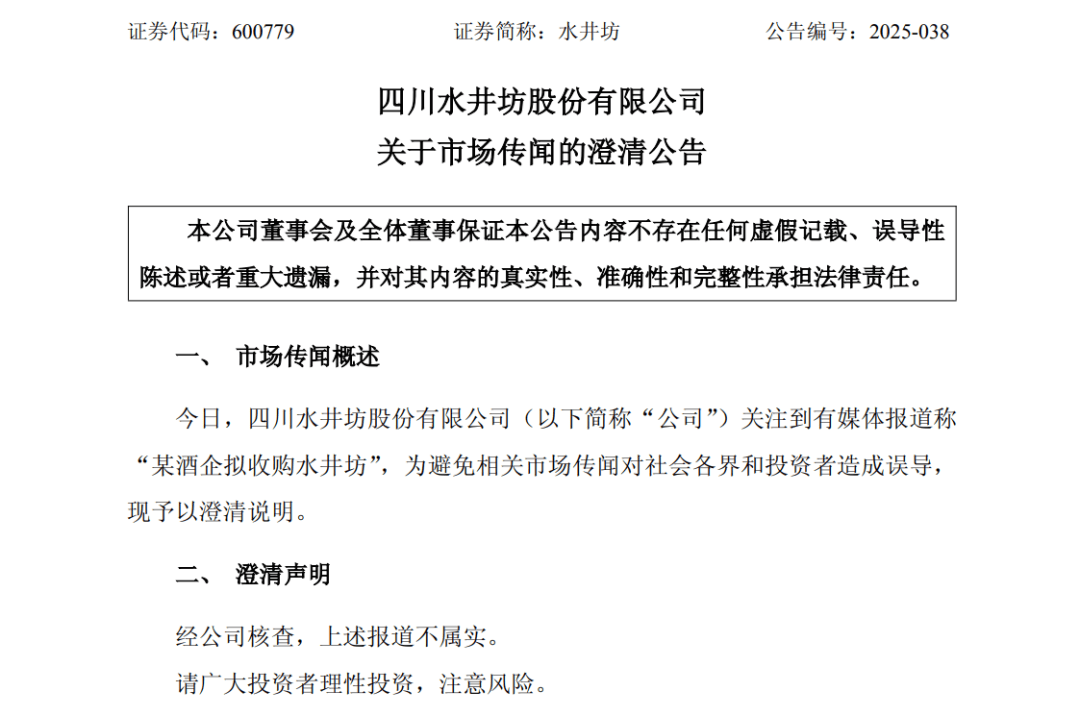
Group 1 - On December 25, Sichuan Shui Jing Fang Co., Ltd. experienced a sudden stock price surge, closing at the daily limit, amid rumors of a potential acquisition by Jian Nan Chun [1][3] - Shui Jing Fang issued a clarification stating that the reports regarding the acquisition were untrue, urging investors to make rational investment decisions and be aware of risks [1] - The company's stock price was reported at 39.80 yuan, with a market capitalization of 19.403 billion yuan [4] Group 2 - Shui Jing Fang was established in 1996 and is headquartered in Chengdu, primarily engaged in the production and sale of liquor products, with key brands including "Shui Jing Fang" and "Di Yi Fang" [5] - For the first three quarters of 2025, Shui Jing Fang reported revenue of 2.348 billion yuan, a year-on-year decrease of 38.01%, and a net profit attributable to shareholders of 326 million yuan, down 71.02% [5][7] - The company recently signed actor Tony Leung as the brand ambassador for its "Di Yi Fang" brand, marking his first endorsement in the liquor sector [7]
水井坊紧急辟谣,股价跌超2%,前一日涨停
21世纪经济报道· 2025-12-26 03:06
Core Viewpoint - Water Margin's stock price experienced volatility, initially dropping by 2.79% to 38.69 yuan per share after a previous surge that led to a limit-up closing, driven by rumors of a potential acquisition by Jian Nan Chun [1][7]. Group 1: Stock Performance - On December 26, Water Margin's stock opened lower at 38.69 yuan, down 2.79%, leading the decline in the liquor sector [1]. - The day before, on December 25, the stock price surged and closed at the daily limit, leading the entire liquor sector [1][7]. - The market capitalization of Water Margin is reported at 189 billion yuan, with a PE ratio of 34.8 [2]. Group 2: Acquisition Rumors - Water Margin issued a clarification on December 25, denying rumors of being acquired by Jian Nan Chun, stating that the reports were untrue [3]. - The source of the acquisition rumor remains unclear, with Water Margin representatives expressing surprise at the speculation [7]. - Jian Nan Chun, a larger liquor company with sales exceeding 169 billion yuan in 2023, has been speculated to be interested in Water Margin [8]. Group 3: Market Context - The liquor production industry has faced restrictions on IPOs, with no successful listings since 2016, leading many companies to consider Hong Kong for public offerings [8]. - Jian Nan Chun faces additional challenges for potential listing due to legal issues involving its actual controller and trademark ownership disputes [8].

大反转突袭!水井坊涨停疑被收购?官方连夜发声:不属实
Sou Hu Cai Jing· 2025-12-26 03:06
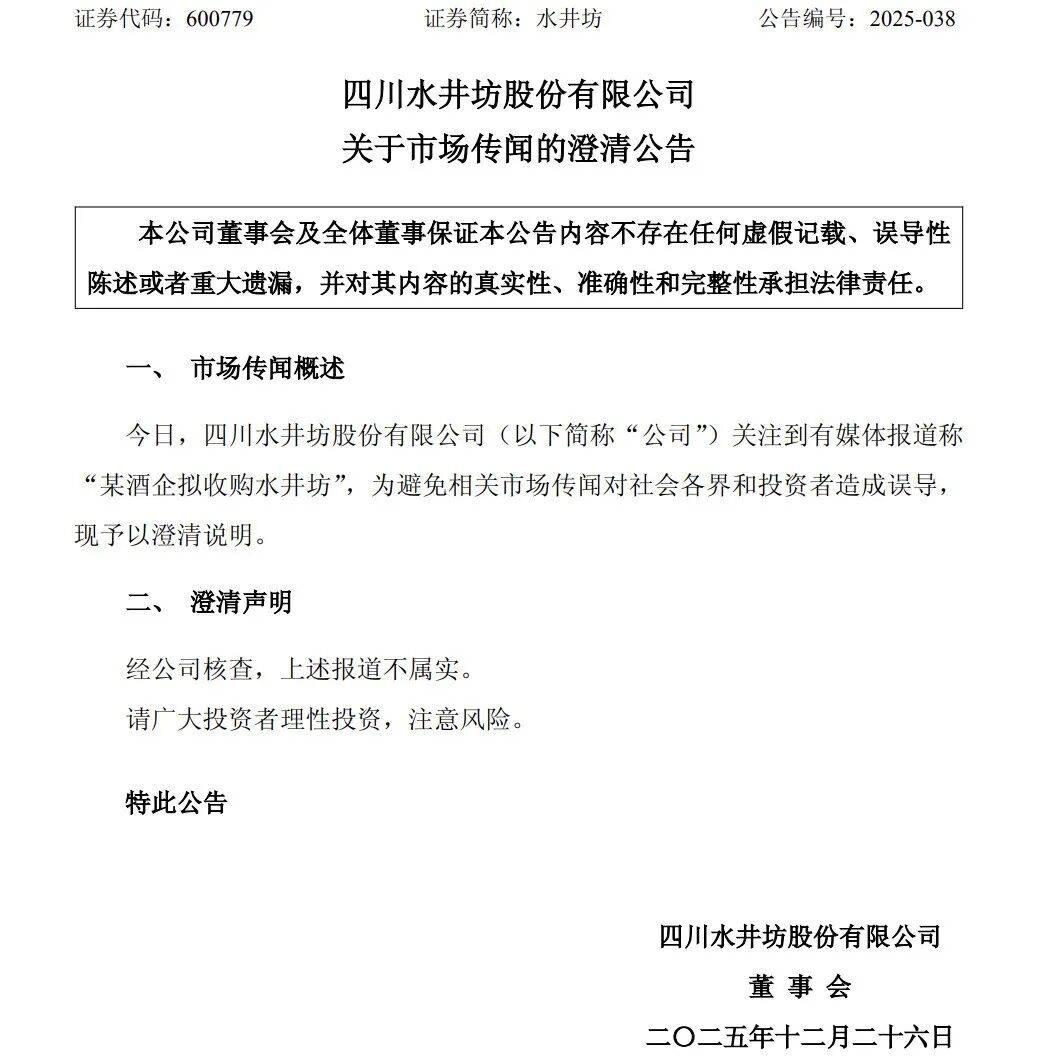
Core Viewpoint - Sichuan Water Well Square Co., Ltd. clarifies that recent media reports about a potential acquisition by another liquor company are untrue, aiming to prevent misinformation from affecting investors and the public [3][4]. Group 1: Company Clarification - The company emphasizes that the reports regarding an acquisition are false and urges investors to make rational investment decisions [4]. - The board of directors guarantees the accuracy and completeness of the announcement, taking legal responsibility for its content [2]. Group 2: Market Reaction - Following the clarification, Water Well Square's stock price surged, reaching a 10% increase and hitting the daily limit on December 25 [5][8]. - Other liquor stocks also experienced gains, with notable increases in shares of Huangtai Liquor and Jiu Gui Liquor, among others [8]. Group 3: Financial Performance - For the first three quarters of the year, the company reported a revenue of 2.348 billion, a year-on-year decrease of 38.01%, and a net profit attributable to shareholders of 326 million, down 71.02% [12][13]. - The company is implementing measures to stabilize its value chain, including reducing promotional activities and managing inventory more effectively [12]. Group 4: Industry Context - The liquor industry is currently undergoing a deep adjustment period, with demand declining and prices dropping, leading to a shift from expansion to competition based on existing market share [14]. - Analysts suggest that the industry is nearing a bottom, with potential for recovery in 2026, particularly for quality companies that adapt to market changes [14].
水井坊回落走低 公司澄清被收购传闻
Zheng Quan Shi Bao Wang· 2025-12-26 02:30
Group 1 - The stock of Shuijingfang (600779) fell over 3% during trading on the 26th, following a strong surge that led to a limit-up on the previous afternoon [2] - The company issued a clarification on the evening of the 25th regarding media reports suggesting that "a certain liquor company intends to acquire Shuijingfang," stating that these reports are untrue [2][3] - The company urged investors to make rational investment decisions and to be aware of risks [3]
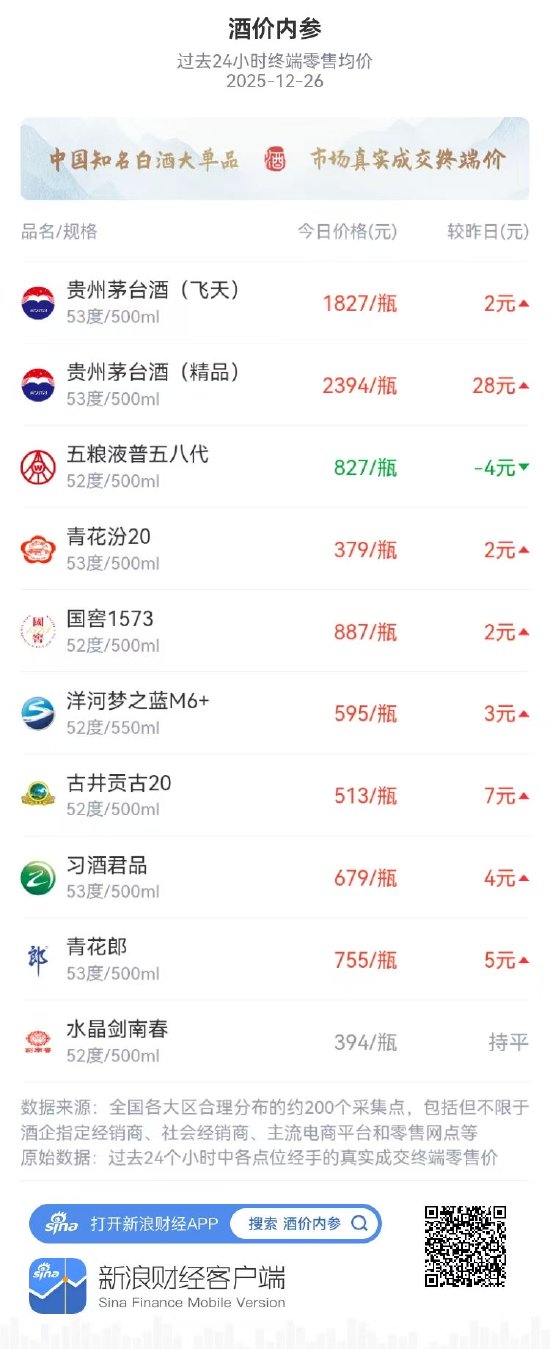
酒价内参12月26日价格发布 五粮液普五八代下跌4元
Xin Lang Cai Jing· 2025-12-26 01:33
Core Insights - The article highlights the continuous upward trend in the retail prices of China's top ten liquor products, with a total price reaching 9,250 yuan, an increase of 49 yuan from the previous day, marking a new high in the past month [1][7]. Price Trends - The market is driven by the leading products from Guizhou Moutai, with most brands experiencing price increases, showing a strong structure of eight rising, one stable, and one declining [1][7]. - The price of Guizhou Moutai (premium) rose by 28 yuan per bottle, achieving a cumulative increase of over 110 yuan over three days [1][7]. - Guizhou Moutai (Feitian) saw a stable increase of 2 yuan per bottle [1][7]. - Other notable price increases include: - Guqingong Gu20: +7 yuan - Qinghualang: +5 yuan - Xijiu Junpin: +4 yuan - Yanghe Dream Blue M6+: +3 yuan - Guojiao 1573 and Qinghualang 20: +2 yuan each - The only product with a price decline was Wuliangye Pu 58th generation, which fell by 4 yuan [1][7][9]. Market Data Collection - The data for the "Liquor Price Reference" is sourced from approximately 200 collection points across various regions, including designated distributors, social distributors, mainstream e-commerce platforms, and retail outlets, aiming to provide objective and traceable market price data [2][8]. Industry News - On the afternoon of the 25th, the A-share liquor sector saw a rise, with Shuijingfang hitting the limit, attracting investor attention due to rumors of Jiananspring planning to acquire Shuijingfang. However, both parties denied any acquisition discussions, and Shuijingfang confirmed its operations are normal [9]. - A broker analyst suggested that the collective rise in the liquor sector may be related to year-end capital rotation [9].


水井坊涨停带领白酒行业集体反弹;泸州老窖智能仓储项目过审丨酒业早参
Mei Ri Jing Ji Xin Wen· 2025-12-26 01:07
NO.1 水井坊涨停带领白酒行业集体反弹 12月25日,水井坊股价异动涨停,随后皇台酒业、金徽酒、酒鬼酒等个股均出现大幅反弹。开源证券分 析指出,食品饮料行业作为必选消费核心赛道,有望直接受益于内需提振战略。行业健康化、品质化成 为核心趋势,叠加成本端压力缓解,头部企业盈利韧性凸显。目前白酒板块磨底阶段或已现,品牌力 强、多价格带布局的龙头标的估值修复可期。 点评:此次板块异动或是白酒行业磨底阶段的明确信号,估值修复具备坚实的逻辑支撑,但短期股价反 弹能否转化为趋势性行情,主要看春节旺季的备货情况与库存去化进度。当前行业平均存货周转天数仍 处于高位,若终端动销未能实质改善,反弹可能面临回调压力。对于投资者而言,可重点关注两条主 线,一是品牌力强、成本控制能力突出的头部龙头,二是具备区域壁垒、受益于国资整合的优质区域酒 企。 该项目通过BIM技术深化设计,预先优化管线布局与设备安装方案,有效化解交叉施工难题;严格执行 标准化工艺流程和三级检验制度,对176个储酒罐配套管线、自动化阀阵系统等关键部位实施精细化实 测实量,确保安装精度;针对食品级设备特殊要求,细化施工防护流程,保障无油压缩设备、多级酒泵 等核心设施 ...
今日A股市场重要快讯汇总|2025年12月26日
Xin Lang Cai Jing· 2025-12-26 00:59
Group 1: Industry Trends and Price Movements - The current spot prices for storage products, including DDR4 and DDR5, are on the rise, with a slight reduction in the rate of increase, attributed to middle traders releasing more inventory for year-end accounting rather than a supply shortage [1][8] - Kingston, a leading module supplier, has significantly raised DRAM prices, indicating that overall spot prices remain strong [1][8] - The NAND Flash spot market is experiencing bullish sentiment due to expectations of rising contract prices, leading suppliers to adopt a withholding strategy, tightening market liquidity and pushing wafer prices higher [1][8] - Despite rising prices, demand from buyers is being suppressed, and the overall market remains firm due to ongoing cost increases and expectations of further price hikes in the supply chain [2][8] Group 2: Company Announcements - Water Margin (水井坊) announced that reports of a potential acquisition by another liquor company are untrue, clarifying the misinformation [3][9] - The company issued a statement urging investors to make rational investment decisions [4][10] Group 3: Macroeconomic and Market Analysis - The U.S. government is adjusting energy policies to reduce reliance on Chinese supply chains in the battery sector, with recent reports indicating a push for subsidies to support domestic battery manufacturing [5][11] - The Biden administration's previous funding for battery manufacturing has been revived, with the Department of Energy recently announcing up to $500 million for battery materials and recycling projects [5][11] - Analysts estimate that U.S. manufacturers will need at least five years to produce sufficient lithium iron phosphate batteries to meet domestic demand, with longer timelines required to establish related supply chains [5][11] Group 4: Market Performance and Commodity Prices - Spot gold prices fell below $4,480 per ounce, while New York futures rose above $4,540 per ounce, indicating mixed performance in precious metals [6][12] - Domestic commodity futures show silver contracts rising by 5% to 18,045.00 yuan, while nickel contracts increased by 2% to 127,630.00 yuan [6][12]
剑南春拟收购水井坊?水井坊发布深夜澄清
Jin Rong Jie· 2025-12-26 00:51
Group 1 - The core point of the news is the significant stock price movement of Shui Jing Fang (600779), which surged to a limit-up price of 39.8 yuan amid rumors of a potential acquisition by another liquor company [1] - Shui Jing Fang issued a clarification on December 25, stating that the reports regarding a potential acquisition were untrue and urged investors to make rational investment decisions [1] - The rumored acquirer mentioned in the market speculation is Jian Nan Chun, which also denied receiving any acquisition information when contacted [5] Group 2 - Shui Jing Fang specializes in the production and sales of liquor products, with two main brands: "Shui Jing Fang" and "Di Yi Fang" [5] - The "Shui Jing Fang" brand includes various product lines such as Shui Jing Fang Jing Tai series, Shui Jing Fang Jing Tai Zhen Cang (Dragon and Phoenix), and Shui Jing Fang Zhen Niang No. 8, while "Di Yi Fang" includes products like Yuan Ming Qing and Di Yi Fang [5] - Core products of the company include Di Yi Fang, Shui Jing Fang Jing Tai, and Shui Jing Fang Zhen Niang No. 8, which cater to different consumer segments [5]