
SCSF(600779)

Search documents
水井坊深夜否认被剑南春收购传言:报道不属实
2 1 Shi Ji Jing Ji Bao Dao· 2025-12-26 00:36
21世纪经济报道记者肖夏 12月25日晚间,水井坊披露澄清公告,直接否认了所谓被剑南春收购的传言。 "今日,四川水井坊股份有限公司关注到有媒体报道称'某酒企拟收购水井坊',为避免相关市场传闻对社会各界和投资者造成误 导,现予以澄清说明:经公司核查,上述报道不属实。"水井坊公告表示。 12月25日下午一点多,水井坊股价突然拉升,后直接以涨停收官,领涨整个白酒板块。市面上出现"剑南春拟收购水井坊"的传 言,源头不明。 21世纪经济报道记者25日下午向水井坊方面求证,不同部门人士均表示并未听说。一位水井坊人士向记者发来一个"一脸懵 逼"的表情。 水井坊上市多年,跨国酒企帝亚吉欧早在2000年代初便通过间接持股入局,2018年至2019年左右通过发起全面要约收购进一步 增持,目前通过旗下主体持有水井坊约63%的股份。 水井坊2024年营收突破50亿元,是其历年最好表现,但在帝亚吉欧全球收入中贡献并不大,仅有个位数占比。 然而水井坊长期被帝亚吉欧视为在中国市场的战略性布局。 2016年至今,A股已经多年没有白酒生产企业成功上市,不少酒企转战港股。2023年初进一步传出消息,主管部门文件将白酒列 入IPO"禁止类产业"。 ...


水井坊,深夜公告澄清!昨日股价涨停!
Xin Lang Cai Jing· 2025-12-26 00:32
Core Viewpoint - Water Jiufang (600779) issued a clarification announcement after its stock price hit the daily limit, denying media reports about a potential acquisition by another liquor company [3][9]. Group 1: Company Announcement - On the evening of December 25, Water Jiufang announced that it had noticed media reports claiming "a certain liquor company intends to acquire Water Jiufang," and clarified that these reports are untrue [3][9]. - The company urged investors to make rational investment decisions and to be aware of risks [3][9]. Group 2: Stock Performance - On the same afternoon, the stock of Water Jiufang experienced significant movement, with its price rising sharply to hit the daily limit, closing at 39.8 yuan, resulting in a total market capitalization of 194 billion yuan [4][10]. Group 3: Company Profile - Water Jiufang specializes in the production and sales of liquor products, owning two major brands: "Water Jiufang" and "First Fang" [6][12]. - The "Water Jiufang" brand includes various product lines such as Water Jiufang Jingtai series, Water Jiufang Jingtai Collection (Dragon and Phoenix), and Water Jiufang Zhenniang No. 8, while the "First Fang" brand includes products like Yuanmingqing and First Fang [6][12]. - The company aims to meet the differentiated needs of various consumer groups with its product offerings, with key products being First Fang, Water Jiufang Jingtai, and Water Jiufang Zhenniang No. 8 [6][12].
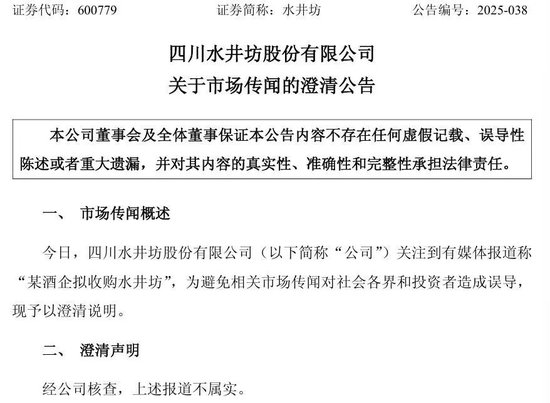
水井坊深夜公告澄清,昨日股价涨停
Zheng Quan Shi Bao· 2025-12-26 00:30
Group 1 - The core point of the article is that Water Well Square has clarified media reports regarding a potential acquisition, stating that these reports are untrue to prevent misleading investors and the public [3] - Following the announcement, Water Well Square's stock price surged to a limit increase, closing at 39.8 yuan, with a total market value of 19.4 billion yuan [3] Group 2 - Water Well Square specializes in the production and sales of liquor products, with two main brands: "Water Well Square" and "First Square" [5] - The "Water Well Square" brand includes various product lines such as Water Well Square Well Platform Series, Water Well Square Well Platform Collection (Dragon and Phoenix), and Water Well Square Zhen Niang No. 8, while "First Square" includes products like Yuan Ming Qing and First Square [5] - The company aims to meet the diverse needs of different consumer groups with its product offerings, with core products being First Square, Water Well Square Well Platform, and Water Well Square Zhen Niang No. 8 [5]
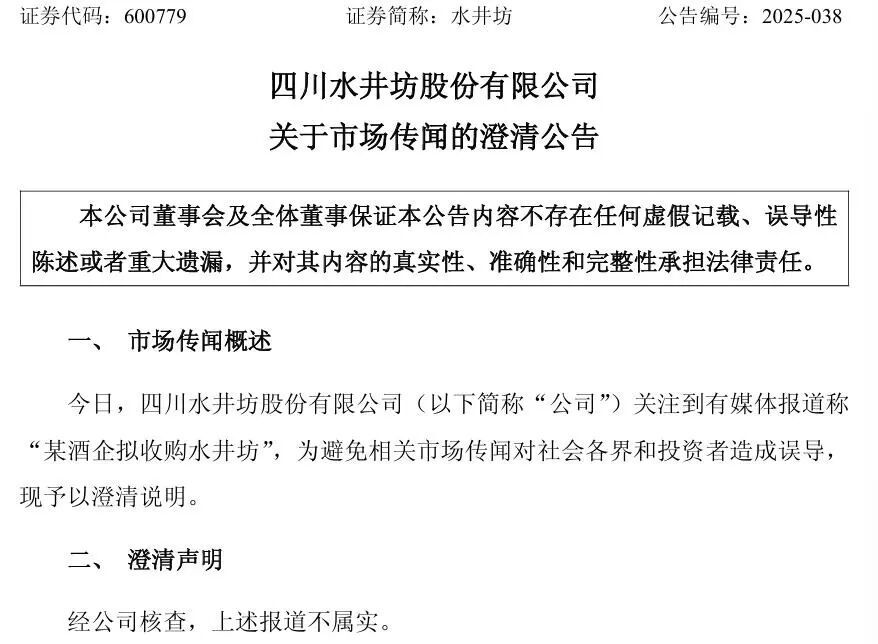
600779,深夜公告澄清!昨日股价涨停!
Xin Lang Cai Jing· 2025-12-26 00:05
Core Viewpoint - Water Jiufang issued a clarification announcement to address media reports about a potential acquisition, stating that the reports are untrue to prevent misleading investors [2][7]. Group 1: Company Announcement - On the evening of December 25, Water Jiufang announced it was aware of media reports claiming "a certain liquor company intends to acquire Water Jiufang," and clarified that these reports are not true [2][7]. - The company urged investors to make rational investment decisions and to be aware of risks [2][7]. Group 2: Stock Performance - On the same afternoon, the stock of Water Jiufang experienced significant movement, with its price rising sharply to hit the daily limit, closing at 39.8 yuan, resulting in a total market capitalization of 194 billion yuan [3][8]. Group 3: Company Profile - Water Jiufang specializes in the production and sale of liquor products, owning two major brands: "Water Jiufang" and "First Fang" [5][9]. - The "Water Jiufang" brand includes various product lines such as Water Jiufang Well Series, Water Jiufang Well Collection (Dragon and Phoenix), and Water Jiufang Zhenniang No. 8, while the "First Fang" brand includes products like Yuanmingqing and First Fang [5][9]. - The company has launched products like Tianhao Chen, Small Water Jiufang, and Water Jiufang Fu to meet the diverse needs of different consumer groups, with First Fang, Water Jiufang Well Series, and Water Jiufang Zhenniang No. 8 being its core products [5][9].
沪银涨超5%创新高;绍兴地铁撞击事故调查报告发布;京东年终奖震惊“打工人”!从19薪到25薪,最高“上不封顶”丨每经早参
Mei Ri Jing Ji Xin Wen· 2025-12-25 23:09
Group 1 - The price of silver in Shanghai rose by 5.50%, reaching a historical high of 18,131 RMB per kilogram [4] - JD.com announced its year-end bonus plan for 2025, with departments upgraded to 19 salaries offering up to 22 salaries for top performers, and those upgraded to 20 salaries offering up to 24 salaries [25] - JD.com's average salary for the procurement and sales department is expected to reach 25 salaries this year, with a target of 26 salaries in 2026 [25] Group 2 - The Egyptian central bank decided to lower the benchmark interest rate by 100 basis points, bringing the deposit rate down to 20% and the loan rate to 21% [4] - The Chinese Ministry of Commerce expressed strong opposition to the U.S. imposing additional tariffs on Chinese semiconductor products, stating that it does not recognize the conclusions of the U.S. 301 investigation [6] - The Ministry of Commerce also responded to questions regarding TikTok's establishment of a joint venture in the U.S., emphasizing the need for solutions that comply with Chinese laws and regulations [5] Group 3 - The National Defense Ministry of China stated that it will increase pressure in response to provocations from Taiwan independence advocates, emphasizing the necessity of military preparedness [8] - The Chinese government announced an increase in the compensation and living allowance standards for certain retired military personnel and other beneficiaries starting from August 1, 2025 [9] - The National Tobacco Monopoly Administration is seeking public opinion on a draft notice to enforce restrictive policies on the e-cigarette industry [7] Group 4 - Longi Green Energy confirmed a price increase for silicon wafers, with average increases reaching 12% [20] - Xiaomi announced the price of its new flagship model, the Xiaomi 17 Ultra, starting at 6,999 RMB, reflecting a 500 RMB increase from the previous model [21] - Deep Blue Automotive completed a C-round financing of 6.122 billion RMB, aimed at enhancing its competitiveness in the new energy vehicle sector [26]




水井坊发布澄清公告:“某酒企拟收购”传闻不属实
Cai Jing Wang· 2025-12-25 22:29
12月25日,水井坊发布关于市场传闻的澄清公告。表示公司关注到有报道称"某酒企拟收购水井坊",为避免相关市场 传闻对社会各界和投资者造成误导,现予以澄清说明。经公司核查,上述报道不属实。 (企业公告) ...
沪银涨超5%创新高!这款白银基金限购100元;952名涉电诈嫌疑人被押解回国;绍兴地铁撞击事故调查报告发布;埃及降息100基点丨每经早参
Mei Ri Jing Ji Xin Wen· 2025-12-25 22:09
因圣诞节假期,欧美等主要市场周四休市。 每经编辑|陈鹏程 王晓波 V 日本11月失业率公布 2 荣耀WIN系列将于12月26日正式发布 3 星宸科技2025开发者大会暨产品发布会将于1 月26日举办 4 北京市机器人产业协会成立大会将于12月26E 召开 5 国家发改委12月26日将举行新闻发布会,介绍 国家创业投资引导基金有关工作 1 隔夜市场 沪银收涨5.50%,报18131元人民币/公斤,创历史新高。 当地时间25日,埃及央行在当天召开的货币政策委员会会议上决定,将基准利率下调100个基点。此次降息后,存款利率降至20%,贷款利率降至21%。此 次降息,是埃及央行2025年内的第五次降息。 2 商务部回应TikTok将在美成立合资公司 商务部新闻发言人何咏前12月25日在回答关于TikTok将在美成立合资公司的有关提问时说,中国政府希望企业达成符合中国法律法规、利益平衡的解决方 案。 商务部:坚决反对美对华半导体产品加征301关税 商务部新闻发言人何咏前25日在回答关于美宣布对部分中国半导体产品加征301关税的有关提问时说,中方注意到有关情况,已通过中美经贸磋商机制向美 方提出严正交涉。中方不认同美方3 ...

剑南春收购水井坊?最新回应
Bei Jing Ri Bao Ke Hu Duan· 2025-12-25 16:36
Group 1 - The core viewpoint of the article revolves around the market speculation regarding a potential acquisition of Shuijingfang by Jiananchun, which led to a significant increase in Shuijingfang's stock price, closing at 39.8 yuan on December 25 [1] - Shuijingfang issued a clarification on the evening of December 25, stating that the reports of an acquisition were untrue and urged investors to make rational investment decisions [2] - Shuijingfang primarily focuses on the production and sales of liquor products, with notable offerings including the First Fang, Shuijingfang Yuanmingqing, and Shuijingfang Jingcui [5] Group 2 - The company is headquartered in Chengdu, with subsidiaries in major cities like Beijing and Shanghai, and a branch in Qionglai, Sichuan Province [6] - Shuijingfang was listed on the Shanghai Stock Exchange in 1996, and the current chairman is Fan Xiangfu [6]
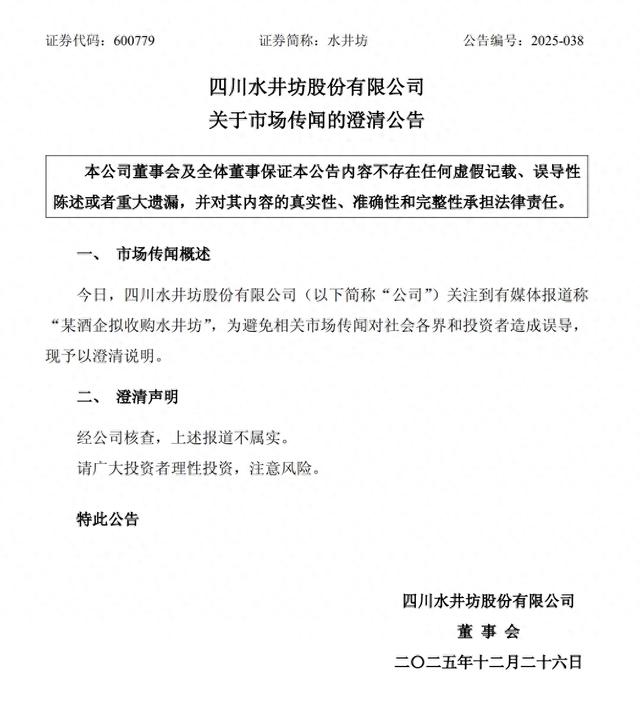
剑南春收购水井坊?双方火速回应“不知情”|公司舆情哨
Sou Hu Cai Jing· 2025-12-25 16:15
Core Viewpoint - The recent acquisition rumor involving Jian Nan Chun and Shui Jing Fang has sparked significant movement in the Chinese liquor market, particularly in the A-share market, despite both companies denying any knowledge of the acquisition [1][3][4]. Group 1: Market Reaction - On December 25, the A-share liquor sector saw a notable increase, with Shui Jing Fang's stock price hitting the daily limit at 39.80 yuan per share, driven by substantial capital inflow [1]. - Other leading liquor companies, including Kweichow Moutai, Wuliangye, Luzhou Laojiao, Yanghe, and Shanxi Fenjiu, also experienced stock price increases, indicating a collective market response [5]. Group 2: Company Responses - Both Shui Jing Fang and Jian Nan Chun have publicly stated they are unaware of any acquisition discussions, with Shui Jing Fang emphasizing that its operations remain normal [4][5]. - This is not the first time Shui Jing Fang has faced acquisition rumors; previous claims regarding a potential acquisition by Xijiu were also denied by the company [4]. Group 3: Historical Context - Jian Nan Chun and Shui Jing Fang have a historical connection, both being part of the "Six Golden Flowers" of Sichuan liquor, which adds to the speculation around potential synergies [5][6]. - The historical context includes past foreign investments in Shui Jing Fang by Diageo, which highlights the interest of international players in the Chinese liquor market [5]. Group 4: Industry Dynamics - The rumor reflects deeper market dynamics, including an ongoing adjustment period in the liquor industry, where increased competition has led to heightened expectations for mergers and acquisitions [6]. - The potential for integration between Jian Nan Chun and Shui Jing Fang is seen as feasible due to their cultural and regional similarities, although the complexity of Shui Jing Fang's current ownership structure makes such a merger unlikely in the short term [6].

每天三分钟公告很轻松 | 水井坊澄清“某酒企拟收购水井坊”报道不属实
Shang Hai Zheng Quan Bao· 2025-12-25 16:12
Group 1 - Water Well Square clarified that reports of a certain liquor company intending to acquire it are untrue, urging investors to make rational investment decisions [1] Group 2 - Baida Qiancheng plans to acquire 100% of Xiamen Zhonglian Century Co., Ltd. through a combination of share issuance and cash payment, with the transaction expected to constitute a major asset restructuring [2] - Zhonglian Century is a leading digital marketing service provider, and this acquisition aims to enhance Baida Qiancheng's marketing business and competitive edge [2] Group 3 - *ST Jianyi received a debt waiver of 1.4 billion yuan and a cash donation of 400 million yuan from its controlling shareholder, Zhuhai Zhengfang Group, to support its development [4] Group 4 - Yichang Technology is undergoing a change in its actual controller from Gaojin Group to Chuzhou City State-owned Assets Supervision and Administration Commission, following a share transfer agreement [5] Group 5 - Tian Tie Technology's controlling shareholder, Xu Jiding, has been criminally detained, but the company asserts that this will not significantly impact its daily operations [6][7] Group 6 - Unigroup Guowei plans to establish a new company with several partners, including a subsidiary of CATL, to engage in automotive domain control chip business [8] - Zhongding shares intends to set up a joint venture for humanoid robot manufacturing and OEM business [8] Group 7 - Guangju Energy has acquired an 8% stake in Shenzhen Mawan Power Co., Ltd. for 680 million yuan, increasing its ownership from 6.42% to 14.42% [9] Group 8 - Hainan Airport plans to sell 90% of its stake in Sanya Airport Infrastructure Co., Ltd. for approximately 500 million yuan, expecting an investment gain of about 200 million yuan [10] Group 9 - Hongsheng Huayuan's subsidiaries have pre-qualified for 27 procurement packages from the State Grid Corporation, with a total estimated value of approximately 569 million yuan [12]


