水井坊

Search documents
预调酒专家-安徽河南江苏综合白酒大商交流
2026-03-22 14:35
Summary of Conference Call Records Company and Industry Overview - **Company**: 百润股份 (Bairun Co., Ltd.) - **Industry**: Alcoholic Beverages, specifically focusing on pre-mixed cocktails and whiskey, as well as traditional Chinese liquor (Baijiu) Key Points and Arguments Sales Performance - **Q1 2026 Sales**: Sales progress is slightly slower than planned, with an expected pre-tax sales of approximately 700 million yuan, roughly flat compared to the same period in 2025 [1][3] - **Sales Channels**: Traditional "夫妻老婆店" (small family-owned stores) now account for over 30% of sales, down from 60%, while convenience stores and snack systems are seeing significant growth [1][4] - **Whiskey Sales**: The whiskey business aims for a growth target of 70%-80% in 2026, with sales in January-February around 20-30 million yuan [1][7] Product Lines and Marketing Strategies - **Core Products**: The "强爽" (Qiangshuang) series will be the main product focus for 2026, with nationwide promotion starting in late April [1][6] - **New Products**: The company plans to launch new products in the "果冻酒" (Jelly Wine) and "清享" (Qingxiang) series, with distribution strategies targeting specific channels [5][6] - **Promotional Activities**: The "2元乐享" (2 Yuan Enjoyment) campaign for the Qiangshuang series has shown positive results in test markets, leading to a nationwide rollout [6] Market Dynamics - **Post-Festival Sales**: Sales performance post-Chinese New Year has been stable, but brand differentiation is increasing, with some brands like Moutai and Wuliangye showing positive growth while others like Yanghe and Laojiao are experiencing declines [1][2] - **Regional Competition**: In the Anhui market, the "迎驾洞藏" (Yingjia Cave Aged) series is significantly impacting the sales of "古井原浆" (Gu Jing Yuan Jiang) [2][13] Channel Adjustments and Future Goals - **Channel Strategy**: The company is adjusting its channel strategy, focusing on high-growth areas while managing costs associated with new channels [4][3] - **Future Goals**: The aim is to optimize logistics and reduce costs through direct warehouse deliveries, which could save approximately 1.5 yuan per box in logistics costs [4] Financial Performance and Projections - **Sales Targets**: The sales target for March 2026 is set at 350 million yuan, with current performance at over 200 million yuan, indicating a gap to meet the target [3] - **Profitability Concerns**: Increased investments in new channels are impacting overall net profit levels, despite growth in certain areas [2][4] Brand-Specific Insights - **Yanghe's Transformation**: Yanghe is undergoing significant changes, shifting from a market-oriented to an inventory-oriented strategy, which may lead to improved sales dynamics by May 2026 [2][13][14] - **Moutai's Pricing Strategy**: Moutai is implementing a consignment model for non-standard products, which is expected to enhance price control and reduce capital occupation by distributors [15][17] Market Trends and Consumer Behavior - **Consumer Preferences**: There is a noticeable shift in consumer preferences towards higher-end products, impacting the sales of mid-range offerings [13][30] - **Inventory Management**: Many distributors are currently holding back on payments due to unclear future policies, which is affecting market dynamics and pricing [19][26] Conclusion - The company is navigating a complex market landscape with strategic adjustments in product focus, channel management, and promotional activities. The overall outlook for 2026 remains cautiously optimistic, with significant growth potential in the whiskey segment and ongoing challenges in traditional liquor sales.
2026年2月:中国酒类行业展望
Zhong Cheng Xin Guo Ji· 2026-02-09 11:21
Investment Rating - The report maintains a stable investment rating for the Chinese liquor industry, indicating that the overall credit quality of the industry is not expected to change significantly in the next 12 to 18 months [5]. Core Insights - The liquor industry is closely tied to macroeconomic conditions and per capita income levels. Recent years have seen consumption pressures due to economic slowdown, low investment, and policy restrictions, leading to negative revenue and profit growth for large-scale enterprises [6][8]. - The white liquor sector has been experiencing a continuous decline in production since 2017, with a "volume and price drop" scenario expected to persist into 2025 due to high inventory and slow market movement [6][14]. - The beer industry remains stable with high market concentration, but faces challenges from reduced consumption in dining and entertainment venues. The trend towards product premiumization and innovation continues to drive growth [5][26]. - Overall, the liquor industry is under pressure from weak economic recovery and consumption policies, with expectations of continued downward pressure on revenue and profits in the future [10][39]. Summary by Sections Key Points - The liquor industry's demand is significantly affected by macroeconomic conditions and per capita income. Recent economic factors have led to a decline in revenue and profit growth for large-scale enterprises [6][9]. - White liquor production has been decreasing since 2017, with a projected "volume and price drop" scenario continuing into 2025 due to high inventory levels and slow market activity [14][25]. - The beer industry maintains a high concentration level, with stable production capacity utilization. However, the reduction in dining and entertainment venues has negatively impacted beer consumption [26][37]. Analytical Approach - The analysis focuses on the credit fundamentals of the liquor industry, examining key indicators affecting consumption since 2025, including disposable income, consumer confidence, and policy adjustments [7]. Industry Fundamentals - The liquor industry's demand is closely linked to macroeconomic conditions and disposable income levels. Recent years have seen consumption pressures due to economic slowdown and policy restrictions [8][9]. - The white liquor sector has been facing a continuous decline in production, with a significant drop in output expected in 2025 due to high inventory and slow market movement [14][25]. Financial Performance - Since 2025, white liquor enterprises have generally experienced significant declines in operating performance, while beer companies have benefited from optimized product structures [39][40]. - The overall debt levels of liquor companies are low, and while debt service indicators have declined, they remain favorable. Group companies have access to financing channels that support their debt repayment capabilities [39][40].
2026元春白酒动销更新
2026-02-05 02:21
Summary of Conference Call Records Industry Overview: High-End Baijiu Market Key Points - The high-end baijiu market is experiencing an overall decline, but leading brands like Moutai and Wuliangye are gaining market share due to price adjustments and stable gifting demand, with consumer choices becoming more concentrated [1][7] - Business consumption has significantly decreased, with a reported drop of 30%-40% in formal business segments [6] - The overall sentiment in the baijiu market is cautious, yet there remains a rigid demand for gifting [2] Company-Specific Insights Moutai - Moutai's current price is around 1,650 yuan, with low inventory levels; the company expects to clear most of its historical inventory before the Spring Festival [3] - A new 1×4 specification product was launched to cater to price-sensitive consumers amid economic downturns, with expected demand peaking around the Spring Festival [8] - Post-Spring Festival, Moutai's price is anticipated to fluctuate between 1,500 and 1,600 yuan, depending on supply dynamics [9] Wuliangye - Wuliangye has achieved a 60% collection rate, with a 30% increase in contracts compared to the previous year, and a stable wholesale price around 790 yuan [3][20] - The company has implemented strategies such as adjusting payment and delivery methods to stabilize prices and improve sales performance [11][12] - In the Chengdu region, Wuliangye's sales have increased by 30%-40% due to streamlined operations and focused distribution [13] Guojiao 1573 - Guojiao 1573 is facing significant sales pressure, particularly in the Chengdu market, with a reported decline of 32%-33% year-on-year [3][21] - The company is struggling with slow collection rates and high inventory levels, leading to potential adjustments in market strategy [1][16] Other Brands - Secondary high-end brands like Jian Nan Chun and Hong Hua Lang have shown mixed performance, with Jian Nan Chun remaining stable while others like She De and Shui Jing Fang have seen declines [4][5] - The overall performance of mid-range baijiu brands remains stable, but there is a noticeable decline in demand for business event wines [8] Market Dynamics - The gifting market for high-end baijiu remains stable, accounting for 60%-70% of the gifting market share, despite a general decline in overall consumption [15] - The non-standard product segment is experiencing a decline of about 30%, primarily due to reduced product offerings [10] - The competitive landscape in the 1,000 yuan price segment is primarily dominated by Wuliangye, with Moutai's 1,935 product impacting market dynamics [45] Future Outlook - The high-end baijiu market is expected to stabilize, with potential growth in specific segments like Moutai and premium products, especially if market activities increase post-Spring Festival [46][48] - The trend of concentrating premium Moutai products among large distributors is likely to enhance market stability and pricing structures [49] This summary encapsulates the key insights from the conference call records, highlighting the current state and future expectations of the high-end baijiu market and its leading companies.



水井坊回应“剑南春收购”传闻,当日股价曾涨停
Xin Lang Cai Jing· 2025-12-26 04:11
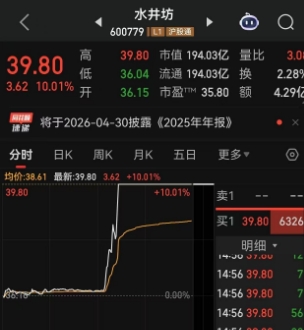
Group 1 - Water Well Company (水井坊) issued a clarification announcement denying media reports about a potential acquisition by another liquor company, specifically Jian Nan Chun, stating that the reports are untrue [1] - Following the acquisition rumors, Water Well's stock price surged to a closing price of 39.8 yuan, with a total market capitalization of 19.4 billion yuan, but subsequently fell to 38.95 yuan the next day after the clarification [1][2] - The company has been facing performance pressure, with a reported revenue of 2.348 billion yuan for the first three quarters of the year, a year-on-year decline of 38.01%, and a net profit of 326 million yuan, down 71.02% [2] Group 2 - The white liquor industry is currently undergoing adjustments, with the number of large-scale enterprises decreasing by over 100 to 887, and production volume down by 5.8% to 1.9159 million kiloliters [3] - Sales revenue for the industry showed a slight increase of 0.19% to 330.42 billion yuan, while profits decreased by 10.93% to 87.687 billion yuan [3] - Analysts suggest that consumer behavior is shifting towards more rational spending, impacting the mid-to-high-end market, which is experiencing inventory issues and price inversions due to previous overproduction [3]

A股又见小作文兴风作浪,一则“剑南春要收购水井坊”消息传出,水井坊直线涨停,单日市值增加超17亿元,双方各自回应
Jin Rong Jie· 2025-12-25 10:29
Core Viewpoint - The rumor of Jian Nan Chun acquiring Shui Jing Fang led to a significant surge in Shui Jing Fang's stock price, causing a ripple effect across the entire A-share liquor sector, with all 20 listed liquor companies experiencing gains [1][3]. Group 1: Stock Market Reaction - Shui Jing Fang's stock price jumped 10% to 39.8 yuan per share, adding over 1.7 billion yuan to its market capitalization within half an hour [1]. - Other liquor stocks also saw substantial increases, with Huangtai Liquor rising over 7%, Jiu Gui Liquor up more than 5%, and Jin Hui Liquor increasing by over 4% [1]. Group 2: Company Responses - Representatives from Shui Jing Fang and Jian Nan Chun stated that they had not received any acquisition information, and Shui Jing Fang has not made any official announcements regarding the rumor [3]. - This is not the first time rumors of Shui Jing Fang being acquired have surfaced; previous claims regarding Xi Jiu acquiring shares were denied by Shui Jing Fang's management [4]. Group 3: Shareholding Structure - Diageo holds a 63.27% stake in Shui Jing Fang, having gradually increased its share since acquiring 43% of the controlling shareholder in 2006 [5]. - Shui Jing Fang's historical performance has been volatile, with periods of significant challenges, including being labeled as a "ST" (special treatment) stock [5]. Group 4: Jian Nan Chun Developments - Jian Nan Chun has been active, with a recent change in shareholding where the local state-owned asset management center acquired approximately 14.51% of the company, becoming its second-largest shareholder [6]. - The acquisition was made through a debt investment, which has led to speculation regarding potential trademark disputes [7]. Group 5: Industry Outlook - Some brokerages believe that the liquor sector is showing clear signs of bottoming out, with expectations of a gradual recovery in the coming years [9]. - The industry is currently undergoing a deep adjustment, with only a few top brands like Moutai and Fenjiu showing positive growth [9].

直播间里的开盖酒、换瓶酒能买吗?
Huan Qiu Wang· 2025-12-01 05:51
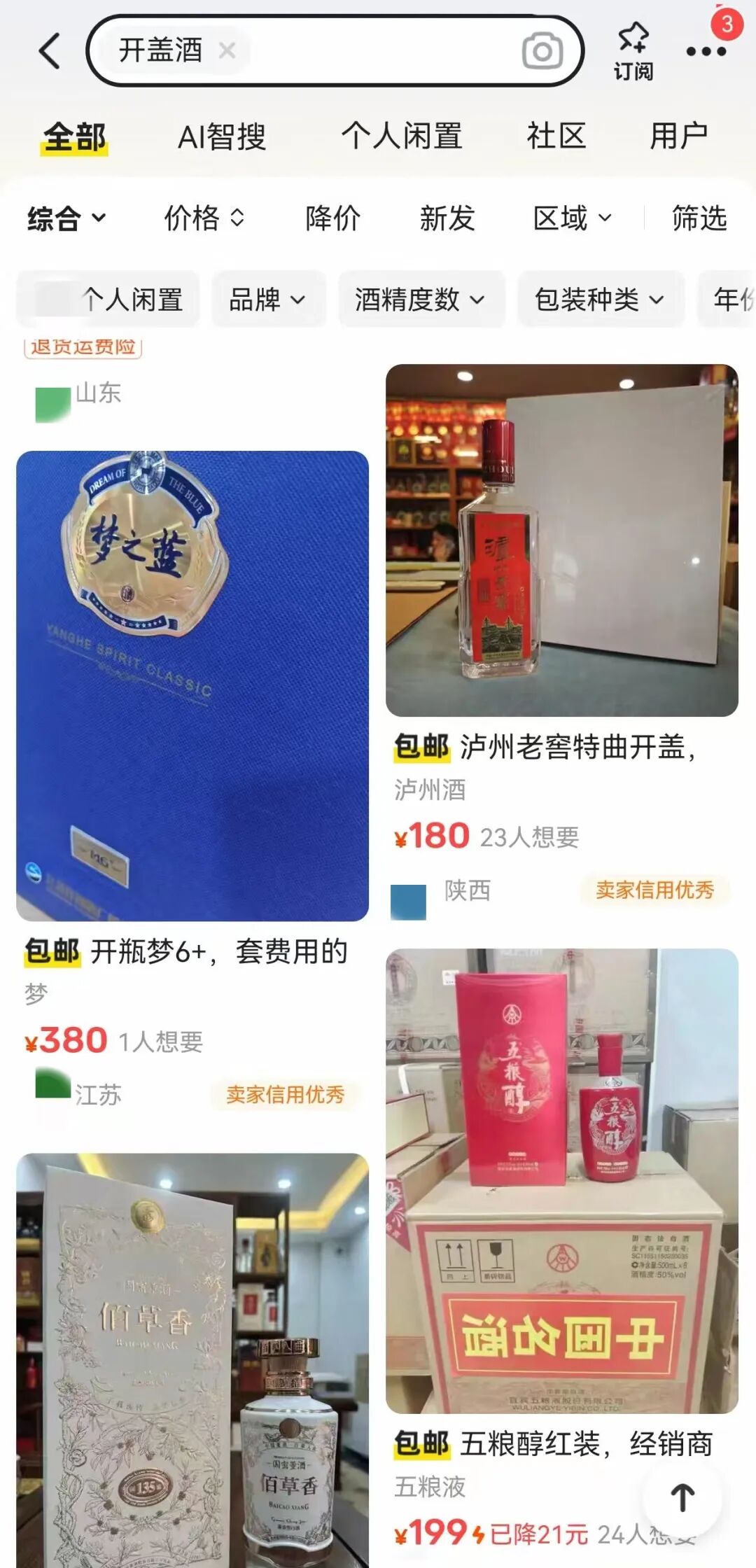
Core Viewpoint - The article highlights the rising trend of low-priced "opened" or "damaged" liquor being sold on live streaming and second-hand platforms, raising concerns about product safety and authenticity [1][2][3]. Group 1: Sales Channels and Pricing - Some liquor brands are being sold at significantly lower prices on live streaming platforms compared to official retail prices, such as a case of 53-degree 500ml Yuanxi liquor priced at 380 yuan versus 590 yuan on official platforms [1][2]. - Various brands are available on second-hand platforms, with prices for opened bottles ranging from 199 yuan for Wuliangchun to 380 yuan for Yanghe Dream Blue [1][2][3]. Group 2: Product Integrity and Safety Concerns - The practice of selling "opened" liquor raises questions about the integrity of the product, as many brands require the bottle to be opened for verification, which can compromise packaging [12][13]. - Legal experts indicate that selling opened or repackaged liquor may violate food safety and trademark laws, posing risks of counterfeit products [13][14]. Group 3: Consumer Warnings and Recommendations - Consumer organizations have repeatedly warned about the safety risks associated with opened liquor, emphasizing that compromised packaging can lead to contamination and spoilage [15][16]. - Recommendations include purchasing liquor from reputable sources such as large supermarkets or licensed online retailers to minimize risks associated with low-priced opened products [16].
段永平捐赠1万股茅台股票;沱牌舍得品牌线上授权店铺公布丨酒业早参
Mei Ri Jing Ji Xin Wen· 2025-11-03 01:05
Group 1 - Duan Yongping donated 10,000 shares of Kweichow Moutai, valued at 15 million RMB, emphasizing the importance of dividends over market value [1] - Kweichow Moutai has a strong dividend capability, having distributed over 330 billion RMB in dividends since its listing, with projected dividends exceeding 500,000 RMB for the donated shares in 2024 [1] - The donation reflects confidence in the core value of leading companies in the liquor industry, highlighting that true industry barriers stem from sustained profitability and dividend capacity rather than short-term market fluctuations [1] Group 2 - Shede Liquor announced the official authorized online stores for its "Tuo Pai She De" brand across major e-commerce platforms, aiming to combat counterfeit risks [2] - This initiative is a significant step in channel governance, protecting consumer rights and maintaining brand reputation while preventing unauthorized low-price sales that could disrupt offline distribution networks [2] Group 3 - Taobao and Tmall reported over 50% year-on-year growth in liquor sales, with notable performance in baijiu, beer, and health food liquor [3] - Brands like Fenjiu and Guojiao 1573 experienced substantial sales increases during the "Double 11" shopping event, indicating strong online operational effectiveness [3] - The explosive growth in online sales, particularly the 20-fold increase in orders for Yijiu Yijiu's flash sales, demonstrates the power of the "online traffic + instant delivery" model, highlighting the accelerating trend of online penetration in the industry [3]
天风证券:双节动销符合预期 白酒板块情绪或有望修复
Zhi Tong Cai Jing· 2025-10-20 08:25
Core Viewpoint - The market atmosphere during the "Double Festival" is relatively flat, with a significant reduction in the traditional "peak season effect" [1][2] Sales and Pricing - Overall sales of liquor are expected to decline by 20%-30% during the Mid-Autumn Festival and National Day, aligning with pre-festival expectations [2] - Terminal sales showed a mild month-on-month recovery in September, but remain under pressure; wholesale prices have decreased year-on-year, leading to a contraction in channel profits [1][2] - High-end liquor prices are stabilizing after a decline, with brands like Moutai and Wuliangye showing signs of recovery in pricing [5][7] Inventory and Channel Dynamics - Distributors are facing increased inventory levels due to sluggish sales in Q2 2025, with pre-festival stocking leading to a temporary rise in inventory [1][2] - Despite a slight reduction in inventory during the festival season, it is expected that real estate liquor distributors will still hold high inventory levels [1][2] Regional Performance - There is a notable regional differentiation in sales performance, with high-end brands and regional leaders showing resilience, while mass-market products face challenges [3][4] - In Jiangsu, urban banquet sales are stable, while rural markets show weakness; in Henan, the mass-market price segment is becoming the main sales driver [3] - In Sichuan, demand for mid-range products is under pressure in urban areas, while county markets show stable performance for products priced between 300-500 yuan [3] Consumer Behavior - The consumption trend is shifting towards rationality, with stable performance in essential consumption scenarios like banquets and family gatherings, while business and government consumption remains weak [4] - The 100-yuan price segment is becoming the main sales driver, with high-cost performance products gaining popularity in regions like Henan and Shandong [6] Investment Recommendations - The company suggests that with the upcoming Q3 earnings disclosures, risks may be fully released, and the sentiment in the liquor sector may see a recovery [7] - Specific stocks to watch include those with strong elasticity in policy expectations and consumer recovery, such as Guizhou Moutai and Shanxi Fenjiu [7]

水井坊(600779):压力稳步释放,重视渠道健康
HTSC· 2025-08-29 04:53
Investment Rating - The report maintains a "Buy" rating for the company [6][4]. Core Views - The company reported a total revenue of 1.5 billion and a net profit attributable to the parent company of 110 million for the first half of 2025, reflecting a year-on-year decline of 12.8% and 56.5% respectively. The second quarter saw a more significant drop, with total revenue of 540 million and a net profit of -80 million, marking a year-on-year decrease of 31.4% and 251.2% respectively [1][2]. - The company emphasizes channel health and is focused on rational and pragmatic approaches to alleviate channel pressure. It aims to cultivate consumers and empower sales [1][2]. - The company is advancing three core strategies: product upgrade and innovation, brand premiumization, and marketing breakthroughs, with expectations for marginal improvements in terminal sales driving performance recovery in 2026-2027 [1][4]. Summary by Sections Financial Performance - In the first half of 2025, the company's gross margin decreased by 1.7 percentage points to 79.3%, with a more pronounced decline in the second quarter to 74.4%, attributed to a significant drop in high-end product sales and increased promotional gifts [3]. - The sales expense ratio increased by 2.6 percentage points to 36.3% in the first half of 2025, with a notable rise to 52.1% in the second quarter due to increased marketing investments [3]. - The net profit margin for the first half of 2025 was 7.0%, down 7.1 percentage points year-on-year, while the second quarter saw a net profit margin of -15.8% [3]. Market Strategy - The company is focusing on maintaining a stable value chain while actively managing inventory levels, with new channel revenue increasing by 126.1% in the first half of 2025 [2]. - The company categorizes core cities into fortress, pioneer, and potential types for targeted investment and support, employing a tailored approach to market layout [2]. Valuation and Forecast - The report projects earnings per share (EPS) for 2025-2027 to be 2.25, 2.36, and 2.47 RMB respectively, with a target price set at 63.00 RMB based on a 28x price-to-earnings (PE) ratio for 2025 [4][7].
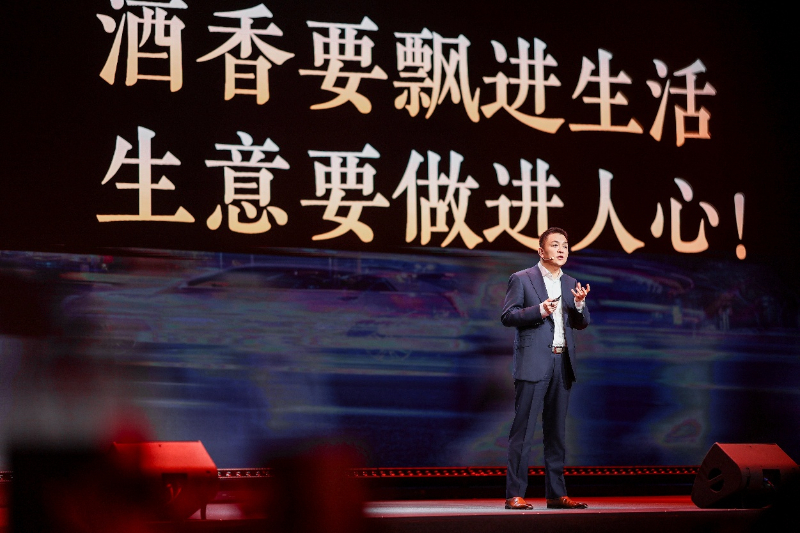
水井坊胡庭洲:进军宴席等核心消费场景 与消费者建立更紧密连接
Xin Hua Wang· 2025-08-12 05:58
Core Insights - The core viewpoint of the article emphasizes the strategic transformation of Sichuan Shui Jing Fang Co., Ltd. under the leadership of General Manager Hu Tingzhou, focusing on consumer engagement and emotional connections in the high-end liquor market [1][2][5]. Group 1: Brand Strategy - Shui Jing Fang launched a new brand strategy targeting two distinct market segments: "Shui Jing Fang" for the 300-800 RMB price range and "Di Yi Fang" for the high-end market above 800 RMB, aiming to enhance brand value through differentiated product positioning [2][5][6]. - The brand philosophy "Drink Fine Wine, Celebrate Beautiful Moments" was introduced to strengthen consumer recognition in key emotional consumption scenarios such as banquets and celebrations [2][7]. Group 2: Market Dynamics - The liquor industry is experiencing a shift towards a "rational consumption" phase, where consumer preferences are increasingly defining value, necessitating a focus on quality, branding, and service from liquor companies [3][5]. - The demand for traditional business banquets is declining, while social gatherings and family celebrations are on the rise, prompting companies to adapt their strategies to meet evolving consumer needs [5][9]. Group 3: Operational Strategy - Shui Jing Fang is focusing on enhancing its channel management through targeted strategies for different city markets, categorizing them into fortress, pioneer, and potential markets to optimize distribution and sales efforts [11][13]. - The company emphasizes the importance of consumer engagement through group purchases and tailored marketing strategies to build brand awareness and loyalty [11][15]. Group 4: Financial Performance - Shui Jing Fang anticipates a net profit of approximately 1.341 billion RMB for 2024, reflecting a year-on-year growth of about 6%, and an expected revenue of around 5.217 billion RMB, indicating a 5% increase [15]. - The company attributes its resilience during industry adjustments to its long-standing reputation, financial health, and the support of its major shareholder, Diageo, which has extensive experience navigating economic cycles [15].