Bank Of Jiangsu(600919)

Search documents
江苏银行(600919) - 江苏银行董事会决议公告
2026-01-04 08:00
证券代码:600919 证券简称:江苏银行 公告编号:2026-001 优先股代码:360026 优先股简称:苏银优 1 江苏银行股份有限公司董事会决议公告 本公司董事会及全体董事保证本公告内容不存在任何虚假记载、 误导性陈述或者重大遗漏,并对其内容的真实性、准确性和完整性承 担个别及连带责任。 表决结果:同意 15 票,反对 0 票,弃权 0 票。 详 情 请 查 阅 公 司 同 日 刊 登 在 上 海 证 券 交 易 所 网 站 (www.sse.com.cn)的江苏银行股份有限公司 2025 年度中期利润分 配方案公告。 特此公告。 江苏银行股份有限公司(以下简称"公司")第六届董事会第二 十五次会议通知于 2025 年 12 月 24 日以电子邮件方式发出,会议于 2026 年 1 月 4 日在公司以现场和视频方式召开。本次会议应参与表 决董事 15 名,实际参与表决董事 15 名,高级管理人员列席会议。会 议符合《公司法》等法律法规及公司章程的有关规定,表决所形成的 决议合法、有效。 会议由公司董事长葛仁余先生主持,审议通过以下议案: 关于江苏银行股份有限公司 2025 年度中期利润分配方案的议案 ...

江苏银行(600919) - 江苏银行2025年度中期利润分配方案公告
2026-01-04 08:00
本公司董事会及全体董事保证本公告内容不存在任何虚假记载、 误导性陈述或者重大遗漏,并对其内容的真实性、准确性和完整性承 担个别及连带责任。 重要内容提示 证券代码:600919 证券简称:江苏银行 公告编号:2026-002 优先股代码:360026 优先股简称:苏银优 1 江苏银行股份有限公司 2025 年度中期利润分配方案公告 1、2025 年 5 月 23 日,公司 2024 年年度股东大会审议通过《关 于提请江苏银行股份有限公司股东大会授权董事会决定 2025 年中期 利润分配的议案》。 ●分配比例:每 10 股派人民币 3.309 元(含税) ●本次利润分配以实施分红派息股权登记日登记的总股本为基 数,具体日期将在分红派息实施公告中明确。 ●公司 2024 年年度股东大会已审议通过中期利润分配相关事宜, 本次利润分配方案经董事会审议通过后实施。 一、利润分配方案内容 经德勤华永会计师事务所(特殊普通合伙)审阅,江苏银行股份 有限公司(以下简称"公司")2025 年半年度归属于母公司股东的 净利润为人民币 202.38 亿元。经董事会审议,公司 2025 年中期利润 分配方案如下:拟以实施分红派息股权 ...
市领导慰问金融机构年底决算一线员工
Zhen Jiang Ri Bao· 2025-12-31 18:44
Group 1 - The visit was led by the Deputy Mayor Zhou Kai, who expressed sincere greetings and New Year wishes to frontline employees in the financial management departments and banking institutions during year-end settlement [1] - The delegation visited several banks including Agricultural Development Bank, Bank of China, Jiangsu Bank, Huaxia Bank, and Zhenjiang Rural Commercial Bank, engaging with staff and gathering reports on annual operational performance [1] - The visit included discussions on the progress of year-end settlement work and appreciation for the contributions made by employees to the economic and social development of Zhenjiang [1] Group 2 - The delegation also conducted research on the transformation of tax service halls at the local tax bureau and examined consumer rights protection efforts at the local financial regulatory bureau [1] - At the People's Bank of China Zhenjiang branch, the team reviewed the operation of the municipal treasury business and inspected the management of the branch's data center [1]

银行:银行2026年展望:稳中求进
2025-12-31 16:02
Summary of the Conference Call Transcript Industry Overview - The banking sector is entering a phase of high-quality development, with a focus on absolute and relative returns from bank stocks, driven by high dividend yields and asset quality [3][4][20]. Key Points Financial Performance Projections - Expected revenue growth for listed banks in 2026 and 2027 is +2.5% and +3.6% respectively, with net profit growth of +1.9% and +2.6% [4][20]. - Revenue and profit growth are anticipated to improve due to: 1. Narrowing net interest margin pressure 2. Quality-focused credit issuance amid weak demand [4][20]. 3. Stabilization of fee income growth after several years of fee reductions [4][20]. 4. Stable or improving net non-performing loan generation rates [4][11]. 5. Accelerated supply-side reforms leading to a reduction in the number of bank licenses, improving competition and operational landscape [4][11]. Customer Demand and Market Dynamics - The low-interest-rate environment has shifted customer demand, with government and state-owned enterprises becoming significant contributors to leverage, affecting the structure of new social financing [5][10]. - Regulatory policies are influencing the development of inclusive finance, focusing on risk compensation rather than merely increasing customer numbers [5][10]. Risk Factors - Risks associated with real estate developers and retail sectors are highlighted, with potential for greater-than-expected exposure [6][11]. Profitability and Valuation Adjustments - Adjustments to profitability forecasts for 2025 and 2026 have been made, with a focus on net interest income recovery and fee income growth [20][21]. - The expected net interest margin for 2026 is projected to be approximately 1.34%, a decrease of 6 basis points from 2025 [21][22]. - Fee income is expected to grow by 3.6% and 4.9% in 2026 and 2027 respectively, indicating a positive trend in non-interest income [21][22]. Asset Quality and Credit Costs - The net non-performing loan generation rate is expected to stabilize or slightly decline, with structural characteristics of retail and corporate lending continuing [11][21]. - Credit costs are projected to remain stable at around 0.58% for 2026 and 2027, reflecting the balance between corporate and household debt servicing capabilities [21][22]. Investment Recommendations - The report suggests a continued positive outlook for bank stocks, emphasizing the importance of dividend yield and asset quality in investment decisions [3][4][20]. Additional Insights - The banking sector is undergoing a transformation towards high-quality development, with a shift in focus from scale to quality, driven by macroeconomic pressures and regulatory changes [12][20]. - The reduction in the number of banking licenses over the past five years indicates successful risk management efforts within the sector [11][12]. - The report emphasizes the need for banks to adapt their strategies to maintain competitiveness in a changing regulatory and economic environment [12][20].



银行业十五五展望系列专题(上篇):回眸十四五,监管引导和主动求变下的银行经营理念重构
Shenwan Hongyuan Securities· 2025-12-31 14:14
Investment Rating - The report indicates a positive outlook for the banking industry, suggesting a return to a price-to-book (PB) ratio of 1x during the "15th Five-Year Plan" period, focusing on stable profitability and high-quality development [3][4]. Core Insights - The banking sector is transitioning from a focus on scale to quality, with an emphasis on risk management and structural optimization. The "15th Five-Year Plan" includes the goal of building a strong financial nation, highlighting the importance of high-quality development [3][16]. - The report identifies key changes in the banking industry during the "14th Five-Year Plan," including a shift in credit structure, a focus on profitability, and the need for banks to balance risk and efficiency [2][4]. - Regulatory support is expected to stabilize net interest margins, which have reached record lows, with a projected recovery in the coming years [5][19]. Summary by Sections 1. From Quantity to Quality - The banking industry has evolved through three five-year plans, with a shift from rapid expansion to a focus on quality and risk management. The current phase emphasizes high-quality development and financial support for key sectors [2][10]. 2. Developments During the "14th Five-Year Plan" 2.1 ROE: Resilience of State-Owned Banks and Advantages of City Commercial Banks - The return on equity (ROE) for listed banks has remained around 10%, with city commercial banks showing a slight advantage due to higher leverage and better provisioning [19][20]. 2.2 Credit: Moving Away from Scale to Balance Capital and Efficiency - Banks are prioritizing structural transformation over sheer volume, focusing on supporting key sectors and optimizing credit distribution [4][12]. 2.3 Interest Margin: Recovery from Continuous Decline - The report anticipates a stabilization of net interest margins, which have been under pressure, with regulatory measures aimed at supporting banks [5][19]. 2.4 Risk: Provisioning to Support Stability - The banking sector is expected to manage risks more effectively, with a focus on maintaining adequate provisions to support profitability during challenging economic conditions [4][19]. 2.5 Financial Markets: An Alternative Revenue Stream - The report highlights the increasing importance of financial market activities as a means to smooth revenue amid declining interest income, with banks diversifying their investment strategies [4][19]. 3. Investment Analysis Opinion - The report suggests a dual strategy of focusing on leading banks and undervalued city commercial banks, anticipating a recovery in valuations for state-owned banks that have been lagging [3][4].


银行业“十五五”展望系列专题(上篇):回眸“十四五”,监管引导和主动求变下的银行经营理念重构
Shenwan Hongyuan Securities· 2025-12-31 11:51
Investment Rating - The report maintains a positive outlook on the banking industry, indicating a "buy" rating for the sector during the "15th Five-Year Plan" period [1]. Core Insights - The banking sector is transitioning from a focus on quantity to quality, emphasizing risk management and efficiency in capital utilization. This shift is driven by the need to support the real economy while managing risks effectively [2][3]. - The report highlights that the return on equity (ROE) for listed banks has remained resilient, averaging around 10%, with city commercial banks leading at 11%-12% ROE, while state-owned banks maintain about 10% [2][3]. - Key changes observed during the "14th Five-Year Plan" include a shift away from scale-driven growth towards a balanced approach between capital and efficiency, a stabilization of net interest margins, and an increased focus on capital markets as a revenue source [2][3]. Summary by Sections 1. From Quantity to Quality - The banking industry has evolved through three five-year plans, with a core transformation focusing on risk and efficiency rather than mere volume [2][3]. 2. High-Quality Development During the "14th Five-Year Plan" 2.1 ROE: Resilience of State-Owned and City Commercial Banks - Listed banks' ROE has slightly declined but remains around 10%, reflecting operational pressures while showcasing resilience [23]. 2.2 Credit: Balancing Capital and Efficiency - The focus has shifted from merely increasing credit volume to optimizing the structure of credit distribution, with significant changes in loan allocation towards technology and green sectors [16][19]. 2.3 Net Interest Margin: Stabilization Efforts - Regulatory support is expected to stabilize net interest margins, which have reached record lows, with proactive measures to prevent further declines [2][3]. 2.4 Risk Management: Provisioning for Stability - The banking sector has moved past peak risk levels, with provisions supporting ROE stability, while new economic challenges require ongoing risk management [2][3]. 2.5 Capital Markets: A New Revenue Stream - Capital market activities have become increasingly important, with banks leveraging these for revenue amidst pressure on interest income [2][3]. 3. Investment Analysis Opinion - The report suggests a focus on stable, high-quality development, with an expectation for bank valuations to return to 1x price-to-book (PB) ratios. It emphasizes a dual strategy of investing in leading banks and quality city commercial banks [3][4].



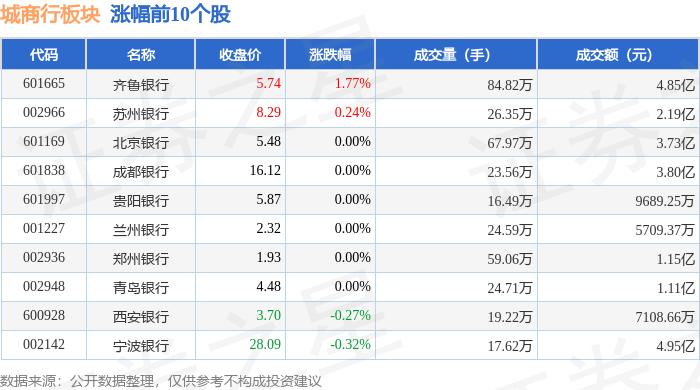
城商行板块12月31日跌0.33%,厦门银行领跌,主力资金净流入2.01亿元
Zheng Xing Xing Ye Ri Bao· 2025-12-31 09:07
Market Overview - The city commercial bank sector experienced a decline of 0.33% on December 31, with Xiamen Bank leading the drop [1] - The Shanghai Composite Index closed at 3968.84, up 0.09%, while the Shenzhen Component Index closed at 13525.02, down 0.58% [1] Individual Bank Performance - Qilu Bank closed at 5.74, up 1.77% with a trading volume of 848,200 shares and a transaction value of 485 million [1] - Suzhou Bank closed at 8.29, up 0.24% with a trading volume of 263,500 shares and a transaction value of 219 million [1] - Xiamen Bank closed at 7.34, down 1.08% with a trading volume of 133,200 shares and a transaction value of 97.8 million [2] - Nanjing Bank closed at 11.43, down 0.78% with a trading volume of 235,600 shares and a transaction value of 270 million [2] Capital Flow Analysis - The city commercial bank sector saw a net inflow of 201 million from institutional investors, while retail investors experienced a net outflow of 9.56 million [2] - The capital flow for individual banks shows that Shanghai Bank had a net inflow of 48.9 million from institutional investors, while Hangzhou Bank had a net outflow of 50.55 million [3] - Suzhou Bank recorded a net inflow of 30.66 million from institutional investors, while retail investors had a net outflow of 27.1 million [3]


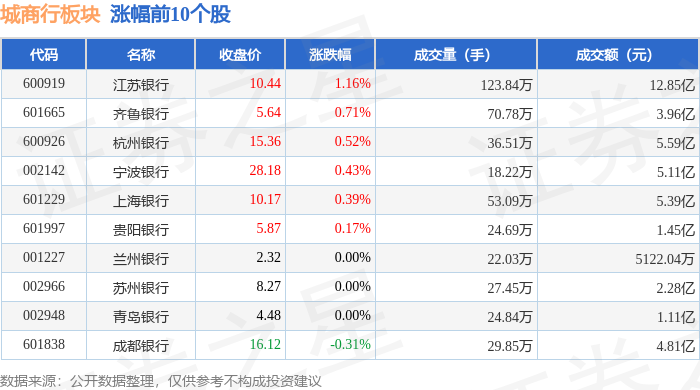
城商行板块12月30日涨0.13%,江苏银行领涨,主力资金净流入1.91亿元
Zheng Xing Xing Ye Ri Bao· 2025-12-30 09:08
Market Performance - The city commercial bank sector increased by 0.13% compared to the previous trading day, with Jiangsu Bank leading the gains [1] - The Shanghai Composite Index closed at 3965.12, down 0.0%, while the Shenzhen Component Index closed at 13604.07, up 0.49% [1] Individual Stock Performance - Jiangsu Bank closed at 10.44, up 1.16% with a trading volume of 1.2384 million shares [1] - Qilu Bank closed at 5.64, up 0.71% with a trading volume of 707,800 shares [1] - Hangzhou Bank closed at 15.36, up 0.52% with a trading volume of 365,100 shares [1] - Ningbo Bank closed at 28.18, up 0.43% with a trading volume of 182,200 shares [1] - Shanghai Bank closed at 10.17, up 0.39% with a trading volume of 530,900 shares [1] - Guiyang Bank closed at 5.87, up 0.17% with a trading volume of 246,900 shares [1] - Chengdu Bank closed at 16.12, down 0.31% with a trading volume of 298,500 shares [2] Capital Flow - The city commercial bank sector saw a net inflow of 191 million yuan from institutional investors, while retail investors experienced a net outflow of 7.0084 million yuan [2] - The main capital inflow and outflow for individual banks are detailed, with Hangzhou Bank receiving a net inflow of 128 million yuan from institutional investors [3] - Jiangsu Bank had a net inflow of 111 million yuan from institutional investors but a net outflow of 124 million yuan from speculative funds [3]



江苏银行斩获金融界“金智奖”投资价值上市公司 以高质量发展韧性铸就投资价值典范
Sou Hu Cai Jing· 2025-12-29 10:04
12月26日,以"新开局、新动能、新征程"为主题的"启航·2025金融峰会"在北京圆满举办,大会由金融界主办,汇聚监管部门、行业协会、金融机构、上市 公司、媒体等数百位相关领导和重磅嘉宾。会上,第十四届金融界"金智奖"年度评选结果重磅揭晓,江苏银行荣获"投资价值上市公司"。 "金智奖"旨在树立高质量发展标杆,引导上市公司聚焦主业、持续创新、践行社会责任,推动资本向优质企业集聚。本届评选中,金融界上市公司研究院紧 密契合"十五五"规划建议中"提升上市公司质量"的要求,将高质量发展内核分解为社会责任、实业贡献、投资回报、成长前景、创新效率、杰出品牌六大维 度,以企业财务数据和公开信息为基础建立量化分析模型,最终覆盖A股、港股及中概股超8000家企业,评选出近200家获奖企业。 "投资价值上市公司"以资本价值与发展潜力为核心评判标准,聚焦财务健康度、行业赛道前景、核心竞争力、公司治理规范性及可持续发展能力。旨在树立 价值投资标杆,推动行业结构优化,引导市场回归理性投资,构建良性资本市场生态。 风险防控是银行稳健经营的核心,江苏银行深入推进风险管理体制改革,智慧化防控体系日益成熟。2025年三季报显示,报告期末不良贷 ...

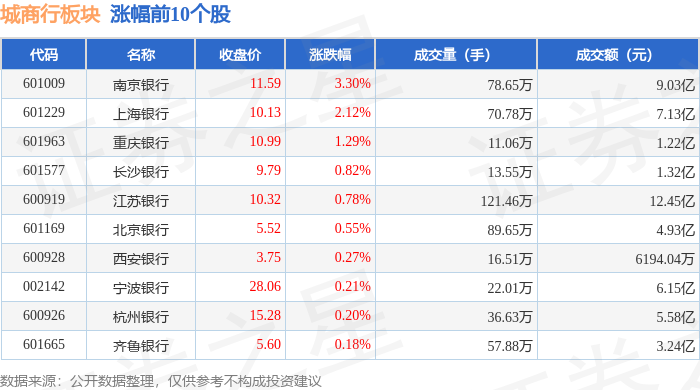
城商行板块12月29日涨0.79%,南京银行领涨,主力资金净流入7889.42万元
Zheng Xing Xing Ye Ri Bao· 2025-12-29 09:06
证券之星消息,12月29日城商行板块较上一交易日上涨0.79%,南京银行领涨。当日上证指数报收于 3965.28,上涨0.04%。深证成指报收于13537.1,下跌0.49%。城商行板块个股涨跌见下表: | 代码 | 名称 | 收盘价 | 涨跌幅 | 成交量(手) | 成交额(元) | | | --- | --- | --- | --- | --- | --- | --- | | 6000109 | 南京银行 | 11.59 | 3.30% | 78.65万 | | 9.03亿 | | 601229 | 上海银行 | 10.13 | 2.12% | 70.78万 | | 7.13亿 | | 601963 | 重庆银行 | 10.99 | 1.29% | 11.06万 | | 1.22亿 | | 601577 | 长沙银行 | 9.79 | 0.82% | 13.55万 | | 1.32亿 | | 616009 | 江苏银行 | 10.32 | 0.78% | 121.46万 | | 12.45 Z | | 601169 | 北京银行 | 5.52 | 0.55% | 89.65万 | | 4.93亿 | | ...