Bank Of Jiangsu(600919)

Search documents
经营周期与配置价值的再平衡-银行业2026年度投资策略
2025-12-29 01:04
Summary of Key Points from the Conference Call Industry Overview - The banking industry is expected to achieve absolute profit growth in 2026, although relative returns and elasticity may be lower [1][2] - Focus on fundamentally strong city commercial banks such as Hangzhou Bank, Jiangsu Bank, and Nanjing Bank [1][2] Core Insights and Arguments - **Interest Margin Stabilization**: There is optimism regarding the stabilization of interest margins in 2026, with some banks potentially seeing a rebound. However, asset quality risks in real estate and retail sectors, particularly concerning mortgage and personal business loans, remain a concern [3][9] - **Risk Bottom Line Establishment**: Establishing a significant risk bottom line is crucial for the valuation recovery of the banking sector. Policy support has alleviated risks in real estate and local government financing [4][5] - **Supply-Side Reform**: The banking sector is undergoing accelerated supply-side reforms, leading to market share concentration among large banks and leading city commercial banks. Capital is becoming a scarce resource, making it easier for stronger banks to obtain capital [6] - **Loan Growth Forecast**: Credit growth is expected to continue its year-on-year decline, with loan balance growth projected to drop to approximately 5.5%. New loan volume may decrease to around 15 trillion yuan, primarily due to ongoing weakness in retail loans [8] - **Profit Growth Expectations**: State-owned banks are expected to see revenue growth driven by interest income, while leading city commercial banks may achieve revenue growth rates of 5% to 8% despite slight declines in net interest margins [11] Additional Important Insights - **Market Concerns on Mortgage Loans**: There are significant concerns regarding mortgage loan risks due to falling property prices and rising delinquency rates. However, many mortgage loans still maintain a comfortable safety margin [13][15] - **Investment Logic for Bank Stocks**: The investment logic for bank stocks is based on undervaluation recovery following the establishment of significant risks. City commercial banks are particularly attractive due to their low price-to-book ratios and high return on equity [16] - **Short-Term Volatility Factors**: The banking sector has faced short-term volatility due to a shift in active funds towards aggressive styles, impacting defensive stocks like banks. However, long-term funds have been increasingly allocated to quality city commercial banks [17][18] Conclusion - The investment strategy for 2026 emphasizes monitoring risks in real estate and retail sectors under regulatory protection, while focusing on undervalued recovery opportunities in quality city commercial banks [7]



江苏银行“美食+”助力消费焕新升级
21世纪经济报道· 2025-12-28 23:14
Core Viewpoint - The article emphasizes the importance of the restaurant industry as a key driver of consumer demand and economic vitality, highlighting Jiangsu Bank's initiatives to integrate financial services into the dining sector to stimulate consumption and support social welfare [1][4]. Group 1: Jiangsu Bank's Initiatives - Jiangsu Bank has launched the "I am Chef" series of activities to promote dining consumption, providing a platform for over 22 million customers to explore local cuisine and enjoy dining discounts [4][6]. - The bank offers a combination of consumer-oriented and merchant-oriented services, including "consumption red envelopes" and payment discounts for consumers, while providing credit and operational support for merchants [4][5]. - The bank has developed a "聚惠" platform to offer significant discounts during promotional events, collaborating with well-known brands to enhance consumer benefits [7][8]. Group 2: Consumer Engagement and Marketing Strategies - Jiangsu Bank organizes various themed food festivals and events throughout the year, such as "Lobster Festival" and "Hot Pot Festival," to keep consumers engaged and stimulate continuous dining consumption [7][8]. - The bank utilizes social media and live streaming to promote food experiences and enhance consumer interaction, creating a vibrant dining atmosphere [4][6]. - Special financial products, such as the "Foodie" credit card, are introduced to provide exclusive benefits and enhance the value of consumer spending [4][5]. Group 3: Financial Services and Support for Merchants - Jiangsu Bank supports restaurant businesses through a comprehensive approach that includes funding, credit support, and wealth management services, aiming to drive growth in the dining sector [5][11]. - The bank's initiatives also focus on enhancing payment experiences for merchants by promoting digital currency transactions, ensuring safer and more efficient payment processes [11]. - By extending financial services to the supply side of the consumption chain, Jiangsu Bank aims to create a win-win situation for consumers and merchants, fostering a thriving consumption ecosystem [11].


银行业 2026 年度投资策略:经营周期与配置价值的再平衡
Changjiang Securities· 2025-12-28 07:31
Core Insights - The foundation for the valuation recovery of bank stocks is the establishment of a solid risk bottom line, with bank stocks currently in the process of confirming this bottom line [4][19] - Stable allocation value is leading the valuation recovery, with financial supply-side reforms accelerating in the long term, resulting in increased concentration of market share among state-owned banks and leading city commercial banks [4][7] - The focus for 2026 is on the stabilization of net interest margins and retail risk pressures, with expectations for improved liability costs driving net interest margins to stabilize [8][21] Group 1: Risk Bottom Line and Valuation Recovery - The valuation cycle of bank stocks fluctuates around the operating cycle, characterized by a pressured macro environment and significantly narrowed bank interest margins since 2023 [7][19] - The market anticipates a stabilization of interest margins and overall asset quality by 2026, although retail and real estate sectors remain under pressure [7][19] - The ongoing process of establishing a risk bottom line is crucial for the recovery of bank stock valuations, with state-owned banks expected to play a leading role in the consolidation of financial institutions [7][30] Group 2: Fundamental Focus on Interest Margin Stabilization and Retail Risk - Total loan growth is expected to decline to 5.5% in 2026, with a year-on-year decrease of approximately 1 trillion yuan, primarily due to continued pressure from retail loans [8][40] - The net interest margin is projected to stabilize, with a potential decrease in deposit costs by 20 to 30 basis points as excess savings from three-year fixed deposits mature [8][21] - Asset quality concerns are particularly focused on mortgage and collateralized loans, with the loan-to-value (LTV) ratio of current mortgage loans remaining at controllable levels [8][21] Group 3: Investment Opportunities and Market Dynamics - Bank stocks are still significantly undervalued from a PB-ROE perspective, especially among quality city commercial banks [9][29] - Despite short-term fluctuations in funding, the allocation value of bank stocks remains intact, with insurance capital continuing to increase its holdings in response to asset scarcity [9][21] - Recommended stocks include Hangzhou Bank, Nanjing Bank, and Jiangsu Bank, with a focus on quality city commercial banks and dividend-yielding assets like China Merchants Bank and Bank of Communications [11][9]



建信中关村产业园封闭式基础设施证券投资基金关于改聘会计师事务所的公告
Shang Hai Zheng Quan Bao· 2025-12-26 19:17
Group 1 - The company has appointed Jiangsu Bank as a new sales agent for certain open-end funds, effective December 29, 2025 [2] - The change in the auditing firm is based on prudent principles and aims to support the development of fund operations and future auditing needs [4] - The new auditing firm possesses qualifications relevant to infrastructure fund auditing, ensuring no adverse impact on project operations or the rights of fund shareholders [4] Group 2 - The announcement regarding the appointment of Jiangsu Bank and the change in auditing firm has been approved by the company's board of directors [4] - Investors can inquire about the fund details through Jiangsu Bank's customer service or the company's hotline [2] - The company emphasizes the importance of reading the fund's contract and prospectus before investing [2]

城商行板块12月26日跌0.67%,厦门银行领跌,主力资金净流出5996.58万元
Zheng Xing Xing Ye Ri Bao· 2025-12-26 09:07
Core Viewpoint - The city commercial bank sector experienced a decline of 0.67% on December 26, with Xiamen Bank leading the drop, while the Shanghai Composite Index rose by 0.1% and the Shenzhen Component Index increased by 0.54% [1] Group 1: Market Performance - The closing price of Xiamen Bank was 7.56, reflecting a decrease of 2.45% with a trading volume of 139,200 shares and a transaction amount of 106 million yuan [2] - Other notable banks included Guizhou Bank at 5.90 (-1.17%), Ningbo Bank at 28.00 (-1.10%), and Chongqing Bank at 10.85 (-0.91%) [2] - The overall city commercial bank sector saw a net outflow of 59.97 million yuan from main funds, while retail funds experienced a net outflow of 80.69 million yuan [2] Group 2: Fund Flow Analysis - Hangzhou Bank had a main fund net inflow of 11.5 million yuan, but retail funds saw a net outflow of 76.27 million yuan [3] - Ningbo Bank recorded a main fund net inflow of 56.33 million yuan, while retail funds had a net outflow of 6.51 million yuan [3] - The overall trend indicates that while some banks attracted main fund inflows, retail investors were largely withdrawing their investments [3]

江苏银行北京宣武门支行开展现金知识 宣传活动
Bei Jing Shang Bao· 2025-12-26 03:00
活动现场,工作人员结合商户日常现金收付高频场景,普及人民币核心防伪特征与简易识别技巧,重点 演示误收假币后的证据留存、部门上报等实操流程,助力商户规避经营风险。此外,工作人员详细解读 了《人民币管理条例》,重点讲解"现金与非现金支付并行"的服务规范,提示大家遵守不得拒收现金的 法律规定,保障消费者支付选择权,同时邀请商户预约零钱包订制及残损币兑换服务,助力其实现"找 零无忧"。 近日,江苏银行北京宣武门支行组建专项服务团队,走进支行周边商圈商户开展现金知识宣传活动。活 动精准对接商户现金使用需求,切实提升商户反假币意识与现金使用效率,帮助商户守好"钱袋子"。 此次宣传活动为商户送上了"干货满满"的现金知识大礼包,支行以专业的讲解赢得了商户的一致认可。 下一步,江苏银行北京宣武门支行将持续聚焦商户金融需求,做好全方位金融服务,为商户营造安全便 捷的现金使用环境。 ...
反假知识“送上门” 江苏银行北京宣武门支行开展反假货币知识宣传活动
Bei Jing Shang Bao· 2025-12-26 03:00
此次宣传活动,是江苏银行北京宣武门支行深化"金融为民"服务理念、积极履行社会责任的具体行动。 展望未来,江苏银行北京宣武门支行将继续深耕金融知识普及工作,走进更多企业与社区,通过线上线 下联动,持续扩大宣传覆盖面,为营造安全、健康的金融消费环境贡献坚实力量。 活动现场,支行通过摆放宣传海报、派发宣传折页以及现场讲座等多种形式,与医院员工进行深度互 动。支行工作人员结合真实案例,用通俗易懂的语言详细拆解了人民币的防伪特征,重点讲解了"一 看、二摸、三听、四测"的识假技巧。针对医院职工在日常现金收付中可能遇到的假币相关场景,支行 工作人员还特别演示了发现假币后的标准处置流程,提示大家不能私自收缴假币,如误收假币要尽快上 交至人行、公安机关或银行网点,确保大家不仅"能识别",更"懂处理"。 为进一步提升企业员工的金融风险防范意识,守护好百姓的"钱袋子",近日,江苏银行北京宣武门支行 走进某眼科医院,开展了一场别开生面的反假货币知识专项宣传活动,将专业的金融安全技能送到医护 人员身边。 "这种老版钞票怎么辨别真伪?""如果收到疑似假币该去哪里鉴定?"面对医院职工的踊跃提问,支行工 作人员耐心一一解答,现场学习氛围持续 ...
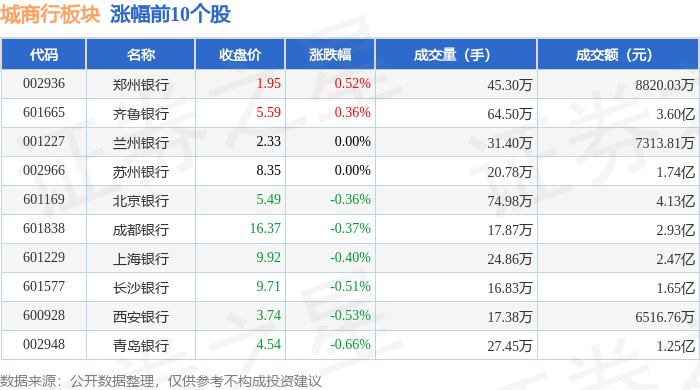
城商行板块12月25日涨0.07%,上海银行领涨,主力资金净流出1.11亿元
Zheng Xing Xing Ye Ri Bao· 2025-12-25 09:14
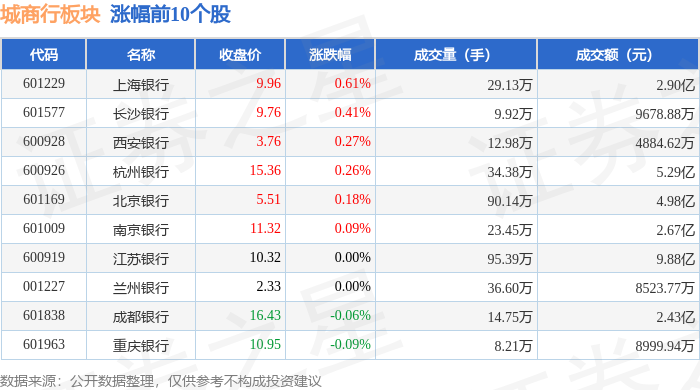
Market Performance - The city commercial bank sector increased by 0.07% compared to the previous trading day, with Shanghai Bank leading the gains [1] - The Shanghai Composite Index closed at 3959.62, up 0.47%, while the Shenzhen Component Index closed at 13531.41, up 0.33% [1] Individual Stock Performance - Shanghai Bank (601229) closed at 9.96, up 0.61% with a trading volume of 291,300 shares and a transaction value of 290 million [1] - Other notable performers include: - Changsha Bank (601577) at 9.76, up 0.41% [1] - Xi'an Bank (600928) at 3.76, up 0.27% [1] - Hangzhou Bank (600926) at 15.36, up 0.26% [1] - Beijing Bank (601169) at 5.51, up 0.18% [1] Capital Flow Analysis - The city commercial bank sector experienced a net outflow of 111 million from institutional investors, while retail investors saw a net inflow of 121 million [2] - The overall capital flow indicates a mixed sentiment, with institutional investors withdrawing funds while retail investors are increasing their positions [2] Detailed Capital Flow by Bank - Hangzhou Bank (600926) had a net inflow of 38.46 million from institutional investors, but a net outflow of 43.46 million from speculative funds [3] - Beijing Bank (601169) saw a net inflow of 23.41 million from institutional investors, with a net outflow of 18.77 million from speculative funds [3] - Guizhou Bank (601997) had a significant net inflow of 22.19 million from institutional investors, but a net outflow of 36.07 million from retail investors [3]

江苏省上市公司ESG-V评级榜|上市公司观察
Sou Hu Cai Jing· 2025-12-25 08:28
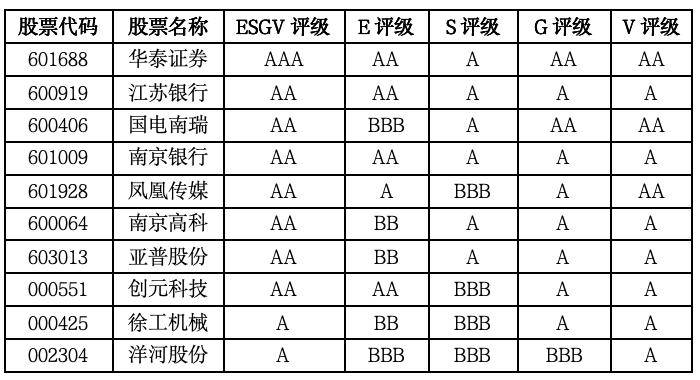
Core Viewpoint - The article discusses the importance of identifying the true responsibility and value of companies in the context of ESG (Environmental, Social, and Governance) governance, particularly through the newly released ESG-V rating list for listed companies in Jiangsu Province, which evaluates 621 companies to provide insights into their sustainable capabilities and investment values [1][2]. Group 1: ESG-V Rating System - The ESG-V rating system incorporates four dimensions: Environment (E), Social (S), Governance (G), and Value (V), aiming to provide a dual perspective of sustainability and investment potential for responsible investing [2][8]. - The top-rated companies, including Heng Rui Medicine, Huatai Securities, and Yuyue Medical, received the highest AAA rating, showcasing strong compliance and stable value characteristics [2][3]. Group 2: Industry Insights - The majority of high-rated companies share common traits such as mature governance structures, clear profit models, and stable value creation, with notable examples in the pharmaceutical and financial sectors [3][4]. - The overall distribution of ratings shows that 43% of companies are rated BBB or above, indicating a foundational balance between environmental, social, governance, and value dimensions among Jiangsu's listed companies [3][4]. Group 3: State-Owned Enterprises Performance - There is a noticeable performance divergence among state-owned enterprises, with some like Jiangsu Bank excelling in governance and value dimensions, while others lag in transparency and environmental management [4]. - The rating distribution reveals a "spindle-shaped" structure, with over 60% of companies rated between BB and A, indicating that many are still in the middle stage of establishing responsible governance [4][5]. Group 4: Future Implications - The ESG-V rating list serves as a lens to observe the ongoing journey of companies in Jiangsu towards green transformation and capital recognition, emphasizing the need for sustainable institutional foundations and rational market pricing for long-term value [8].




年末银行零售信贷竞技:经营贷低至2.35%,消费贷优惠来袭
2 1 Shi Ji Jing Ji Bao Dao· 2025-12-24 14:10
Core Viewpoint - The competition among banks for operating loan rates has intensified, with rates as low as 2.35% being offered, driven by a combination of policy guidance, market competition, and the need for banks to support small and micro enterprises [1][3]. Group 1: Operating Loan Rates - Current operating loan rates are competitive, with banks offering rates around 2.5% for secured loans and approximately 3% for unsecured loans, with potential for further negotiation based on client creditworthiness [1][2]. - A notable case is a small business owner who secured a loan at around 3% linked to the LPR, highlighting the favorable lending environment compared to previous years [1]. - Different banks are focusing on various aspects of their operating loan products, but the common themes are "low rates and high limits" [1]. Group 2: Bank Strategies and Offerings - Major state-owned banks are maintaining stable operating loan rates around 3%, with some offering rates as low as 2.5% for qualified clients [2]. - Banks are enhancing customer engagement through promotional activities, such as referral rewards for existing clients who bring in new customers [2]. - Flexibility in loan eligibility criteria is evident, with banks like Ping An Bank requiring only two years of company establishment and a certain level of account turnover [2]. Group 3: Market Dynamics and Future Outlook - The current favorable operating loan rates are attributed to a combination of shrinking traditional mortgage assets and regulatory encouragement for banks to support small businesses [3]. - Experts predict limited room for significant rate decreases in the short term, with rates likely to stabilize at low levels due to ongoing regulatory support for financial institutions to benefit the real economy [3]. - Concerns about excessively low rates potentially leading to risks such as fund arbitrage are noted, indicating that banks need to maintain a balance in their pricing strategies [3]. Group 4: Consumer Loan Market - Consumer loans are also becoming a competitive area for financial institutions, with rates generally above 3%, and efforts to stimulate consumption through various financial products [4][5]. - Major state-owned banks are offering consumer loan rates in the range of 3.3% to 4.5%, with some flexibility based on individual credit profiles [5]. - Financial institutions are actively promoting consumer loans, especially in anticipation of peak consumption periods, with various incentives and promotional campaigns being launched [6][7].