Bank Of Jiangsu(600919)

Search documents
富时中国A50指数将纳入洛阳钼业、阳光电源
Di Yi Cai Jing· 2025-12-03 10:39
富时罗素宣布对富时中国指数系列的季度审核变更,富时中国A50指数纳入洛阳钼业、阳光电源,剔除 了江苏银行和顺丰控股;调整结果将于2025年12月19日盘后生效。 ...




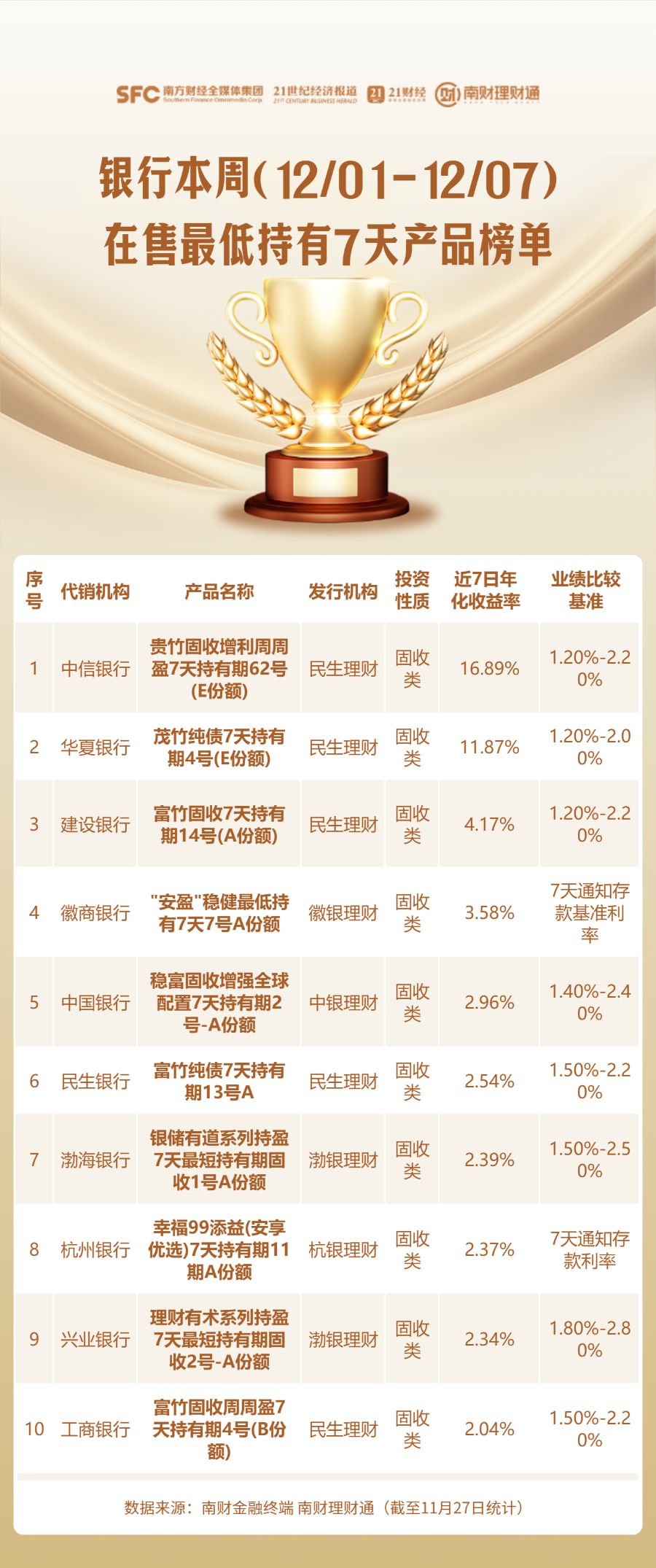
哪家商业银行最低持有期理财产品收益更高?
2 1 Shi Ji Jing Ji Bao Dao· 2025-12-02 10:37
Core Insights - The article focuses on the performance of minimum holding period RMB public offering products, ranking them based on annualized returns for holding periods of 7, 14, 30, and 60 days [1][4][12] Group 1: 7-Day Holding Period Products - The top-performing product is from Minsheng Bank with an annualized return of 4.17% [3] - Other notable products include: - Huishang Bank with 3.58% [3] - Bank of China with 2.96% [3] - Minsheng Bank's Fuzhu Pure Bond with 2.54% [3] - Bohai Bank with 2.39% [3] Group 2: 14-Day Holding Period Products - Minsheng Bank's product "Jingxiang Fixed Income Incremental Dual-Week" leads with a return of 34.68% [5] - Other significant products include: - Minsheng Bank's Fuzhu Pure Bond with 5.66% [5] - WeBank's "Anying" Stable Income with 4.47% [5] - SPDB's "Wealth Management Series" with 2.33% [5] Group 3: 30-Day Holding Period Products - Minsheng Bank's "Guizhu Fixed Income Incremental Monthly" tops the list with a return of 21.23% [9] - Other key products include: - Minsheng Bank's Fuzhu Fixed Income with 13.53% [9] - Bank of China with 7.64% [9] - Huishang Bank's "Happiness 99" with 6.07% [9] Group 4: 60-Day Holding Period Products - The leading product is from Minsheng Bank with a return of 15.12% [13] - Other notable products include: - CITIC Bank's Fuzhu Pure Bond with 8.94% [14] - Bank of China with 4.57% [14] - Huishang Bank's product with 3.46% [14]







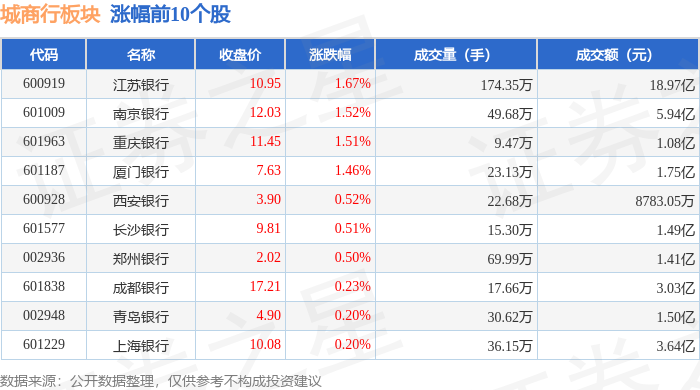
城商行板块12月2日涨0.43%,江苏银行领涨,主力资金净流出3.16亿元
Zheng Xing Xing Ye Ri Bao· 2025-12-02 09:05
Group 1 - The city commercial bank sector increased by 0.43% on December 2, with Jiangsu Bank leading the gains [1] - The Shanghai Composite Index closed at 3897.71, down 0.42%, while the Shenzhen Component Index closed at 13056.7, down 0.68% [1] - Jiangsu Bank's closing price was 10.95, reflecting a 1.67% increase, with a trading volume of 1.7435 million shares and a transaction value of 1.897 billion [1] Group 2 - The city commercial bank sector experienced a net outflow of 316 million from institutional funds, while retail investors saw a net inflow of 421 million [2][3] - The trading data for various banks showed mixed performance, with Ningbo Bank declining by 0.69% and Guizhou Bank remaining unchanged [2] - Shanghai Bank had a net outflow of 46.6477 million from institutional funds, while retail investors contributed a net inflow of 2.33839 million [3]




12月指数定期调样的影响估算




HTSC· 2025-12-01 12:34
Quantitative Models and Construction Methods 1. Model Name: Liquidity Impact Coefficient Model - **Model Construction Idea**: This model measures the liquidity impact of index adjustments on individual stocks by calculating the ratio of net fund flows to the stock's recent average daily trading volume[12][13] - **Model Construction Process**: The liquidity impact coefficient for a stock is calculated as follows: $$ impact_{i} = \sum_{k=1}^{N} \frac{\Delta weight_{k,i} \times AUM_{k}}{amt\_avg_{i,20}} $$ - \( \Delta weight_{k,i} \): Estimated weight change of stock \( i \) in index \( k \) - \( AUM_{k} \): Total assets under management of passive products tracking index \( k \) as of the end of November - \( amt\_avg_{i,20} \): Average daily trading volume of stock \( i \) over the past 20 trading days as of the end of November[12][13] - **Model Evaluation**: The model provides a quantitative framework to estimate short-term liquidity shocks caused by index adjustments, but it is subject to data discrepancies and assumptions, which may lead to deviations from actual results[13] --- Model Backtesting Results Liquidity Impact Coefficient Model - **Top 5 Stocks with Highest Positive Impact Coefficients**: - Zhangjiagang Bank (002839 CH): 11.55[15] - Jiangzhong Pharmaceutical (600750 CH): 11.44[15] - Tower Group (002233 CH): 11.04[15] - Jichuan Pharmaceutical (600566 CH): 10.14[15] - Zhengbang Technology (002157 CH): 9.99[15] - **Top 5 Stocks with Highest Negative Impact Coefficients**: - Shenzhen Expressway (600548 CH): -24.95[16] - Vanward Electric (002543 CH): -20.90[16] - Aviation Materials (688563 CH): -14.06[16] - Huaxi Biology (688363 CH): -10.81[16] - Ninghu Expressway (600377 CH): -10.54[16] --- Quantitative Factors and Construction Methods 1. Factor Name: Net Fund Flow Factor - **Factor Construction Idea**: This factor estimates the net fund inflow or outflow for stocks due to index adjustments, based on changes in index weights and the total AUM of passive products tracking the index[9][10] - **Factor Construction Process**: - Outflow Amount: Total AUM of linked products multiplied by the stock's actual weight in the index as of the end of November - Inflow Amount: Total AUM of linked products multiplied by the estimated weight of the stock in the index post-adjustment - Weight estimation is based on free-float market capitalization and index-specific weighting rules, such as dividend yield weighting or market capitalization weighting[9][10] - **Factor Evaluation**: The factor provides a transparent and systematic approach to estimate fund flows, but it is sensitive to assumptions about future index weights and AUM changes[9][10] --- Factor Backtesting Results Net Fund Flow Factor - **Top 5 Stocks with Highest Net Fund Inflows**: - Victory Precision (300476 CH): 112.61 billion CNY[10] - Dongshan Precision (002384 CH): 99.32 billion CNY[10] - Guangqi Technology (002625 CH): 77.81 billion CNY[10] - Sugon Information (603019 CH): 65.44 billion CNY[10] - Top Group (601689 CH): 53.07 billion CNY[10] - **Top 5 Stocks with Highest Net Fund Outflows**: - China Mobile (600941 CH): -40.02 billion CNY[11] - CRRC Corporation (601766 CH): -36.40 billion CNY[11] - Aluminum Corporation of China (601600 CH): -34.29 billion CNY[11] - TCL Zhonghuan (002129 CH): -30.07 billion CNY[11] - Huagong Tech (000988 CH): -27.44 billion CNY[11]
透视上市银行盈利能力丨银行与保险
清华金融评论· 2025-12-01 10:46
Core Viewpoint - The overall performance of A-share listed banks shows a recovery in both revenue and net profit, with state-owned banks maintaining significant profitability, while the return on equity (ROE) continues to decline across the sector [2]. Revenue Performance - The revenue of listed banks is generally stable with internal differentiation, and state-owned banks continue to stand out [3]. - Over 60% of banks reported positive revenue growth in Q3 2025, with 29 banks showing growth and 13 experiencing declines [4]. - The six major state-owned banks achieved a total revenue of CNY 2.72 trillion, a year-on-year increase of 1.87% in Q3 2025, with all six banks reporting growth [4]. - Among the four major banks, Industrial and Commercial Bank of China (ICBC) had the highest revenue at CNY 821.80 billion, up 2.17% year-on-year [4]. - Joint-stock banks reported a total revenue of CNY 1.12 trillion, a decline of 2.56% year-on-year, with only two banks showing revenue growth [5][6]. - City commercial banks collectively generated CNY 402.08 billion in revenue, a year-on-year increase of 4.67%, with 14 out of 17 banks reporting growth [7]. - Rural commercial banks saw a slight decline in revenue, totaling CNY 790.64 billion, with 10 banks reporting a minor decrease of 0.03% year-on-year [8]. Net Profit Performance - The net profit of listed banks steadily increased, with 35 banks reporting year-on-year growth and 7 experiencing declines [10]. - The six major state-owned banks reported a combined net profit of CNY 1.09 trillion, a year-on-year increase of 1.32% in Q3 2025, with all six banks achieving positive growth [10]. - ICBC led the state-owned banks with a net profit of CNY 271.88 billion, up 0.52% year-on-year [10]. - Joint-stock banks collectively reported a net profit of CNY 406.10 billion, a slight decline of 0.10% year-on-year, with only four banks showing profit growth [11]. - City commercial banks achieved a net profit of CNY 173.60 billion, reflecting a year-on-year increase of 6.79%, with 16 banks reporting growth [12]. - Rural commercial banks reported a total net profit of CNY 377.78 billion, a year-on-year increase of 3.41%, with most banks showing varying degrees of growth [13]. Return on Equity (ROE) - The overall ROE for listed banks continued to decline, with only one bank exceeding the regulatory benchmark of 11% [14]. - Among state-owned banks, none met the 11% ROE requirement, with the highest being Construction Bank at 7.40% [15]. - Joint-stock banks also fell short of the 11% benchmark, with the best performer, China Merchants Bank, achieving an ROE of 9.13% [15]. - City commercial banks did not meet the 11% standard either, with only two banks exceeding 10% [16]. - In the rural commercial bank sector, only one bank met the regulatory requirement, with Jiangsu Changshu Rural Commercial Bank leading at 11.36% [18].




城商行板块12月1日涨1.5%,厦门银行领涨,主力资金净流出2.78亿元
Zheng Xing Xing Ye Ri Bao· 2025-12-01 09:10
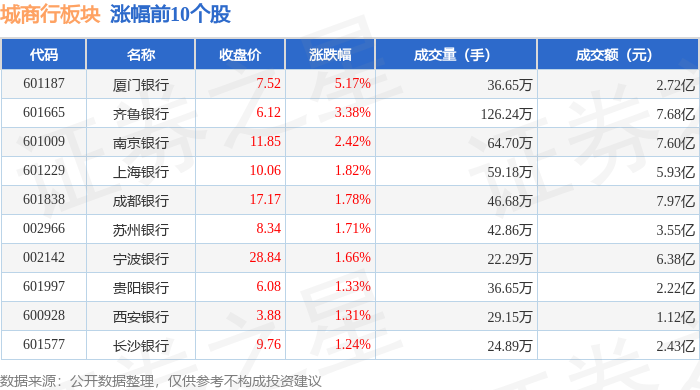
Market Performance - The city commercial bank sector increased by 1.5% on December 1, with Xiamen Bank leading the gains [1] - The Shanghai Composite Index closed at 3914.01, up 0.65%, while the Shenzhen Component Index closed at 13146.72, up 1.25% [1] Individual Bank Performance - Xiamen Bank's closing price was 7.52, with a rise of 5.17% and a trading volume of 366,500 shares, amounting to 272 million yuan [1] - Qilu Bank closed at 6.12, up 3.38%, with a trading volume of 1.26 million shares, totaling 768 million yuan [1] - Nanjing Bank's closing price was 11.85, increasing by 2.42%, with a trading volume of 647,000 shares, amounting to 760 million yuan [1] - Shanghai Bank closed at 10.06, up 1.82%, with a trading volume of 591,800 shares, totaling 593 million yuan [1] - Chengdu Bank's closing price was 17.17, increasing by 1.78%, with a trading volume of 466,800 shares, amounting to 797 million yuan [1] Fund Flow Analysis - The city commercial bank sector experienced a net outflow of 278 million yuan from institutional investors, while retail investors saw a net inflow of 240 million yuan [1] - The table shows various banks' net fund flows, indicating mixed results among different institutions [2]


重磅调研来了
Zhong Guo Ji Jin Bao· 2025-12-01 02:20
Core Viewpoint - The integration of technology and finance is driving the high-quality development of innovative enterprises in China, with banks playing a crucial role in providing tailored financial services to support the growth of these companies [1][2]. Group 1: Financial Support for Technology Enterprises - Jiangsu province has over 89,000 technology-based SMEs and 57,000 high-tech enterprises, leading the nation in these categories [2]. - By the end of Q3 2025, the balance of technology loans in Jiangsu exceeded 5 trillion yuan, a year-on-year increase of 16% [2]. - The China Bank Jiangsu branch provided systematic financial services to technology enterprises, adjusting support based on company performance over seven years [3][4]. Group 2: Comprehensive Financial Services - China Bank Jiangsu branch served over 24,000 technology finance clients, with a technology loan balance of 551.7 billion yuan, up 21.9% year-on-year [4]. - Construction Bank Suzhou branch developed a "3+4" technology financial service system, enhancing support for technology innovation [4][5]. - By the end of October 2025, Construction Bank Suzhou branch served over 12,000 technology enterprises, with a technology loan balance exceeding 160 billion yuan [5]. Group 3: Innovative Financial Products - Jiangsu Bank launched products like "Smart Transformation Loan" and "Low Carbon Loan" to meet the needs of growing technology enterprises [6][7]. - By September 2023, Jiangsu Bank's technology loan balance reached nearly 290 billion yuan, serving 24,000 technology enterprise clients [7]. - Changshu Rural Commercial Bank focused on small and micro enterprises, providing tailored financial services and achieving over 2200 technology enterprise loans with a balance exceeding 15 billion yuan [6][7]. Group 4: Collaborative Financial Models - Zhejiang province introduced the "Zheke United Loan" model to enhance cooperation among banks, addressing the limitations of single-bank services [8][10]. - Since its launch, 27 banks in Zhejiang have participated in the "Zheke United Loan," providing loans totaling 10.87 billion yuan to 197 enterprises [11]. - The model allows for risk-sharing among banks, enhancing the capacity to support technology enterprises [10][11]. Group 5: Growth-Focused Financial Initiatives - Anhui province implemented the "Common Growth Plan" to address the mismatch between risk and return in technology credit [15][19]. - By September 2023, the plan had signed over 15,000 enterprises, with a loan balance exceeding 210 billion yuan [17][18]. - The "Common Growth Plan 2.0" introduced a "Stock Option Income Swap Model" to facilitate easier access to financing for technology enterprises [19][21].
长三角6家上市城商行的韧性增长:息差承压之下营收净利双增,对公业务成信贷“主引擎”
Mei Ri Jing Ji Xin Wen· 2025-11-30 12:34
Core Insights - The six A-share listed city commercial banks in the Yangtze River Delta are demonstrating resilient growth despite the pressure of narrowing interest margins, achieving both revenue and net profit growth in the first three quarters of the year [1][2] Revenue and Profit Growth - All six banks reported year-on-year growth in net interest income, with Nanjing Bank and Jiangsu Bank leading with growth rates of 28.52% and 19.61% respectively, ranking among the top in A-share listed banks [2][3] - Jiangsu Bank achieved a revenue of 671.83 billion yuan and a net profit of 305.83 billion yuan, leading among city commercial banks [2] Asset Expansion - As of the end of September, Jiangsu Bank held total assets of 4.93 trillion yuan, marking a 24.68% increase from the beginning of the year, making it the fastest-growing bank in terms of asset size among A-share listed banks [4][5] - Other banks like Ningbo Bank and Nanjing Bank also reported double-digit asset growth rates [4] Loan and Deposit Growth - The six banks experienced robust growth in both loans and deposits, with Jiangsu Bank's deposits reaching 2.54 trillion yuan, a 20.22% increase, the only bank in A-share with such growth [5] - Corporate loans became the main driver for credit expansion, with significant increases in sectors like technology finance, inclusive finance, and green finance [5][6] Asset Quality - The overall asset quality of the six banks remained stable, with non-performing loan ratios either holding steady or declining, indicating effective risk management strategies [7][8] - Jiangsu Bank's non-performing loan ratio decreased to 0.84%, while Nanjing Bank's ratio remained stable at 0.83% [7] Capital Adequacy - Shanghai Bank reported a high core Tier 1 capital adequacy ratio of 10.52%, reflecting improvements in capital management and risk mitigation strategies [8] - Several banks have completed convertible bond conversions to strengthen their capital positions [8] Dividend Distribution - Several banks, including Shanghai Bank and Suzhou Bank, have completed mid-term dividend distributions, with Jiangsu Bank and Ningbo Bank also progressing on their dividend plans [9][10] - The focus on increasing cash dividends reflects a commitment to enhancing shareholder returns, with some banks planning to maintain a cash dividend ratio of no less than 30% in the coming years [10]

城商行板块11月28日跌0.62%,上海银行领跌,主力资金净流出3.79亿元
Zheng Xing Xing Ye Ri Bao· 2025-11-28 09:05
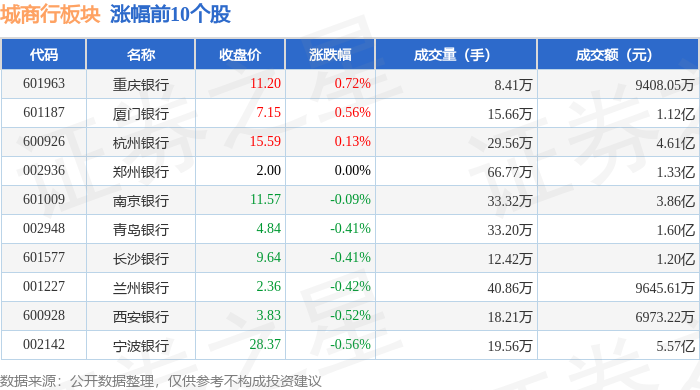
Core Viewpoint - The city commercial bank sector experienced a decline of 0.62% on November 28, with Shanghai Bank leading the drop, while the overall stock market showed slight gains [1][2]. Market Performance - The Shanghai Composite Index closed at 3888.6, up 0.34% - The Shenzhen Component Index closed at 12984.08, up 0.85% [1]. Individual Stock Performance - Chongqing Bank: Closed at 11.20, up 0.72%, with a trading volume of 84,100 shares and a turnover of 94.08 million yuan - Xiamen Bank: Closed at 7.15, up 0.56%, with a trading volume of 156,600 shares and a turnover of 112 million yuan - Hangzhou Bank: Closed at 15.59, up 0.13%, with a trading volume of 295,600 shares and a turnover of 461 million yuan - Zhengzhou Bank: Closed at 2.00, unchanged, with a trading volume of 667,700 shares and a turnover of 13.3 million yuan - Nanjing Bank: Closed at 11.57, down 0.09%, with a trading volume of 333,200 shares and a turnover of 38.6 million yuan - Qingdao Bank: Closed at 4.84, down 0.41%, with a trading volume of 332,000 shares and a turnover of 16 million yuan - Changsha Bank: Closed at 9.64, down 0.41%, with a trading volume of 124,200 shares and a turnover of 12 million yuan - Lanzhou Bank: Closed at 2.36, down 0.42%, with a trading volume of 408,600 shares and a turnover of 96.46 million yuan - Xi'an Bank: Closed at 3.83, down 0.52%, with a trading volume of 182,100 shares and a turnover of 6.97 million yuan - Ningbo Bank: Closed at 28.37, down 0.56%, with a trading volume of 195,600 shares and a turnover of 557 million yuan [1][2]. Capital Flow Analysis - The city commercial bank sector saw a net outflow of 379 million yuan from institutional investors, while retail investors contributed a net inflow of 86.74 million yuan [2][3]. - The following stocks had notable capital flows: - Hangzhou Bank: Net inflow of 9.48 million yuan from institutional investors - Qilu Bank: Net inflow of 6.55 million yuan from institutional investors - Suzhou Bank: Net inflow of 6.07 million yuan from institutional investors - Qingdao Bank: Net inflow of 3.22 million yuan from institutional investors - Lanzhou Bank: Net inflow of 2.34 million yuan from institutional investors - Zhengzhou Bank: Net outflow of 0.96 million yuan from institutional investors - Guizhou Bank: Net outflow of 1.41 million yuan from institutional investors - Xi'an Bank: Net outflow of 2.69 million yuan from institutional investors - Nanjing Bank: Net outflow of 9.30 million yuan from institutional investors - Chongqing Bank: Net outflow of 9.87 million yuan from institutional investors [3].
十二月金股汇
Dongxing Securities· 2025-11-28 02:52
Group 1: Company Performance Highlights - Rilian Technology (688531.SH) achieved a revenue growth of 44.01% year-on-year, with a total revenue of 737 million CNY in the first three quarters of 2025[10] - Weisheng Information (688100.SH) reported a total revenue of 2.745 billion CNY in 2024, reflecting a year-on-year growth of 23.35%[14] - Foxit Software (688095.SH) recorded a revenue of 676 million CNY in the first three quarters of 2025, up 32.81% year-on-year[16] - Zhejiang Xiantong (603239.SH) maintained a strong position in the automotive sealing strip market, benefiting from the rising demand for high-end products[21] - Jin Yinhe (300619.SH) reported a significant increase in net profit by 220.37% year-on-year, reaching 12 million CNY in the third quarter of 2025[30] Group 2: Market Trends and Strategic Moves - Rilian Technology plans to acquire 66% of SSTI, enhancing its capabilities in semiconductor testing equipment[12] - Weisheng Information is expanding its international business, focusing on energy IoT projects in countries along the Belt and Road[15] - Foxit Software is transitioning to a subscription model, with subscription revenue growing by 68% year-on-year in the third quarter[18] - Zhejiang Xiantong is entering the robotics sector, aiming to diversify its business and enhance growth potential[24] - Jin Yinhe is expected to benefit from the lithium battery industry's growth, with projected revenues of 20.50 billion CNY in 2025[36]