
HZBank(600926)

Search documents
银行股热度持续攀升 去年四季度业绩改善“强势出圈”
Zheng Quan Shi Bao· 2025-04-24 22:13
Group 1 - Since April, 9 bank stocks have reached historical highs, indicating a sustained increase in industry interest [1][2] - In Q4 2024, bank performance has significantly improved, with many banks reporting positive results in Q1 of this year [1][5] - The total cash dividends for the banking sector are expected to reach a new high, with 12 bank stocks each exceeding 10 billion yuan in annual dividends [1][7] Group 2 - On April 24, the banking index closed up 1.16%, with major banks like Bank of China, Agricultural Bank of China, and Industrial and Commercial Bank of China hitting record highs [2] - The stock prices of major banks have steadily increased this year, with Shanghai Bank showing a year-to-date increase of 15.52% [2] - The banking sector is favored as a low-valuation, high-dividend defensive asset amid ongoing market fluctuations [3] Group 3 - Over 90% of the 36 bank stocks that have released their 2024 annual reports or performance forecasts reported year-on-year profit growth [5] - Shanghai Pudong Development Bank reported the highest year-on-year profit growth at 23.31%, driven by rapid credit growth and improved asset quality [5] - The total net profit of the disclosed bank stocks in Q4 2024 exceeded 480 billion yuan, marking a 5.66% increase from the previous year [5] Group 4 - Five bank stocks have released Q1 2025 performance reports, with several banks reporting year-on-year profit growth [6] - Major banks have indicated ongoing improvements in their asset-liability structures and operational efficiency [6] Group 5 - As of April 24, 29 bank stocks have announced dividend plans, with a total cash dividend amounting to 357.84 billion yuan [7] - The cumulative cash dividends for the banking sector in 2024 have reached 616.13 billion yuan, surpassing the previous year's total [8] - Industrial and Commercial Bank of China announced a cash dividend of 1.646 yuan per 10 shares, totaling 58.66 billion yuan, marking a continuous growth for nine years [8]





超6000亿元分红!本周正式开启
21世纪经济报道· 2025-04-24 14:56
Core Viewpoint - The article discusses the commencement of the bank dividend season in China, highlighting the significant cash dividends announced by various banks, particularly state-owned banks, and the trends in dividend distribution for 2024. Group 1: Dividend Announcements - Starting from this week, the bank dividend season officially begins, with China Bank announcing a cash dividend of 0.1216 yuan per share for the year-end of 2024 [2] - As of April 23, 36 banks have disclosed their dividend plans, with a total dividend amount of 616.26 billion yuan, including over 230 billion yuan in interim dividends from the previous year [3][8] - China Bank's annual dividend distribution is notably earlier than in previous years, which typically occurred between June and July [5] Group 2: Dividend Distribution Details - According to the distribution plan, China Bank will distribute a total cash dividend of 35.798 billion yuan based on its total ordinary share capital of 29.4388 billion shares, with A-shares accounting for 25.629 billion yuan of this total [6][7] - The total cash dividend for the year 2024, including interim dividends, amounts to 0.2424 yuan per share, totaling approximately 71.36 billion yuan [7] Group 3: Performance of Major Banks - The six major state-owned banks have collectively announced dividends exceeding 420 billion yuan, with all six banks increasing their dividend amounts compared to the previous year, totaling nearly 100 billion yuan more [8][9] - The total dividend amount for the six major banks accounts for over 70% of the entire banking sector's dividend total, indicating their strong profitability and dividend capacity [9] Group 4: Dividend Yields and Trends - Industrial and Commercial Bank of China leads with a dividend amount of 109.773 billion yuan, followed by China Construction Bank with 100.754 billion yuan, and Agricultural Bank of China and China Bank with 84.661 billion yuan and 71.36 billion yuan, respectively [9][10] - The average dividend payout ratio for state-owned banks remains stable at 30% or higher, with an increasing trend in dividend frequency to twice a year [9][11] Group 5: Individual Bank Strategies - China Merchants Bank plans to initiate interim dividends for 2025, marking its first such distribution, with a cash dividend ratio of 35.3% last year [10] - Other banks, such as Industrial Bank and Huaxia Bank, have also committed to maintaining or increasing their dividend payout ratios above 30% [11][15] - Zhejiang Merchants Bank's cash dividend for 2024 is 4.284 billion yuan, maintaining a payout ratio above 30%, although slightly lower than previous years [13] Group 6: Overall Market Sentiment - The trend of increasing dividends is seen as a way to enhance investor confidence and stabilize stock prices, with analysts emphasizing the importance of sustainable dividend policies based on solid operational performance [16]





“大象股”也疯狂!这个板块密集新高
Zheng Quan Shi Bao Wang· 2025-04-24 11:03
Group 1 - The banking sector has seen 9 stocks reach historical highs this month, including major state-owned banks like ICBC, ABC, and CCB, with significant year-to-date gains [2][4] - The banking sector index rose by 1.16% on April 24, outperforming the market, with notable increases in stock prices for major banks [2][3] - The overall performance of the banking sector improved significantly in Q4 of the previous year, with 33 out of 36 banks reporting year-on-year profit growth [4][5] Group 2 - The total cash dividends announced by banks for 2024 have reached a record high of 6,161.26 billion yuan, surpassing the previous year's total [6][7] - Major banks like ICBC, CCB, and ABC have declared dividends exceeding 500 billion yuan, contributing to the sector's reputation for high dividends [6][7] - Ningbo Bank reported the highest year-on-year increase in dividends at 50%, indicating a strong commitment to shareholder returns [7]

派的早、红包大!银行派现潮启幕,分红总额突破6000亿元
2 1 Shi Ji Jing Ji Bao Dao· 2025-04-24 06:14
根据统计,截至4月23日,已经有36家银行披露了分红计划,分红总额为6161.26亿元,这其中包括去年 超2300亿元的中期分红。 分红大户 从本周开始银行分红季正式开启。4月20日,中国银行发布公告显示,中国银行A股每股派发2024年末 期现金红利0.1216元(税前,下同),股权登记日为4月24日,除权(息)日为4月25日,现金红利发放 日为4月25日。 华福证券分析称,观察近3年不同类型上市银行现金分红情况,国有大行保持稳定的高现金分红比例, 近3年现金分红比例均超30%;股份制商业银行近3年平均现金分红比例逐年提升,2023年达到29.4%; 城商行近3年平均现金分红比例有所下滑,2023年平均现金分红比例为24.8%;农商行现金分红比例为 各类银行中最低,2023年平均现金分红比例为22%。 值得注意的是,中国银行此次年度分红落地明显早于往年。数据显示,中国银行自2006年在A股上市以 来,年度分红派息时间均在6月至7月。 根据分配方案,中国银行2024年末期利润分配以方案实施前的该行普通股总股本2943.88亿股为基数, 每股派发现金红利0.1216元,共计派发现金红利357.98亿元。其中,A股 ...

上市城商行2024业绩盘点!郑州银行营收同比降超5%,北京银行净利排名被宁波银行超越
Xin Lang Cai Jing· 2025-04-24 00:40
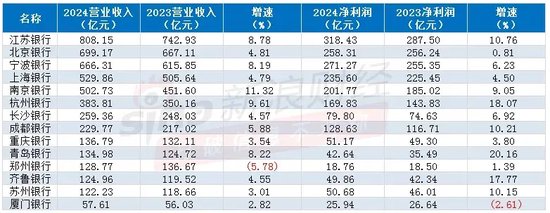
Core Insights - In 2024, 14 out of 17 A-share listed city commercial banks have reported their financial results, with 13 showing positive revenue growth, while only Zhengzhou Bank experienced a decline [1][2][4] - Beijing Bank fell to third place in net profit rankings, overtaken by Ningbo Bank, with a slight increase of 0.81% year-on-year [1][5][6] - Asset quality improved for 10 banks, with a decrease in non-performing loan (NPL) ratios, while Zhengzhou Bank had the highest NPL ratio at 1.79% [1][7][10] Revenue Performance - Jiangsu Bank led with a revenue of 808.15 billion yuan, followed by Beijing Bank and Ningbo Bank, both exceeding 600 billion yuan [3][4] - Zhengzhou Bank reported a revenue decline of 5.78%, dropping to the 11th position among the banks [2][4] - Nanjing Bank showed strong performance with a revenue increase of 11.32%, reaching 502.73 billion yuan [4] Net Profit Analysis - The top three banks in net profit were Jiangsu Bank (318.43 billion yuan), Ningbo Bank (271.27 billion yuan), and Beijing Bank (258.31 billion yuan) [5][6] - Beijing Bank's net profit growth was the lowest in four years, while Qingdao Bank, Hangzhou Bank, and Qilu Bank reported significant growth rates exceeding 17% [6] Asset Quality Metrics - Ten banks reported a decrease in NPL ratios, with Zhengzhou Bank having the highest at 1.79% [8][10] - The provision coverage ratios for all banks were above the regulatory minimum of 150%, with Hangzhou Bank leading at 541.45% [11][12] Asset Growth - Total assets for the 14 banks showed positive growth, with Jiangsu Bank, Suzhou Bank, and Ningbo Bank exceeding 15% growth [13][15] - Beijing Bank maintained the largest asset size at over 4.2 trillion yuan, while Xiamen Bank had the smallest at 407.83 billion yuan [15][16] Strategic Insights - Banks are focusing on regional advantages and optimizing their business strategies to enhance competitiveness [16][17] - Nanjing Bank aims for high-quality development and value creation, while Hangzhou Bank emphasizes regional marketing strategies [17]



险资“盯上”城商行
阿尔法工场研究院· 2025-04-23 13:33
导语 :当5200亿国有大行注资落地,险资与城商行的"东风"又何时到来? 一边是银行业净息差持续走低,另一边却是险资逆势扫货。 4月15日,杭州银行(600926.SH)发布公告称,新华保险(601336.SH)受让该公司3.3亿股获批。 杭州银行,是今年以来被险资举牌的第4家银行。其中,招商银行还被平安人寿"举牌"了两次。 以下文章来源于阿尔法工场金融家 ,作者金妹妹 追踪保险银行业圈内动态,剖析最新风向,分享有料、有价值的"内行人"洞察见解。 作 者 | 金妹妹 阿尔法工场金融家 . 来源 | 阿尔法工场金融家 金妹妹从近年来上市公司的年报中统计,在险资持股市值前10位的个股中,有7只都是银行股。 在去年险资纷纷开启的新一轮"举牌潮"中,银行股已颇受青睐。进入2025年后,这一趋势表现得更 为明显。 银行业受到的种种经营挑战,并不影响险资入局银行股的决心。高企的分红率、新会计准则带来的 平滑效应、以及银行和保险的战略协同,都让险资对银行动心不已。 银行同样也需要长期稳定的资金支持,以度过经济周期下转型不可避免的阵痛。 金妹妹从业内了解到,在本轮国有大行注资落地前,今年初,几家具有代表性的大型保险公司受邀 ...

回馈投资者!近6000亿“红包雨”即将来袭
Jin Rong Shi Bao· 2025-04-23 11:10
随着A股上市银行年报的陆续披露,各家银行的分红方案也陆续拉开了帷幕。 《金融时报》记者梳理数据时发现,截至4月22日,在42家A股上市银行中,共有26家银行公布了2024 年分红方案。从分红金额来看,这26家银行累计派发现金红利近6000亿元,较去年增加超百亿元。 分机构类型来看,六家国有大行依旧是上市银行分红的"主力军"。根据年报数据,2024年六大行现金分 红金额合计超4200亿元,占全行业分红总额超七成,且分红比例均稳定在30%及以上。 其中,工商银行(601398)以1097.73亿元的派息总额领跑全行业,建设银行(601939)2024年分红金 额也超过千亿元,达1007.54亿元。农业银行(601288)、中国银行(601988)、交通银行 (601328)、邮储银行(601658)2024年分别派发现金红包846.61亿元、713.6亿元、281.46亿元和 259.41亿元。 股份制银行的分红情况也十分亮眼,但也出现了一定分化。招商银行(600036)以504.4亿元的分红总 额稳坐股份行的"头把交椅"。兴业银行(601166)分红总额达到220.21亿元,分红比例首次突破30%。 "2024 ...


从三个县域小故事看杭州银行如何赋能区域民营经济
Zhong Guo Jin Rong Xin Xi Wang· 2025-04-23 07:43
Group 1: Economic Characteristics and Financial Support - The block-style characteristic industry is a prominent feature of Zhejiang's economy since the reform and opening up, with the private economy being the main force behind it [1] - Hangzhou Bank focuses on policy guidance and regional characteristics, innovating financial products to empower county economies and support private enterprises in Zhejiang [1] - As of the end of 2024, Hangzhou Bank's loans in manufacturing, green finance, technology, and inclusive small microcredit have seen year-on-year growth of 26.27%, 21.52%, 29.52%, and 29.91% respectively [1] Group 2: Technological Innovation and Financial Solutions - Financial support is crucial for the rapid technological iteration and high R&D investment in the new energy industry, acting as a catalyst for the transformation of scientific achievements [2] - A specific new energy technology company in Changxing has developed key technologies for lithium battery-related functional films, supported by a tailored technology loan of 4.5 million yuan from Hangzhou Bank [2] - The financial backing has enabled the company to enhance R&D efforts, optimize product performance, and significantly improve market competitiveness, contributing to regional economic development [2] Group 3: Intellectual Property Financing - Intellectual property financing is an effective attempt to address the financing difficulties faced by small and medium-sized enterprises while unlocking the market value of intellectual property [3] - A daily necessities company specializing in cotton swabs and other hygiene products received a 3 million yuan loan through a patent pledge loan scheme, alleviating financial pressure and reducing costs [3] - The loan has allowed the company to increase R&D investment and expand its international market presence [3] Group 4: Marine Industry and Financial Innovation - The fishing industry in Zhoushan is supported by policies and financial initiatives, with Hangzhou Bank providing tailored loans to enhance the efficiency of aging fishing vessels [6][7] - The bank has issued loans to over 50 squid fishing boats and supported more than 20 marine enterprises in upgrading vessels and optimizing production capacity [7] - Financial products like "Comprehensive Loans for Ocean Fisheries" and "Cloud Pledge Loans" address the operational funding needs of fishing enterprises, enabling them to operate more efficiently [7][8]
出海热撞上“对等关税”,银行跨境金融业务能否再获“大丰收”?
券商中国· 2025-04-21 01:25
随着国内经济转型,银行机构普遍处于息差收窄、营收放缓的境地。然而,券商中国记者梳理上市银行 2024年年报发现,不少上市银行的国际结算量猛增,带来的收益呈现可观的正增长。 随着我国外贸"朋友圈"越来越大,服务企业出海需求以及跨境电商等中小微企业,成为商业银行拓展营收的重 要途径。 近期有国有大行的银行高管在业绩说明会上表示要提高境外机构的协同,也有股份行在其年报中直接表示 要"力争用三年时间走进同类型银行第一梯队",此外还有一些中小银行高管表态要拓展客户国际化,拓展跨境 金融方面的收入。 不可忽视的是,不同于去年,2025年美国推出所谓的"对等关税",中小企业出海尤其对口美国相关业务出现 了不确定性,国际金融市场的波动又将对企业出海和银行国际化转型带来哪些复杂的影响? 国际业务对营收贡献增大 我国进出口规模于2024年再创历史新高,并实现了同比增长5%,这给国内商业银行的营收带来了提升效应。 以中国银行为例,该行跨境业务是其传统优势业务,并领先同业。2024年在境内资产总额增速放缓、盈利指 标增速和贡献度下降的情况下,中国银行在"中国香港澳门台湾地区",以及"其他国家和地区"实现了经营规模 和业绩较快增长,且 ...

杭州银行:深化消费金融发展战略,助力市场信心修复与消费复苏
Quan Jing Wang· 2025-04-21 00:27
Group 1 - The core viewpoint of the news is that Hangzhou Bank is actively promoting consumer finance to boost consumption and is seeing a recovery in housing loan demand in the Hangzhou region [1][2] - In Q1 2025, the number of new homes sold in Hangzhou reached 12,007 units, and second-hand homes reached 23,605 units, representing a year-on-year increase of 1% and 35% respectively, indicating a gradual recovery in market confidence [1] - Hangzhou Bank is implementing a three-pronged strategy of "product optimization + customer segmentation + technology empowerment" to enhance its consumer loan offerings and meet diverse customer needs [1] Group 2 - The bank's consumer loan issuance increased by 16% in 2024, while the balance grew by 12%, with market share in various regions also improving [1] - Hangzhou Bank is committed to creating a positive cycle of "consumer finance - resident consumption - real economy" by providing high-quality consumer financial services to residents [2]