
HZBank(600926)

Search documents
优先股隐退永续债上位!银行业资本补充进入密集冲刺期,年利息至少省3%
Xin Lang Cai Jing· 2026-01-04 05:31
Core Viewpoint - The Chinese banking industry is undergoing a significant transformation, with banks redeeming high-cost preferred shares and issuing perpetual bonds as a more cost-effective financing alternative, driven by declining social financing costs and regulatory changes [2][4][11]. Group 1: Redemption of Preferred Shares - By the end of 2025, a total of 9 banks announced the redemption of preferred shares, amounting to 111.8 billion RMB in domestic preferred shares and 5.72 billion USD in foreign preferred shares [4]. - In December 2025 alone, five banks, including Changsha Bank and Beijing Bank, redeemed a total of 45.8 billion RMB in preferred shares [3]. - The redemption of preferred shares is facilitated by their lack of maturity dates but includes redemption clauses, allowing banks to manage capital flexibly [4]. Group 2: Issuance of Perpetual Bonds - As of December 31, 2025, Chinese commercial banks issued 69 perpetual bonds, raising a total of 821.8 billion RMB, marking a historical high in both issuance quantity and scale [5]. - The interest rates for newly issued perpetual bonds generally ranged from 2.0% to 2.9%, the lowest in nearly three years, with a significant issuance peak occurring in the second half of 2025 [5][6]. - The issuance of perpetual bonds is seen as a response to the urgent need for capital replenishment, especially among small and medium-sized banks facing declining capital adequacy ratios [2][6]. Group 3: Cost Savings and Financial Efficiency - By replacing preferred shares with perpetual bonds, banks can save at least 3% annually on interest expenses, significantly reducing their financing costs [8][10]. - For instance, the interest rate on newly issued perpetual bonds is substantially lower than that of previously issued preferred shares, with examples showing potential annual savings of 12.8 million RMB for banks like Industrial Bank [10]. - The transition from preferred shares to perpetual bonds is viewed as a strategic move to optimize capital structure and reduce interest payment burdens, aligning with regulatory requirements [8][10]. Group 4: Regulatory Environment and Market Dynamics - The shift towards perpetual bonds is influenced by regulatory changes that favor capital instruments with loss absorption capabilities, making traditional preferred shares less attractive [11]. - The approval process for issuing perpetual bonds is simpler and faster compared to preferred shares, which require dual regulatory approvals, thus enhancing their appeal to banks [11]. - The current low-interest-rate environment is expected to persist, allowing banks to lock in low financing costs for the next 5 to 10 years, effectively mitigating the pressure from narrowing net interest margins [10].








媒体看杭银 | 扎根山海间 “活水”润实体 杭州银行因地制宜服务实体经济高质量发展
Xin Lang Cai Jing· 2026-01-04 01:29
Group 1 - The core idea of the articles revolves around the role of financial institutions, particularly Hangzhou Bank, in supporting small and medium-sized enterprises (SMEs) and enhancing their operational capabilities through innovative financing solutions [1][2][3][4][5][6][7][8][9][11][12][13][14][15][16][17][18][19][20] Group 2 - Hangzhou Bank provided an 8 million yuan credit loan to Zhejiang Haishide Food Co., Ltd., which is on the verge of achieving an annual output value of nearly 200 million yuan, helping stabilize the company amid fluctuating squid raw material prices [1][6][11][17] - The bank has developed a systematic service mechanism to support the squid fishing and processing industry in Zhoushan, which is a significant sector in the region [16][17] Group 3 - The bank is focusing on unlocking "sleeping assets" of SMEs by utilizing innovative collateral methods such as pollution rights and patent pledges, thus transforming these assets into development momentum [2][3][12][13][14] - A textile company in Shaoxing received 50 million yuan through a supply chain financing solution based on pollution rights, significantly enhancing its production capacity [2][12][13] Group 4 - Hangzhou Bank emphasizes tailored financial products for local industries, adhering to a "one county, one policy" approach to effectively channel financial resources into the grassroots economy [4][15] - The bank has established a specialized team to support the technology sector, providing customized credit solutions to companies in critical stages of development [5][18][20] Group 5 - The bank's green finance initiatives include a comprehensive service plan to support carbon peak pilot construction, with a green loan balance of 97.17 billion yuan as of June [19] - The bank has also launched "green deposit" products and ESG-themed investment products to integrate green concepts into its operations [19][20]


近期多只慈善理财低调发行!三大捐赠机制成主流
Zheng Quan Shi Bao Wang· 2026-01-02 11:03
Core Insights - The integration of wealth management and charitable initiatives is gaining momentum among banks and financial companies, with a notable increase in the issuance of charity-themed financial products since December 2025 [1][3][7] Group 1: Charity-Themed Financial Products - Multiple financial institutions, including 招银理财, 广银理财, and 平安理财, have launched charity-themed financial products, with 招银理财 raising a total of 9.65 billion RMB for its recent product during the fundraising period from December 17 to 23, 2025 [3] - 招银理财's two charity-themed products have collectively raised over 1.1 billion RMB, with a commitment to donate 50% of the management fees to the Shenzhen Volunteer Service Foundation [3] - 广银理财 introduced its first "financial + public welfare" charity product, which includes a mechanism for donating excess returns to support educational initiatives in rural areas [4] Group 2: Donation Mechanisms - The charity-themed financial products primarily utilize three main donation mechanisms: fixed percentage of management fees, a portion of excess performance fees, or a certain percentage of annual returns for donations [7] - Most existing charity financial products are structured as closed-end products, which helps to stabilize the net asset value and maximize the potential for charitable donations [7] Group 3: Industry Trends and Impact - As of December 22, 2025, a total of 53 charity-themed financial products have been issued in the market, indicating a significant rise in interest and participation in this sector [7] - 信银理财 has reported that its "温暖童行" charity financial brand has raised over 26 billion RMB and donated more than 15 million RMB to benefit over 70,000 children by the end of November 2025 [6]
近期多只慈善理财低调发行!三大捐赠机制成主流
券商中国· 2026-01-02 10:46
Core Viewpoint - Multiple banks and wealth management companies are actively integrating wealth management with charitable initiatives, guiding financial resources towards positive social impact [1][2]. Group 1: Recent Developments in Charitable Financial Products - The issuance of charitable-themed financial products has accelerated, with banks like China Merchants Bank Wealth Management and Guangfa Wealth Management launching such products since December 2025 [2][4]. - China Merchants Bank's charitable product raised a total of 9.65 billion RMB during its fundraising period from December 17 to 23, 2025, with previous products raising 1.38 billion RMB, totaling over 11 billion RMB for two products [4]. - These charitable products incorporate mechanisms for donations, with a commitment to donate 50% of the management fees, capped at 300,000 RMB, to support volunteer programs in Shenzhen [4]. Group 2: Innovative Donation Mechanisms - Guangfa Wealth Management introduced a "superior return donation" mechanism in its charitable product, where any excess returns above the benchmark will be donated to improve infrastructure and education in rural areas [5]. - Ping An Wealth Management also launched a product with a similar donation mechanism, supporting children from disadvantaged families [5]. - ICBC Wealth Management's charitable product donates all excess returns to a project aimed at supporting children in need, showcasing a commitment to various charitable activities [6]. Group 3: Industry Trends and Statistics - As of December 22, 2025, the market saw the issuance of 53 charitable-themed financial products, primarily closed-end fixed-income products, which are generally low-risk [8]. - The majority of these products utilize three main donation models: fixed percentage of management fees, part or all of excess performance fees, and a percentage of annual returns [8]. - The closed-end structure of these products helps ensure investor interests are protected while maximizing the potential for charitable donations [8].

杭州银行(600926) - 浙江天册律师事务所关于杭州银行股份有限公司2025年第一次临时股东大会的法律意见书
2025-12-31 11:15
法律意见书 浙江天册律师事务所 关于 杭州银行股份有限公司 2025 年第一次临时股东大会的 法律意见书 法律意见书 浙江天册律师事务所 关于 杭州银行股份有限公司 2025 年第一次临时股东大会的 法律意见书 编号:TCYJS2025H2285 号 浙江省杭州市杭大路 1 号黄龙世纪广场 A 座 11 楼 310007 电话:0571-87901111 传真:0571-87901500 致:杭州银行股份有限公司 浙江天册律师事务所(以下简称"本所")接受杭州银行股份有限公司(以 下简称"杭州银行"或"公司")的委托,指派本所律师金臻、黄金参加公司 2025 年第一次临时股东大会,并根据《中华人民共和国公司法》(以下简称"《公司 法》")、《中华人民共和国证券法》(以下简称"《证券法》")、《银行保 险机构公司治理准则》(以下简称"《治理准则》")和《上市公司股东会规则》(以 下简称"《股东会规则》")等法律、法规和其他有关规范性文件的要求及《杭 州银行股份有限公司章程》(以下简称"《公司章程》")《杭州银行股份有限公司 股东大会议事规则》(以下简称"《股东大会议事规则》")的规定出具本法律意见 书。 在本法 ...
杭州银行(600926) - 杭州银行2025年第一次临时股东大会决议公告
2025-12-31 11:15
证券代码:600926 证券简称:杭州银行 公告编号:2025-097 杭州银行股份有限公司 2025年第一次临时股东大会决议公告 本公司董事会及全体董事保证本公告内容不存在任何虚假记 载、误导性陈述或者重大遗漏,并对其内容的真实性、准确性和 完整性承担法律责任。 重要内容提示: 本次会议是否有否决议案:无 一、 会议召开和出席情况 (一)股东大会召开的时间:2025 年 12 月 31 日 (二)股东大会召开的地点:浙江省杭州市上城区解放东路 168 号杭银大厦四楼会议室 (三)出席会议的普通股股东及其持有股份情况: | 1、出席会议的股东和代理人人数 | 572 | | --- | --- | | 2、出席会议的股东所持有表决权的股份总数(股) | 4,138,387,962 | | 3、出席会议的股东所持有表决权股份数占公司有 | 57.0891 | | 表决权股份总数的比例(%) | | (四)表决方式是否符合《公司法》及《公司章程》的规定, 大会主持情况等 本次股东大会由杭州银行股份有限公司(以下简称"公司" "杭州银行")董事会召集,宋剑斌董事长主持会议。本次股东大 会采取现场和网络投票相结合的方 ...
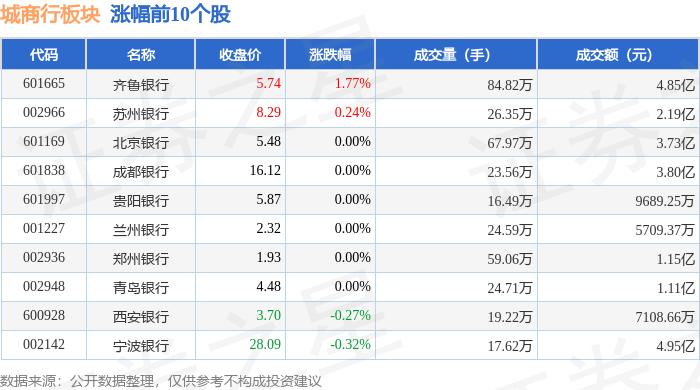
城商行板块12月31日跌0.33%,厦门银行领跌,主力资金净流入2.01亿元
Zheng Xing Xing Ye Ri Bao· 2025-12-31 09:07
Market Overview - The city commercial bank sector experienced a decline of 0.33% on December 31, with Xiamen Bank leading the drop [1] - The Shanghai Composite Index closed at 3968.84, up 0.09%, while the Shenzhen Component Index closed at 13525.02, down 0.58% [1] Individual Bank Performance - Qilu Bank closed at 5.74, up 1.77% with a trading volume of 848,200 shares and a transaction value of 485 million [1] - Suzhou Bank closed at 8.29, up 0.24% with a trading volume of 263,500 shares and a transaction value of 219 million [1] - Xiamen Bank closed at 7.34, down 1.08% with a trading volume of 133,200 shares and a transaction value of 97.8 million [2] - Nanjing Bank closed at 11.43, down 0.78% with a trading volume of 235,600 shares and a transaction value of 270 million [2] Capital Flow Analysis - The city commercial bank sector saw a net inflow of 201 million from institutional investors, while retail investors experienced a net outflow of 9.56 million [2] - The capital flow for individual banks shows that Shanghai Bank had a net inflow of 48.9 million from institutional investors, while Hangzhou Bank had a net outflow of 50.55 million [3] - Suzhou Bank recorded a net inflow of 30.66 million from institutional investors, while retail investors had a net outflow of 27.1 million [3]


“消失”的银行监事长
Shang Hai Zheng Quan Bao· 2025-12-30 19:26
Core Viewpoint - The bank supervisory board system, in operation for nearly 30 years, is approaching its end as banks begin to abolish this structure in favor of audit committees, following new regulations from the China Securities Regulatory Commission (CSRC) and the Financial Regulatory Bureau [2][3][4]. Regulatory Framework for Reform - The new Company Law, effective from July 2024, allows financial institutions to replace supervisory boards with audit committees, fundamentally changing the requirement for supervisory boards as mandatory entities [3][4]. - The Financial Regulatory Bureau has issued policies that support the transition, allowing financial institutions to choose between retaining supervisory boards or establishing audit committees to perform supervisory functions [3][4]. Differences in Implementation - There is a differentiation in the approach to abolishing supervisory boards between listed and non-listed banks, with listed banks required to eliminate supervisory boards by 2026, while non-listed banks have the option to retain them [4][5]. - Major state-owned banks have already initiated the process of abolishing supervisory boards, with the five largest banks voting to remove them in April 2025 [5]. Effectiveness and Challenges of Supervisory Boards - The supervisory board has been criticized for its lack of independence, professionalism, and efficiency, often leading to overlapping functions and ineffective oversight [6][7]. - The costs associated with maintaining a supervisory board are significant, with estimates suggesting that listed banks could save millions annually by abolishing this structure [7]. Transition Paths for Supervisory Board Members - Former supervisory board members may transition to roles within the audit committee, take on positions in other financial institutions, or retire from the industry [8]. - The governance mechanism is expected to become more efficient, with fewer decision-making layers and a more direct oversight structure through audit committees [8].


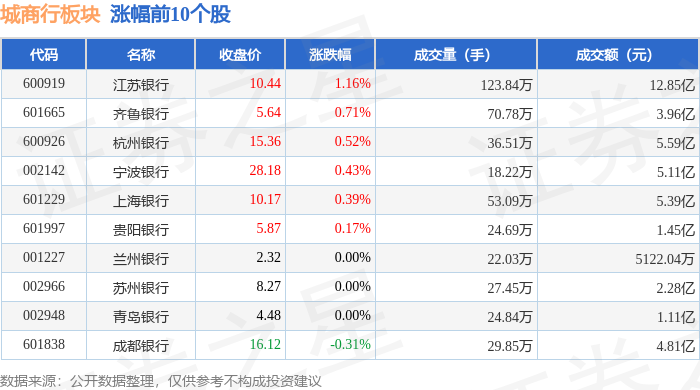
城商行板块12月30日涨0.13%,江苏银行领涨,主力资金净流入1.91亿元
Zheng Xing Xing Ye Ri Bao· 2025-12-30 09:08
Market Performance - The city commercial bank sector increased by 0.13% compared to the previous trading day, with Jiangsu Bank leading the gains [1] - The Shanghai Composite Index closed at 3965.12, down 0.0%, while the Shenzhen Component Index closed at 13604.07, up 0.49% [1] Individual Stock Performance - Jiangsu Bank closed at 10.44, up 1.16% with a trading volume of 1.2384 million shares [1] - Qilu Bank closed at 5.64, up 0.71% with a trading volume of 707,800 shares [1] - Hangzhou Bank closed at 15.36, up 0.52% with a trading volume of 365,100 shares [1] - Ningbo Bank closed at 28.18, up 0.43% with a trading volume of 182,200 shares [1] - Shanghai Bank closed at 10.17, up 0.39% with a trading volume of 530,900 shares [1] - Guiyang Bank closed at 5.87, up 0.17% with a trading volume of 246,900 shares [1] - Chengdu Bank closed at 16.12, down 0.31% with a trading volume of 298,500 shares [2] Capital Flow - The city commercial bank sector saw a net inflow of 191 million yuan from institutional investors, while retail investors experienced a net outflow of 7.0084 million yuan [2] - The main capital inflow and outflow for individual banks are detailed, with Hangzhou Bank receiving a net inflow of 128 million yuan from institutional investors [3] - Jiangsu Bank had a net inflow of 111 million yuan from institutional investors but a net outflow of 124 million yuan from speculative funds [3]



银行年末揽储冲刺: 利率上浮、贴息返现与隐秘的KPI战场
Zhong Guo Zheng Quan Bao· 2025-12-29 22:08
Group 1 - The core viewpoint of the articles highlights that banks are intensifying their deposit acquisition strategies as the end of the year approaches, employing various promotional tactics such as higher interest rates and giveaways to attract customers [1][2][6] - Banks are offering competitive interest rates for different deposit amounts, with examples including a 1.90% interest rate for new funds of 200,000 yuan at Hangzhou Bank [2][4] - Some banks are incentivizing deposits through lotteries and gifts, with reports of customers receiving shopping vouchers for making deposits, indicating a shift from traditional incentives like rice and oil to more appealing rewards [1][4][5] Group 2 - The pressure on bank employees to meet performance targets is driving aggressive deposit acquisition tactics, with some employees reportedly using personal funds to offer cash back to customers [4][5] - The practice of "timing deposits" is prevalent, where banks aim to boost their deposit figures at the end of the year to improve their financial statements, despite regulations prohibiting such practices [6][7] - Experts suggest that to address the issues of aggressive deposit acquisition, banks need to reform their assessment mechanisms, reduce the emphasis on short-term deposit targets, and enhance customer loyalty through better wealth management and service offerings [7]