
NZP(601018)

Search documents
宁波港(601018) - 宁波舟山港股份有限公司关于收购舟山港综保区码头股权暨关联交易的公告
2025-12-23 11:31
宁波舟山港股份有限公司 关于收购舟山港综保区码头股权暨关联交易的公告 本公司董事会及全体董事保证本公告内容不存在任何虚假记载、 误导性陈述或者重大遗漏,并对其内容的真实性、准确性和完整性承 担法律责任。 重要内容提示: 为解决同业竞争问题,宁波舟山港股份有限公司(以下简称"公 司"或"上市公司")拟以人民币 705,970,273.69 元的交易对价现 金收购控股股东宁波舟山港集团有限公司(以下简称"宁波舟山港集 团"或"控股股东")持有的舟山港综合保税区码头有限公司(以下 简称"综保区码头"或"标的公司")100%股权; 证券代码:601018 证券简称:宁波港 编号:临 2025-057 债券代码:175812 债券简称:21 宁港 01 1、本次交易概况 2025 年 12 月 22 日,公司召开第六届董事会第二十三次会议审 议通过《关于宁波舟山港股份有限公司收购综保区码头股权暨关联交 易的议案》,同意公司以自有资金购买宁波舟山港集团持有的综保区 码头 100%股权,并授权公司管理层签署股权转让协议等相关文件。 公司与宁波舟山港集团于 2025 年 12 月 22 日就本次交易签署了《宁 波舟山港股份有 ...

宁波港(601018) - 宁波舟山港股份有限公司第六届董事会第二十三次会议决议公告
2025-12-23 11:30
证券代码:601018 证券简称:宁波港 编号:临 2025-056 债券代码:175812 债券简称:21 宁港 01 宁波舟山港股份有限公司 第六届董事会第二十三次会议决议公告 本公司董事会及全体董事保证本公告内容不存在任何虚假记载、 误导性陈述或者重大遗漏,并对其内容的真实性、准确性和完整性承 担法律责任。 该议案已经公司第六届董事会审计委员会第十五次会议、独立董 事 2025 年第四次专门会议审议通过,并同意提交本次董事会会议审 议。 一、董事会会议召开情况 2025 年 12 月 22 日,宁波舟山港股份有限公司(以下简称"公 司")在宁波环球航运广场 4603 会议室以现场会议的方式召开了公 司第六届董事会第二十三次会议。此次会议于 2025 年 12 月 17 日以 书面方式通知了全体董事。 会议应到董事 16 名,实到董事 14 名,公司董事长陶成波、董 事金星、丁送平、任小波、滕亚辉、李文波、胡绍德、刘士霞、于永 生、赵永清、潘士远、肖汉斌、肖英杰、刘杰参加了本次会议;公司 董事柳长满由于工作原因请假,书面委托公司董事任小波代为出席; 公司董事陈志昂由于工作原因请假,书面委托公司董事金星代为 ...
宁波港:拟7.06亿元收购舟山港综保区码头100%股权
Mei Ri Jing Ji Xin Wen· 2025-12-23 11:29
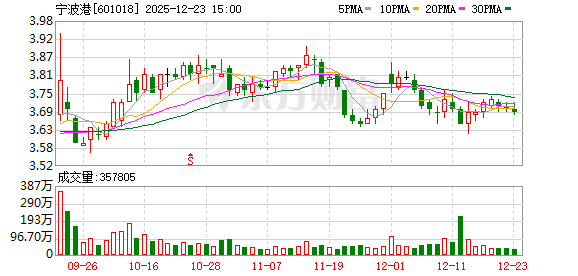
每经AI快讯,12月23日,宁波港(601018.SH)公告称,为解决同业竞争问题,公司拟以7.06亿元现金收购 控股股东宁波舟山港集团有限公司持有的舟山港综合保税区码头有限公司100%股权。交易价格较账面 值溢价21.99%。 (文章来源:每日经济新闻) ...

宁波港:拟以7.06亿元现金收购舟山港综合保税区码头有限公司100%股权
Ge Long Hui· 2025-12-23 11:29
格隆汇12月23日|宁波港公告,拟以人民币7.06亿元的交易对价现金收购控股股东宁波舟山港集团有限 公司持有的舟山港综合保税区码头有限公司100%股权,该价格较2025年9月30日综保区码头100%股权 对应的所有者权益账面值5.79亿元溢价1.27亿元,溢价率为21.99%。 ...
宁波港:公司会在定期报告中披露相关报告期末的股东人数
Zheng Quan Ri Bao Wang· 2025-12-17 07:39
证券日报网讯12月16日,宁波港(601018)在互动平台回答投资者提问时表示,公司会在定期报告中披 露相关报告期末的股东人数。 ...
宁波港发生2笔大宗交易 合计成交1047.48万元
Zheng Quan Shi Bao Wang· 2025-12-12 15:45
Group 1 - Ningbo Port executed two block trades on December 12, totaling 2.8698 million shares and a transaction value of 10.4748 million yuan, with a transaction price of 3.65 yuan per share [1][2] - Institutional proprietary seats participated in both trades, resulting in a net purchase of 10.4748 million yuan [1] - The closing price of Ningbo Port on the same day was 3.65 yuan, reflecting a decline of 1.35%, with a daily turnover rate of 1.12% and a total trading volume of 799 million yuan [1] Group 2 - The latest margin financing balance for Ningbo Port is 447 million yuan, with an increase of 13.9934 million yuan over the past five days, representing a growth rate of 3.23% [2] - Ningbo Zhoushan Port Co., Ltd. was established on March 31, 2008, with a registered capital of 1,945,438.8399 million yuan [2] - Detailed block trade data shows that the two trades involved 205.68 million shares for 7.5073 million yuan and 81.30 million shares for 2.9675 million yuan, both at a price of 3.65 yuan [2]
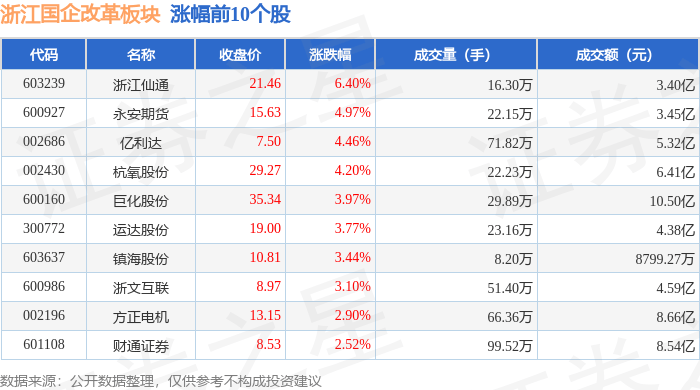
浙江国企改革板块12月8日涨0.93%,浙江仙通领涨,主力资金净流入4065.98万元


Sou Hu Cai Jing· 2025-12-08 09:25
Market Overview - On December 8, the Zhejiang state-owned enterprise reform sector rose by 0.93% compared to the previous trading day, with Zhejiang Xiantong leading the gains [1] - The Shanghai Composite Index closed at 3924.08, up 0.54%, while the Shenzhen Component Index closed at 13329.99, up 1.39% [1] Top Gainers in Zhejiang State-Owned Enterprises - Jiangxi Xianyun (603239) closed at 21.46, up 6.40%, with a trading volume of 163,000 shares and a transaction value of 340 million [1] - Yong'an Futures (600927) closed at 15.63, up 4.97%, with a trading volume of 221,500 shares and a transaction value of 345 million [1] - Yilida (002686) closed at 7.50, up 4.46%, with a trading volume of 718,200 shares and a transaction value of 532 million [1] - Hangzhou Hydrogen (002430) closed at 29.27, up 4.20%, with a trading volume of 122,300 shares and a transaction value of 641 million [1] - Juhua Co., Ltd. (600160) closed at 35.34, up 3.97%, with a trading volume of 298,900 shares and a transaction value of 1.05 billion [1] Top Losers in Zhejiang State-Owned Enterprises - Zhejiang Zhenyuan (000705) closed at 9.91, down 1.49%, with a trading volume of 86,400 shares [2] - Kang En Bei (600572) closed at 4.65, down 1.48%, with a trading volume of 334,600 shares [2] - Zhongjie Resources (002021) closed at 2.67, down 1.48%, with a trading volume of 323,300 shares [2] Capital Flow Analysis - The net inflow of main funds in the Zhejiang state-owned enterprise reform sector was 40.66 million, while retail funds saw a net inflow of 58.29 million [2] - Speculative funds experienced a net outflow of 98.95 million [2] Individual Stock Fund Flow - Juhua Co., Ltd. (600160) had a main fund net outflow of 50.89 million, with a retail net inflow of 14.95 million [3] - Yilida (002686) saw a main fund net inflow of 44.27 million, but a retail net outflow of 27.83 million [3] - Hangzhou Oxygen (002430) had a main fund net inflow of 39.64 million, with a retail net outflow of 19.51 million [3]
宁波港11月集装箱吞吐量预计增10.8% 前9月营收229亿完成年度计划78%
Chang Jiang Shang Bao· 2025-12-04 00:30
Core Viewpoint - Ningbo Port is experiencing steady growth in port production, with significant increases in container and cargo throughput in November 2025 compared to the previous year, indicating a strong operational performance and a focus on sustainable development [1][2]. Group 1: Operational Performance - In November 2025, Ningbo Port expects to achieve a container throughput of 4.49 million TEUs, a year-on-year increase of 10.8%, and a cargo throughput of 99.7 million tons, up 7.8% [2]. - For the first nine months of 2025, the cumulative container throughput reached 39.24 million TEUs, reflecting a 9.9% increase year-on-year, while cargo throughput was 911.45 million tons, up 6.8% [2]. - The total container throughput for January to November 2025 is projected to be 48.29 million TEUs, a 10.2% increase from 43.83 million TEUs in the same period of 2024 [2]. Group 2: Financial Performance - In the first three quarters of 2025, Ningbo Port reported revenue of 22.882 billion yuan, a 4.68% increase year-on-year, and a total profit of 5.457 billion yuan, which is a slight decrease of 4.59% [6]. - The net profit attributable to shareholders was 3.875 billion yuan, down 5.54% year-on-year, while the non-recurring net profit increased by 9.06%, indicating a strengthening of core business profitability [6][7]. - The company aims to achieve a revenue of 29.5 billion yuan and a total profit of 7 billion yuan for the full year of 2025, with the first three quarters accounting for 77.57% and 77.96% of these targets, respectively [7]. Group 3: Strategic Developments - Ningbo Port is enhancing its global market influence through the establishment of subsidiaries in Singapore and Japan, and is actively integrating logistics groups to improve operational efficiency [3]. - The company is advancing its smart and green port initiatives, with significant automation and environmental projects underway, including the completion of wind power integration and a high clean energy usage rate of 74% [4][5]. - Ongoing infrastructure projects include the completion of major container handling facilities and the installation of large equipment, which are expected to enhance operational capabilities [3].
宁波舟山港年集装箱吞吐量首超4000万标准箱
Ren Min Ri Bao· 2025-12-03 21:54
Core Viewpoint - Ningbo-Zhoushan Port has become the third port globally and the second in China to exceed an annual container throughput of 40 million TEUs as of December 2 [1] Group 1 - The annual container throughput of Ningbo-Zhoushan Port surpassed 40 million TEUs on December 2 [1] - This milestone positions Ningbo-Zhoushan Port after Shanghai Port and Singapore Port in terms of container throughput [1] - The achievement highlights the growing significance of Ningbo-Zhoushan Port in global shipping and logistics [1]
航运港口2025年11月专题:原油、干散货吞吐量承压,集装箱吞吐量高增
Xinda Securities· 2025-12-03 14:50
Investment Rating - The industry investment rating is "Positive" [2] Core Insights - The report highlights that the throughput of crude oil and dry bulk cargo is under pressure, while container throughput is experiencing significant growth [2][8] - From January to October 2025, the total import and export value reached 37.31 trillion yuan, a year-on-year increase of 3.6%, with exports growing by 6.2% [17] - Coastal major ports achieved a cargo throughput of 96.44 billion tons, up 3.5% year-on-year, with foreign trade cargo throughput at 41.91 billion tons, increasing by 3.6% [3][34] Summary by Sections 1. Overview: National Import and Export Total and Cargo Throughput - The total import and export value from January to October 2025 was 37.31 trillion yuan, with imports at 15.19 trillion yuan (flat year-on-year) and exports at 22.11 trillion yuan (up 6.2%) [17] - Coastal major ports' cargo throughput reached 96.44 billion tons, a 3.5% increase year-on-year, while foreign trade cargo throughput was 41.91 billion tons, up 3.6% [3][34] 2. Container: Container Shipping Rates and Throughput - As of November 28, 2025, the China Container Freight Index (CCFI) was at 1121.8 points, down 23.58% year-on-year, while the Shanghai Container Freight Index (SCFI) was at 1403.13 points, down 35.04% year-on-year [4][37] - From January to October 2025, container throughput at coastal major ports reached 25.908 million TEUs, a year-on-year increase of 6.6% [4][43] 3. Liquid Bulk: Oil Shipping Rates and Crude Oil Throughput - The Baltic Dirty Tanker Index (BDTI) was at 1452 points on November 28, 2025, reflecting a year-on-year increase of 62.78% [5][45] - Crude oil imports from January to October 2025 totaled 471 million tons, a 3.1% increase year-on-year, while the throughput at major crude oil receiving ports was 329 million tons, down 3.25% year-on-year [6][53] 4. Dry Bulk: Bulk Shipping Rates and Iron Ore, Coal Throughput - The Baltic Dry Index (BDI) was at 2560 points on November 28, 2025, up 89.07% year-on-year [7][55] - From January to October 2025, iron ore throughput at major ports reached 1.164 billion tons, a year-on-year increase of 3.45%, while coal throughput was 571 million tons, down 0.28% year-on-year [61][70] 5. Key Port Listed Companies Monthly Throughput - In October 2025, major port companies reported various throughput figures, with Shanghai Port Group achieving a cargo throughput of 0.49 billion tons and container throughput of 453.5 million TEUs [73]


